Watchlist July 2026
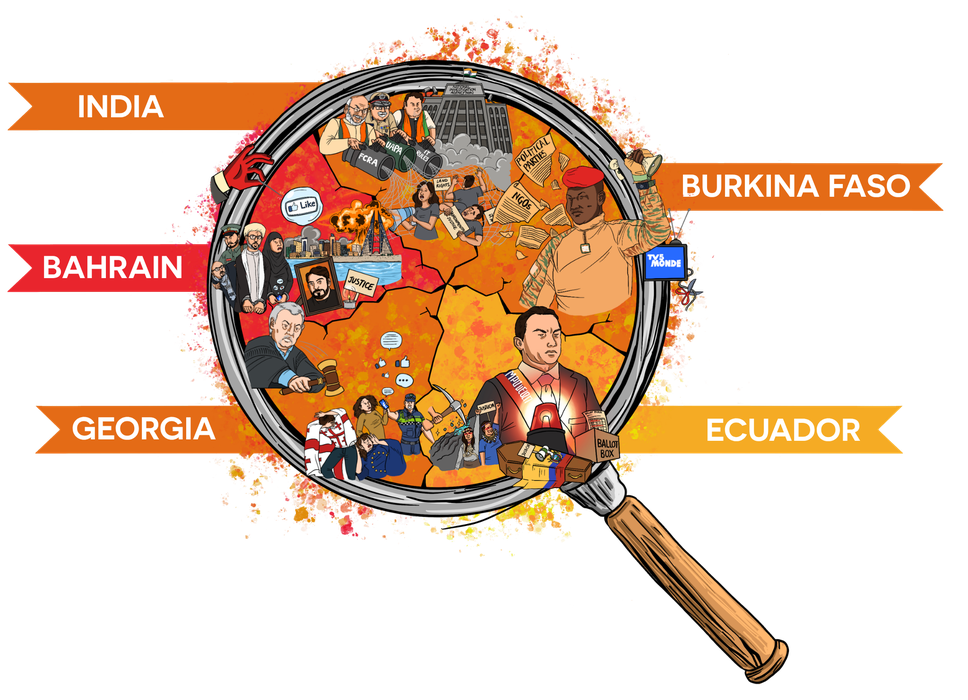
July Watchlist 2026
Latest Update: 29 July 2026 - The new CIVICUS Monitor Watchlist highlights serious concerns regarding the exercise of civic freedoms in Bahrain, Burkina Faso, Ecuador, Georgia, India
The Watchlist draws attention to countries where there is a serious decline in respect for civic space, based on an assessment by CIVICUS Monitor research findings, our research partners and consultations with activists on the ground. In the coming weeks and months, the CIVICUS Monitor will closely track developments in each of these countries as part of efforts to ensure greater pressure is brought to bear on governments. CIVICUS calls upon these governments to do everything in their power to end the ongoing crackdowns immediately and ensure that perpetrators are held to account. Descriptions of the civic space violations happening in each country are provided below. If you have information to share on civic space in any of these countries, please write to monitor@civicus.org

Bahrain's CIVIC SPACE RATING: CLOSED
After the US and Israel’s attack on Iran in late February 2026, neighbouring countries embarked on curbing freedoms amid Iran’s retaliation. As the war expanded, with Iran targeting Israel and neighbouring countries hosting US forces such as Bahrain, the United Arab Emirates, Kuwait and Qatar, a wider securitisation of civic space emerged across the region as countries moved to clamp down on free expression regarding the war.
In Bahrain, authorities have exploited the war on Iran to launch a wide-ranging and ongoing series of human rights violations, including a relentless and systematic campaign of arrests and detentions, targeting prominent human rights defenders and political leaders, hundreds of religious figures, peaceful protesters, online activists, and those who oppose government policies or express opinions regarding the war. At least 200 people have been detained for expressing their personal opinions about the war on social media, and for participating in peaceful demonstrations. They are being held in secret locations, isolated from the outside world, and without being allowed to contact their families or lawyers. Detainees have been charged under a recurring set of offences, including "spreading false news," "glorifying terrorism," and "undermining public order," with several cases resulting in sentences of up to ten years and, in one case, life imprisonment.
Two weeks after the war started, on 16th March 2026, the Ministry of Interior issued a warning against using social media accounts to “photograph, publish, or recirculate any image, video, or information that constitutes a threat to the security and safety of the nation.”
Since then, several activists have been detained. Writer and labour activist Khalil Yaqoub Buhazaa was arrested on 3rd May 2026 after he was summoned for questioning regarding his writings and social media posts. He remained in detention from 5th May until his release on 15th June 2026 when the public prosecution dropped charges of incitement against the government and spreading false news that had been preferred against him. Similarly, on 9th May 2026, the Bahraini Ministry of Interior announced the arrest of 41 religious scholars following widespread raids on their homes. They were charged with fabricated offences, including espionage and raising funds to finance terrorist operations carried out by foreign entities, after being accused of being in direct contact with, and financially supporting, the Iranian Revolutionary Guard.
Cases of torture and killing of detained activists have also been documented. In late March 2026, the family of political prisoner Mohammed Abdulmohsen Al-Mousawi, received his body which reportedly bore signs of torture. He had been arbitrarily arrested by security forces alongside his cousins, Ahmed Al-Mousawi and Mustafa Al-Mousawi, while they were travelling to attend a religious gathering. The three men were taken to an undisclosed location and held incommunicado. While authorities alleged they were involved in espionage for foreign entities, credible sources indicate that their detention was instead linked to opinions they had expressed on social media. The whereabouts and fate of Ahmed and Mustafa Al-Mousawi remain unknown. Mohammed Al-Mousawi had previously spent 12 years in prison as a prisoner of conscience before being released in 2024. Worryingly, prominent human rights and environmental activist, Mohammed Jawad Hameed was held for over 100 days in detention after he was arbitrarily arrested on 7th April 2026 for criticising the custodial death of Mohammed Al-Mousawi on social media. His detention was extended repeatedly, including on 16th June 2026 on a charge of "hatred of the regime”, further illustrating the use of indefinite pretrial detention to punish public criticism. He was released on 18th July 2026.
Authorities have also weaponised draconian citizenship laws to clamp down on dissent and opinions around the war. On 27th April 2026, the government revoked the citizenship of 69 people, more than half of whom were children, leaving 46 of them stateless.
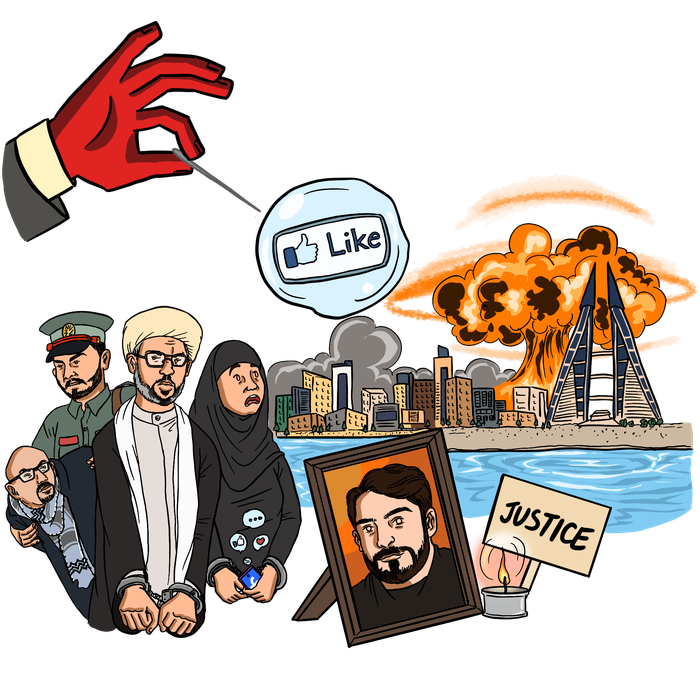
Although the affected families trace their ancestry to Iran, many had been born in Bahrain and had lived there for generations. Authorities accused the individuals of allegedly sympathising with "Iranian hostile acts" or "collaboration with foreign entities," accusing them of supporting Iranian attacks against Bahrain. Those affected were reportedly compelled to sign documents acknowledging the loss of their citizenship and their imminent deportation. The decisions were carried out without due process, and with no meaningful opportunity to challenge or appeal them. After efforts to deport some of those affected to Iran were unsuccessful, authorities deported them to Oman, while others travelled to Europe, where they have sought political asylum.
Concerned about the scale of ongoing violations in the country, five detained political and human rights leaders in Jaw Central Prison, including Abdulhadi Al-Khawaja, issued a joint appeal on 14th May 2026, calling on the Bahraini authorities to halt the crackdown, release all prisoners of conscience, and emphasising the importance of opening a serious national dialogue to address the crises.

Burkina Faso's CIVIC SPACE RATING: REPRESSED
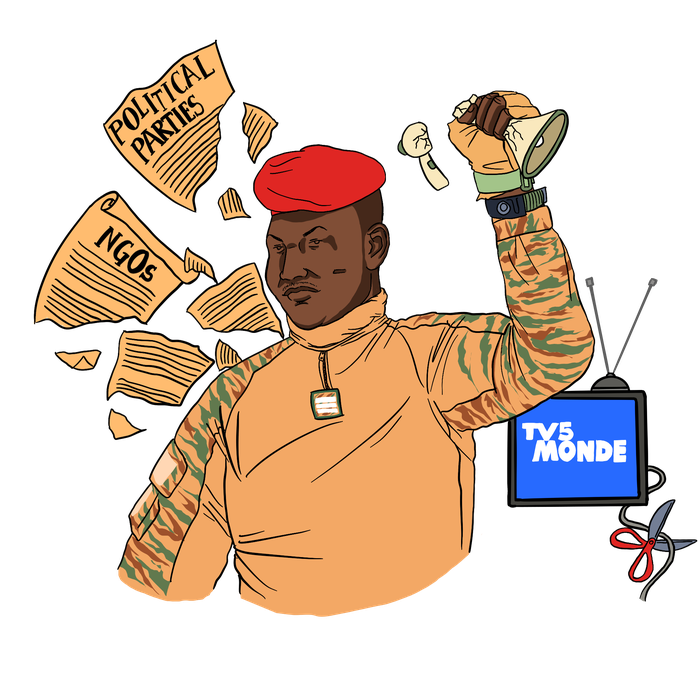
Burkina Faso is placed on the CIVICUS Monitor Watchlist as military authorities escalate their crackdown on civil society and freedom of association through restrictive legislation, the dissolution and suspension of civil society organisations (CSOs), the abolition of political parties and reprisals for those criticising the military authorities. Since the military takeover in September 2022, civic space in the country has deteriorated, with increasing media censorship, arbitrary arrests, judicial harassment and forced conscriptions of journalists and activists, enforced disappearances and restrictive legislation, among other civic space concerns.
On 15th April 2026, Burkina Faso’s Minister of Territorial Administration issued an order dissolving 118 CSOs, citing non-compliance with Law 011-2025/ALT on freedom of association, a law adopted in July 2025 which introduced strict reporting, administrative, and legal compliance requirements for CSOs. Despite the law granting CSOs a one-year period to comply with the new requirements, the CSOs were dissolved before the grace period ended.
Between mid-April and early June 2026, military authorities suspended hundreds of other CSOs, using grounds such as “failure to renew governing bodies”. As of 11th June 2026, at least 1,174 CSOs were suspended or dissolved.
Unions and religious associations were not spared. On 26th May 2026, the Minister of Territorial Administration issued an order suspending the General Student Union of Burkina Faso (UGEB), the largest student union, for a renewable period of three months on accusations of “glorifying terrorism”. The suspension occurred following UGEB’s statement criticising the government’s security record and persistent insecurity in the country. The Coordination of Young Muslims of Burkina (CJMB), and Association As Salam, both of which operate in social, humanitarian, and educational domains, were suspended for alleged acts of “public disorder” or having carried out activities that did not conform to their purpose.
Beyond the dissolution and suspension of CSOs and associations, the military authorities adopted restrictive laws and regulations, including the 2025 Code of Persons and Family which criminalises same-sex relations and grants authorities the power to revoke citizenship for anyone deemed to act against state interests. Furthermore, CSOs are now required to have a ‘statistical visa’ before conducting research and are mandated to maintain cash accounts with the state-controlled Treasury Deposit Bank.
In January 2026, Burkina Faso’s government authorities formally dissolved all political parties, stating the decision as being part of efforts to “rebuild the state” and claiming that the “proliferation of political parties has led to excesses, fostering division among citizens and weakening the social fabric”. The dissolution decree repealed all laws regulating political parties and requires parties to transfer their assets to the State. Activities of political parties had been suspended since 30th September 2022.
In the past years, several media outlets were suspended by the national media regulator, the High Council for Communication (CSC), as a result of their reporting, in particular on the security situation. On 5th May 2026, the CSC indefinitely suspended the French television channel TV5 Monde, alleging that coverage contained “disinformation” and “apology of terrorist acts,” including the use of unverified amateur footage and emphasis on “the supposed prowess of terrorist groups”. The media outlet was previously suspended in April and June 2024.
Military authorities continue to target individuals for their criticism. On 26th May 2026, hooded police and military forces arrested Imam Mohamad Ishaq Kindo, a prominent Sunni Imam and preacher, following his public criticism of a restrictive religious freedom bill that prohibits the establishment of places of worship within public services. In the past years, several activists and journalists were forcibly conscripted into the armed forces or subjected to enforced disappearances and abductions. Journalist Atiana Serge Oulon’s whereabouts remain unknown two years after security forces abducted him on 24th June 2024.
In February 2026, the military authorities suspended the United Nations Human Rights Office in Burkina Faso, weeks after the release of a press statement by UN human rights chief Volker Türk urging authorities to end the repression on civic space. Meanwhile, Burkina Faso, along with Niger and Mali, initiated the process to withdraw from the International Criminal Court (ICC).
Ecuador's CIVIC SPACE RATING: OBSTRUCTED
Ecuador remains on our Watchlist as civic space continues to deteriorate at an alarming pace. Environmental and human rights defenders, anti-corruption activists, civil society organisations and journalists continue to face escalating violence, criminalisation and intimidation amid a deepening security crisis. The government’s repeated reliance on states of emergency and its declaration of an “internal armed conflict” have expanded the military’s unchecked role in public security, raising serious concerns over reports of gross human rights violations and the erosion of the rule of law.
Most recently, on 18th June 2026, President Daniel Noboa issued Executive Decree No. 424, again purporting to declare an “internal armed conflict” throughout Ecuador. It enables law enforcement operations against broadly defined threats and contemplates immunity, pardons, and commutation measures that heighten risk of abuses and impunity. On 14th July 2026, Executive Decree No. 448 subsequently established the National Comprehensive Security Plan 2025-2029 as a public policy. Its sweeping and overly broad concept of “violent extremism” may lead to surveillance, infiltration, stigmatisation or criminalisation of Indigenous organisations, trade unions, student movements and people participating in peaceful protests. It also could expand oversight of CSOs and independent media, without adequate safeguards against arbitrary interference.
Against this backdrop, lethal attacks against human rights defenders have become a pressing matter. The killing of environmental defender Manuel Cabrera in February 2026, reportedly linked to his opposition to mining projects, and the violent death of anti-corruption and environmental defender Monika Silva in June 2026 laid bare the acute risks confronting those defending environmental rights and exposing corruption. These cases follow an already deadly 2025, when Front Line Defenders documented at least seven defenders killed in Ecuador.
Criminalisation, stigmatisation and intimidation of activists and CSOs remain prevalent. In June 2026, environmental defender Javier Yánez Coronel was arbitrarily detained during a police operation in Puerto Quito, province of Pichincha. According to the Alianza de Organizaciones por los Derechos Humanos del Ecuador, the operation was allegedly conducted without a judicial warrant and marked by due process irregularities. He was prosecuted and publicly portrayed by police on official social media channels as connected to organised crime. In mid-July 2026, Yánez Coronel was acquitted at first instance, but authorities had yet to take any measures to remedy the violations against him. This recent case illustrates how law-enforcement operations can become entangled with environmental and territorial conflicts, exposing defenders to criminalisation and stigmatisation.
The patterns extend beyond individual defenders to communities using the courts to protect their land and environment from extractive projects. During judicial proceedings in June and July 2026 challenging the Curipamba-El Domo copper-gold mining project, operated by a Canadian company, communities from Las Naves, San Luis Pambil and Zapotal, along with their legal representatives from the Ecumenical Human Rights Commission (CEDHU), reported tactics of intimidation, including police photographing participants at a peaceful vigil without explanation, a drone flying over a peaceful protest, and online threats on social media. Pressure also extended to CEDHU: on the eve of the first hearing in June 2026, several project supporters publicly called on the authorities to investigate the organisation and its funding. The timing, immediately before the hearing, and the wider context of the 2025 Social Transparency Law (see below) raised concerns that regulatory mechanisms could be instrumentalised to stigmatise and intimidate. Since 2021, human rights organisations have reported escalating criminalisation and intimidation, a situation also noted by UN Special Procedures in 2024.
Authorities have continued to impose arbitrary financial controls against civil society organisations. For example, in June 2026, the Union of Peasant and Indigenous Organisations of Cotacachi (UNORCAC) reported that its institutional bank accounts had been frozen without prior notice or adequate information about the legal basis, procedure or duration of the measure. According to the organisation, the freeze was based on confidential intelligence reports that remain inaccessible, preventing it from effectively challenging the allegations. The measure forms part of a broader pattern of criminalisation targeting Indigenous organisations in the aftermath of the Indigenous-led 2025 nationwide strike (“paro nacional”), with at least 30 of UNORCAC members facing criminal proceedings related to their participation. Since September 2025, several organisations have had their bank accounts frozen under powers introduced by the 2025 Social Transparency Law during alleged anti-money laundering investigations by the Financial and Economic Analysis Unit (UAFE), indicating that financial controls may be used to target civil society.
Journalists remain at serious risk: six killings were documented in 2025, making it the deadliest year on record. This hostile environment has persisted into 2026, with those investigating corruption facing intimidation and harassment. According to the press freedom organisation Fundamedios, authorities were responsible for almost half of the attacks on freedom of expression recorded between January and June 2026. On 19th June 2026, investigative journalist Hernán Higuera of Ecuavisa announced that he would stop reporting on the Progen procurement scandal, one of Ecuador’s biggest corruption cases in recent years, declaring that his wife was dismissed from a public-sector position and his son lost his medical residency at a public hospital following his reporting.
On 30th June 2026, the Presidency’s General Secretariat for Public Administration announced civil and criminal proceedings against GRANASA, publisher of the national newspapers Diario Expreso and Diario Extra, two of the country’s most widely circulated privately owned newspapers. The detailed allegations of financial irregularities against GRANASA, viewed in the context of documented pressure on critical media, raised concerns about a potential chilling effect. This came months after the company was temporarily placed under state administration in February 2026.
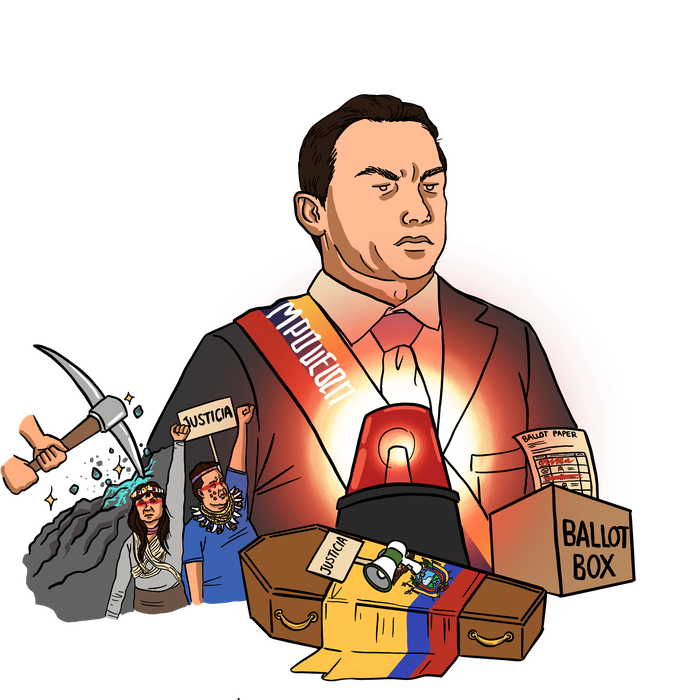
The November 2026 local elections, brought forward from February 2027, will take place in a constrained political environment, marked by restrictions on opposition participation. On 17th July 2026, days before the deadline for registering electoral alliances, the Electoral Disputes Tribunal temporarily suspended Movimiento AMIGO, the political party sponsoring the suspended main opposition party Revolución Ciudadana, effectively preventing it from contesting elections. This follows Revolución Ciudadana’s nine-month suspension in March 2026 during a confidential money-laundering investigation, while in April 2026 the National Electoral Council cancelled the legal status of Construye Movement, a centrist opposition party, and Unidad Popular, a long-established left-wing party. Although a court subsequently reinstated Unidad Popular, Construye remains excluded.
Georgia's CIVIC SPACE RATING: REPRESSED
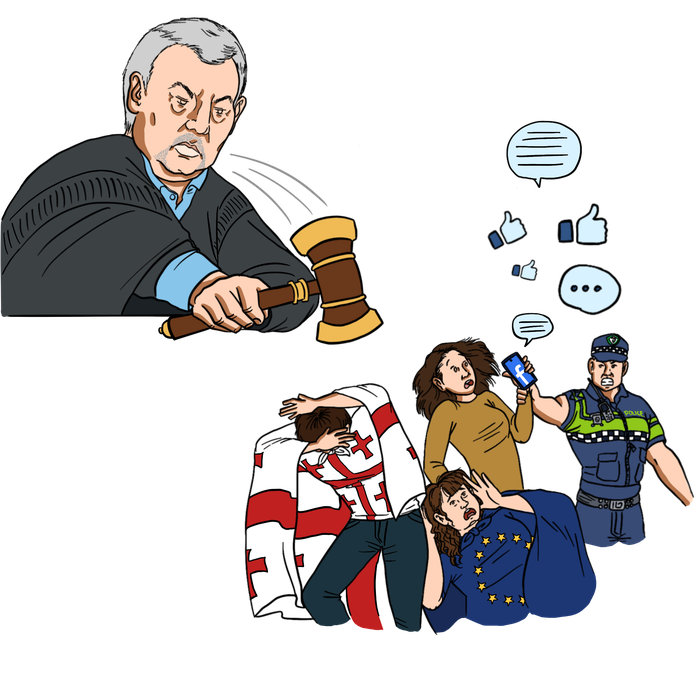
Georgia remains on our Watchlist as the political crisis that began in late 2024 continues to erode civic space at a frightening pace. The crisis followed the government's abrupt U-turn on EU accession, which sparked mass protests that were met with violence—both from security forces and masked thugs suspected to be affiliated with the government. Since then, in an attempt to stifle continued public discontent, Georgian authorities have adopted a cascade of repressive laws targeting foreign funding for civil society and media and criminalising peaceful protest. These laws are being employed to devastating effect: protesters are being imprisoned and punished with crippling fines, criticism of politicians and public figures is being prosecuted in rushed trials and civil society faces financial collapse.
At the end of May 2026, a 61-year-old protester became the first person to receive a criminal sentence solely for peaceful protest activity after being convicted for repeatedly blocking roads. He was sentenced to nine months in prison, having already spent seven months in pre-trial detention. The conviction was based on amendments to protest legislation adopted in response to the mass anti-government mobilisations, which introduced criminal liability and prison sentences of up to two years for repeat protest-related offences, including obstructing the movement of pedestrians, covering one’s face or disobeying a police officer. In late June, a second protester prosecuted under these provisions received a three-month prison sentence, which he had already served, along with a one-year suspended sentence under a plea agreement.
Throughout May and June, courts delivered judgments against more than 60 people charged over protests and clashes on 4th October 2025. The unrest, which coincided with the municipal elections, erupted after some opposition politicians and public figures called for a “peaceful revolution”. Protesters attempted to enter the Presidential Palace but were repelled by riot police. Of those charged, 29 people, including both alleged protest organisers and participants, received multi-year prison terms for organising or participating in “group violence”, “incitement against the constitutional order” and “attempting to seize facilities of strategic importance”. Others received partially or fully suspended sentences through plea agreements. A woman protester who was sentenced to seven years in prison for “organising group violence” has alleged ill-treatment and sexual harassment in prison, stating that she attempted suicide because of her imprisonment and was subsequently fined for it by prison management. A 72-year-old doctor, who claims he was only providing medical assistance to protesters amid clashes with police, was sentenced to five years in prison.
Aside from imprisonment, protesters also face draconian fines. One individual, who was sentenced to seven years in prison in the 4th October case, has reportedly accumulated fines totalling 270,000 USD for blocking roads during protests. In April, several people reported having their bank accounts seized over protest-related fines of which they had not previously been notified, amounting to tens of thousands of US Dollars per person.
Authorities are also widening their crackdown on online expression. From 1st June 2026, a new department was formed within the Interior Ministry to monitor and prosecute public statements deemed to “insult human dignity and contain hate speech”. As this move followed 2025 amendments making insulting public officials an administrative offence, watchdogs quickly raised alarms that the new unit would be used to target government critics. Indeed, the department, which is tasked with “proactively” initiating cases based on comments made on social media, without the alleged target having to file a complaint, has allowed authorities to crack down on public remarks against politicians and public figures at scale. In its first month of operation, the office had already referred 150 cases to the courts, with several cases already recorded of courts imposing fines of over 1,000 USD for insults directed at political figures. According to media reports, courts across Georgia now hear several such cases each day, with some hearings lasting only a few minutes.
In parallel, the mounting restrictions on foreign-funded civil society and media since 2024 have crippled their operations. Under a law passed in March 2026, any funds coming from abroad deemed intended to “exert influence” over public policy, regardless of the amount, are subject to government approval under penalty of imprisonment, while
previous legislation forced organisations to register under stigmatising “foreign agent” labels and provide the government with sensitive data on their beneficiaries. The restrictions have made civil society organisations’ work nearly impossible: according to research published by Human Rights Watch (HRW) in July 2026, citing an unpublished survey of Georgian CSOs, 96 percent of organisations reported acute financial difficulties, and 94 percent had reduced their activities, with some ceasing operations altogether. Beyond these laws’ chilling effect, the Georgian government has directly intervened to block civil society organisations from accessing funding. In 2025, 12 non-governmental organisations and initiatives had their bank accounts frozen as part of a criminal investigation linked to their support for protesters. HRW also documented several cases in which the authorities refused to approve grants for election monitoring and for healthcare and harm reduction services for the LGBTQI+ community.
India's CIVIC SPACE RATING: REPRESSED
The situation for civic space has regressed further in Prime Minister Narendra Modi’s third term.
Human rights defenders continue to be persecuted. In March 2026, eleven activists - including students, labour rights activists and anti-displacement campaigners - were picked up by Delhi Police in plain clothes, without arrest warrants or notice to their families. While in police custody, some of the student activists experienced torture or ill-treatment.
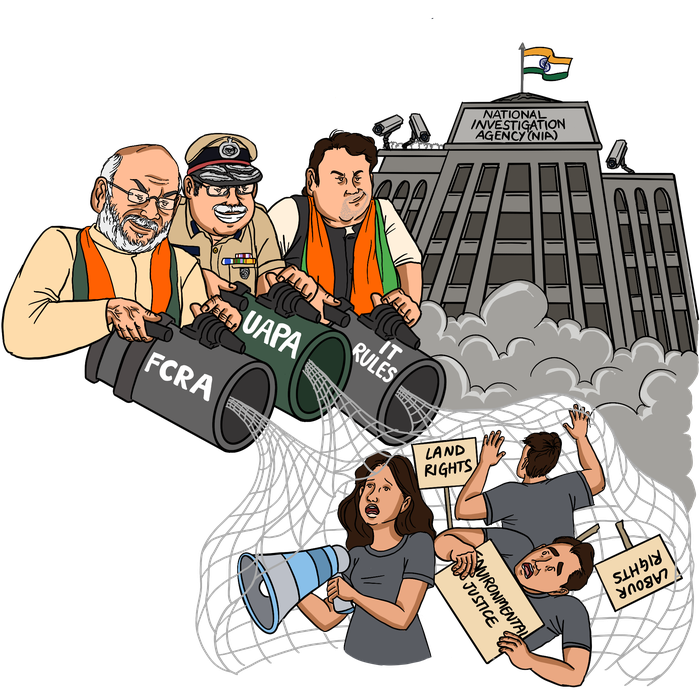
In April 2026, the National Investigation Agency (NIA) renewed its pursuit of human rights defenders in the long-running Bhima Koregaon case, several of whom have already spent years in pre-trial detention under the draconian Unlawful Activities (Prevention) Act (UAPA), before being released on bail. The case involved 16 activists, lawyers and academics who were arrested on alleged charges of ‘Maoist’ links, following a large public rally in Bhima Koregaon in Maharashtra in December 2017. NIA officials visited the Mumbai Press Club to probe a gathering of these activists held on its premises in January 2026 and sought cancellation of their bail.
In June 2026, activists Umar Khalid and Sharjeel Imam were once again denied bail. They have been detained under the UAPA since 2020 in a conspiracy case linked to the February 2020 Delhi riots. In July 2026, indigenous rights activist Pranab Doley was detained for campaigning against plans for a five-star hotel near the Kaziranga National Park, built on land Adivasi (Indigenous) people have rights to.
Reports of violations by the police during protests have continued. In April 2026, police were accused of excessive force at a protest by factory workers in Noida, Uttar Pradesh, over low wages and poor working conditions. Police subsequently detained more than 300 people, including at least seven activists. On 20 July 2026, police used tear gas and suspended mobile internet services to disrupt a protest by the Cockroach Janta Party (CJP), a youth-led protest movement seeking education and employment reforms.
Journalists have also been targeted in 2026. In February 2026, investigative journalist Ravi Nair was sentenced to one year’s imprisonment for defamation over social media posts critical of the Adani Group, a multinational company. In April 2026, the office of daily newspaper Asomiya Pratidin was attacked following comments by Assam Chief Minister, in which he criticised the publication. In the same month, police undertook an investigation into social media news outlet TeluguScribe using anti-terror legislation.
The Committee to Protect Journalists (CPJ) warned in April 2026 that proposed amendments to India's Information Technology (Intermediary Guidelines and Digital Media Ethics Code) Rules, 2021 - subsidiary legislation that regulates online content - would grant the authorities sweeping powers to censor independent journalists.
A film - Satluj - which deals with the life of activist Jaswant Singh Khalra in Punjab in the 1980s and 1990s, was banned by the authorities in July 2026, 48 hours after its release, citing the IT rules.
There have also been increasing efforts to control NGOs using the restrictive 2010 Foreign Contribution (Regulation) Act. It has been used to restrict funding and investigate critical NGOs. Recent amendments in June 2026 grant the authorities sweeping new powers over the assets of NGOs whose foreign-funding licences have been withdrawn. The new rules require NGOs to disclose social media accounts and websites, restricts foreign nationals from being ‘key functionaries’ and bars NGOs from carrying out activities deemed “political”.
Restrictions were also reported in Kashmir. Kashmiri activist Khurram Parvez, arrested in 2021, and journalist Irfan Mehraj, arrested in 2023, are facing charges under the UAPA. In March 2026, authorities throttled the internet while in April 2026, the authorities flagged seven X accounts reporting on human rights issues as “anti-India”. Three publishers were arrested in Kashmir in July 2026 for distributing books deemed “objectionable” by the authorities.