This update covers developments relating to the freedoms of expression, association and peaceful assembly in Venezuela from mid-October 2025 to mid-January 2026.
General
UN experts and human rights organisations express concern over Venezuela following unlawful US military intervention and the declaration of a state of emergency
In early January 2026, several UN Experts and international human rights organisations, including Amnesty International, CEJIL, CIVICUS, DPLF, ICJ, ISHR, GCR2P, HRW, OMCT, and WOLA, have expressed serious concern about the situation in Venezuela following the unlawful use of military force by the United States (US) and the subsequent declaration of a state of emergency by Venezuelan authorities, warning that recent developments risk further entrenching repression and militarisation in a country already experiencing a profound human rights and humanitarian crisis.
On 3rd January 2026, US military forces conducted operations across Caracas and the northern states of Miranda, Aragua and La Guaira. According to media reports, nearly 50 Venezuelan soldiers were killed, and more than 112 people were injured. The operation included the abduction of President Nicolás Maduro and his wife, Cilia Flores, from Venezuelan territory under alleged drug-related offences. Such an action breached the UN Charter and may amount to an act of aggression under international law. Two days later, Delcy Rodríguez was sworn in as Venezuela’s interim president, after the Supreme Court invoked Article 234 of the Constitution to address the president’s “temporary absence”. Rodríguez had served as vice president from 2018 until early January 2026.
These events followed months of dozens of lethal airstrikes by the US government against suspected drug traffickers in the Caribbean and the Pacific, resulting in at least 115 extrajudicial killings, along with other unlawful armed actions. According to political experts, these attacks fit squarely within a long US tradition of coercive diplomacy and intervention in the region, signalling the Donald Trump administration’s broader foreign policy objectives, as made clear in the National Security Strategy 2025, which focuses on domination and advancing US interests over the protection of democracy and human rights.
On the same day as the January attacks, Venezuelan authorities declared a nationwide state of emergency, formally characterised as a state of external commotion. The decree gives the executive sweeping powers over security operations and the management of critical infrastructure, while restricting freedom of movement and the right to peaceful assembly. For example, it orders police to “immediately begin the national search and capture of everyone involved in the promotion or support for the armed attack by the US”. The measure, which lasts for 90 days and can be extended, represents the highest level of emergency provided for under the constitution.
UN experts have warned that the use of emergency powers risks imposing excessive restrictions on fundamental rights. Likewise, the UN Independent International Fact-Finding Mission on Venezuela (FFM) said the measures reflect a long-standing pattern of grave human rights violations: “The Fact-Finding Mission is deeply concerned about the risk of further serious human rights violations in the coming days and weeks amid heightened volatility, including the US government’s assertion that it intends to 'run' the country for the foreseeable future at the same time that Venezuelan authorities have declared a state of emergency.”
According to civil society organisations, security forces and armed pro-government militia groups, known as colectivos, have carried out arbitrary detentions, patrolled public spaces, carried assault weapons, stopped vehicles, and searched individuals and their mobile phones. The growing militarisation of public life has heightened concerns about further erosion of human rights, in a society already grappling with state repression.
These developments come against the backdrop of Venezuela’s prolonged political crisis, a complex humanitarian emergency and a sustained assault on civic space. Well-documented grave human rights violations and systematic state repression have sharply curtailed civic freedoms.
The CIVICUS Monitor has documented how the authorities have targeted human rights defenders, journalists and protesters through the use of broadly defined terrorism and national security charges. As outlined in its latest report, People Power under Attack 2025, this pattern points to a wider strategy of repression and the criminalisation of independent civil society in the aftermath of the 2024 election crisis. The country is currently classified in the most severe category, “closed”, indicating that there is complete closure - in law and in practice - of civic space.
In Venezuela, a state policy exists to silence and suppress dissenting voices or those perceived as members of the opposition, according to the FFM. Since 2019, the mission has examined in detail how the country’s repressive apparatus operates, including the mechanisms it relies on and the legal frameworks used to justify these actions. That structure remains in place and, according to dozens of civil society organisations, must be dismantled as part of any credible and genuine democratic transition.
🇻🇪Desde @CIVICUSalliance y junto a otras organizaciones de la sociedad civil suscribimos este decálogo de exigencias prioritarias que permitan encauzar la situación actual de #Venezuela hacia una transición democrática genuina y creíble.
— CIVICUS Español (@CIVICUSespanol) January 21, 2026
📲https://t.co/bJJNGVT9qV
.@cejil @_CEPAZ pic.twitter.com/JNU3KklcPb
Association
Prominent HRD freed as Venezuela begins to release some political prisoners
On 8th January 2026, human rights defender Rocío San Miguel was released after nearly two years in arbitrary detention. Her family said she remains subject to precautionary measures that replace imprisonment, meaning she does not enjoy full liberty. San Miguel is a Venezuelan-Spanish lawyer and director of Control Ciudadano, a civil society organisation that monitors the role of the armed forces and security policies in Venezuela.
As previously reported, on 9th February 2024, officers of the General Directorate of Military Counterintelligence (DGCIM) detained San Miguel and five relatives at Simón Bolívar International Airport. Six days later, authorities confirmed that the Bolivarian National Intelligence Service (SEBIN) were holding her at El Helicoide in Caracas. Authorities charged her with treason, conspiracy, terrorism and association, following a decision by the Second Court Against Terrorism, and withheld information on her whereabouts during the initial period of detention.
"Llegó feliz e incrédula de lo que le estaba pasando (…). Estuvo detenida un año y 11 meses, en el que jamás pudimos tener contacto con ella (…). Nos dijo que había sido operada dos veces": Theresly Malavé (@theresly ), abogada de Rocío San Miguel, en entrevista para #LaTarde… pic.twitter.com/IQ3vsIcbLz
— NTN24 (@NTN24) January 9, 2026
San Miguel’s release formed part of a broader process of political prisoner releases, including journalists (see Expression), announced amid significant political upheaval in Venezuela (see General). Authorities also released several political figures, including Biagio Pilieri, linked to María Corina Machado’s 2024 presidential campaign, and Enrique Márquez, a former electoral authority and presidential candidate.
Venezuelan officials presented the releases as a step towards peace. Civil society organisations, including the Committee for the Freedom of Political Prisoners (CLIPPVE), Justicia, Encuentro y Perdón, and the Venezuelan Programme Education-Action on Human Rights (PROVEA), raised concerns about the lack of transparency in the process. They reported that authorities carried out releases sporadically, without clear criteria, independent verification or guarantees of full legal freedom. In many cases, authorities released detainees without judicial decisions lifting charges, while families continued to wait outside detention centres without information.
According to Foro Penal, the country’s leading organisation providing legal assistance to people detained for political reasons, authorities released at least 143 people between 8th and 19th January 2026. However, 777 people, including 99 women, remain detained for political reasons, while more than 11,300 others continue to face restrictive measures on their liberty, such as reporting requirements or travel bans.
Balance de #PresosPoliticos en Venezuela al 19/01/2026 por 𝗙𝗼𝗿𝗼 𝗣𝗲𝗻𝗮𝗹:
— Foro Penal (@ForoPenal) January 20, 2026
𝗧𝗼𝘁𝗮𝗹 𝗽𝗿𝗲𝘀𝗼𝘀 𝗽𝗼𝗹í𝘁𝗶𝗰𝗼𝘀: 777*
Desde la semana pasada
Hombres: 678
Mujeres: 99
Civiles: 604
Militares: 173
Adultos: 775
Adolescentes: 2
Encarcelados: 0
Excarcelados: 151 (143… pic.twitter.com/5n009Glxuv
Public vilification against human rights organisation
On 13th January 2026, Jorge Rodríguez, president of the National Assembly, publicly accused Foro Penal of demanding payment from families to secure the release of detained relatives. Rodríguez also claimed that lawmakers held lists of people allegedly released. He made these statements amid a highly politicised context of ongoing detentions and announced releases of political prisoners (see above).
Foro Penal immediately rejected the accusations as false. The organisation stated that it has provided free legal assistance in Venezuela and internationally for more than 23 years and has supported over 15,000 victims of human rights violations without charging for its services. Foro Penal also denied ever requesting payment to include individuals on lists of political detainees.
The organisation attributed uncertainty surrounding recent releases to official opacity, rather than to civil society reporting. Foro Penal stated that authorities have not published clear or complete information on who has been released or the criteria applied, which has intensified anxiety among detainees’ families and civil society actors. It called on the National Assembly to make any verified lists of released individuals public, citing the matter’s public interest and humanitarian relevance.
Foro Penal further noted that, while state authorities alone control detention and release decisions, none of the documented releases would have occurred without sustained documentation, registration and advocacy by civil society organisations.
Enforced disappearance concerns raised after arbitrary detention of trade union adviser
On 26th November 2025, around 30 armed and masked officers arbitrarily detained Arnaldo Méndez Silva, a trade union labour adviser and human rights activist, at his home in Venezuela. Witnesses reported that the officers, dressed in black and arriving in three unmarked vehicles, identified themselves as linked to the SEBIN, the Bolivarian National Police (PNB) or allied paramilitary forces. During the operation, officers threatened family members, confiscated all mobile phones and violently removed Méndez Silva from the house. Relatives stated that officers beat him while forcing him into a vehicle and that additional officers kicked him repeatedly.
Authorities did not present an arrest warrant and provided no information about any investigation. Since the operation, authorities have not disclosed Méndez Silva’s whereabouts, and officials have denied holding him or providing details of his detention. Authorities have not brought him before a judge. Relatives and civil society organisations have therefore characterised the case as an enforced disappearance under international human rights standards. Concerns for his life and health remain acute, as Méndez Silva has a spinal condition that causes chronic pain and limited mobility, and officers assaulted him during the detention.
In early December 2025, Méndez Silva’s family sought information and remedies from the Human Rights Prosecutor’s Office, the Public Prosecutor’s Office, and the Ombudsperson’s Office, Venezuela’s national human rights institution. These efforts did not produce effective responses. Family members also visited several detention centres, including El Helicoide, a major detention facility in Caracas that human rights organisations have described as a torture centre. Authorities there denied holding Méndez Silva or having any information about his case.
On 21st December 2025, the Inter-American Commission on Human Rights (IACHR) adopted Resolution 96/2025, granting precautionary measures in favour of Arnaldo Méndez Silva. The IACHR found that he faces a situation of gravity and urgency, as his rights to life and personal integrity are at risk of irreparable harm.
#CIDH otorga #MedidasCautelares a favor de Arnaldo Méndez Silva respecto de #Venezuela.
— CIDH - IACHR (@CIDH) December 24, 2025
👉🔗📰https://t.co/xbqGKexB2t pic.twitter.com/7fXRqkTiq8
Opposition leader dies in SEBIN custody, intensifying concerns over deaths in detention
On 5th December 2025, former Nueva Esparta governor and opposition figure Alfredo Javier Díaz Figueroa died in custody at El Helicoide. Díaz was a member of Acción Democrática, a long-standing opposition political party. Authorities arbitrarily detained him on 24th November 2024 amid a post-electoral crackdown following the July 2024 presidential election.
During the first four days after his detention, authorities did not disclose Díaz’s whereabouts, denied him access to a lawyer of his choice and later charged him with “incitement to hatred” and “terrorism”, offences frequently used against government critics. After authorities brought him before judicial officials, Díaz remained isolated and incommunicado for more than a year. His family reported that authorities denied him adequate medical care and regular family visits. Officials also refused his request to attend his father’s funeral, and security forces reportedly raided relatives’ homes shortly after his detention. These conditions persisted until his death while in SEBIN custody.
According to the Venezuelan legal assistance organisation Foro Penal, 17 political detainees have died in state custody since 2014. Other organisations, including Justicia, Encuentro y Perdón and the Venezuelan Prison Observatory, reported 25 deaths over the same period in detention centres, hospitals and under house arrest, as well as five post-release deaths linked to serious health complications.
Civil society groups also document at least 92 political detainees with urgent medical needs, including cancer, Alzheimer’s disease, diabetes and hypertension. These conditions raise concerns of cruel, inhuman or degrading treatment, prohibited under international standards such as the UN Nelson Mandela Rules, the Convention against Torture, and the International Covenant on Civil and Political Rights.
On 10th December 2025, five international civil society organisations, including CIVICUS, called for independent and impartial investigations, an end to arbitrary detention and enforced disappearance, and urgent measures to prevent further deaths in custody.
🇻🇪🔴 | Organizaciones internacionales condenamos la muerte en custodia de Alfredo Javier Díaz Figueroa, exgobernador de Nueva Esparta y líder opositor, ocurrida el 5 de diciembre en El Helicoide bajo control del SEBIN en Venezuela. (1/4)
— Due Process of Law Foundation (@DPLF_info) December 9, 2025
Comunicado en📄: https://t.co/UaszbY58xm pic.twitter.com/2wFUV4q7GA
Union leader held incommunicado
On 29th November 2025, security forces arbitrarily detained Elías Torres, acting General Secretary of the Confederation of Workers of Venezuela (CTV), in Caracas. According to reports from trade unions and human rights organisations, officers raided his apartment and carried out the detention without presenting a judicial warrant. Since his detention, authorities have not brought Torres before a judge, disclosed any formal charges, or confirmed his place of detention.
Torres is 74 years old and has serious chronic health conditions, including hypertension, type 2 diabetes and heart failure. He previously underwent spinal surgery and requires daily medication. Relatives reported that authorities have not allowed them to deliver treatment or verify his health status, raising concerns for his life and physical integrity. Torres is a long-standing trade union leader who has defended labour rights and raised complaints internationally, including before the ILO.
CTV members and relatives reported that repeated visits to prosecutors’ offices, courts and detention centres have produced no official information on his whereabouts. Human rights defenders also reported that Criminal Courts in Caracas refused to receive a habeas corpus petition filed on his behalf, leaving his detention without judicial review.
As documented by the European Union System for an Enabling Environment (EU SEE), regional and international trade union organisations have publicly raised concerns about the case, warning that Torres’s detention undermines the right to freedom of association. The CTV requested the urgent intervention of the International Labour Organization (ILO) Committee on Freedom of Association.
According to a public communication, ILO advocacy mechanisms have been activated with the Venezuelan authorities regarding Torres’s detention and that of another trade union leader from the construction sector, also detained in late November 2025. Labour rights organisations further reported that up to 15 trade union leaders remain deprived of liberty in Venezuela.
La Confederación Sindical de Trabajadores y Trabajadoras de las Américas (CSA) condenó este lunes la detención del dirigente de la Confederación de Trabajadores de Venezuela (CTV), José Elías Torres, por parte de agentes de seguridad venezolanos.
— PROVEA (@_Provea) December 1, 2025
La @CSA_TUCA exigió a las… pic.twitter.com/kXS7vvg7Ag
Public vilification against HRD
On 24th November 2025, during a live broadcast on state television, Nicolás Maduro accused Raúl Cubas, co-founder of the Venezuelan human rights organisation PROVEA, of playing a role in Maduro’s alleged detention in 1996 when he was a trade union leader. Maduro made these allegations without presenting evidence and further asserted that Cubas had acted as an informant for Argentine security forces involved in torture. In the same intervention, Maduro labelled PROVEA as an organisation that “works for the CIA,” directly questioning its legitimacy.
Raúl Cubas is a survivor of enforced disappearance and torture during Argentina’s military dictatorship (1976–1983). In 1976, Argentine security forces abducted him and held him at the Escuela de Mecánica de la Armada (ESMA), a detention and torture centre, for 18 months. After his release, Cubas went into exile in Venezuela in 1979. He returned to Argentina in 1984 to give testimony before the National Commission on the Disappearance of Persons (CONADEP), contributing to investigations into dictatorship-era crimes.
PROVEA and its members have faced sustained reprisals in recent years, including the arbitrary detention of the organisation’s lawyer, Eduardo Torres. PROVEA has also been subject to public attacks and threats. The IACHR granted precautionary measures to PROVEA and its members in 2015, which were expanded in April 2025 in response to ongoing risks.
Denunciamos nuevos señalamientos sin fundamento de Nicolás Maduro contra Raúl Cubas, defensor y cofundador de PROVEA.
— PROVEA (@_Provea) November 27, 2025
Ataques que reactivan un patrón de estigmatización que incrementa el riesgo para su vida e integridad, especialmente ante la militarización y hostigamiento a la… pic.twitter.com/YDowgpSqIt
Concerns over threats to strip nationality
On 2nd December 2025, during a debate in the National Assembly on the loss of Citgo assets, an oil company owned by the state-owned enterprise PDVSA and based in the US, lawmakers raised the possibility of revoking the nationality of several Venezuelans accused of facilitating the loss of those assets.
As reported by the European Union System for an Enabling Environment (EU SEE), public threats to revoke nationality have intensified in recent months. Political leaders have also promoted similar proposals in public statements, calling for the removal of nationality from various Venezuelans.
At the time of reporting, available information does not indicate that authorities have implemented nationality revocations against the individuals targeted. Civil society organisations warned that repeated threats of nationality deprivation function as an intimidation tactic against civil society and political opponents and risk creating a chilling effect that may undermine civic space.
Despite new law, ICC jurisdiction over Venezuela remains intact
On 4th December 2025, the National Assembly approved, at second reading, the Law for Palestine and Justice, whose stated aim is to repeal the domestic law that approved ratification of the Rome Statute of the International Criminal Court (ICC). National Assembly leaders framed the move as a defence of national sovereignty and a response to what they described as political instrumentalisation of the ICC, following its ongoing investigation into alleged crimes against humanity in Venezuela (Situation Venezuela I, formally opened in November 2021).
According to Acceso a la Justicia, a civil society organisation dedicated to monitoring justice administration and the rule of law in Venezuela, the law repeals the domestic approving legislation from 2000, but does not itself withdraw Venezuela from the ICC or the Rome Statute. Under international law, a state remains bound by a treaty unless it follows the specific withdrawal procedure that the treaty sets out. Article 127 of the Rome Statute requires a state to submit written notification of withdrawal to the UN Secretary-General, after which withdrawal takes effect one year later and does not apply retroactively to past conduct. Venezuela has not submitted such a notification, and its Constitution assigns authority over treaty denunciation to the President, not the National Assembly.
Thus, Venezuela remains a State Party to the Rome Statute, and the ICC retains jurisdiction over alleged crimes committed while the treaty has been in force, including conduct under investigation since at least 2017 and pursued under the Situation Venezuela I examination. Even if the executive branch later pursues formal withdrawal, that process cannot halt the current investigation or affect alleged crimes committed before withdrawal took effect.
Expression
Partial release of journalists fails to ease pressure on media freedom
On 14th January 2026, authorities released 19 journalists and press workers who had been detained between 2022 and 2025, following an announcement by National Assembly President Jorge Rodríguez in early January (see Association).
Authorities frequently cited broad criminal offences in such cases, including “incitement to hatred”, “terrorism”, “association to commit crimes” and “spreading false news”. Many detainees experienced incommunicado detention, confiscation and deletion of journalistic material, digital surveillance and restrictions on movement, televised accusations by senior officials, denial of access to lawyers of choice and proceedings before specialised courts, including remote hearings, generating serious due process concerns.
Those released included several high-profile cases that illustrate the broader pattern of repression against the press:
- Nicmer Evans, director of the outlet Punto de Corte, was arbitrarily detained by SEBIN agents in December 2025 after publicly reporting on security officials’ presence at his home.
- Nakary Mena Ramos, a reporter for Impacto Venezuela, was arbitrarily detained in April 2025 after producing an audiovisual report and charged with “hate crimes” and “publishing fake news”. She remained detained for months and was separated from her six-year-old daughter.
- Roland Carreño, a journalist and social activist, was arbitrarily detained in August 2024, marking his second imprisonment since 2020, despite precautionary measures granted by the IACHR. Authorities restricted his access to legal counsel and family members.
- Carlos Marcano, a journalist and university lecturer, was arbitrarily detained at his home in May 2025 without a judicial warrant and held in pre-trial detention.
- Carlos Julio Rojas, a journalist and a community leader, was forcibly taken by unidentified men in April 2024 and later accused by the Prosecutor’s Office of involvement in an alleged assassination plot, following public statements by senior officials.
Although the January 2026 releases reduced the number of journalists in detention, many of those freed continue to face ongoing criminal proceedings or restrictive conditions, meaning they have not regained full liberty. Several journalists remain detained.
As of mid-January 2026, the National Press Workers Union (SNTP) reported that at least six journalists and media workers remained in custody, including Marifel Guzmán, Rory Branker, Juan Francisco Alvarado, Deivis Correa, Jonathan Carrillo and Juan Pablo Guanipa. Civil society organisations note that excarceration without dismissal of charges does not amount to full freedom and leaves individuals subject to continuing legal uncertainty.
#AlertaSNTP | Han pasado 13 días desde que Jorge Rodriguez anunció la liberación de personas presas por razones políticas. Seguimos esperando que nuestros compañeros periodistas y trabajadores de la prensa sean liberados. Ellos y todos los detenidos.
— SNTP (@sntpvenezuela) January 21, 2026
Aún faltan 6 #21Ene pic.twitter.com/Bg4KtjtXZO
Journalists detained and surveilled during presidential inauguration in Venezuela
On 5th January 2026, security forces arbitrarily detained at least 14 journalists and media workers in Caracas while they covered the inauguration of Delcy Rodríguez as Venezuela's interim president (see General). According to the SNTP, detentions occurred inside the National Assembly, in surrounding areas, and in the Altamira neighbourhood.
Authorities later released 13 journalists without bringing them before a judicial authority, while they deported one foreign correspondent from CNN International. During the detentions, security officials searched journalists' equipment, compelled them to unlock their mobile phones, and reviewed or deleted content from messaging applications and social media platforms.
The Committee to Protect Journalists (CPJ) condemned the detentions, stating that they form part of a broader pattern of intimidation aimed at obstructing independent coverage of matters of public interest. CPJ called on authorities to ensure that journalists can work without surveillance, intimidation or retaliation.
A related incident occurred on 4th January 2026, when SEBIN agents arbitrarily detained two reporters for two hours while they covered a security operation at the Colombia-Venezuela border. According to Luis Carlos Vélez of Univision Noticias, officers checked identity documents and mobile phones and deleted journalistic material before releasing them.
The SNTP also reported that these incidents occurred during a state of emergency declared in early January 2026 (see General) and that its application has coincided with tightened restrictions on journalistic work, particularly affecting foreign correspondents and international media outlets.
Argentine C5N team expelled at airport
On 9th December 2025, Venezuelan migration authorities denied entry and expelled three Argentine journalists, Nicolás Monafó, Adrián Salonia and cameraman Sebastián Solís, from Simón Bolívar International Airport. The team, reporting for the Argentine news channel C5N, arrived at around 2:00 a.m., when officials requested documentation, took photographs and questioned them.
After approximately two hours, authorities informed them that they lacked authorisation to enter the country and escorted them through the terminal to another aircraft. The journalists were expelled to Bolivia without a formal explanation or written notification, where they awaited onward travel back to Buenos Aires.
According to the freedom of expression organisation Espacio Público, the expulsion adds to ongoing restrictions on international media access in Venezuela, where foreign journalists have faced refusals of entry, detention and deportation in recent years as part of broader pressures on independent press coverage.
Radio shutdown in La Guaira
On 26th November 2025, Venezuela’s telecommunications regulator, the National Telecommunications Commission (Conatel), ordered the closure of La Radio 93.7 FM in La Guaira, ending broadcasts in the Carlos Soublette municipality, a coastal area near the capital, Caracas. Four Conatel officials visited the station, issued a closure record and confiscated transmission equipment, including the console, microphones and transmitter. Authorities stated that the station operated without authorisation. The station’s owners have stated that they intend to pursue legal remedies to recover the seized equipment.
The station’s owners reported that they had pending documentation and proof of fee payments connected to a long-running application to regularise their broadcasting licence. They said Conatel had not issued a final response. La Radio 93.7 FM had operated for 12 years and employed four staff members alongside 14 independent producers. The closure resulted in immediate job losses, including for a worker with visual impairment and an older employee with health conditions.
La Radio 93.7 FM broadcast cultural, news and opinion programming and had previously aired content supportive of the government, as well as hosted official political activities, indicating that the station did not position itself as an opposition outlet. Staff also reported that authorities had authorised another station to operate on the same frequency in a different part of the region, raising concerns about unequal regulatory treatment.
Independent media faces digital disruption as website goes offline
On 21st November 2025, the independent Venezuelan news outlet El Pitazo reported that its main website went offline and remained inaccessible, with the reasons unclear. The outlet said that its hosting provider, Contabo, informed it that all data stored on the server had been deleted, without providing an explanation of how or why this occurred.
El Pitazo has previously reported intermittent blocking and cyber incidents affecting its site in the context of broader constraints on access to independent news. While investigating the incident with its local technology provider, El Pitazo announced plans to launch an alternative website and a blog to continue publishing news and maintain public access to information.
The outage highlights the digital vulnerabilities faced by independent media in Venezuela, where online platforms frequently experience technical disruptions or access restrictions.
Peaceful Assembly
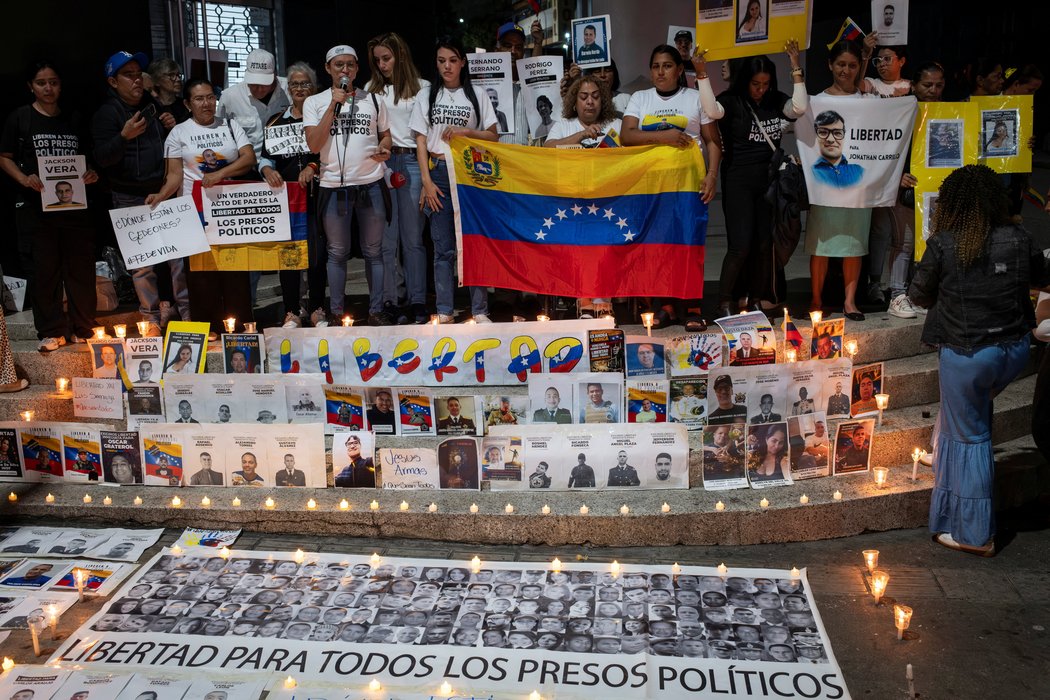
Families hold vigils outside detention centres demanding release of political prisoners
On 20th January 2026, families of people detained for political reasons in Venezuela held vigil protests for several consecutive nights outside major detention centres, including El Helicoide in Caracas and Tocorón prisons in Aragua state. Relatives said they held the vigils to demand the release of all those they consider arbitrarily detained, noting that releases since early January 2026 have been limited while hundreds remain in custody.
Outside Tocorón, dozens of families said that at least 140 political prisoners remained detained and that only a small number had been freed from that facility. They called on Jorge Rodríguez, president of the National Assembly, and Tarek William Saab, the Public Prosecutor, to honour earlier pledges to release people held on political grounds. In Caracas, another group of relatives protested in front of the Public Prosecutor’s Office to press for information on detained relatives.
Pro-government women’s march held in Caracas
On 6th January 2026, a peaceful protest took place in Caracas led by women supporters of the ruling party. Dozens of participants marched to express support for Venezuela’s interim leadership and to reject what they described as external aggression. Protesters carried banners and chanted slogans consistent with official government messaging, and articulated political demands rather than socio-economic grievances, distinguishing this mobilisation from other recent protests centred on labour or social rights.
Unresolved labour demands drive protests in late 2025
On 18th December 2025, peaceful protests took place in Aragua and Sucre, as citizens demanded action on unresolved labour and social rights amid ongoing economic hardship.
In Aragua, protesters raised concerns over labour conditions, social security, access to healthcare and food availability, reflecting persistent grievances linked to declining living standards and the absence of effective state responses to workers’ demands.
In Sucre, retired workers from the Salinas de Araya, a state-owned salt production complex, continued a peaceful protest that had already lasted seven days. They demanded payment of outstanding salary-related claims linked to debts owed by Corposucre, a regional public entity. Protesters reported that authorities had not presented concrete solutions or a clear timetable to address the arrears.
#18Dic | #BalancePreliminarOVCS
— Observatorio de Conflictos (@OVCSocial) December 19, 2025
📌 2 protestas en 2 estados del país 🇻🇪
Aragua
Sucre
📢 Exigencias
Laborales
Seguridad social
Salud
Alimentación#Sucre Jubilados de las Salinas de Araya luego de siete días de protesta pacífica siguen exigiendo reivindicaciones salariales por… pic.twitter.com/t6v3dM3DKs
On 10th December 2025, a peaceful protest took place in Monagas state, in eastern Venezuela, where more than 30 former employees of Unicasa, a national retail company, gathered outside the Labour Inspectorate, the public authority responsible for enforcing labour law and resolving employment disputes. Protesters demanded payment of severance entitlements following the company’s closure and said that their claims remained unresolved despite repeated requests to administrative authorities.