Freedom of association
Civil society environment: funding challenges, bureaucratic requirements for charitable organisations reduced
The federal programme “Demokratie leben!” (“Live Democracy!”), which funds civil society projects linked to the promotion of democracy and countering extremism, has become the subject of political dispute since the Christian Democratic Union’s (CDU) Karin Prien took office as federal minister for education, family affairs, senior citizens, women and youth in May 2025. During 2025, and increasingly in spring 2026, the programme’s direction came under political pressure from the Union (CDU/CSU), the senior partner in the governing coalition, which tightened funding criteria and put existing projects under review. According to Tagesschau, the programme became controversial within the party following widespread protests in 2025 against the party’s collaboration with the far-right Alternative for Germany (AfD) to push through controversial migration measures (see previous CIVICUS Monitor update). At the time, the CDU/CSU alleged that the demonstrations were being indirectly financed through state funding provided by the programme. In the 2026 federal budget, funding for the programme was cut by €4.5 million to around €186 million. Many organisations, including established counselling services for those affected by online hate, have been hit by the cuts, as the funding did not cover rising wage and material costs.
In March 2026, media reported that Prien was planning a major restructuring of the programme, arguing that its results had too often failed to justify the public spending involved. Under the reported plans, funding for more than 200 projects would end at the close of 2026. The ministry announced it intends to shift funding away from non-governmental organisations and towards locally rooted institutions such as schools, volunteer fire brigades and sports clubs, give greater weight to digital prevention, and commission more independent evaluations. It has since published new funding calls setting out its criteria. Civil society groups criticised the plans. The Federal Conference of Migrant Organisations said ending more than 200 initiatives would amount to a deliberate dismantling of the country’s social infrastructure, with a disproportionate impact on migrant organisations.
The draft federal budget for 2026 brought considerable financial uncertainty and funding cuts for many civil society organisations. Although around €209 million was still allocated for 2026 in areas such as diversity and democracy, wider budget consolidation left many organisations in a structurally precarious position. While the federal government made savings, some states took targeted measures of their own. In its two-year budget for 2025 and 2026, Baden-Württemberg strengthened citizen participation and allocated funding to civil society networks to counter social polarisation.
Several changes to charity law took effect between 2025 and early 2026. Following approval by the Bundesrat, the upper house of parliament, measures to reduce bureaucracy came into force in January 2026. Charitable organisations with annual income of up to €100,000, up from €45,000 previously, are now exempt from the requirement to spend their funds within a set period. The change reduces the administrative burden on smaller, volunteer-run associations and non-profit organisations and may make it easier for them to build up reserves.
Infrastructure law changes limit public participation, critics say
In 2026, Germany adopted the Infrastructure Future Act, which came into force in July. According to the Civic Space Watch platform, civil society groups raised concerns that the law makes public hearings on some infrastructure projects conditional on authorities deeming them “necessary”. They said this removes an important channel for public scrutiny. Separately, a draft reform of the Building Code published in 2026 proposed making early public participation in urban planning optional. Civil society organisations warn the measures would reduce the opportunities for communities and civil society to influence decisions with environmental and social impacts.
Court admits criminal organisation charges against Last Generation activists
In February 2026, the Potsdam Regional Court admitted charges against five members of the climate group Last Generation on suspicion of forming a criminal organisation, the first indictment of its kind in Germany. The court’s state security chamber said it had accepted the indictment filed by the Neuruppin public prosecutor’s office in May 2024. A trial date has not yet been set.
According to the indictment, the four men and one woman were involved in actions targeting facilities at the PCK oil refinery in Schwedt, Berlin Brandenburg Airport and the Barberini Museum in Potsdam between April 2022 and May 2023. In addition to forming a criminal organisation, they are accused of disrupting public services, coercion, criminal damage and other offences.
The Neuruppin prosecutor’s office began investigating the group in December 2022 and carried out searches in several federal states. Prosecutors in Flensburg and Munich have since also brought charges against members of the group, which has disbanded in its original form and renamed itself. The association Rückendeckung für eine aktive Zivilgesellschaft (Backing for an Active Civil Society), which supports the activists, said a total of 11 climate activists were under investigation in connection with the case. It said the Potsdam court was the first to allow charges of this kind to proceed to trial.
On 31st March 2026, the Flensburg Regional Court admitted the lesser charges of criminal damage and trespass against a Last Generation activist but rejected the charge of membership in a criminal organisation, a decision the public prosecutor’s office has appealed.
Five Palestine solidarity activists stand trial in Stuttgart on criminal organisation charges
Five Palestine solidarity activists from the United Kingdom, Spain, Ireland and Germany, known as the “Ulm 5”, are on trial in Stuttgart on charges including membership of a criminal organisation and causing about €1 million in property damage. On 8th September 2025, the five broke into a site in Ulm belonging to Elbit Systems, one of Israel’s largest arms manufacturers, and were arrested shortly afterwards. Prosecutors accuse Palestine Action Germany, the network the activists belong to, of being a criminal organisation, and the five of being its members. The trial before the Stuttgart Regional Court began on 27th April 2026 and is being held in the high-security courtroom at Stammheim. In statements to the court in May 2026, the activists described their action as necessary civil disobedience. They said all legal means had failed to stop what they called Germany’s complicity in genocide through arms exports to Israel, made possible by Elbit Systems’ subsidiary operations in Germany.
The defence argues that the charges are disproportionate and politically motivated, and that they reflect the German state’s support for Israel. It says the activists caused only non-violent property damage and should be tried for that alone. The conditions of the defendants’ detention have also drawn criticism. All five have been held in high-security pre-trial detention since September 2025, beyond the usual six-month limit. They have been kept in solitary confinement in separate prisons for up to 23 hours a day and have appeared in court handcuffed behind a glass partition. Proceedings have been repeatedly extended, and the trial is now expected to continue until February 2027.
If convicted of membership of a criminal organisation, the activists face up to five years in prison. Critics warn that a conviction could lead authorities to treat civil disobedience movements as criminal organisations rather than as legitimate forms of political dissent. Amnesty International Germany said the case was a further example of laws intended to combat terrorism being misused against protest movements. It said the prosecution violated fundamental rights and risked deterring political engagement.
Police raid queer community centre in Berlin, prompting solidarity protest
On 18th October 2026, 38 police officers raided Casa Kuà, a queer community centre in Berlin’s Kreuzberg district, on the orders of the public prosecutor’s office over an alleged violation of drug legislation. Officers confiscated items and recorded the personal details of at least 21 people, none of whom were accused of an offence, according to a police officer quoted by taz.
The raid prompted a spontaneous solidarity gathering of around 100 people outside the building, including members of the transgender community who regularly use the centre. Protesters condemned the operation as discriminatory and said it heightened concerns about the treatment and protection of queer people.
Freedom of peaceful assembly
Climate protests
Fridays for Future stages nationwide climate protests
On 24th April 2026, Fridays for Future held nationwide demonstrations against the German government’s climate and energy policies. Organisers said protests took place in more than 65 locations and drew tens of thousands of people. Police reported smaller turnouts in major cities, including around 350 participants in Berlin, 400 in Munich, 300 in Frankfurt and 100 in Cologne. In Berlin, demonstrators gathered outside the CDU headquarters before marching to the Social Democratic Party of Germany (SPD)’s headquarters, Willy Brandt House. Protesters criticised Federal Economy Minister Katherina Reiche (CDU), accusing her of favouring the gas industry and undermining the transition to renewable energy. They called for an end to fossil fuel subsidies and gas expansion, and urged the government to adopt stronger climate protection policies.
Climate activists protest against fossil fuel expansion in Hamm amid reports of police violence
In May 2026, nearly 2,000 climate activists from Germany and abroad took part in a climate camp in Hamm, organised by the climate justice alliance Ende Gelände, to oppose plans for new gas-fired power plants and the expansion of fossil fuels. Swedish climate activist Greta Thunberg also attended. Ende Gelände had called for non-violent civil disobedience, including blockades of gas infrastructure, and police prepared a major operation to protect power plants and other critical infrastructure.
According to the Civic Space Watch platform, peaceful protesters faced restrictions on their right to assemble, including bans on parts of the planned actions and police preventing participants from reaching registered assemblies. The platform reported that police used excessive force, including batons. It also raised concerns about the treatment of detained protesters, who were allegedly denied medical attention, food and access to toilets, while some were held outdoors in high temperatures or in overheated police vehicles. The platform said the incidents reflected broader concerns about the criminalisation of climate activism in Germany.
Court restricts cycling protest against motorway extension
On 29th July 2026, a German administrative court restricted the location of a protest against a motorway extension organised by the environmental group Tour de Natur. According to an alert on the Civic Space Watch platform, the group has organised annual protest bike rides since 1991. This year, it planned to protest against the extension of the A5 motorway on the motorway itself, but local authorities and administrative courts barred the protesters from using the motorway, citing safety concerns.
Article 8 of the German Basic Law, which guarantees freedom of assembly, generally includes the right to choose where an assembly takes place, although exceptions can be made if public safety is at risk. The alert argued that where the purpose of an assembly is directly linked to a particular location, this must be taken into account in the legal assessment, and that the need to close a motorway for a few hours is not in itself a sufficient safety concern to justify restricting freedom of assembly. German courts have reached differing conclusions on protests on motorways in the past.
Human chains in more than 100 cities demand stronger climate protections
On 3rd October 2026, thousands of people formed human chains in more than 100 German cities to demand stronger climate protection and social justice. Organisers estimated that around 19,000 people took part in the nationwide action, held under the slogan “It’s burning!”, and said the chains stretched for a combined 21 kilometres across 112 cities. The action was designed as a symbolic chain linking the Federal Constitutional Court in Karlsruhe with the Federal Chancellery in Berlin, passing through dozens of cities along the way. In cities including Berlin and Dresden, participants held up blank white sheets of paper to symbolise a fresh political start. The action was organised by environmental and climate groups, churches, trade unions and other organisations, including Fridays for Future and Environmental Action Germany (Deutsche Umwelthilfe). Protesters called for greater action on climate change, citing heat-related deaths, floods and forest fires.
School strikes against conscription: students face fines, investigations
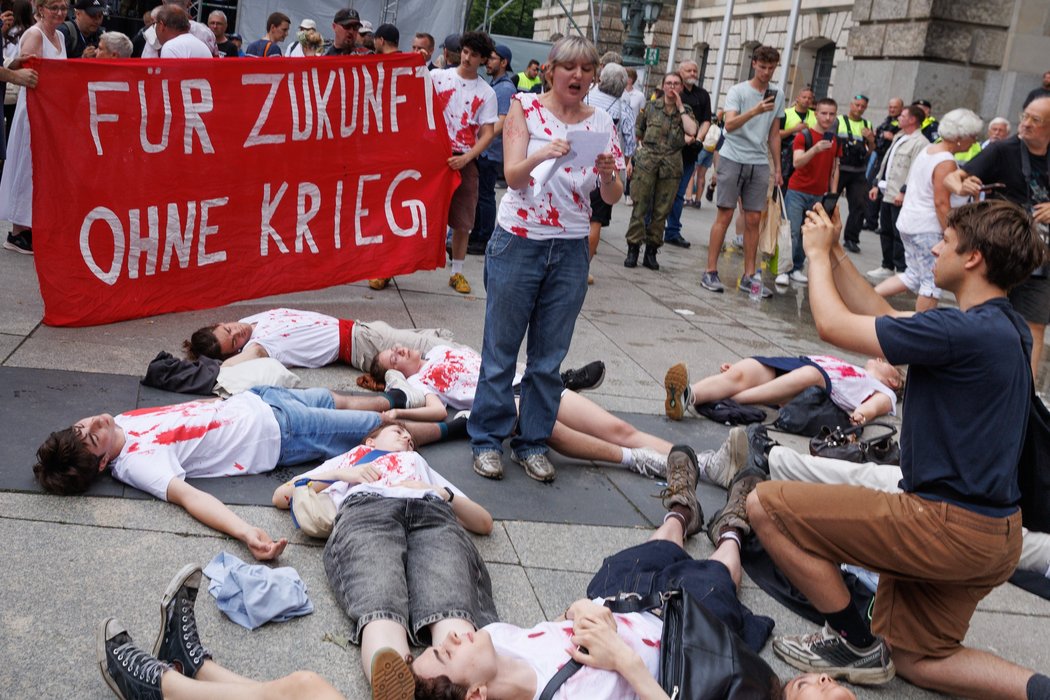
Between December 2025 and September 2026, tens of thousands of students across Germany took part in nationwide school strikes against the government’s reform of military service. The government argued that the country needed to strengthen its defences in response to the growing threat from Russia following its full-scale invasion of Ukraine. Legislation passed in December 2025 introduced mandatory questionnaires for 18-year-old men, and voluntary ones for women, to assess their willingness and suitability for military service. From mid-2027, men will also be required to undergo a nationwide medical examination to assess their fitness for service. The law also includes a provision for so-called “demand-based conscription”. Under this provision, if there are not enough volunteers to meet the personnel targets set by law for the Bundeswehr, Germany’s armed forces, the Bundestag can vote to conscript part of an age group.
The first demonstrations took place on 5th December 2025, the day the Bundestag approved the Military Service Modernisation Act, with up to 40,000 students reportedly taking part nationwide. Protests were held in 80 to 90 cities and regions, with larger rallies in Berlin (3,000 to 7,000 participants), Hamburg, Dresden, Leipzig, Hanover and Cologne. During a second strike on 5th March 2026, organisers said more than 50,000 people, including students, parents and teachers, joined more than 100 demonstrations across the country. A third strike followed on 8th May, with more than 50,000 students demonstrating in over 100 cities, and a fourth on 25th September drew more than 45,000 young people.
Students faced restrictions and possible disciplinary action for taking part in the protests during school hours. In Baden-Württemberg, some students were fined for missing lessons to attend the demonstrations. Critics said the fines were disproportionate, as the measure is intended as a last resort against persistent truants.
Police also opened investigations into several students over placards criticising Chancellor Friedrich Merz during the March and May demonstrations. At a protest in Berlin in early March 2026, police confiscated a placard reading “Merz leck Eier”, a vulgar insult aimed at the chancellor, from an 18-year-old protester. They then opened an investigation on suspicion of defamation and slander of a person in political life. A few weeks later, police in Giessen confiscated a similar placard and opened an investigation in that case too. In May 2026, a placard carried by a schoolgirl reading “Friedrich should die on the Eastern Front himself!” also led to a criminal investigation.
Protests in solidarity with Palestine and against arms manufacturers
Rheinmetall factory in Berlin’s Wedding district becomes focus of protests
Throughout 2026, anti-militarisation and pro-Palestinian activists staged a series of protests outside Rheinmetall’s ammunition-component factory on Hussitenstraße in Wedding, a densely populated district of Berlin. Protesters opposed the conversion of the former automotive plant into a military production site and argued that arms manufacturing in a residential area endangered local residents. Police maintained a presence around the factory, which was reinforced with additional fencing and barbed wire.
On 10th April 2026, seven activists from the pro-Palestinian group Peacefully Against Genocide staged a sit-in at the factory entrance to protest against the company’s alleged supply of weapons to Israel. They glued their hands to the pavement in front of the gates and chanted slogans including “Freedom for Palestine” and “Stop the genocide”. Police used solvents to remove the glue and then detained the protesters. The activists accused Rheinmetall of supplying weapons used by Israeli forces in the occupied Palestinian territories and elsewhere in the region, and criticised the German government for authorising arms production and exports to Israel.
In May, footage published by Anadolu Agency showed police drawing their guns on activists after they arrived in a van outside the factory. The protesters were subsequently searched and arrested. Peacefully Against Genocide condemned the police response and said demonstrations would continue.
In June, protesters set up a camp in the nearby Humboldthain park, holding daily demonstrations, discussions and talks about conflicts in which Rheinmetall weapons have been used.
When the factory officially began producing ammunition components in July, it became the scene of the largest protests to date. On 9th July 2026, around 100 demonstrators tried to block the access roads to the factory. Police said they had recorded the personal details of more than 60 people and arrested two activists on suspicion of assaulting officers. They also said two officers had been injured. Clashes broke out during the police operation.
On 11th July 2026, around 2,000 people marched from near Gesundbrunnen station towards the factory under the slogan “Wedding Without Weapons – Together Against War”. Swedish climate activist Greta Thunberg was among the participants. Police said there had been several offences, including the use of fireworks, the wearing of masks, and banned slogans, and that several groups had tried to break away from the march towards the factory. Video footage showed officers using force during arrests, striking protesters, pushing them to the ground and dragging them by the neck. According to police, 18 protesters were temporarily detained and 26 sets of proceedings were opened, including for breaching the ban on face coverings, assault and resisting officers.
On 14th July 2026, more than 30 activists, including Thunberg, protested again outside the factory to demand an end to Rheinmetall’s arms supplies to Israel. Some demonstrators staged a sit-in and glued themselves to the road, blocking access to the site, while others chanted “Free Palestine” and “Free Gaza”. Police used force to remove the protesters from the street and detained several activists for identity checks. The group reiterated calls for Rheinmetall to halt all deliveries to Israel and to close the Berlin factory.
Pro-Palestinian activists blockade arms factories across Germany
On 15th October 2026, pro-Palestinian activists staged coordinated sit-ins outside arms manufacturing sites in several German states, blocking entrances to protest against continued German arms exports to Israel. The actions were organised by Peacefully Against Genocide and targeted sites belonging to Rheinmetall and General Dynamics. According to the group, more than 70 people took part.
In Berlin, 11 activists protested outside the Rheinmetall factory in Wedding, nine of whom glued themselves to the road to block access. Police said they were called at around 5.30am and deployed about 90 officers to remove the demonstrators. Police said they had opened an investigation on suspicion of coercion and of using symbols of unconstitutional organisations in slogans chanted at the protest. Video footage showed police using pain compliance holds on a young female demonstrator, as well as dragging protesters on the ground.
Laila Fuisz of Peacefully Against Genocide said the German government continued to approve arms deliveries to Israel despite what she described as genocide against Palestinians, while companies such as Rheinmetall continued production. She said international law prohibited supplying weapons used in genocide, and that the blockades were intended to defend human rights and protect lives. Other protesters said the killing of civilians and children in Gaza had motivated them to take part. Further protests were planned across Germany.
Around 200 reported injured at anti-rearmament protest in Cologne
On 5th September 2026, a demonstration in Cologne against rearmament and Rheinmetall ended in violent clashes between protesters and police. The Disarm Rheinmetall alliance said around 3,500 people took part, while police put attendance in the low thousands. According to Demosanitäter, a volunteer group of protest medics, around 200 demonstrators were injured, 22 of whom needed further medical or emergency treatment. Police said 11 officers had been injured, one of whom was unfit for duty.
The alliance accused police of excessive force and criticised the six-hour kettling of some demonstrators. Police said masked individuals had fired steel balls at officers, punched and kicked them and sprayed them with fire extinguishers. Police used physical force and held around 300 people to record their personal details, a process that lasted until about 10pm. Police said they had opened investigations into suspected aggravated assault and serious breaches of the peace.
Dozens reported injured at Nakba Day demonstration in Berlin
On 16th May 2026, around 2,000 people took part in a demonstration in Berlin’s Kreuzberg district marking the 78th anniversary of the Nakba, under the slogan “End the occupation of Palestine – 78 years of Al Nakba”. The march protested against Israel’s military operations in Gaza and the war in Iran, and up to 700 police officers were deployed. Demonstrators carried placards accusing Germany of complicity in genocide in Gaza and calling for an end to the occupation.
Police initially described the demonstration as peaceful but later said the atmosphere had become aggressive. They said officers and journalists had been attacked and banned slogans chanted. Video footage published by Middle East Eye and Al Jazeera showed officers charging into the crowd, using irritant spray, and pushing, punching and kicking participants. Organisers said around 30 people had been injured by police. Police said they had temporarily detained 15 people on suspicion of criminal offences and that one officer had been slightly injured.
Court overturns ban on speaker at Frankfurt Palestine solidarity demonstration
The city of Frankfurt barred one speaker from appearing at a Palestine solidarity demonstration planned for 18th July 2026. On 17th July, the Frankfurt Administrative Court ruled that the ban was unlawful and granted the organisers’ urgent application. The court found that the city’s assessment of the risk of criminal offences did not meet constitutional standards, and that ambiguous statements had to be interpreted in light of freedom of expression. The demonstration went ahead the following day.
Protests against the far-right
Thousands protest against far-right march marking Dresden bombing anniversary
On 14th February 2026, around 3,000 people protested in Dresden against a march by about 2,000 far-right extremists marking the 81st anniversary of the city’s bombing in the Second World War. The counter-protests began in the morning, with three marches converging on a central rally, while further groups gathered along the route of the far-right march. Demonstrators also held loud protests at the march’s closing rally.
Some counter-protesters staged sit-ins to block the route, and police used pepper spray to remove them. Police said demonstrators had repeatedly tried to break through barriers and that officers had been attacked and injured. They said they had opened investigations into suspected breaches of the peace and assaults on officers. There were no reports of direct confrontations between the far-right marchers and counter-demonstrators. Far-right groups have repeatedly used the anniversary to promote narratives that downplay Germany’s responsibility for the war.
Thousands protest against far-right AfD party conference in Erfurt
On 4th July 2026, around 20,000 people gathered in Erfurt to protest against the annual conference of the far-right Alternative for Germany (AfD) party, held ahead of regional elections. The demonstrations, organised by trade unions, civil society groups and left-wing parties, aimed to disrupt the two-day event. Protesters called for the party to be banned, citing its anti-democratic positions and demands for mass deportations.
Protesters blocked roads leading into the city and staged sit-ins, and some reportedly abseiled from a motorway bridge. There were clashes between some demonstrators and police in riot gear. Authorities deployed large numbers of officers, including reinforcements from across Germany. Despite the blockades, most AfD delegates reached the conference centre, and the party said the event began on time.
The Committee for Fundamental Rights and Democracy (Komitee für Grundrechte und Demokratie), which observed the protests, criticised the police operation. It said police had “deliberately committed clear violations of the law, exercised unnecessary violence and injured dozens of people.” According to the organisation, between 6,000 and 10,000 officers were deployed, supported by armoured vehicles, water cannon, a helicopter and police dogs. It said police made no attempt to de-escalate, instead charging protesters without warning and using tear gas and pepper spray on the crowd. The committee also reported that right-wing streamers were able to threaten and harass protesters without police intervening.
Tens of thousands protest against AfD across Germany
On 12th September 2026, around 150,000 people demonstrated in about 20 German cities, including Berlin, Hamburg and Munich, calling for a ban on the AfD. The protests, organised by the campaign group Pruef, followed the AfD’s strong performance in the Saxony-Anhalt state election, in which it won nearly 44 per cent of the vote.
Demonstrators carried signs reading “Ban the AfD now” and “Democracy needs no alternatives”. Christoph Bautz, head of the campaign group Campact, said civil society was mobilising to prevent those it regards as enemies of the constitution from gaining power. Police put the turnout in Berlin at several thousand. The AfD held a counter-rally in the city, attended by its lead candidate in the upcoming regional election. The party’s electoral gains have intensified public opposition and calls for a ban. No major incidents were reported.
Counter-protest outnumbers AfD march in Neumünster
On 17th October 2026, around 1,200 people protested in Neumünster, Schleswig-Holstein, against a march organised by the AfD and its youth organisation, Generation Germany. Five counter-demonstrations were registered, with organisers urging residents not to let the city be taken over by a far-right march.
The AfD march, held under the motto “Secure the future — preserve identity!”, drew around 130 participants, although 500 had registered in advance. Local media reported repeated calls for “remigration” and deportations during the march. Police said there had been isolated incidents during the day. Officers forcibly removed counter-protesters who had staged a sit-in to obstruct the AfD march.
More than 1,000 protest against AfD event in Leverkusen
On 20th October 2026, more than 1,000 people protested in Leverkusen against an event featuring AfD co-leader Alice Weidel and AfD politician Ulrich Siegmund. The demonstration was organised by civil society groups, local initiatives and trade unions in opposition to right-wing extremism and exclusion. Protesters gathered outside the Forum Leverkusen venue with placards, whistles and chants, and the Cologne band Bläck Fööss performed at the rally.
Shortly before the event began, there were scuffles between attendees and counter-protesters, some of whom blocked access to the venue. According to police, officers intervened after an AfD politician was pushed behind a fence separating demonstrators from party representatives. Police said they had filed several criminal complaints, detained one person and opened investigations into alleged graffiti and violations of the ban on face coverings. Police described the day as largely positive despite isolated incidents.
Freedom of expression
UN expert raises concerns over restrictions on Palestine solidarity and self-censorship
Irene Khan, the UN Special Rapporteur on the promotion and protection of the right to freedom of opinion and expression, made an official visit to Germany from 26th January to 6th February 2026. In her report, published in July, she identified major trends affecting freedom of expression in the country. These included growing polarisation in society, a chilling effect on speech, and a rise in antisemitism, Islamophobia and hate speech against migrants and minorities.
She acknowledged Germany’s strong constitutional protection of human rights, its independent judiciary, its diverse media and its initiatives in the digital sphere. However, she expressed concern about the excessive use of criminal law to restrict freedom of expression, particularly in relation to Palestine and to climate advocacy and activism. Among her concerns over Palestine solidarity were protest bans, arrests, the use of force, restrictions on slogans and raids on the homes of human rights defenders. She also described a climate of stigmatisation and self-censorship in civic, academic and artistic spaces.
Government proposes expanded biometric surveillance powers for police
In April 2026, the federal cabinet approved a package of three bills to expand the digital investigative powers of security authorities. They are the Act to Strengthen Digital Investigative Powers in Police Work, the Act to Strengthen Digital Investigative Powers to Counter Threats of International Terrorism, and an act amending the Code of Criminal Procedure. The bills would allow authorities to automatically compare facial images with photos and videos available online, carry out automated analysis of large data sets, and use existing personal data to train AI surveillance systems. The package is being considered by parliament and has not yet been passed.
Civil society groups and legal experts have warned that automated biometric matching against online data would infringe the privacy of people who post photos and videos of themselves. It would also affect people who appear in the background of images without their knowledge or consent. Critics said the technology would make it possible to identify people in public spaces and online, creating the technical basis for comprehensive tracking of the population. They also warned that automated data analysis could be used to build detailed personal profiles and draw conclusions far beyond the purposes for which the data was originally collected. They said such systems were prone to error, lacked transparency and could lead to discrimination. The civil rights organisation Society for Civil Rights (GFF) described the plans for biometric internet searches and automated data analysis as largely unconstitutional. Digital rights groups warned that the ability of authorities to monitor and profile individuals could deter people from speaking out, taking part in public debate, engaging in activism or attending protests.
In a separate reform, the Bundestag passed a new Federal Police Act on 10th July 2026, the first overhaul of the law since 1994. It allows federal police to use AI-supported facial recognition at airports, railway stations and border areas, and AI “behaviour recognition” that alerts officers to supposedly threatening conduct. It also widens the use of surveillance software on personal devices, regulates drones and counter-drone measures, and makes it easier to detain migrants awaiting deportation. The governing CDU/CSU and SPD added the real-time facial recognition provisions days before the vote, without a public hearing. Digital rights groups said the law effectively ended anonymity in public spaces, and Amnesty International warned that random checks could enable racial profiling.
Proposed changes to Freedom of Information Act raise press freedom concerns
On 2nd July 2026, the governing CDU/CSU-SPD coalition agreed on a 34-point economic reform package that includes proposals to amend the federal Freedom of Information Act (IFG). Only natural persons would be able to submit requests, which would prevent newsrooms and civil society organisations from filing requests as organisations. The coalition also agreed to examine limiting the right to request information to German and EU citizens living in Germany, excluding non-EU and exiled journalists, among others. Applicants would also have to show a “legitimate interest” in the information and the €500 cap on fees would be replaced by charges based on processing costs. Officials handling requests would be anonymised and exemptions from disclosure would be widened in four areas: critical infrastructure, counter-espionage, counter-terrorism and scientific research. This mirrors an earlier proposal for amendments to Berlin’s state-level FOI law, which was withdrawn following widespread criticism. The Mapping Media Freedom platform warned that the changes would create significant barriers for journalists and reduce scrutiny of public authorities.
More than 100 civil society organisations and media outlets signed an open letter urging the government to drop the plans. Critics, including members of the SPD’s parliamentary group, said the changes would amount to the de facto abolition of the law. In late September, the government said it was sticking to the reform, but no draft bill had been published and the timetable remained open.
Saarland intelligence law reform weakens protections for journalists
On 29th April 2026, the Saarland state parliament passed amendments to the state’s Constitution Protection Act, which governs the work of the regional domestic intelligence service. The reform, adopted with the votes of the SPD and CDU, removes key safeguards against the surveillance of journalists. Under the previous law, journalists were exempt from covert technical surveillance measures such as spyware and wiretapping. The amended law no longer contains a full ban and offers only limited protection. It also drops the requirement for independent bodies to review surveillance measures against journalists in advance.
The Saarland Journalists’ Association (SJV) strongly criticised the reform. It said journalists would now be less protected than other professions, such as lawyers and members of parliament. The association said the changes may conflict with Article 4 of the European Media Freedom Act, which protects journalistic sources and restricts the use of spyware against media professionals, and that they posed a wider threat to press freedom. The SJV said it had raised its concerns during the legislative process, but they had not been taken into account. The reform also gives the intelligence service new powers, including access to mobile phone cell data, bank account details and public video surveillance footage. The amended law came into force in July 2026.
Berlin court rules for AfD lawmaker in case against Correctiv “remigration” report
On 17th March 2026, the Berlin Regional Court II ruled in favour of Gerrit Huy, a Bundestag member for the far-right Alternative for Germany (AfD), in a lawsuit over Correctiv’s reporting on the so-called “Potsdam meeting”. At the November 2023 meeting, AfD politicians and far-right activists discussed plans for “remigration”, a term for the mass deportation of people of foreign origin. The court barred Correctiv from repeating two statements: that the meeting had produced a “master plan” to expel German citizens, and that Huy had proposed stripping dual nationals of their German citizenship. It also prohibited a statement about another participant, Ulrich Vosgerau. This contradicted an earlier ruling in Hamburg in Correctiv’s favour.
Correctiv editor-in-chief Justus von Daniels said the outlet was surprised by the ruling, given its success in Hamburg, and Correctiv has filed an appeal, which the Berlin Court of Appeal (Kammergericht) is due to hear in February 2027. In a separate case in October 2026, the same court overturned a lower court ban and ruled that Correctiv’s reporting on Vosgerau was permissible opinion. Since publishing its investigation, Correctiv has faced repeated legal action and attacks from AfD members and associates, which press freedom groups have described as attempts to silence its reporting.
Journalists face assaults at far-right events and police violence
The Mapping Media Freedom project documented more than 100 press freedom violations in Germany between the start of 2026 and the end of October, including 24 physical assaults, 28 attacks on property and 38 legal attacks.
Many of the physical attacks took place at far-right events or targeted journalists reporting on the far right. On 25th March 2026, three Spiegel TV journalists filming a documentary on neo-Nazi networks were beaten and pepper-sprayed in Fretterode, Thuringia, allegedly by prominent neo-Nazi Thorsten Heise and his son. The journalists needed hospital treatment, and both suspects were released the same evening. On 25th June, a reporter and camera operator from the blog hessencam were assaulted by participants at a far-right conspiracy movement event outside the Reichstag in Berlin, and their equipment was snatched and thrown to the ground.
The campaign for the Saxony-Anhalt state election saw several incidents at AfD events. On 22nd August, a far-right YouTuber shoved and verbally abused a Spiegel TV crew in Merseburg, calling the outlet a “far-left rag” and demanding the journalists leave. Two days later in Lützen, a security guard grabbed POLITICO journalist Anne McElvoy by the arm and pushed her away as she waited to interview the AfD’s lead candidate, Ulrich Siegmund. Police at the scene then checked her ID and asked her to delete a photo of the guard, and a journalists’ union criticised the officers for failing to protect her. On election day, 6th September, a woman shoved the camera of WDR camera operator Fabian Thomm in Magdeburg after he filmed police detaining her group for giving a Nazi salute, damaging his equipment and causing minor injuries. On 3rd October, journalist and YouTuber Hannes Kreschel was hit and kicked at an AfD event in Brandenburg by an attendee wearing clothing of a banned neo-Nazi band. According to Kreschel, police then barred him from the venue while allowing his attacker to stay.
Journalists also reported violence by police. On 14th February, at the counter-protests against the far-right march in Dresden, a Pixel Roulette photojournalist said an officer struck them with a baton despite their visible camera and press pass. On the same day, journalist Michael Krell said an officer punched him in the face, splitting his lip, as he documented police action against counter-protesters, and that officers threatened to detain him when he asked for their identification numbers.