Introduction
Civic space in Serbia is rated “repressed” by the CIVICUS Monitor, following a downgrade in December 2025 that cited violence against protesters, mass detentions, intimidation and pressure on independent media in response to massive, student-led protests that began after the fatal collapse of a railway station canopy in Novi Sad in November 2024.
Between December 2025 and March 2026, ahead of local elections in ten municipalities, pressure on government critics intensified. Government officials repeatedly targeted independent media, and journalists faced death threats and smear campaigns. The Independent Journalists’ Association of Serbia recorded 38 incidents of attacks, threats and pressure on journalists in January, followed by a further 34 incidents in February and 30 in March.
Supporters of the student movement faced reprisals at work, including dismissals and suspensions. Students campaigning in municipalities where elections were due to take place, and those supporting them, were harassed and attacked, with several women activists subjected to gender-based harassment and intimidation.
The right to protest was also under threat, with protests forcibly dispersed, protesters attacked by government supporters and reportedly intimidated by the security services.
Freedom of association
On 7th February 2026, activists from the student movement taking part in the “Student in Every Village” outreach campaign were followed, filmed and provoked by groups of unknown men and women while going door to door in Darosava, a village near Aranđelovac, one of ten municipalities holding local elections in March 2026. The students said the group repeatedly asked “Who is paying you?” and that one man tried to attack a student, who escaped into a car. According to the students, police officers who arrived did not intervene to remove those harassing them. The portal Pravo u centar reported that Lazarevac municipality officials were among the groups harassing the students. On 28th February, students campaigning door to door in Sevojno, another municipality due to hold local elections the following month, were verbally attacked by men who the local association United for Sevojno identified as activists of the ruling Serbian Progressive Party (SNS).
After the Darosava incident, the pro-government local portal Ucentar published a video of Stevan Mihajlović, a Kragujevac activist and member of a local citizens’ assembly, who had supported the students during the altercation and argued with one of the harassers. On the night of 9th February, his car was vandalised in Kragujevac’s Erdoglija neighbourhood, with its tyres slashed and windows broken. Mihajlović reported the attack to the police and described it as an attempt to intimidate him into abandoning his activism. On 10th February, Kragujevac’s citizens’ assemblies held a rally in his support on Đački Square. More than a week after the attack, the perpetrator had still not been identified.
On 10th February 2026, an anonymous Instagram profile, “69.kula”, published the photographs and full names of 14 women in Kula who had taken part in protests or criticised the local SNS authorities, and threatened to release “explicit content” about them. The Women’s Movement KULA and more than 20 women’s and civil society organisations condemned the threats as digital and gender-based violence used for political intimidation during the local election campaign. They also noted that the authorities had not responded adequately to the women’s complaints.
Also in February, pro-government tabloids and television channels, joined by Minister for European Integration Nemanja Starović, conducted a smear campaign against the Belgrade Centre for Security Policy (BCSP). A closed event the BCSP organised during the Munich Security Conference was portrayed as “secret diplomacy” against Serbian interests, and attempts were made to link the organisation to the ongoing student protests and the political opposition as part of a broader conspiracy. The National Convention on the European Union, of which the BCSP is a founding member and coordinator of the Chapter 24 working group, condemned the campaign as a manipulation of a standard conference format and part of a wider trend of delegitimising civil society organisations that critically analyse public policy.
Freedom of expression
On its platform for documenting press freedom violations, the Independent Journalists’ Association of Serbia (NUNS) recorded at least 379 incidents of attacks, threats and pressure against journalists and media workers in 2025. In January 2026, NUNS recorded 38 incidents involving journalists and media workers, including eight physical attacks and eight death threats. A further 34 incidents were recorded in February, and 30 more in March.
On 24th December 2025, NUNS condemned threats and sexist insults posted in comments on news portals against women journalists of N1 television, calling them hate speech and incitement to violence. It said the threats had been reported to the authorities and that it expected a swift and effective response. In the same statement, NUNS also condemned the mayor of Bečej, Vuk Radojević, for targeting Kristina Demeter Filipčev, a journalist of the local portal Bečejski mozaik, during Municipal Assembly sessions on 24th November and 23rd December. Radojević addressed her by name, suggested she was politically biased and questioned her professional integrity while she was covering the sessions and was unable to respond.
At the end of December 2025, Bojan Sarić, who had worked for four years at the Kikinda municipal heating company JKP Toplana, lost his job the day after he and his family publicly signed a list of support for the student protest movement. Sarić told N1 that throughout 2025 he had repeatedly refused invitations, some from the director himself, to attend rallies of the ruling Serbian Progressive Party (SNS) and to take part in “Ćacilend”, the pro-government counter-protest encampment in Belgrade’s Pionirski Park. He said the director, Dušan Marjanović, had told him an order had come “from the top” not to renew his contract. Marjanović did not respond to N1’s questions. In April 2026, the Basic Court in Kikinda annulled the dismissal and ordered his reinstatement, a ruling the Court of Appeal in Novi Sad later upheld.
On 3rd January 2026, the Belgrade daily Danas received a threat in the comments section of its website calling for explosives to be thrown at its newsroom. Veran Matić of the Association of Independent Electronic Media (ANEM), who is also a member of the Permanent Working Group for the Safety of Journalists, said the threat had been reported to the Prosecutor’s Office for High-Tech Crime. He noted that Danas and its journalists are frequent targets of threats, and that near-total impunity leaves its staff working in constant fear.
Also in January, independent media and civil society organisations were hit by repeated, apparently coordinated bot attacks on their Instagram accounts. On 10th January, the youth portal Zoomer reported that its followers had jumped from about 29,400 to more than 32,700 in roughly an hour. The next day, the portal Nova.rs reported the same problem, and on 12th January the weekly Radar reported that its followers had risen from 85,800 to 91,900 in under two hours. Both outlets warned that the surges could lead Meta to restrict or remove their accounts. On 18th January, three Instagram accounts belonging to Nova.rs were suspended for 180 days for allegedly breaching community standards, and Radar’s account was deleted. The accounts of the civil society organisations CRTA and OsnaŽene, the Novi Sad outlets Autonomija and VOICE, and photographer Gavrilo Andrić were also suspended. After complaints, Meta restored the Nova.rs and Radar accounts, but the attacks continued. On 20th January, Danas gained about 30,000 followers in half an hour, and on 24th January the Nova.rs and Radar accounts each gained about 20,000 within a short time. ANEM reported the attacks to the Prosecutor’s Office for High-Tech Crime.
Freelance journalist and photographer Marko Dragoslavić faced repeated threats in connection with his reporting on illegal construction in the Stepin Lug forest in Belgrade. On 14th January, while he was filming at the construction site, a worker approached him and put him on a phone call with the investor. After Dragoslavić introduced himself as a journalist, the investor threatened him and hung up. The worker then told him to run away or he would be killed. On the evening of 17th January, an unknown man followed him through the Zvezdara district and threatened to kill him. On the night of 19th January, unknown people rang his intercom and pounded on his door. According to reports, the perpetrators had left by the time a police patrol arrived. ANEM reported the incidents to the prosecutor’s office.
On 15th January 2026, the expanded Senate of the University of Novi Sad rejected the appeal of Jelena Kleut, an associate professor of media studies at the Faculty of Philosophy who had publicly supported the student protests. She had appealed against the university’s decision not to promote her to full professor, although the faculty’s Electoral Council and the university’s Expert Council had approved the promotion. Under the law, failure to secure promotion meant losing her job, and on 21st January the faculty handed her a decision ending her employment. Independent unions and academic networks described the dismissal as part of a “great purge” of Serbian universities. President Aleksandar Vučić said the case had “little to do with the state”, and Education Minister Dejan Vuk Stanković called it “media and political abuse”. The Administrative Court and the Basic Court in Novi Sad both later rejected an interim measure that would have allowed her to return to work pending the outcome of her lawsuit against the university.
On 17th and 24th January 2026, Igor Velić, an activist and columnist from Bor, received death threats in comments under an animated video that targeted and discredited him, posted on the Facebook page “Borski blok”. ANEM filed criminal complaints in response.
In January, Predrag Simonović, a retired police inspector who worked on the investigations into the murders of journalists Slavko Ćuruvija, Dada Vujasinović and Milan Pantić and now writes a column for Radar, received a threatening comment under one of his columns. He later learned that it had been posted by a retired member of the Security Information Agency (BIA). Simonović recalled that in 2023, ahead of the publication of his book on the murder of Ćuruvija, the man, then employed by BIA, had called him for an informal meeting. There, he suggested that Simonović remove official police reports from the book and mentioned Simonović’s minor daughter by name, which Simonović interpreted as a threat. Simonović subsequently filed a police report, but the prosecutor’s office found that no crime had been committed. In February 2026, an unknown person using a foreign phone number harassed his wife and daughter through video calls. Simonović said he would move them out of Serbia because the prosecution and police had not provided him with effective protection.
On 23rd January 2026, during the local election campaign, posters appeared in Kula, Ruski Krstur and Kruščić showing N1 journalists Sanja Kosović and Ina Džakula beneath the WWII-era fascist Ustaša movement slogan “Za dom spremni” and stating that they “do not bear Serbian first and last names”. ANEM filed a criminal complaint against unknown perpetrators for inciting hatred.
On 23rd January 2026, Marija Radovanović, secretary of the Faculty of Medicine at the University of Belgrade, received a decision terminating her employment. Radovanović, who holds whistleblower status, had supported the student blockade of the faculty and reported to the authorities that the dismissal of the faculty’s dean, Tatjana Simić, and the actions of the new acting management were unlawful. She said the reasons given for her dismissal included reporting these irregularities and speaking to the media without approval. She has since taken legal action before the Higher Court.
In early February 2026, pro-government media, including B92, TV Prva, Informer and Dokumentarna TV, aired “Evil Times 2: The Creation of Propaganda”, a film produced by the Novi Sad-based, government-aligned Centre for Social Stability. The film portrays ANEM director Veran Matić as a “traitor and foreign mercenary” and uses a photograph of him taken at Svetogorska 35 in Belgrade, where Slavko Ćuruvija was murdered in 1999. Media associations in the Permanent Working Group for the Safety of Journalists filed a criminal complaint over the broadcast, which they said threatened Matić’s security. Days later, the Centre published a list of 45 names, mostly journalists, to be featured in future episodes. Matić later sued the Centre and asked the Basic Court in Novi Sad to ban further broadcasts.
On 4th February 2026, three staff members of the Department of Media Studies at the Faculty of Philosophy in Novi Sad, Smiljana Milinkov, Stefan Janjić and Ksenija Pavkov, received identical threatening emails reading: “Read this. The Black Hand has marked you. It knows everything. Watch out. A friend.” The same message had been sent to Milinkov in September 2025, but she received no response despite filing a police report and giving forensic data to the prosecutor’s office. The Independent Journalists’ Association of Vojvodina (NDNV) warned that the authorities’ silence on the matter “normalises lawlessness”.
In early February, final-year student Lazar Zgonjanin at the Fifth Belgrade Gymnasium faced disciplinary proceedings after he told N1 that acting principal Danka Nešović, who had received the Saint Sava Award from the government, did not deserve it, and described various retaliatory measures Nešović had taken against staff supporting the student movement, as well as problems in the school’s functioning. According to the Parents’ Council’s lawyer, the school psychologist questioned him for two hours, asking who had paid him, and the procedure could lead to his removal from the school. On 23rd February, the last day of her mandate as acting principal, Nešović suspended six teachers: two Serbian language teachers for attending a meeting of the Academic Committee for Education of the Serbian Academy of Sciences and Arts with parents and students, and two history teachers for sharing social media posts. Teachers said she had removed 12 staff since September for supporting students.
In the provincial administration of Vojvodina, almost 170 employees were declared unassigned at the end of 2025, and the first dismissals followed in early February 2026. Employees said they were being punished for supporting the students. Slavko Matić, who had worked there for 24 years, said his problems began after he spoke to N1 at the reception in Budapest for students who had made a symbolic cycling trip to Strasbourg to bring the student movement’s concerns to the European Parliament. He said about 100 people lost their jobs in the first wave.
From 13th February 2026, DDoS attacks hit the server hosting the websites of Radar, Južne vesti and Glas Šumadije, and from 18th February the sites were practically inaccessible, preventing journalists from publishing. The Journalists’ Association of Serbia (UNS) called on the authorities to establish who was behind the attacks.
On 14th February 2026, freelance journalist Dejana Cvetković was insulted, threatened and sexually harassed by protesters while reporting for Vreme on a demonstration in Surdulica. The protest was held after a local man was killed in a traffic accident involving a young Albanian man related to local bakery owners. Protesters threatened to break her phone, and she had to leave. Her personal data and social media profiles were later shared in a Viber group of protest participants after she reported on the group’s calls to persecute the Albanian family. A journalist from the portal infoVranjske received phone threats after sharing an article about the attack.
On 14th February, TV Informer aired a show targeting several professors of the Faculty of Law in Belgrade by name over their support for the student movement. The Faculty, the student movement and the Association of Judicial Assistants condemned the broadcast as an attempt to discredit the professors and call their personal integrity into question.
On 16th February 2026, a woman verbally attacked N1 reporter Tijana Zarić, filming and following her while Zarić was reporting on a residents’ blockade of road works in Kosovska Street in Belgrade. Police removed the woman.
Activists Lazar Dinić and Ivan Bjelić of the portal Revolt published the identities of men who had attacked students and journalists in Novi Sad on 16th February at a protest near the Serbian National Theatre (see Freedom of peaceful assembly). They then received threatening messages calling them “Ustaše” and threatening to “cut them into pieces”. Their lawyer, Veljko Milić, filed a complaint with the Prosecutor’s Office for High-Tech Crime.
In late February 2026, police announced that two war veterans had been detained on suspicion of conspiring to overthrow the constitutional order, alleging that they had been plotting an armed attack on the president and his family. President Vučić and Speaker of Parliament Ana Brnabić subsequently accused N1 of “inspiring” the alleged plot because it had broadcast the suspects’ lawyer’s statement alongside the police announcement. The lawyer had said the arrests were a form of intimidation ahead of a planned protest. Vučić added that he had “1,000 reasons” to shut down N1, and Nova S. NUNS and ANEM condemned the statements, warning that such rhetoric from the highest state officials encourages threats and attacks on journalists.
Freedom of peaceful assembly
On the evening of 13th January 2026, several hundred people protested outside the local office of the ruling SNS party in Čačak. They were objecting to a concert by folk singer Ana Bekuta on nearby City Square, organised by the city authorities for the Orthodox New Year at a cost of 4.5 million dinars (about €38,000). Video shared on social media shows protesters throwing snowballs at the stage. While police present at the square and outside the SNS office did not intervene, Interior Minister Ivica Dačić later said police had identified 11 people suspected of various offences in connection with the incident. On 14th January, police brought six people before the Higher Public Prosecutor’s Office, which questioned and released them while residents protested outside. Police then filed criminal complaints against the six for “violent behaviour at a public gathering”, alleging they had thrown icicles, and misdemeanour charges against five others. Local lawyer Ivan Ćalović said no icicles had been thrown and noted that the singer had not been injured.
On 14th January 2026, local citizens’ assemblies held a gathering in Valjevo to mark five months since the protests of August 2025, which were met with significant violence from police forces and government supporters and led to nearly 70 arrests. After the gathering, police stopped a man identified as F.P., checked his identity and took him to the Valjevo Police Department for questioning, reportedly for leaving the message “Valjevo remembers” on a traffic sign at the entrance to the police building. He was released some time later.
On 21st January 2026, a protest against the dismissal of Jelena Kleut, a professor known for her outspoken support for the student movement (see Freedom of expression), turned into a blockade of the Faculty of Philosophy in Novi Sad. At about 4pm, police entered the building at the request of Dean Milivoj Alanović, followed by the Gendarmerie, while at least 10 police vans arrived outside. Large numbers of riot police then forcibly pushed students, professors and citizens out of the building, dispersing the protest.
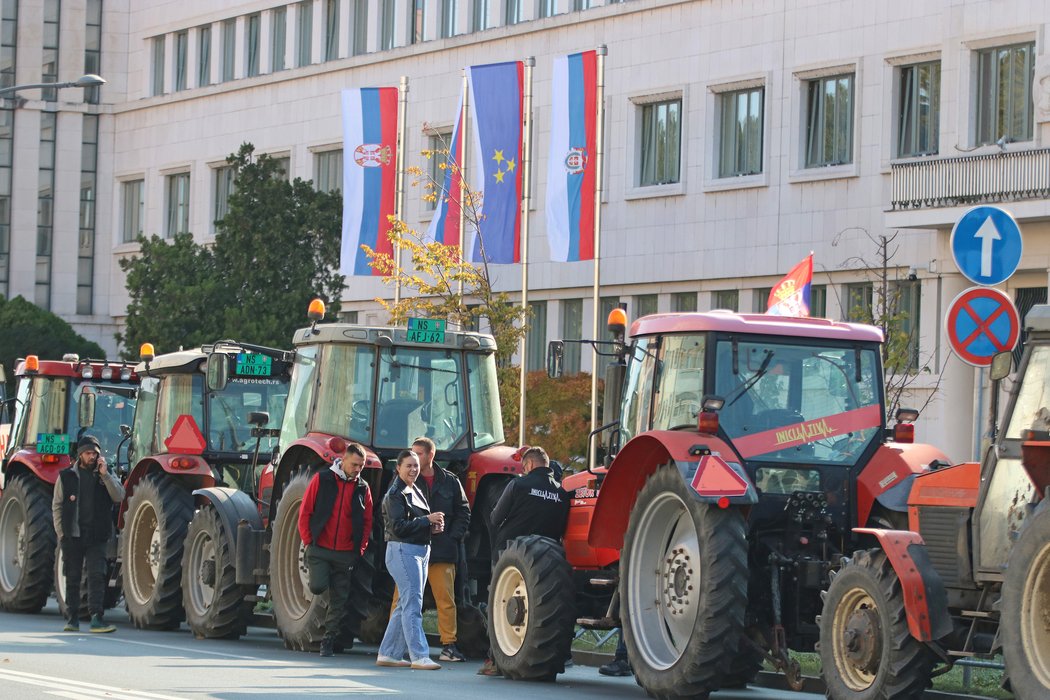
On 11th February 2026, several hundred dairy farmers blocked roads with tractors to protest against low milk prices and cheap imports. Two protests were held: one blocked the Ibarska highway near the village of Mrčajevci, and the other a road near Knić. The farmers said members of the Security Information Agency (BIA) had pressured them the day and night before, asking how the protest would be organised and offering “friendly advice”, but they had decided to go ahead regardless. On the fourth day of the blockade, they reported that BIA representatives had warned them to end it and remove their vehicles or face criminal and misdemeanour charges. The farmers said the blockades would continue and called on others to join in large numbers. The blockades subsequently spread across the country, and on 26th February media reports indicated that 80 main, regional and local roads were blocked. Police filed numerous misdemeanour charges against participants, which the Initiative for the Survival of Farmers of Serbia described as repression.
On 16th February 2026, students and citizens protested near the Serbian National Theatre in Novi Sad, where a ceremony marking 200 years of the Matica Srpska cultural organisation was being held. President Vučić had been announced as a speaker. Around 8pm, a group of men, who had been among the government supporters gathered in front of the theatre, approached and attacked a group of students standing nearby, injuring at least three. Video footage of the incident showed student Inas Hodžić being struck on the back of the head in front of police officers, who did not react. The men also attacked journalist Žarko Bogosavljević, pushing him against a wall, striking him and knocking his phone from his hand. A man filmed slamming a female student’s head against a wall was detained and charged with violent behaviour at a public gathering. After he was identified, media reported that he had previous convictions for violent behaviour. He was the only person detained, and the Higher Court later released him to house arrest. A lawyer for the students said police had not acted on the prosecutor’s order to identify the other attackers.
On 1st March 2026, the 19th day of the farmers’ road blockades, police and the Gendarmerie dispersed farmers and citizens who had tried to block the Trbušnica and Badovinci border crossings with Bosnia and Herzegovina. At Trbušnica, near Loznica, police detained 12 people for failing to obey police orders; they were later released to defend themselves at liberty. Police also arrested Zlatko Kokanović, an environmental activist with the association Ne damo Jadar, accusing him of breaking through a fence with his tractor and injuring two officers. A judge released Kokanović that evening, but he was arrested again on 2nd March, and the court in Loznica ordered him held in pretrial detention for 30 days. At Badovinci, police arrested five people for allegedly attacking officers. Their lawyer, Vladimir Terzić, said they had been subjected to police violence: one had a suspected arm fracture, others had been beaten, and none had been given medical help. Police said they had been attacked with pyrotechnics and stones.
On the afternoon of 2nd March 2026, Jovan Jurišić, 22, who had organised a farmers’ blockade in the village of Bešenovo near Sremska Mitrovica, was beaten near his home. A man blocked Jurišić’s car with his tractor, then threatened him with a metal baseball bat and brass knuckles, saying “now I’ll block you for a change”, and struck him on the knees, hands and back. Jurišić said the attacker was a local SNS member. Police detained three people, reportedly on suspicion of attempted murder.