Introduction
Guinea’s opposition and civil society groups, known as Forces Vives de Guinée (FVG), have expressed frustration over the military government’s failure to meet the 31st December 2024 deadline for returning to civilian rule, as agreed with the Economic Community of West African States (ECOWAS) in 2022. Their frustration led to public protests (see under association) which was met with government crackdowns. On 16th January 2025, the FVG called for its members to withdraw from the National Transitional Council. On 1st April 2025, General Amara Camara, Secretary General at the presidency, announced a referendum for a new constitution on 21st September 2025, with general and presidential elections scheduled for December 2025. Later, on 25th July 2025, Foreign Minister Morissanda Kouyaté outlined a transition timetable set for 31st December 2025, which includes establishing an independent electoral commission and organising national consultations. At the same time, the National Committee for Rallying for Development (CNRD) is ramping up demonstrations in favour of Mamadi Doumbouya, as the constitutional referendum and elections draw near.
On 8th July 2025, Amnesty International and Guinean civil society organisations issued a joint statement condemning the alarming increase in abductions and enforced disappearances of activists and a journalist in Guinea. The statement highlights several cases, including the unresolved disappearances of National Front for the Defence of the Constitution (FNDC) activists Mamadou Billo Bah and Oumar Sylla since July 2024, as previously reported by CIVICUS Monitor, the abduction of journalist Habib Marouane Camara in December 2024 (see under expression), and the abduction and torture of civil society leaders Abdoul Sacko (see under association) and Mohamed Traoré in 2025 (see under expression). These incidents have created a climate of fear and restricted civic space in the country. Despite official announcements of investigations, authorities have not provided any public information on the progress of these cases. The signatories have demanded transparent investigations into all cases of abductions and enforced disappearances and urge Guinea to ratify the International Convention for the Protection of All Persons from Enforced Disappearance.
On 26th December 2024, the national gendarmerie arrested and detained Aliou Bah, the leader of the opposition party Liberal Democratic Movement (MoDeL), bypassing proper legal procedures. On 22nd April 2025, the Conakry Court of Appeal sentenced Aliou Bah to five years in prison, following an initial two-year sentence handed down by the Court of First Instance on 7th January 2025. Bah was convicted of insulting and defaming the transitional president, Mamadi Doumbouya. Political figures, including Cellou Dalein Diallo, leader of the Union of Democratic Forces of Guinea (UFDG), have criticised the verdict, describing it as a “judicial farce” and an attack on fundamental rights.
EXPRESSION
Alarming drop in Guinea’s press freedom ranking
On 3rd May 2025, Reporters Without Borders (RSF) published their World Press Freedom index, showing an alarming drop in Guinea’s press freedom ranking, from 78 in 2024 to 103 out of 180 countries in 2025. According to RSF, 2024 was characterised by censorship of media critical of the military authorities and the abduction, in December 2024, of journalist Habib Marouane Camara, whose whereabouts remain unknown.
Gendarme officers arbitrarily detained, assaulted journalist
On 16th June 2025 in Matoto commune, Conakry region, gendarmes reportedly arbitrarily assaulted and detained Kaïn Naboun Traoré, a journalist from online media outlet Guineematin.com, while he was covering the official opening of the Brevet d’Études du Premier Cycle (BEPC) exams for lower secondary school. After gendarmes noticed Traoré taking photographs of them transporting students, they assaulted and detained him. According to Traoré he was severely beaten “before being taken by force to the gendarmerie station in Entag” for questioning. Traoré was released after several hours in police custody, following the intervention of the Union of Guinean Press Professionals (SPPG).
Lawyer Mohamed Traoré abducted, tortured
On 21st June 2025, a group of at least six unidentified armed men reportedly abducted well-known lawyer and military junta critic Mohamed Traoré from his home in Conakry. Traoré, former president of the Guinean Bar Association and former member of the National Transitional Council (CNT), was subsequently tortured and threatened with death. According to a statement from the Guinean Bar Association, Traoré endured up to 500 lashes, was suffocated with a cloth, and faced death threats. One of the assailants reportedly said, “If it were up to me, I would kill him and that would be the end of it”. During Traoré’s abduction, the armed men also assaulted his daughter.
Later the same day, on 21st June 2025, Traoré was found with serious injuries in Bangouya, Coyah Prefecture, 170 km away from Conakry. Human rights groups believe the abduction and torture of Traoré may have been in retaliation for his resignation from the CNT in January 2025 in response to the failure by the military junta to meet the electoral deadline. In response to the incident, the Guinea Bar Association announced a two-week boycott of court proceedings and withdrawal from transitional institutions established by the junta since the military coup in 2021. On 23rd June 2025, the Public Prosecutor’s Office at the Conakry Court of Appeal initiated investigations into Traoré’s abduction and torture.
Journalist abducted
On 3rd December 2024 in Conakry, unidentified men, wearing gendarme uniforms reportedly abducted journalist Habib Marouane Camara, an investigative journalist and editor-in-chief of online media outlet lerevelateur224.com. Camara was on his way to meet a friend when the men in gendarme uniforms violently stopped, assaulted and took him to an unknown destination. Camara is known for his coverage criticising governance issues in Guinea. At the time of this writing, his whereabouts remain unknown.
In July 2025, RSF appealed to the UN Working Group on Enforced Disappearances to investigate the incident. Before then, in June 2025, RSF along with the Foundation for Investigative Journalists (FIJ) and about 100 journalists and media outlets, came together to sign a petition demanding Guinean military authorities reveal the whereabouts of Habib Marouane Camara.
Online media outlet indefinitely suspended
On 27th January 2025, Guinea’s High Communication Authority (HAC) indefinitely suspended the privately owned news outlet, Dépêche Guinée, citing an opinion piece allegedly inciting insurrection. Dépêche Guinée’s administrator, Abdoul Latif Diallo, denies these claims and states he was not contacted by HAC. This suspension follows previous bans on Dépêche Guinée and Diallo in 2023 and 2024, as well as the revocation of licences for several other media outlets in May 2024, as previously reported by the CIVICUS Monitor. The Committee to Protect Journalists called for the reversal of this decision, highlighting concerns about media censorship and the public’s right to diverse information sources in Guinea.
PEACEFUL ASSEMBLY
At least three killed in crackdown on protests following delay of Guinea’s transition to civilian rule
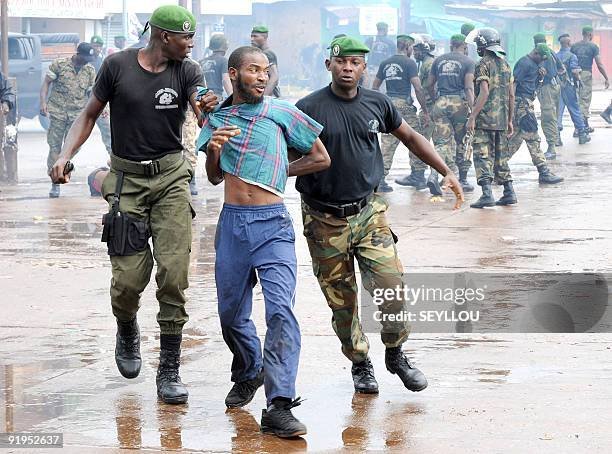
On 6th January 2025, security forces violently dispersed a protest to demand the end of the military regime and swift restoration of constitutional order, organised by the FVG coalition, comprising the country’s main opposition parties and civil society groups. According to FVG, security forces used live ammunition, killing at least three people, including two children, and injuring several others. The protest was held after the military junta failed to meet the transition deadline of 31st December 2024, which was agreed with ECOWAS, through the organisation of elections to transition to civilian rule. While junta authorities cited the absence of proper authorisation as the reason for banning the demonstrations, this action seem to align with the junta’s previously imposed blanket ban on protests until the election campaign begins, as reported previously by the CIVICUS Monitor.
Before the January protests, on 25th December 2024, the FVG had called for a series of peaceful demonstrations against the military junta as from 6th January 2025.
ASSOCIATION
Civil society activist abducted, tortured
On 19th February 2025, unidentified gunmen abducted prominent civil society leader Abdoul Sacko, coordinator of the Guinean Social Forces’ Forum (FFSG), a network calling for the return to a constitutional order, from his home in Conakry. The gunmen allegedly beat him and seized his mobile phone before taking him away in a pick-up truck without licence plates. Sacko’s lawyer said Abdoul Sacko was found the same day of his abduction in a “critical state, tortured and abandoned by his abductors in the bush”, 100km away from Conakry. Sacko’s abduction and torture sparked outrage and widespread condemnation, including by FFSG, opposition figures, and the Media Foundation for West Africa.
Guinea lifts suspension of NGO operating licences
On 10th January 2025, the Ministry of Territorial Administration issued a communiqué announcing the decision to resume issuing licences to associations and NGOs. The Guinean authorities had decreed the suspension of the issuance of licences on 2nd September 2024, ahead of an opposition demonstration coinciding with the third anniversary of the military junta’s rise to power. M’bany Sidibé, president of the Union for the Defence of Consumers of Guinea, expressed satisfaction at the resumption of licence issuances, reiterating that the initial suspension was unjustified and a serious measure against civil society organisations.
Guinea’s military junta suspends multiple political parties
On 14th March 2025, Guinea’s military authorities suspended two major political parties for three months: the Rally of the People of Guinea (RPG), associated with ousted former president Alpha Conde, and the Union of Republican Forces (UFR), led by exiled opposition leader Sidya. The military junta cited the parties’ failure to provide bank details or hold mandatory conferences as reasons for their suspension. Additionally, following the final report on the evaluation of political parties, 27 other parties were disbanded, 28 were suspended for three months, 24 were placed under scrutiny, and four were put under observation for alleged non-compliance with requirements such as providing a registered address or a party logo, or having leaders based overseas or deceased without replacement. Meanwhile, only 75 parties were deemed eligible to conduct regular political activities, while the Union of Democratic Forces of Guinea (UFDG), led by former prime minister and opposition leader Cellou Dalein Diallo, was given 45 days to organise a party conference or face similar sanctions.
In a related move, on 22nd August 2025, just a month before the constitutional referendum scheduled for 21st September 2025, Guinea’s military leader, General Mamadi Doumbouya, suspended three major political parties for three months. This included the RPG of ousted president Alpha Condé, the UFDG of former prime minister Cellou Dalein Diallo, and the Party of Renewal and Progress. The suspension was reportedly due to the parties’ failure to comply with the national political charter and the March 2025 evaluation report. On 29th August 2025, the African Commission on Human and People’s Rights issued an official statement urging the Guinean authorities to take all necessary actions to lift restrictions on civic space and uphold all rights guaranteed by the African Charter and other relevant instruments. This is not the first instance of political parties being suspended by the military junta; on 29th October 2024, Guinea’s military authorities had suspended 53 political parties, as previously reported by the CIVICUS Monitor.