This update covers developments relating to the freedoms of expression, association and assembly in Ecuador from 1st June to 15th August 2025.
Introduction
Country’s security agenda raises alarm over children’s rights
On 24th June, lawmakers approved the Public Integrity Law, signed the next day by President Noboa. While presented as an anti-corruption measure, the law also introduced amendments to the Child and Adolescent Code. For example, it amends Article 385 of the Child and Adolescent Code, raising the maximum prison term for children from eight to fifteen years when crimes are committed during a declared “internal armed conflict.”
Human Rights Watch warned that this law threatens the rights and protections of children, particularly those recruited or used by organised crime groups. The organisation also highlighted the risk that children from low-income, Indigenous and Afro-Ecuadorian communities, already disproportionately vulnerable to criminal recruitment, would bear the brunt of these measures.
The new measures come against the backdrop of worsening insecurity. Criminal group fragmentation has intensified competition over territory, producing record levels of violence. According to the Ecuadorian Observatory of Organised Crime, disputes between rival groups have driven extortion, killings and forced displacement. The impact has been most severe in the coastal provinces of Esmeraldas, Manabí, El Oro and Guayas.
Ecuador has also recorded unprecedented levels of forced displacement. In 2024, violence displaced 101,000 people nationwide, with 49,000 still displaced at year’s end, according to the Norwegian Refugee Council. Ecuador now ranks third in Latin America for internal displacement linked to conflict and violence, following Haiti and Colombia.
Meanwhile, in July 2025, relatives of disappeared persons in Ecuador testified before the Inter-American Commission on Human Rights (IACHR), marking the first time the state was obliged to listen to victims’ accounts in an international forum. Families described how young men, mostly under 30 and from marginalised coastal neighbourhoods, were detained by the military during operations and never seen again.
They recounted emblematic cases, including the December 2024 disappearance of four Afro-Ecuadorian children in Guayaquil’s Las Malvinas district. Sixteen air force personnel allegedly detained, tortured and later killed the youths, whose bodies were found weeks later near a military base. Relatives said the Armed Forces withheld operational logs and invoked “national security” to resist judicial orders for disclosure.
Civil society organisations, including the Alianza de Organizaciones por los Derechos Humanos and the Comité Permanente por la Defensa de los Derechos Humanos de Guayaquil, documented at least 33 cases of enforced disappearance in 2024 alone. The Attorney General’s Office confirmed 31 ongoing investigations since January 2024, all allegedly involving military personnel.
At the hearing, the state delegation outlined recent institutional measures: a specialised prosecutorial unit for investigating illegitimate use of force, coordination with police units on disappearances, and psychosocial assistance services for families. Military representatives reiterated a “zero-tolerance” policy towards rights abuses and highlighted ongoing human rights training.
However, gaps between policy and practice were evident. Civil society argued that families still face obstacles to information, judicial remedies and protection from reprisals. Amnesty International underscored that all cases analysed bore elements of enforced disappearance under international law and warned of ineffective investigations and delayed evidence collection.
The UN human rights office in South America echoed these concerns, stressing that military involvement in public security must remain exceptional, subsidiary and accountable to civilian oversight. It warned that provisions of the newly adopted National Solidarity Law risk undermining accountability.
The warnings align with concerns raised in February 2025 by the UN Committee on the Rights of the Child (CRC/C/ECU/CO/7), which urged Ecuador to address the “deteriorating climate of fear” facing children amid rising gang violence. The committee pointed to increasing child homicides, militarised security measures, and the declaration of the state of emergency and their disproportionate impact on Indigenous, Afro-Ecuadorian and Montubio children. It called for a national plan to prevent recruitment, early interventions in schools, and new programmes to help children exit gangs safely.
The Committee also urged reforms to the criminal code to make recruitment by gangs a distinct offence and pressed the government to ensure that policies such as the “Phoenix Plan” comply with international human rights standards. Beyond security, it called on the state to protect human rights defenders, prevent the use of excessive force in protests, and address systemic discrimination against Indigenous children.
Former vice-president sentenced to 13 years for embezzlement
On 30th June 2025, the National Court of Justice sentenced former vice-president Jorge Glas to 13 years in prison for embezzlement. Glas, a key figure in the administrations of Rafael Correa and Lenín Moreno, is already serving a sentence at La Roca maximum-security prison for his role in the Odebrecht scandal.
The court found Glas and Carlos Bernal, former head of the reconstruction committee, guilty of diverting resources earmarked for recovery from the April 2016 earthquake, which killed 663 people and injured more than 6,000. Judges ruled that funds collected under the Organic Law on Solidarity and Citizen Co-responsibility were channelled into projects that did not benefit affected communities, some linked to companies associated with Bernal’s relatives.
Association
Public vilification and intimidation of Constitutional Court judges undermine judicial independence and rule of law
In early August 2025, the Constitutional Court temporarily suspended 17 articles and a general provision from three urgent laws backed by President Daniel Noboa (see below), following more than 41 constitutional challenges. The Court explained that it adopted the suspension to prevent potential violations of fundamental rights while reviewing the constitutionality of the measures. Since then, President Noboa and senior government officials publicly vilified and intimidated the Court and its judges.
On 4th August, the same day the Court suspended provisions of the three laws, the government aired a national address featuring senior officials flanked by masked soldiers and police. Minister of Government Zaida Rovira accused the judges of undermining public security, declaring: “The Constitutional Court owes the country an explanation—an explanation with faces and with foundations.”
Niels Olsen, president of the National Assembly, defended the laws as urgent measures demanded by the public. “Citizens deserve to know: who will take responsibility for suspending them? Who will answer for leaving without effect legal tools that were already law?” Olsen added: “At this moment there are no middle grounds: either you stand with those defending our country, or with those who take away the tools to hand them to criminals — the enemies of the people.”
On 5th August, President Noboa proposed a referendum that would allow Constitutional Court judges to be subjected to political impeachment. Constitutional experts have stressed that such a mechanism would undermine judicial independence, as the Constitution currently shields judges from political trials, while ensuring civil, criminal and disciplinary accountability.
On 12th August, the country’s president personally led a march in Quito against the Court. Protesters carried banners labelling the judges as “corrupt” and “enemies of the people”, while giant billboards displayed their faces and names. One billboard along the route read: “These are the judges who are stealing our peace. They signed against laws that would protect us.”
In response, the Court condemned the government’s actions as stigmatising and a threat to the safety of its members. It warned that the events surrounding the march announced by the president created additional risks. On the afternoon of 11th August, the security fencing usually installed around the Court’s building was removed without prior notice. The area was then fully militarised, with an unusual deployment of hundreds of armed forces personnel. Only at 10:30 the following morning, after repeated requests, was the perimeter fence reinstalled by the Court’s security team.
Finally, on 15th August, the Comptroller’s Office opened a sweeping audit of the Court’s payroll and human resources, later demanding extensive personnel and selection records. On 19th August, the Energy Ministry ordered the Court to vacate its building within a month, citing administrative needs. The government rescinded the eviction order the following day.
President Noboa’s and top officials’ discourse frames the Court as siding with criminals, portraying judicial oversight as an impediment to urgent security measures. This narrative exploits public fear of escalating violence to delegitimise institutional counterweights.
UN Special Rapporteur on the independence of judges and lawyers Margaret Satterthwaite said labelling judges “enemies of the citizenry” posed a risk to judicial independence and could have a chilling effect. The Inter-American Commission on Human Rights also expressed concern and urged Ecuador to guarantee the independence of the Constitutional Court.
#Ecuador - Estoy profundamente preocupada por las declaraciones e iniciativas del Gobierno que parecen tener la intención de desacreditar, desde la más alta esfera del Poder Ejecutivo, la labor de la Corte Constitucional.
— Margaret Satterthwaite (@SRjudgeslawyers) August 15, 2025
Combinadas con la propuesta de un referéndum… pic.twitter.com/PCIyrkOQvF
New legislative package threatens civil society
President Daniel Noboa has pushed through a package of new laws that threaten fundamental freedoms. Since June 2025, the National Assembly has debated at least four major new laws expanding state security powers: the National Solidarity Law, the Organic Law of Intelligence, the Organic Law for the Strengthening of Protected Areas, and the Organic Law on Social Transparency. The Constitutional Court has provisionally suspended certain provisions of these laws pending its review of their constitutionality (see above).
The proposed measures link civil society organisations (CSOs) to illicit activities and establish mechanisms for dissolving associations, confiscating assets and interfering with financing. They also introduce new offences that could criminalise community self-defence groups, often understood as legitimate forms of territorial defence or anti-extractive resistance.
Except for the Organic Law of Intelligence, all were sent by the executive as “urgent economic projects”, forcing lawmakers to respond within 30 days or automatically enter into force as decree-laws (Article 62 of the Organic Law of the Legislative Function). Legal experts argued the process bypasses democratic debate and concentrates power in the executive.
On 7th June 2025, lawmakers passed the National Solidarity Law, initially presented as a measure to dismantle the criminal economy linked to internal armed conflict. The law was debated and approved within a month, entering into force the same month. As previously reported, it grants the president sweeping powers to declare and respond to an “internal armed conflict”, including the authority to order searches without judicial warrants, authorise detentions of up to 24 hours without prosecutorial oversight, and impose prison terms of up to 30 years for membership in organised armed groups. It also establishes financial and tax measures linked to security operations, creating a special legal regime applicable during armed conflict.
Article 9 classifies self-defence groups as “organised armed structures” without clarifying distinctions between criminal structures and legitimate community organisations: “An organised armed group shall be understood as any structured association of three or more persons, with an organised power structure, that engages in sustained violence against the State, the population, and civilian property.” Front Line Defenders warned that this ambiguity could expose Indigenous and campesino communities to prosecution when they exercise their constitutional right to defend territories from extractive activities or threats to collective rights.
The National Solidarity Law’s implementation depends on a presidential decree recognising an internal armed conflict (Article 6). However, since March 2024, the Constitutional Court has repeatedly ruled that the executive has failed to justify such a declaration. The Court found that the government’s arguments did not establish the criteria required under international law to confirm the existence of an armed conflict.
Nonetheless, on 16th July 2025, President Noboa issued Executive Decree No. 55 confirming the existence of an internal armed conflict, thereby activating the new law’s provisions. The decrees and legislation together reflect a strategy that blends anti-crime objectives with wartime frameworks.
Alongside this, on 11th June, the Organic Law of Intelligence entered into force following its publication in the Official Register. Approved by 77 members of the National Assembly, the law establishes a new national intelligence system, presented as a tool to address organised crime, corruption, cyber threats and other security challenges. It is composed of seven subsystems: military, police, financial, tax, customs, penitentiary and the presidential military guard. All are coordinated by an authority directly appointed by the president. The law empowers these bodies to operate without judicial oversight or parliamentary control.
Article 5 defines “threats” in terms that encompass political, social, economic, environmental and technological factors, allowing authorities wide discretion. Such vague language could allow authorities to treat critics as risks to “the integral security of the state.” Articles 51 and 52 order that telecommunications operators are obliged to provide information to identify and locate individuals at the request of the executive authority. The law also authorises interception, retention and examination of documents and communications “by any means” without a judicial order or prosecutorial authorisation.
On 14th July, President Noboa issued regulations to enforce the law (Decree No. 52), even as constitutional challenges are pending. The rules go further: Article 16 lists types of espionage but leaves the door open to “any other activity” while Article 17 allows key regulations to be made secretly, beyond public or legislative oversight.
Concerns intensified with the announcement that Erik Prince, founder of the private military company Blackwater, would advise Ecuador’s security forces. Prince has previously worked in Haiti and El Salvador, contexts marked by controversial counter-crime operations. According to legal experts, reliance on private contractors could externalise state violence and shield authorities from accountability for arbitrary detentions, illegal surveillance abuses and other human rights violations.
Over 50 CSOs affirmed that the law risks political abuse, repeating past practices in which intelligence agencies were used to monitor human rights defenders, political opponents and journalists. According to the Regional Foundation for Human Rights Advice (Fundación Regional de Asesoría de Derechos Humanos, Inredh), these provisions undermine transparency and may enable surveillance activities without legal safeguards.
#DefiendeTusderchos | Hoy te contamos qué dicen los artículos 5, 16 y 17 de la Ley de Inteligencia y Contrainteligencia en Ecuador:
— INREDH (@inredh1) August 26, 2025
⚠️ Art. 5 de la ley de Inteligencia → Usa definiciones vagas como “amenaza” o “seguridad integral del Estado”, que permiten señalar a cualquiera… pic.twitter.com/0AeRvinTLs
Environmental and Indigenous rights have also been reshaped by the new legislative package. On 10th July, the National Assembly approved the Organic Law for the Strengthening of Protected Areas. Its official goal is to stabilise funding for Ecuador’s system of protected areas, but CSOs argued it reinforces a top-down, militarised model of management.
At least eight environmental and Indigenous organisations, including the A’i Cofán Community of Sinangoe, the Siekopai Nation (NASIEPAI), the Siona Nation (ONISE), the Waorani Organisation of Pastaza (OWAP), the Kichwa Nation of Pastaza (PAKKIRU), and the Ceibo Alliance Foundation, criticised the lack of consultation with at least ten Indigenous nations whose ancestral lands overlap with reserves, in violation of both the constitution and international treaties such as ILO Convention 169 and the Escazú Agreement.
Another area of concern is the potential militarisation of Indigenous territories. Article 6 of the law authorises the security forces to enter ancestral lands unilaterally and without consent, which risks fuelling discrimination, criminalisation and human rights violations. The Constitutional Court has previously affirmed that military interventions in Indigenous territories require the consent of affected communities in line with Article 30.1 of the United Nations Declaration on the Rights of Indigenous Peoples.
Furthermore, Articles 4 and 7 of the law fail to comply with Article 57.4 of the Constitution that prohibits the sale, seizure or division of Indigenous lands, undermining both the right to maintain ancestral possession and the principle of non-regression. By empowering the state and private actors to impose development projects without safeguarding the right to self-determination, the law disregards the right of Indigenous peoples to decide their own economic, social and cultural priorities.
Siekopai leader Justino Piaguaje stated that the law “opens the door for corporate interests to commodify our sacred forests and rivers”, while Luis Canelos, President of the Kichwa People of Pastaza, argued that lawmakers had “betrayed not only the first peoples of this land, but the soul of the nation and the future of our planet.”
Just two weeks later, on 24th July 2025, President Daniel Noboa issued Executive Order 60, which eliminated the Ministry of Environment, Water, and Ecological Transition (MAATE) and transferred its functions to the Ministry of Energy and Mines. This restructuring dismantled the environmental oversight system and concentrated authority in the same ministry responsible for advancing oil and mining projects. The restructuring also saw the closure of the Ministry of Women and Human Rights and the dismissal of 5,000 public workers, part of what the government calls a 41 per cent reduction in ministries and secretariats.
CSOs denounced the measure as a profound weakening of environmental and human rights protections, arguing it places Indigenous peoples and constitutional rights of nature at greater risk. “Now, with the Ministry placed under the authority of extractive interests, we are deeply concerned that compliance with court-ordered land titling will become even more difficult”, said Justino Piaguaje, Siekopai leader.
These changes take place against the backdrop of an International Monetary Fund-backed fiscal and structural reform programme, which promotes investment in mining, hydrocarbons, and energy as priority growth sectors. Such policies could accelerate deforestation, biodiversity loss, and the forced displacement of Indigenous Peoples, while deepening social conflict and criminalisation of protest.
Ecuador approved the #ProtectedAreas Law, but it remains unconstitutional.
— AFrontlines (@AFrontlines) July 29, 2025
With Indigenous orgs across 🇪🇨, we will strike this law down in the courts & ensure that international orgs are aware of the massive scale of govt's violation of its commitments.
🔗https://t.co/VBru6LfkPr pic.twitter.com/VHXlnjdDFL
The fourth element of the package is the proposed Social Transparency Law. On 29th July, President Noboa submitted to the National Assembly the Organic Law for the Control of Irregular Capital Flows, now called the Social Transparency Law. It seeks to regulate and monitor the movement of money, assets and resources considered “irregular”, with special emphasis on CSOs, foundations, corporations, community organisations and other non-profit entities operating in Ecuador. The government argues that the law is necessary to prevent money laundering, organised crime, corruption and misuse of funds. Noboa defended the proposal, claiming it was designed to “combat foundations that seek to destabilise the country”, particularly those accused of supporting illegal mining.
The draft law grants the Superintendence of Popular and Solidarity Economy (SEPS) wide-ranging powers to audit, intervene and sanction CSOs. Obligations include publishing extensive financial and governance information, implementing costly internal and external audits, and creating integrity systems aligned with corporate criminal liability standards. These measures will impose financial and administrative burdens, particularly on smaller, rural and Indigenous organisations, leading to their closure.
The proposed law also requires all CSOs to register in the Unified Information System of Social Organisations (SUIOS), under the Ministry of Government. Civil society organisations fear this centralisation could enable selective enforcement against critical organisations, especially those receiving international funds or working in sensitive areas such as the Amazon.
On 14th August, UN Special Rapporteur on freedom of peaceful assembly and of association Gina Romero urged Ecuador to amend the text. She stressed that while transparency and accountability are legitimate goals, embedding them in a narrative of criminalisation undermines their legitimacy, diverts state resources away from high-risk actors and erodes trust between government and society.
She also underscored that while Ecuador’s private sector channels significant domestic and international capital flows, the draft law focuses almost exclusively on CSOs. This selective approach risks discriminating against associations by implicitly linking them to illicit activity without factual basis.
Informal associations, explicitly protected under Article 36 of the Organic Law on Citizen Participation, are particularly vulnerable. Labelling them as “operating in the shadows” ignores the legitimate reasons why many small or community-based groups remain unregistered, such as limited resources and administrative burdens. By portraying CSOs as threats, the draft law fosters mistrust and hostility towards independent civil society. It also stigmatises civil society under the guise of countering terrorism or money laundering.
1️⃣ #Ecuador | Envié una comunicación al Gobierno sobre el "proyecto de ley orgánica de transparencia social", que podría restringir indebidamente la libertad de asociación y otros derechos fundamentales.
— Gina Romero (@Ginitastar) August 19, 2025
Top officials target 440 CSOs with sweeping financial disclosure request
In recent weeks, civil society organisations and human rights defenders reported a growing campaign of stigmatisation and pressure as President Daniel Noboa’s government pushes ahead with sweeping security and economic reforms (see above).
On 4th August 2025, the Ministry of Environment, Water and Ecological Transition, recently merged with the Ministry of Energy and Mines under Decree 60 (see above), demanded detailed financial and administrative information from more than 440 organisations and environmental human rights defenders. The request gave recipients just 48 hours to comply, coinciding with nationwide demonstrations against the ministry merger.
The information required included annual activity reports, financial statements, tax declarations and details of the origin of funds for the years 2022–2024. CSOs said the scope of the demand and the short time frame amounted to harassment, raising fears that those opposing mining projects could face deregistration or sanctions.
The move followed remarks by senior officials on 29th July 2025, including a former minister, who alleged without evidence that some foundations supporting anti-mining movements were linked to illegal mining and irregular financial flows. “There are foundations that bring in foreign currency to finance anti-mining fronts, to finance irregular economies”. the official said, describing them as “fake foundations.” Other non-governmental groups, he added dismissively, were “watching animals” or “doing art and humanitarian work.”
The Minister of Environment, Water and Mines escalated tensions by dismissing even technical reports from municipal companies as “lies” when they raised concerns about large-scale mining projects. Authorities have not presented proof that CSOs are funnelling money into illicit activities.
Lawyer representing mining company accuses environmental defenders of links to organised crime
On 27th June 2025, lawyer Felipe Rodríguez Moreno, legal representative of Curimining S.A., published a message on the social media platform X accusing the collective Juntos por el Agua in Espíndola canton of being “strategic allies of organised crime and operators of illegal mining.” Members of the collective, part of the National Anti-Mining Front (Frente Nacional Antiminero, FNA), rejected these accusations, describing them as unfounded and stigmatising. The collective noted that the allegations, later amplified by the television channel Teleamazonas, form part of a broader attempt to criminalise legitimate environmental and territorial defence.
Juntos por el Agua defends water sources originating in the Yacuri National Park and the ecosystems that make up the Podocarpus–Yacuri–Tabaconas Namballe ecological corridor. The collective opposes the expansion of extractive activities in southern Ecuador. The statement issued by the collective places the accusations within a wider context of militarisation and a legislative package that expands state security powers.
The collective has demanded a public rectification from the lawyer and called on the Ombudsman’s Office to fulfil its mandate to protect human rights defenders.
📢 COMUNICADO
— Frente Nacional Antiminero (@FNAntiminero) July 3, 2025
El Colectivo Juntos por el Agua del cantón Espíndola, provincia de Loja, denuncia las injurias de Felipe Rodríguez, abogado de la empresa CURIMINING, que busca criminalizar al Frente Nacional Antiminero.
"Frente al despojo minero, resistencia y dignidad". 🍃✊ pic.twitter.com/FQUxeI4Iad
Judge dismisses protection action in case of HRD detained during protest in Quito
On 22nd July 2025, a judge dismissed an application for constitutional protection (acción de protección) brought against the National Police of Ecuador in relation to the alleged arbitrary detention of two human rights defenders, Miguel P. and Jafet G., during a demonstration in Quito in November 2024. The court ruled that the appropriate procedural remedy would have been an application for habeas corpus rather than an acción de protección.
The applicants, represented by Inredh, sought redress not only for the detention but also for alleged cruel, inhuman and degrading treatment suffered during six hours in police custody, together with violations of the right to data protection and the inviolability of private correspondence, following the unlawful search and extraction of data from their mobile telephones by state agents.
Despite the defenders’ clear identification as human rights observers, the judge declined to examine these claims on their merits. The defence team immediately lodged an appeal, recalling Ecuador’s obligations under both constitutional and international law to ensure access to effective remedies, reparation, and guarantees of non-repetition in cases concerning human rights defenders in the context of social protest.
New labour regulation raises concerns of state interference in trade unions
On 25th July 2025, the Ministry of Labour issued Ministerial Agreement MDT-2025-082, titled Regulation on Labour Organisations Governing the Exercise of the Right to Freedom of Association and Trade Union Autonomy. The Ministry stated that the regulation aimed to promote “internal democracy” and “transparency.” The measure establishes rules on the registration, statutes, elections and procedures of trade unions.
The Ecuadorian Confederation of Free Trade Union Organisations (CEOSL) rejected the agreement, warning that it grants administrative authorities powers to intervene in internal union matters such as drafting statutes, conducting elections, managing membership rolls and administering resources. CEOSL argued that the measure contravenes the Constitution of Ecuador and ILO Conventions 87 and 98, which guarantee freedom of association and collective bargaining rights.
The International Trade Union Confederation (ITUC) has long flagged Ecuador as hostile terrain for organised labour. Since 2023, it has ranked among the 10 worst countries in the world for workers. According to ITUC, only about 1 per cent of Ecuadorian workers enjoy access to collective bargaining. Legal thresholds for union formation are so high that organising is effectively impossible in more than 90 per cent of companies. Workers who attempt to unionise often face intimidation, dismissals or even death threats.
A court rejects habeas data petition against human rights organisation
On 26th June 2025, a judge denied a habeas data action filed by lawyer Esteban Polo on behalf of several residents of Las Naves canton, Bolívar province. The court ruled that the video at the centre of the case contained no personal data relating to Polo’s clients. He filed an appeal immediately after the hearing.
As previously reported, the petition sought to compel the Ecumenical Human Rights Commission (CEDHU) to remove from its social media a video published in February 2024. The video denounced irregularities in the environmental consultation process carried out in December 2023 by the Ministry of Environment, Water and Ecological Transition (MAATE) concerning the Curipamba–El Domo mining project.
Peaceful Assembly
Excessive force and criminalisation of EHRDs in Las Naves
On 24th June 2025, more than 500 members of the National Police and Armed Forces entered the community of La Unión in Las Naves canton to disperse residents who had been peacefully protesting the Curipamba–El Domo mining project, operated by Curimining S.A., a subsidiary of the Canadian company Silvercorp Metals. Witnesses reported that security forces used force to enable the entry of company machinery into the area. During the operation, at least two community members sustained injuries: a woman who was shot in the shoulder and a 20-year-old man who suffered a severe head injury requiring 20 stitches.
On 4th July 2025, the Office of the UN High Commissioner for Human Rights in South America met with the Ecumenical Human Rights Commission (CEDHU) and representatives of affected communities from Las Naves canton. Community members expressed concern about contamination and access to water, as well as the use of force during protests. They also reported threats, intimidation and an attack against the life of a community leader. OHCHR reiterated concern about the situation, emphasising the need to respect and facilitate the right to peaceful protest and to guarantee access to water in line with international human rights standards.
As previously reported, residents of Las Naves have maintained peaceful assemblies opposing the open-pit mining project, which they maintain threatens their territory, health, agricultural and livestock activities, as well as water sources that form the headwaters of the Guayas River basin. This basin supplies nearly 40 per cent of the country’s population. The project is advancing in the context of a controversial licensing process for what could become Ecuador’s third large-scale open-pit mine. Civil society organisations alleged that interests linked to the Noboa family, which holds shares in the project, have influenced government actions and that state forces acted in effect as private security for the company.
Front Line Defenders has documented a pattern of criminalisation of environmental human rights defenders opposing the project. Since 2021, authorities have opened more than 50 criminal proceedings against defenders for alleged offences such as illicit association, trespassing, resistance, injury and kidnapping, all linked to their participation in assemblies and protests. Fifteen proceedings remain open, involving 29 defenders from Bolívar and Los Ríos provinces, while 13 defenders have received prison sentences of up to four years without solid evidence. One elderly person was imprisoned for 70 days in late 2024.
Testimonies indicate that mining companies and their allies, including lawyers and judicial officials, have played an active role in initiating these cases. Reports suggest that some police records were drafted by the Attorney General’s Office, raising concerns of a coordinated criminalisation strategy aimed at deterring mobilisation and delegitimising defenders.
🔴 PRONUNCIAMIENTO
— Frente Nacional Antiminero (@FNAntiminero) June 24, 2025
Frente a la grave represión policial contra las familias del cantón Las Naves, que llevan más de un mes en resistencia contra la empresa minera canadiense @CURIMINING_SA. Responsabilizamos al Gobierno de @DanielNoboaOk por la integridad de las personas heridas. pic.twitter.com/THjhh5Ty4y
Mass march in Quito expresses solidarity with Palestine
On 15th June 2025, thousands of people gathered in Quito for a march in solidarity with Palestine. The demonstration began at the Cruz del Papa in La Carolina Park and proceeded through central avenues, including Naciones Unidas, Shyris and Amazonas. Protesters carried Palestinian flags, banners and placards while chanting slogans condemning Israel’s genocide.
During the march, some protesters staged a symbolic performance: women dressed in black with their faces covered by kufiyas represented the death of more than 20,000 children in Gaza. Protesters also briefly stopped at a fast-food chain to denounce its alleged financial support for Israel’s military operations. On Naciones Unidas Avenue, protesters occupied both the street and a pedestrian bridge, calling for justice and international intervention.
⭕️ #ATENCIÓN | A esta hora, las calles de #Quito se llenan de memoria, lucha y espiritualidad.
— Radio Pichincha (@radio_pichincha) June 15, 2025
En el marco de la movilización por Palestina, el Colectivo Yama realiza un rito ceremonial en honor a los niños y niñas as3sin4dos en #Gaza.
Desde la espiritualidad ancestral del… pic.twitter.com/mHW2Vv6FAl
Teachers in Guayaquil protest insecurity
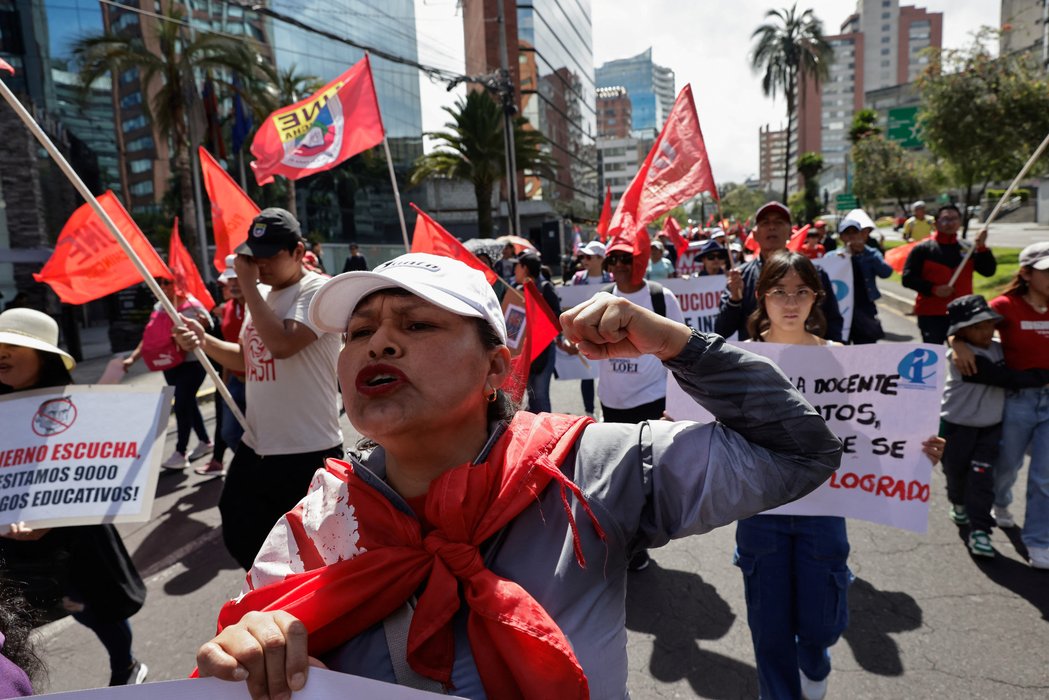
On 18th June 2025, members of the National Union of Educators (Unión Nacional de Educadores, UNE) in Guayas held a protest in San Francisco Square, Guayaquil, demanding that the government declare a state of emergency in the education sector due to rising insecurity. According to UNE, several educators have resigned to protect their own safety and that of their families. During the demonstration, protesters carried banners denouncing the climate of fear in schools and demanding protection for teachers and students.
Gabriela Menéndez, president of UNE–Guayas, stated that at least 200 teachers have reported extortion, with many filing complaints before the Prosecutor’s Office. She criticised the Ministry of Education’s response, noting that instead of addressing the situation, the Minister publicly dismissed the union’s concerns as exaggerated.
Community of San Jacinto demands justice for protester killed during 2022 national strike
On 27th June 2025, dozens of members of the San Jacinto community gathered at El Arbolito Park in Quito to demand justice for Byron Guatatoca, killed during the national strike of 2022. “We demand justice for Byron Guatatoca”, declared community representative Mónica Cuji during the demonstration.
As previously reported, the national strike of June 2022, led by CONAIE and other social movements, was marked by widespread demonstrations against economic and social policies. Human rights organisations documented excessive use of force by security forces during the mobilisations, resulting in deaths, injuries and allegations of arbitrary detention.
#ATENCIÓN
— Ecuador En Directo (@EcEnDirecto) June 27, 2025
Integrantes de la comunidad San Jacinto, junto con la Fundación @inredh1, se concentraron en el parque El Arbolito, en Quito, para demandar justicia por los hechos ocurridos durante el paro nacional de 2022. “Exigimos justicia para Byron Guatatoca”, declaró Mónica… pic.twitter.com/NkRJ01j9aq
Pride Off march takes place in Quito
On 28th June 2025, the Pride Off march took place outside the Northern Government Platform in Quito. The event began at 12:30 p.m. and proceeded along Amazonas Avenue. Participants of diverse genders, orientations and expressions joined the march to reaffirm their commitment to equality, visibility and respect.
The Pride march forms part of annual Pride events in Ecuador, where LGBTQI+ groups and allies mobilise to demand recognition, protection and full enjoyment of rights.
Kichwa communities mobilise demanding justice for oil spill
On 30th June 2025, more than 120 people mobilised in El Coca to demand justice five years after a major oil spill devastated Kichwa territories. Protesters gathered outside the court to denounce delays in judicial proceedings and to call attention to the ongoing impacts on their land, water and livelihoods. They demanded justice for the April 2020 oil spill in the Coca and Napo rivers.
This mobilisation responded directly to the reactivation of the landmark case, following a Constitutional Court ruling in November 2024 that annulled earlier dismissals and ordered a new judicial process with genuine intercultural dialogue. Judge Clemente Paz initially scheduled the hearing for 30th June 2025 in El Coca. However, despite repeated requests by the Federation of United Communes of the Kichwa Nationality of the Ecuadorian Amazon (FCUNAE) to hold the meeting in affected Indigenous territory, the court postponed the dialogue to 25th July and denied the request without justification.
Kichwa leaders stressed that conducting the dialogue in their communities is essential, as the plaintiffs continue to endure daily impacts of contamination.
📍Big Oil’s impunity won’t silence us. We rise in solidarity with the #Kichwa
— AFrontlines (@AFrontlines) June 30, 2025
120+ people mobilized in El Coca, #Ecuador, demanding justice 5 years after a massive oil spill devastated their land & lives. The court delayed dialogue, so we brought the truth to their doorstep📣 pic.twitter.com/3bf1vTv065
March called by President Noboa targets the Constitutional Court
On 12th August 2025, President Daniel Noboa led a march in Quito to protest the Constitutional Court’s suspension of several provisions from three urgent laws (see association). Giant billboards along the route displayed the faces of the nine justices, with captions blaming them for “stealing peace.” The march moved from Avenida Patria (Puente del Guambra) to Avenida 6 de Diciembre.
By late morning, crowds in football shirts and carrying tricolour flags gathered near El Ejido park and moved towards the court’s headquarters. Interior Minister John Reimberg urged protesters to tell judges not to “take away the tools” to fight criminal groups. President Noboa arrived just before noon, greeting supporters from within a heavy security cordon. Senior officials and lawmakers, including the president of the National Assembly, joined him.
The Metropolitan Transit Agency reported significant closures, and at least 733 buses brought supporters from other provinces. The Presidency’s spokesperson denied government funding for the billboards.
As the march advanced, the Constitutional Court stated that the billboards stigmatised the justices, increased risks to their security, and threatened judicial independence (see association).
March in support of Constitutional Court and against government restructuring
On 7th August 2025, more than 30 civil society organisations marched peacefully in Quito from the Caja del Seguro to the Constitutional Court to support the court’s decision to temporarily suspend provisions of the government’s legislative package. Protesters carried banners rejecting dismissals of public-sector workers and the closure of ministries and secretariats.
On 14th August, hundreds of people, including trade unions, students, dismissed public workers and cultural sector employees, marched through Quito demanding respect for the Constitutional Court and rejecting the government’s restructuring under Decree 60. The decree reduced ministries from 20 to 14 and secretariats from nine to three, eliminating around 5,000 jobs. Protesters also denounced rising unemployment and mass layoffs at Petroecuador, which union representatives warned had disrupted oil operations in the Amazon.
The protests took place amid wider concerns over President Daniel Noboa’s legislative agenda and restructuring measures (see above).
Expression
Violence against journalists
Attacks and threats against journalists in Ecuador are reaching alarming levels. In the first half of 2025 alone, press freedom organisation Fundación Periodistas Sin Cadenas recorded 129 attacks against journalists, including death threats, intimidation, armed attacks, and even killings.
The cases reflect a pattern: journalists covering corruption, protests, or community struggles are being targeted by officials, state security, and organised crime. From Quinindé to Guayaquil to Quito, reporters have been assaulted, threatened, or forced into exile. Some of the cases are summarised below:
On 30th May 2025, a municipal official assaulted journalist Jefferson Ana of Megavisión and his cameraman while they covered a citizen protest in the Guachal neighbourhood of Quinindé, Esmeraldas province. Residents had called the press to denounce the mayor’s failure to restore local roads. During the protest, neighbours burned tyres and blocked the street with sticks.
Ana explained that after completing interviews and preparing to leave, a municipal vehicle approached at high speed in an intimidating manner. The head of municipal machinery exited the car, insulted the journalists and questioned their presence. Despite Ana’s explanation that the community had invited them, the municipal officer continued to confront them. He pushed Ana, threatened the cameraman, and when Ana attempted to leave on a motorcycle, he kicked him, causing him to fall and drop his belongings. Several workers in the area witnessed the incident.
On 2nd June, he publicly denounced the assault during a live broadcast of Megavisión’s news programme, where colleagues expressed solidarity and stressed that the aggression had been intended to provoke a violent reaction from the journalist.
A similar incident occurred on 26th July, when it was reported that Raúl Caicedo, allegedly the driver of the local mayor, physically assaulted and threatened Ana. Ana explained that Caicedo intercepted him, accused him of publishing defamatory content about his personal life, and demanded that he delete an alleged online post by 6 p.m. or face consequences. Ana denied publishing any such content, clarifying that he had never referred to Caicedo or his family in his reporting. According to Ana, Caicedo grabbed him by the shirt and helmet strap, shouted insults, restrained him, and then punched him in the face.
Following this, Ana sought medical attention for swelling on his right cheek and pain in his eye, head and neck. He publicly denounced the assault, expressing concern for his safety and that of his family.
On 13th June 2025, a municipal councillor assaulted journalist Juan Barreno of the digital outlet Transparencia Riobamba while he covered a football match between Club Deportivo Olmedo and Liga de Macas at the Riobamba Stadium. Barreno explained that the councillor initially approached him, shook his hand and warned: “Keep talking like that and you’ll see what happens.”
The journalist clarified that he had never reported on him but had covered the “Altares” corruption case involving the Riobamba mayor. Minutes later, the municipal councillor returned twice more, insulting Barreno and, on the third occasion, attempting to headbutt him and pushing him against a wall. Colleagues and bystanders intervened to separate the councillor, but he continued verbally attacking Barreno.
On 19th June 2025, three motorcyclists intimidated journalist Maithe Morán and cameraman Cristian Manchón from RTS evening news while they prepared a live broadcast at a petrol station on Carlos Julio Arosemena Avenue, north of Guayaquil. The men surrounded them, revved their engines and circled as Morán prepared to go on air. “I don’t think their intention was to rob us, but to intimidate us for being journalists,” Morán said. Despite the situation, she completed the live broadcast, which video footage captured. Morán reported that she had already experienced intimidation. Two days earlier, in the El Papagayo neighbourhood, an unlicensed vehicle approached her team in a threatening manner after coverage, forcing them to retreat quickly.
On 2nd July 2025, unknown individuals issued death threats against community journalist Evelyn Calderón, her husband and her children, after she covered an alleged attempt by the Parish Decentralised Autonomous Government (GAD) of San Antonio de Pichincha to transfer communal land in Rumicucho to a private company. Neighbours, who claim to hold documentation supporting community ownership, invited Calderón to report on the incident and told her they had also faced threats for opposing the project.
During the coverage, Calderón encountered the GAD president, who acted in a hostile manner and attempted to prevent her from filming. Calderón managed to record video evidence of the dispute. Hours later, she received a WhatsApp call via a relative of her husband, allegedly linked to those involved in the construction. The caller warned her: “Do not publish anything. If you love your children, if you want your family to be well, do not release that report. Everything is already arranged, do not get into trouble.”
Calderón has previously faced retaliation for her reporting. As documented, police officers visited her home in Quito hours after she published an investigative report alleging possible influence peddling by the president of the Parish GAD of San Antonio de Pichincha.
On 12th July 2025, a car without licence plates stopped outside the home of journalist Marco Cadena, director of the digital outlet La Naranja in Imbabura province. One of the occupants pointed a gun at his mother. Fearing for his life and the safety of his family, Cadena decided to resign from his position at the outlet.
This incident marked the culmination of escalating threats linked to his investigative reporting. The aggression intensified after Cadena covered alleged corruption in the Municipal Water Company and possible connections between public-sector employees and organised crime groups.
He explained that the threats began with damage to his car, which he initially considered an isolated incident. During the electoral period, he received text messages with death threats, photographs of his home and movements, and images of his car’s licence plate. Aggressors also targeted one of his colleagues
On 25th July 2025, armed attackers targeted Marcelo Ruiz, a correspondent for TC Televisión in Manabí province, while he drove along the Portoviejo–Santa Ana road. Another vehicle intercepted him near the El Guabito neighbourhood, and the assailants fired several shots, injuring him in both arms. Medical personnel transferred Ruiz to the Portoviejo Specialty Hospital, where doctors removed the bullets during surgery. TC Televisión confirmed that Ruiz remained in stable condition after the operation.
La Policía Nacional está tras la pista de los responsables del atentado contra el periodista Marcelo Ruiz, corresponsal de TC Televisión, en Manabí.
— TC Televisión (@tctelevision) July 28, 2025
Más noticias en: https://t.co/vd5iYTBjuq pic.twitter.com/H5x7Lvf1K7
On 12th August 2025, at least four journalists sustained injuries when protesters, presidential bodyguards and National Police officers assaulted them during a march called by President Daniel Noboa against the Constitutional Court.
Daniel Romero, journalist for Diario Expreso, reported that police officers prevented him from covering the march. As he recorded from the steps of the Court, one officer pushed him away when President Noboa arrived to speak from the back of a pickup truck. Despite Romero identifying himself as press, another officer shoved him forcefully into the crowd of protesters.
Journalists Angelly Tinoco and Sinchi Gómez from Wambra Radio reported that bodyguards and protesters attacked them on Avenida 6 de Diciembre as they tried to document Noboa’s arrival. Tinoco stated that bodyguards pushed her repeatedly, while a woman inside the security cordon shoved her to the ground, leaving her knees bleeding. Gómez said that guards and protesters pulled her by the arm and vest and pushed her violently, even though both wore press credentials and protective vests.
Video
— Wambra Medio Comunitarioᅠ (@wambraEc) August 12, 2025
Nuestras compañeras periodistas acaban de ser agredidas en la marcha del presidente Daniel Noboa contra la Corte Constitucional.
Hombres vestidos de civil las empujaron de forma violeta. A gritos y empujones buscaron que las periodistas se retiren para abrir el paso del… pic.twitter.com/1cHItQ8Lzp
Photoreporter Diego Lucero from GK said that protesters kicked him while he documented a confrontation between government supporters and a small group of opposition protesters. He noted that police officers stood by without intervening. In the same incident, AFP journalist Paola López reported that protesters threw water on her.
Arahí Vega from La Hora confirmed on her X account that protesters and state security forces blocked her work. She shared video footage showing police pushing journalists and protesters, forming a cordon to keep reporters away.
Journalist targeted with defamation and secrecy charges
In June 2025, Fundamedios reported that David Granja Ramos, director of Radio Ideal in Napo province, faces two simultaneous legal proceedings after publishing information on a property dispute involving the Agricultural Centre of Tena.
On 21st February 2025, Granja reported that members of the Agricultural Centre continued to demand judicial restitution of their building, which they alleged was under irregular control by lawyer Olegario Valarezo. The report also noted that the case involved investigations into alleged influence peddling and procedural fraud.
Shortly afterwards, two cases were opened against the journalist. The first, a criminal complaint for defamation, was filed on 24th February by Gilber Garzón Dalgo, who claims to be the Centre’s president. The second, opened ex officio by the Attorney General’s office, accuses Granja of disseminating restricted information after publishing a prosecutorial document already read publicly at a guild assembly.
Granja described the dual proceedings as a form of judicial harassment and warned that they may be reprisals for Radio Ideal’s editorial line, which includes strong environmental coverage and oversight of land and resources in the Amazon.
Media outlets face content removals after reporting on local authorities
In July 2025, Fundamedios reported a wave of coordinated digital attacks against three local outlets in Morona Santiago province, La Mañana MS, Exprésate Morona Santiago and Radio Sentimientos. The attacks led to the removal of dozens of videos and publications from their platforms. The affected media outlets stated that the eliminations were triggered by false copyright claims used to suppress critical reporting on municipal and provincial authorities, particularly the Prefecture of Morona Santiago.
On 28th June 2025, La Mañana MS reported the deletion of 18 videos from its Facebook page, most of them documenting citizen complaints about unfinished public works, deteriorated infrastructure and alleged municipal negligence in Macas.
Two days later, Exprésate Morona Santiago experienced a similar attack. Shortly after publishing an interview with a local producer who alleged unpaid debts by the Prefecture, Facebook removed the video under a copyright claim. At least 10 additional videos were subsequently deleted, and the outlet’s WhatsApp channel was also targeted, with files removed at random.
On 1st July 2025, Radio Sentimientos in Gualaquiza saw its live interview with a musician critical of the Prefect deleted for alleged copyright violations. Days later, three unrelated interviews, including with a police officer and a community leader, were also taken down. All removals were attributed to the same user profile, “Ámbar Armijos”, which the outlets suspect is linked to the same actor responsible for previous attacks on other local media.
Cartoonist denounces cancellation of political satire exhibition
Caricaturist Vilma Vargas, widely known as Vilmatraca, denounced the cancellation of her exhibition El jardín de las malicias at the Casa de la Cultura Ecuatoriana (CCE), Núcleo del Azuay. The show, scheduled to open on 4th July 2025 at the Efraín Jara Idrovo Hall, featured satirical works critical of political power.
The cancellation was communicated without formal justification, despite the exhibition having been promoted by the CCE itself. Vargas described the decision as an act of censorship, recalling that her 2016 exhibition “Huarmicaricaturas por la libertad” was also censored under the administration of then-president Rafael Correa.
CCE director Martín Sánchez Paredes accepted responsibility for the cancellation and apologised to both the artist and the public. He cited “political, social, technical, security and institutional transition factors” as reasons, while distancing the decision from the institution’s internal electoral process. He expressed regret and suggested that a future administration could resume the exhibition “to guarantee freedom of expression as a fundamental cultural principle.”
Court acquits journalist in defamation case linked to electoral reporting
On 23rd July 2025, the Judicial Criminal Unit of Loja acquitted journalist Boris Sarango, director of the digital outlet Primer Reporte, of charges brought by former National Assembly candidate Ángel Geovanny Loayza Guamán. Loayza accused Sarango of causing “discredit” after the publication of a news article that referenced his judicial record. Judge Diego Ochoa Aldeán ruled that Sarango’s reporting contained no falsehood or bad faith.
The case stemmed from a 3rd February 2025 article titled “8 candidates from Loja have faced criminal proceedings”, published during the electoral campaign. The piece drew on public judicial information and highlighted candidates with prior cases, including Loayza, whose proceedings appeared in the Council of the Judiciary’s system. Although the cases had been archived at the preliminary stage, Loayza described the article as “malicious and reckless” and filed a criminal complaint. He sought USD 50,000 in damages and psychological treatment for the journalist, invoking a fourth-class offence under the Comprehensive Organic Criminal Code, which carries a penalty of 15 to 30 days in prison.
Sarango’s defence team demonstrated that the information relied on official records and did not constitute defamation. The judge accepted these arguments and granted full acquittal. Loayza announced plans to appeal the ruling.
The contested article formed part of a collaborative investigative project led by Fundamedios and Fundación Periodistas Sin Cadenas, which reviewed judicial records of 2,089 Assembly candidates. More than 40 media outlets across Ecuador reproduced the findings, and Primer Reporte published the data with a local focus.
Other developments
Landmark law recognising and protecting domestic work
On 1st August 2025, the National Assembly approved a landmark reform of its Labour Code that for the first time formally recognises and protects domestic work. The new law guarantees social security for household workers, bans child labour in private homes, and creates mechanisms to report rights violations.
Women’s groups and unions welcomed the reform as a victory for a sector long excluded from basic protections. Most domestic workers in Ecuador are women from poor and Indigenous communities who have faced decades of exploitation and informality.
💪🏽📜 ¡Avance histórico!
— CIDDT (@CentroTrabajoEc) August 5, 2025
Se aprobó la reforma al Código del Trabajo para dignificar el trabajo del hogar.
Desde @CIDDT_Ec acompañamos este proceso junto a @Untha_Ecuador y @ceosl1.
¡Seguimos hasta que la dignidad sea costumbre! ✊🏽 pic.twitter.com/DBO32w8Rtz