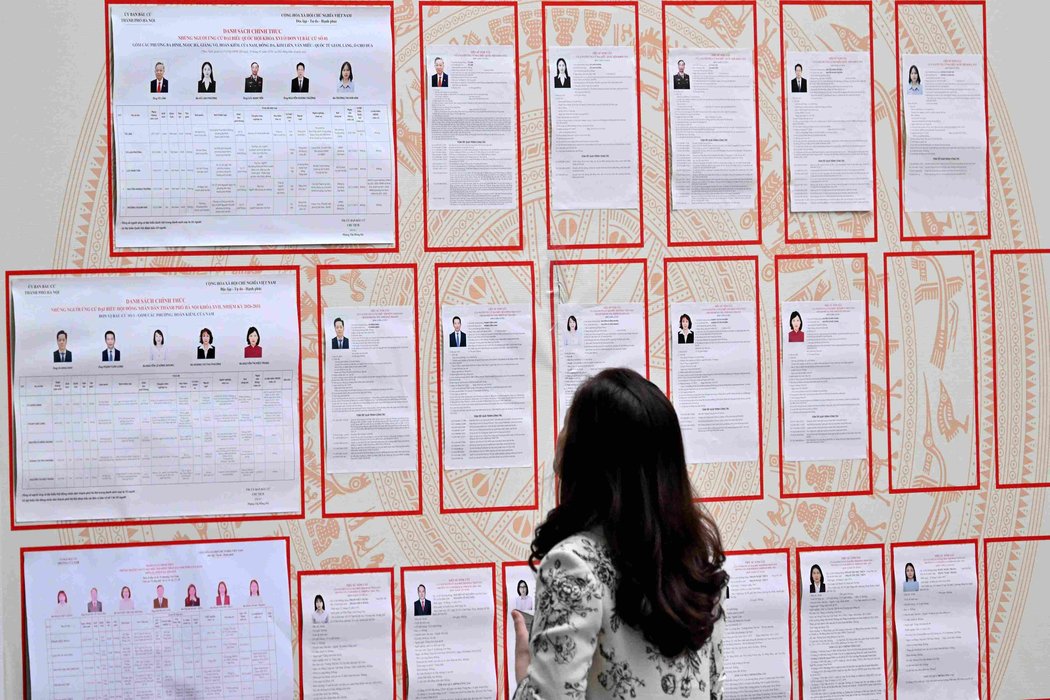
The state of civic space in Vietnam is rated as ‘closed’. Among ongoing concerns documented are systematic attempts to silence human rights defenders, journalists and bloggers, including their jailing under national security laws, restrictions on their freedom of movement, and torture and ill-treatment in detention. There are also strict controls on the media, online censorship and controls on social media as well as ongoing restrictions on peaceful protests.
In February 2026, Human Rights Watch reported that the authorities cracked down harshly on dissidents and perceived critics of the government as the Communist Party leadership consolidated its power in 2025. The authorities targeted for arrest and prosecution those raising issues on social media such as religious freedom, land rights, Indigenous rights, and corruption. Through 2025, Vietnam held more than 160 political prisoners and detained at least 40 others for criticising the government. Courts sentenced at least 32 people to prison under Criminal Code Article 331.
The ruling Communist Party secured near-total control of the National Assembly following the 2026 nationwide elections, on 14th March 2026, underscoring the continued absence of political competition in the country’s electoral system. Nearly 93 percent of the 864 parliamentary candidates are Communist Party members and the vast majority of the 500 seats in the National Assembly were won by members of the party. Vietnam does not permit opposition political parties, and all candidates for elections must undergo a multi-stage vetting process overseen by the Communist Party and affiliated organisations.
In recent months, activists have been arrested under vague laws, convicted and sentenced even in absentia, including lawyers, land rights activists and religious freedom activists. A human rights group was designated as a terrorist organisation while an ethnic Montagnard activist was coerced into confessing online after being extradited from Thailand. Journalists, bloggers and social media activists have been criminalised or assaulted for posting critical comments online. A new draft policy raises concerns around surveillance.
Association
According to Human Rights Watch (HRW), the government escalated arrests of perceived dissidents in the weeks before Vietnam’s 14th Communist Party Congress held in January 2026.
Activists sentenced in absentia
Vietnam’s Ministry of Public Security has charged two Germany-based political dissidents, Le Trung Khoa and Nguyen Van Dai (left), with disseminating anti-state propaganda. Temporary arrest warrants have also been issued for both men. I don’t think it’s easy to arrest them though pic.twitter.com/NYI62Dcgyg
— Nga Pham (@ngahpham) November 18, 2025
On 31st December 2025, a court in Hanoi convicted and sentenced in absentia the prominent human rights lawyer Nguyen Van Dai under Article 117 of the Penal Code to 17 years in prison for criticising Vietnam’s Communist Party leaders on social media. A former political prisoner who suffered government retaliation for more than two decades, including two prison terms, he was allowed to leave Vietnam for Germany in June 2018 while serving a 15-year prison sentence. He has been living in exile ever since.
On the same day, another court in Hanoi convicted and sentenced in absentia the Berlin-based journalist Le Trung Khoa, 54, to 17 years in prison under Article 117 of the Penal Code. Le Trung Khoa is the founder and editor-in-chief of Thoibao.de, an online Vietnamese language news outlet that publishes political news and commentary about Vietnam’s leaders.
Land rights activists detained while house searched
On 11th January 2026, police in Nghe An Province searched the home of activist Ho Thi Hai, 45, in Quỳnh Mai Ward and temporarily detained her. She faces charges under Article 331 of the Criminal Code for “abusing democratic freedoms”. According to a public statement, authorities seized “numerous documents and objects related to the alleged violation.” Provincial police claim that Hai “fully admitted to her criminal actions” during questioning and announced that they will “continue to investigate and expand the case.”
Hai has been a regular figure in protests and advocacy activities regarding the widening of National Highway 1A, which runs through her community. Local residents have been fighting for fair compensation for years after the highway project requisitioned their land.
Khmer Krom monk and activists sentenced
HRF calls for the unconditional release of Khmer Krom activists Thach Nga and Thach Xuan Dong and Buddhist monk Venerable Kim Som Rinh and demands an end to the judicial harassment of Khmer Krom advocates.https://t.co/hKgWj11cuf
— Human Rights Foundation (HRF) (@HRF) April 11, 2025
On 18th November 2025, authorities in Vietnam sentenced an ethnic Khmer Krom monk and two activists to three and a half years in prison on charges of ‘abusing democratic freedoms’ under Article 331 of the Vietnamese Criminal Code.
According to CSW, Venerable Kim Som Rinh, Thach Nga and Thach Xuan Dong were arrested, charged and taken into custody in Tra Vinh Province in southern Vietnam on 27th March 2025.
Venerable Kim Som Rinh is a respected leader known for advocating for religious and cultural rights. He was defrocked by the state-sanctioned Vietnam Buddhist Sangha in March 2024 in a move seen as an attempt to stifle dissent. The three men have been held incommunicado without access to family or legal representation.
These cases are part of a broader pattern of repression against the Khmer Krom, an indigenous community that primarily resides in Vietnam’s Mekong Delta, who face systemic discrimination, cultural suppression, and restrictions on the freedoms of expression, assembly, and religion or belief.
An August 2025 report from a group of UN experts confirmed that at least 17 Khmer Krom monks, activists, and defenders have been arbitrarily detained, subjected to unfair trials, and, in some cases, tortured during pre-trial detention, as part of an escalating crackdown on the community.
Pastor convicted for spreading anti-state propaganda
Civil society and activist sources report that Pastor Nguyen Manh Hung, a 71-year-old Protestant minister, was sentenced on 30th October 2025 by the Lam Dong Provincial People’s Court to six years in prison and five years of probation for “making and disseminating anti-state materials” under Article 117 of the Penal Code.
As previously documented, in January 2025, police in Ho Chi Minh City arrested pastor Nguyen Manh Hung after he was accused of spreading anti-state propaganda in a Facebook post. In the post he claimed that Vietnam’s Communist Party once referred to those who bought land as ‘cruel landlords,’ while these days, ‘those who abuse power to acquire land are called ‘outstanding’’.
Human rights group designated as a terrorist organisation
The Vietnamese government has declared the Vietnamese-American human rights organisation Boat People SOS (BPSOS) as a terrorist organisation.
According to CSW, in a press release dated 14th February 2026 and issued on state-controlled media, BPSOS and its senior leadership were derided for ‘assisting organisations and individuals participating in anti-Vietnam activities.’ The article went on to explicitly name BPSOS as a terrorist organisation and describe its president, chief operating officer and chief financial officer as terrorists. The article published the home address of BPSOS president Dr Nguyen Dinh Thang.
The authorities justified this by citing legal advice and support BPSOS has provided to one of the co-founders of Montagnards Stand for Justice, Y Quynh Bdap (see case below).
BPSOS is a Vietnamese-American human rights organisation that was founded in the 1980s to assist refugees fleeing Vietnam. BPSOS provides assistance to victims of human rights violations in Vietnam, trains civil society on their protections under international law, protects Vietnamese asylum seekers in neighbouring countries, and supports victims of human trafficking around the globe.
Coerced TV confession of Montagnard activist following transnational repression
UN experts concerned over the extradition of Vietnamese Montagnard human rights defender & refugee Y Quynh Bdăp from Thailand to Viet Nam, warning that his return exposes him to serious risks of torture, ill-treatment & other grave human rights violations.https://t.co/9ECjDCRmNy pic.twitter.com/U7WKhUyj8N
— UN Special Procedures (@UN_SPExperts) December 4, 2025
In December 2025, Vietnamese state media VTV broadcast a forced confession from Vietnamese human rights defender Y Quynh Bdap, co-founder of Montagnards Stand for Justice (MSFJ), in which he was coerced to falsely claim MSFJ's involvement in terrorist attacks.
On 28th November 2025, the Thai authorities extradited him to Vietnam, following a court decision issued two days earlier. Y Quynh Bdap is a United Nations (UN)-recognised refugee, who had lived in Thailand since 2018, following protracted acts of harassment he suffered in Vietnam in relation to his peaceful and legitimate human rights activities.
Bdap was arrested in Thailand on 11th June 2024, after being sentenced in absentia by a Vietnamese court to 10 years in prison over terrorism charges for his alleged involvement in the 2023 attacks on two police stations in Vietnam’s Dak Lak Province - charges that he categorically denied.
UN experts had expressed deep concern over the extradition, warning that his return exposes him to a serious risk of torture or other ill-treatment, enforced disappearance, arbitrary detention and other grave human rights violations.
Expression
Conviction of three individuals for posting video and articles
#Vietnam 🇻🇳 “Do Van Nga’s detention is yet another example of Vietnam’s relentless campaign to silence independent journalism and commentary,” said Shawn Crispin, @pressfreedom's senior Southeast Asia representative. https://t.co/sIXDXjoYMT pic.twitter.com/sBaF5AZ5PO
— IFEX (@IFEX) December 3, 2025
Three individuals linked to the Berlin-based journalist Le Trung Khoa were arrested in November and December 2025. They include journalist Do Van Nga, a political blogger, Huynh Bao Duc, and Pham Quang Thien, the former director of the Centre for Technology and Multimedia Communications of the Government Portal.
The Vietnamese authorities accused Le Trung Khoa of posting videos and articles “that distorted and slandered the people’s government…and caused confusion.” The police alleged that Do Van Nga wrote nine of the articles and Pham Quang Thien one of them. They accused Huynh Bao Duc of helping edit and insert images into four videos. For these so-called “crimes,” the court sentenced Do Van Nga to seven years in prison, Huynh Bao Duc to six-and-a-half, and Pham Quang Thien to five-and-a-half years.
Blogger arrested for critical online comments
Hanoi police arrested blogger Hoang Thi Hong Thai on 7th January 2026 for comments she made on social media critical of the government, which garnered thousands of views. Since the mid-2010s, Hoang, a 45-year-old blogger and businesswoman, has published hundreds of comments on social media focusing on sociopolitical issues and expressing sympathy for rights activists who have suffered repression. As of January 2026, her Meta account had 120,000 followers.
In late April 2025, the police prohibited her from leaving Vietnam, summoned her and interrogated her about her writing, and threatened to arrest her. In June, she published an online post criticising articles 117 and 331 of Vietnam’s penal code for violating the right to freedom of speech enshrined in Vietnam’s constitution, and urged the National Assembly to amend or abolish these laws. The day before her arrest, Hoang Thi Hong Thai had written about the suffering that she and her children experienced during the 11 years since she began posting on social media.
Journalist Le Anh Hung arrested on ‘propaganda’ charge
#Vietnam 🇻🇳 “Le Anh Hung never should have been imprisoned the first time, and detaining and charging him again is a gross affront to press freedom,” said Shawn Crispin, @pressfreedom's senior Southeast Asia representative.https://t.co/gdXYIt6jgY pic.twitter.com/kGygMxztzq
— IFEX (@IFEX) March 23, 2026
On 9th March 2026, police arrested journalist Le Anh Hung at a friend’s house in central Dak Lak province.
According to the Committee to Protect Journalists, the journalist has been charged under Article 117 of the penal code, which criminalises “propagandising against the state” and carries penalties of up to 20 years in prison.
Hung contributes to various independent outlets, including Thien Dan, and posts to his own blog. He also writes books, including the self-published “Power and the Control of Power in Societies.”
Hung, a former contributor to the U.S. Congress-funded Voice of America (VOA), was arrested in 2018 and held alternately in prison and in a psychiatric hospital until his 2022 conviction under Article 331, which criminalises the abuse of “democratic freedoms to infringe upon the interests of the State.” He was released in July 2023, after serving a five-year sentence under abusive conditions.
Hung is a member of the Independent Journalists Association of Vietnam, a local group that works outside the state-dominated media. Several of its members, including founder Pham Chi Dung, have been convicted and sentenced to harsh jail terms.
Independent journalist detained and assaulted
#Vietnam: CPJ calls on Vietnamese authorities to investigate the alleged assault and arbitrary detention of independent journalist Nguyen Hoang Vi, who was held for more than 10 hours by Ho Chi Minh City police without being informed of a reason.https://t.co/B5WVU0Gnwy…
— CPJ Asia (@CPJAsia) March 23, 2026
On 19th March 2026, independent journalist Nguyen Hoang Vi was intercepted on the street by police while taking her child to school and transported to a Ho Chi Minh City police station, where she was held for more than 10 hours without being informed of the reason for her detention.
According to the Committee to Protect Journalists, Vi was struck repeatedly on the head with a sandal by a police officer she identified as Nguyen Ba Duong, who made her sign a “stack” of printouts of journalism she had posted to her Facebook page. She was released without charge.
The harassment came shortly after Vi posted sceptical comments on social media about voting and voter registration cards ahead of recently held elections. As a former frequent contributor to independent Vietnamese media who now publishes on her social media channels, Vi has previously been targeted for her reporting.
Woman arrested for posting videos accusing judge of misconduct
According to The Vietnamese, In February 2026, a 52-year-old woman in An Giang Province, Nguyen Thi Cam Chi, was arrested and held pending investigation on charges of “abusing democratic freedoms to infringe upon the interests of the state” after publishing videos online alleging that a judge handled a land dispute case improperly.
Investigators also conducted a search of her residence and seized documents and digital devices related to the case. Authorities allege Chi, acting as a court-authorised representative in a civil land dispute that already had a legally binding judgment, used her Facebook and TikTok accounts to post multiple videos and materials that insulted and damaged the reputations of the presiding judge at the People’s Court of Area 9 in An Giang Province and several other individuals and organisations.
The move underscores the ongoing use of Article 331 of the Criminal Code to prosecute individuals for social media activity the government deems harmful to public order and state interests. This provision has been used repeatedly in recent years to prosecute bloggers, lawyers, journalists, and activists for online commentary, with human rights groups documenting hundreds of convictions under Article 331 since 2018.
Facebooker arrested in Thanh Hoa province for abusing democratic freedoms
A resident of Thanh Hoa province was arrested and charged under Article 331 of the Penal Code for allegedly abusing democratic freedoms after using social media to criticise local authorities and officials.
On 14th January 2026, police announced they had initiated criminal proceedings and ordered the temporary detention of 58-year-old Le Minh Vu. The authorities allege that between 2023 and 2025, Vu repeatedly used his personal Facebook account and a related fan page to post content critical of the Communist Party, state institutions, and local leaders.
According to police statements his posts were said to contain insults, accusations, and unverified claims that allegedly harmed the reputation of officials and negatively affected political security, public order, and social stability.
Following his arrest, police searched Vu’s residence and confiscated documents and electronic materials believed to be connected to the alleged offences. Authorities are still investigating the case and have not publicly disclosed the specific posts or evidence supporting the charges.
New draft policy raises concerns around surveillance
A new draft policy by the Ministry of Public Security has raised concerns over digital surveillance powers.
According to The Vietnamese, Public Security Minister said in February 2026 that the country will “focus on building a cybersecurity firewall.”
The remark comes as lawmakers finalise a sweeping overhaul of the country’s legal framework on cybersecurity. In December 2025, the 15th National Assembly passed a new Cybersecurity Law, set to take effect on 1st July 2026. Drafted by the Ministry of Public Security (MPS), the law consolidates and replaces the 2018 Cybersecurity Law and the 2015 Law on Information Security.
The 2025 statute introduces new elements to the system of online governance, including language that for the first time references the development of a national firewall system.
Further details emerged roughly two months later when the ministry released for public comment a draft titled “National Technical Standard on Cybersecurity—Firewall—Basic Technical Requirements.” The draft outlines a system described as a mandatory infrastructure for monitoring and filtering Internet activity.
According to the proposal, firewall devices that meet national standards would have features to filter internet traffic and perform deep packet inspection (DPI), which means they can closely examine the data being sent over networks.
The system would also integrate user identity data into individualised control policies and include web-filtering mechanisms based on blacklists of at least 100,000 domain names. Blacklists are defined as collections of IP addresses, domains, and URLs subject to restriction under information security policies, aimed at blocking content or activity deemed “undesirable.”
In addition, network devices would be required to log detailed information about every user session, including time stamps, source and destination addresses, protocols, and system responses. User activity would then be evaluated and assigned a “risk level,” triggering automated controls or alerts to cybersecurity authorities when thresholds are exceeded.
Taken together, the legislative and regulatory measures signal a significant expansion of centralised state oversight of Vietnam’s digital infrastructure.