Thailand’s civic space is rated as ‘repressed’ by the CIVICUS Monitor. Scores of individuals including activists have been charged or convicted for royal defamation (lèse-majesté) and given harsh sentences for their speeches and social posts critical of the monarchy. Some were denied bail. Censorship was also documented, and protesters have also been targeted with arrest and prosecution.
On 1st July 2025 Thailand's Constitutional Court suspended Prime Minister Paetongtarn Shinawatra, who came under mounting pressure to resign over her leaked phone conversation with former Cambodian leader Hun Sen. The clip, in which Paetongtarn criticised a Thai military commander, sparked public anger and a petition for her dismissal, which the court is now considering.
In July 2025, civil society organisations raised concerns about the escalating armed conflict along the Cambodia–Thailand border that has led to the tragic loss of life, displacement of civilians, and growing insecurity in affected communities.
In recent months, human rights defenders and activists continue to be arrested and prosecuted for royal defamation and other baseless charges. Among them include woman human rights defender Pimsiri “Mook” Petchnamrob and Arnon Nampa, a pro-democracy activist sentenced to a total of 29 years’ jail. An academic was arrested for insulting the Thai monarchy while the courts decided that the blocking and removal of weblinks were legal. Amnesty bills from civil society and a progressive political party were rejected.
The authorities also charged or convicted protesters linked to the 2022 anti-APEC protests, protests on land and indigenous issues, a 2023 protest outside a police station, and around a 2020 parliament protest. There has been ongoing judicial harassment of human rights defender Anchana Heemmina and Muslim activists in the Deep South. A new report highlights risk faced by human rights defenders in the country.
Expression
Women human rights defender on trial
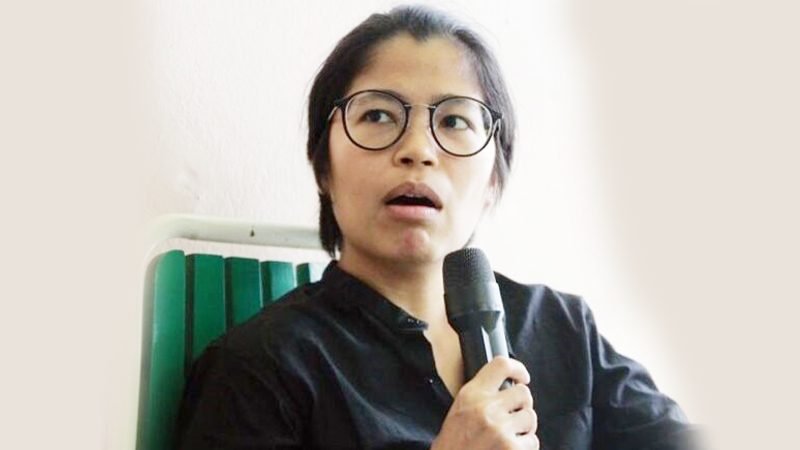
Woman human rights defender Pimsiri “Mook” Petchnamrob is facing trial on criminal charges related to her legitimate exercise of freedom of expression and peaceful assembly. In June 2025, court hearings against Pimsiri were held before the Ratchadapisek Criminal Court.
As previously documented, in November 2021, Pimsiri was charged and indicted on a total of ten charges after delivering a speech during a peaceful protest in November 2020 near the 11th Military Regiment Headquarters in Bangkok. The charges include Sections 112 (lèse-majesté), 116 (sedition), 215 (illegal assembly) and 216 (failure to disperse illegal assembly) of the Criminal Code. She was also charged with violation of the Emergency Decree and the Public Assembly Act.
On the same day of the indictment, she was released on bail subject to two bail conditions: not to engage in activities that damage the monarchy institution and not to leave the country without the court’s approval.
Her requests to travel abroad to participate in the UN Human Rights Council (UNHRC) in Switzerland have been consistently denied.
On 11th July 2025, UN experts expressed grave concern over the ongoing judicial proceedings against Pimsiri and called on the government to drop charges against her and other human rights defenders who participated in pro-democracy protests. They added that “lèse-majesté laws, with their vague formulation and severe penalties, have no place in a democracy. Their widespread and punitive use to silence dissent, suppress public debate, and intimidate human rights defenders, political opponents, civil society activists, journalists, and ordinary citizens violates Thailand’s international human rights obligations.”
The UN Committee on the Elimination of Discrimination against Women (CEDAW), in its recent concluding observations published in July 2025, was "deeply concerned" about the situation of women human rights defenders. It recommended the authorities create "an enabling environment" for women human rights defenders to exercise their rights to freedom of expression, peaceful assembly, and association, both offline and online.
Pro-democracy activist sentenced to a total of 29 years’ jail
#Thailand: 5 years ago, activist @arnonnampa was arrested for participating in a protest. He now faces 29 years in prison on multiple charges, primarily for royal defamation. We call on Thai authorities to release him & drop all charges. https://t.co/glc4wD3z4w
— CIVICUS (@CIVICUSalliance) August 7, 2025
#StandAsMyWitness pic.twitter.com/lsxvR8XaIT
Arnon Nampa, a prominent pro-democracy activist and human rights lawyer who has been arbitrarily imprisoned since September 2023, was sentenced four times between March and July 2025. He has now faced ten convictions and has been sentenced to a total of 29 years’ jail for his activism.
Arnon Nampa is one of the founders of Thai Lawyers for Human Rights (TLHR), a leading human rights organisation. He has also represented individuals facing judicial harassment for criticising the authorities or being involved in protests. He was at the forefront of a protest movement that erupted in 2020 when hundreds of thousands of people, many of them young students, took to the streets to call for democratic changes, including the role of the monarchy.
On 27th March 2025 he received an additional two-year sentence for lèse-majesté (royal defamation) in connection with a speech delivered in Chiang Mai, a northern province in Thailand, in November 2020.
On 28th May 2025 the Bangkok Criminal Court found Arnon guilty of violating the lèse-majesté law and sentenced him to two years’ imprisonment. Arnon was also found guilty of violating the Loudspeaker Act, which prohibits the use of loudspeakers in public without prior permission from local authorities.
On 25th June 2025 he was sentenced to two years and eight months in prison for royal defamation in connection with a speech he gave at a protest in December 2020.
Arnon was sentenced to another two years and four months’ jail on 8th July 2025 for royal defamation and sedition in connection with a speech he gave at a protest in Bangkok in November 2020.
Activists and critics arrested and prosecuted for royal defamation
The government has continued to use royal defamation (lèse-majesté) provisions or Article 112 to arrest and convict activists, critics and politicians for insulting the monarchy. Courts routinely deny bail to individuals charged or impose strict conditions in cases where bail is granted. According to Thai Lawyers for Human Rights, since July 2020 at least 281 individuals have been charged for royal defamation.
On 25th March 2025, three activists - Wanwalee Thammasattaya, Benja Apan and Kiattichai Tangpornpun were found guilty of royal defamation and given suspended sentences over speeches given at a protest at the Pathumwan Skywalk in June 2021, after a judge ruled that defaming deceased kings also constituted an offence under the royal defamation law. They were charged with violating the Sound Amplifier Act and the Emergency Decree issued in response to the COVID-19 pandemic in Thailand.
A 27-year-old pro-democracy activist has been sentenced to two years in prison for royal defamation over a Facebook post made in 2022.
— Prachatai English (@prachatai_en) April 28, 2025
Link in reply. pic.twitter.com/VoILWsL36w
A 27-year-old pro-democracy activist - Pimchanok Jirataiyanon - was sentenced to two years in prison in April 2025 for royal defamation over a Facebook post made in 2022. The post in question said: “The government is shit, the institution is shit”, which a complainant interpreted as intended to refer to the royal institution without mentioning it explicitly.
On 14th May 2025, the Supreme Court sentenced a 28-year-old man from Sa Kaeo province to one year and six months in prison for a royal defamation charge filed against him for commenting on a picture of King Vajiralongkorn posted in the monarchy reformist Facebook group Royalist Marketplace.
A 26-year-old graffiti artist was sentenced to 3 years in prison on 1st July 2025 for posting on Facebook a picture of himself pointing a shoe at an image of King Vajiralongkorn and Queen Suthida. He was charged for royal defamation and under the Computer Crimes Act after a complaint was filed against him by Anon Klinkaew, leader of the ultra-royalist group People’s Centre to Protect the Monarchy, who has filed several royal defamation complaints against activists and netizens and has been involved in attacks on pro-democracy activists and citizen journalists.
On 6th July, the Appeal Court sentenced a pro-democracy activist to prison for royal defamation over a speech delivered during a protest at the King Taksin the Great Monument on 6th December 2020. She was later released on bail.
The Appeal Court has sentenced a pro-democracy activist to prison for royal defamation over a speech delivered during a protest at the King Taksin the Great Monument on 6 December 2020. She was later released on bail.
— Prachatai English (@prachatai_en) July 6, 2025
Link in reply. pic.twitter.com/4DJpHW49Xj
On 31st July 2025, the Court of Appeal sentenced an activist and two protesters to prison on royal defamation charges over a photo of them holding signs at a protest. Activist Wanwalee Thammasattaya was charged with royal defamation and violation of the Computer Crimes Act along with two protesters over a photo she posted of the trio holding signs at a protest on 21st November 2020, which took place in Bangkok’s Siam Square shopping district. All three were sentenced to four years in prison, reduced to two years and eight months because they gave useful testimony.
Pro-democracy activist Nawat Liangwattana has been indicted on another count of royal defamation filed against him over a speech he gave at a protest on 14 November 2023, said Thai Lawyers for Human Rights (TLHR).
— Prachatai English (@prachatai_en) August 5, 2025
Link in reply. pic.twitter.com/8zOsX4A9EH
Pro-democracy activist Nawat Liangwattana was indicted on 5th August 2025 on another count of royal defamation filed against him over a speech he gave at a protest on 14th November 2023. The protest was organised by the student activist group United Front of Thammasat and Demonstration (UFTD) after the Move Forward Party, which won the most seats in the 2023 general election, failed to form a government.
Academic arrested for insulting Thai monarchy
In April 2025, prominent American academic Paul Chambers was arrested on charges of insulting the monarchy.
Chambers is a lecturer at Naresuan University in central Thailand who writes analyses on the kingdom’s military and politics. A warrant for his arrest was issued after a complaint was filed by a regional army command.
He was accused of publishing a blurb on a website in connection with an ISEAS webinar by Singapore’s Institute of Southeast Asian Studies in October 2024 about military reshuffles. He denied all charges and said he neither wrote nor published the blurb on the website. The army based its complaint on a Facebook post by a Thai royalist, who translated the webinar notice into Thai.
Chambers was released after multiple bail requests over two days were denied. He posted 300,000 baht ($8,800) for his release and was barred from leaving the country. Thai authorities also revoked his work visa.
On 2nd May 2025, Thai prosecutors said they will not pursue charges against Chambers.
Court upholds decision to block and remove web links
In April 2025, the Court of Appeal upheld a lower court’s order from 2022 to block and remove 52 URLs, including the website www.no112.org which was used to collect signatures for a petition to repeal Section 112 by the group “The People for abolition of Section 112” under Section 20 of the Computer Crime Act. The website became inaccessible after the Ministry of Digital Economy and Society stated it had been blocked due to alleged violations of the Computer Crimes Act.
The Court ruled that, in the absence of specific procedural guidance under the Act, the lower court had lawfully applied provisions from both the criminal and civil procedure codes. It found that the content, which advocates for the repeal of Section 112 of the Criminal Code, violated public order and morality by undermining the monarchy, which is protected under Section 6 of the 2017 Constitution. The Court concluded that such expression is unconstitutional and could incite social division, thereby justifying the blocking order consistent with the Act’s purpose.
Peaceful Assembly
The authorities have also continued to restrict and prosecute protesters for the exercise of their right to peaceful assembly.
Convictions for 2022 anti-APEC protests
The Thai government’s use of force against demonstrators tarnished its hosting of the APEC summit & spotlighted its intolerance of dissenting voices. Foreign delegates got to see firsthand the violent repression of largely peaceful protests in #Thailand.
— Elaine Pearson (@PearsonElaine) November 23, 2022
https://t.co/c5hHKYY7rd pic.twitter.com/74KadtyC7o
In March 2025, the Dusit District Court convicted four political activists - Passarawalee Thanakitwibulphon, Payu Bunsopon, Phanupong Srithanuwat, and Kornchanok Saenprasert - along with one monk, for their participation in the “People Stop APEC 2022” rally on 18th November 2022, protesting the APEC Summit held in Bangkok from 16th to 19th November 2022. Each individual was fined THB 2,500 (about USD 75) without custodial sentences.
The five individuals were indicted in May 2024 for: gathering together in groups of 10 or more people; using violence, threatening to use violence, or doing anything to cause chaos in the country (Criminal Code Section 215); not stopping the gathering as ordered by the official (Criminal Code Section 216); and jointly violating or failing to comply with the conditions or orders of the public assembly officer, including not correcting the situation within the time period announced by the public assembly officer (Public Assembly Act 2015).
Individuals charged for protest on land and indigenous issues
The Metropolitan Police Bureau has extended the 50-meter no-protest zone around Government House until April 6.
— Thai Enquirer (@ThaiEnquirer) April 1, 2025
This extension comes as the police aim to manage protests from the People’s Movement for a Just Society (P-Move), which is calling for changes to conservation laws and… pic.twitter.com/w4PZJUY6NY
On 29th April 2025, seven protesters were charged under the Public Assembly Act for participating in a 1st April 2025 protest in front of the Government House in Bangkok. The protest was organised by the People’s Movement for a Just Society, indigenous groups and farmers. They were calling on the government to addressing land rights in national forests, to advance the community land title policy, expedite nationality verification for stateless Indigenous Peoples, and support a draft Amnesty Act for those affected by government land and forestry policies.
Four individuals from the Yan Phan automotive workers’ group were also charged with organising a protest on the same day near the Government House, also allegedly violating a 50-metre restriction order.
Nine protesters convicted and sentenced for 2023 protest outside police station
The 9 activists arrested on Monday night during a protest at Samranrat Police Station to demand the release of detained 15-year-old activist Thanalop Phalanchai has been granted bail. #ม็อบ10พฤษภา66 #saveหยก
— Prachatai English (@prachatai_en) May 12, 2023
(Photo by Ginger Cat) pic.twitter.com/M3TBv36tjn
Nine pro-democracy activists were sentenced to two years and ten months in prison in April 2025 for trespassing and other charges resulting from a 2023 protest they staged in front of the Samranrat Police Station to demand the release of a 15-year-old activist.
The protest began after police filed additional charges against Thanalop, who is now detained at the Ban Pranee Juvenile Vocational Training Centre for Girls in Nakhon Pathom pending trial on a royal defamation charge.
During the protest, activists threw red paint and coloured smoke flares at the police station and a spirit shrine in front of the building.
Protests around visit of Myanmar junta leader
A first-year student from Thammasat University was detained after protesting against Myanmar junta leader Min Aung Hlaing’s presence at the 6th BIMSTEC Summit in Bangkok.
— Thai Enquirer (@ThaiEnquirer) April 4, 2025
He was part of a group that staged a protest in front of the Shangri-La Hotel, where the summit was held. He… pic.twitter.com/JrwmGy60WL
In April 2025, protest restrictions were heightened during the visit of Myanmar junta leader Min Aung Hlaing to Bangkok for the 6th Bay of Bengal Initiative for Multi-Sectoral Technical and Economic Cooperation (BIMSTEC) Summit. On 4th April 2025, a first-year student from Thammasat University was detained after protesting against the Myanmar junta leader’s presence at the summit in Bangkok. He was part of a group that staged a protest in front of the Shangri-La Hotel, where the summit was held. He was detained by security guards and later handed over to the police.
On 5th April 2025, Weera Sangthong, a leader of a Myanmar migrant worker network Bright Future, was attacked by members of an ultra-royalist group while arriving at a protest against Myanmar’s junta leader in front of the UN headquarters in Bangkok. Songchai Niamhom, leader of an ultra-royalist group, tried to grab Weera before other ultra-royalist protesters attacked him. Police officers then intervened and took Weera away. It was unclear where he has been taken or if he was being detained or charged.
Three activists indicted for 2020 protest at parliament
3 activists have been indicted on charges of sedition and royal defamation, among other charges, over a protest in front of parliament on 24 September 2020.
— Prachatai English (@prachatai_en) July 18, 2025
Link in reply. pic.twitter.com/edRZBJ36wV
On 17th July 2025, three activists were indicted on charges of sedition and royal defamation, among other charges, over a protest in front of parliament on 24th September 2020. Thai Lawyers for Human Rights (TLHR) reported that Jutatip Sirikhan, Patsaravalee Tanakitvibulpon, and Chanin Wongsri were indicted on charges of sedition, royal defamation, participating in an assembly of more than 10 persons and causing a breach of the peace, violation of the Emergency Decree, and violation of the Communicable Diseases Act.
All three activists were granted bail on security of 180,000 baht (USD 5,567) each and on condition that they must not obstruct or damage their trial.
Association
Judicial harassment of human rights defender Anchana Heemmina
📍 #THAILAND
— Front Line Defenders (@FrontLineHRD) July 22, 2025
Front Line Defenders together with FORUM-ASIA strongly condemn the Thai Government’s intensified judicial harassment against WHRD Anchana Heemmina– solely for expressing political opinion.
We urge Thai authorities to drop all charges against WHRD Heemmina, and call… pic.twitter.com/5tx2Xbnj4b
The government has intensified its judicial harassment of women human rights defender Anchana Heemmina.
Heemmina advocates for peacebuilding and gender justice in Thailand’s Deep South. According to The Asian Forum for Human Rights and Development (FORUM-ASIA) and Front Line Defenders, in May 2024, Heemmina wrote a Facebook post about a mosque demanding 20,000 baht (USD 616) from a military camp that had sourced water from its property but failed to pay the water bill. Heemmina initially misidentified the location but later corrected it to Sai Buri District in Pattani Province. In her post, she was asking to whom she should complain.
The military unit allegedly involved in the dispute subsequently issued a public statement explaining the reason for the delayed payment, and Heemmina thanked them for the clarification.
However, the Thai Navy in Ba Cho District then filed a defamation complaint against Heemmina under Section 328 of the Thai Criminal Code, arguing that her post had caused reputational harm to military units stationed in the area.
On 21st January 2025, the police forwarded her case to the Narathiwat Provincial Prosecutor. Since then, Heemmina has been required to report to the prosecutor on a monthly basis. On 17th June, Heemmina was notified of an additional charge under the 2007 Computer Crime Act for misinformation.
On 17th June 2025, additional charges were filed against Heemmina under Section 14(1) of the 2007 Computer Act for allegedly importing false or distorted data into a computer system. The charges stem from the Facebook post Heemmina made in May 2024.
FORUM-ASIA and Front Line Defenders called on the Thai authorities to stop weaponising laws to suppress freedom of expression and urged the government to cease all forms of judicial harassment against human rights defenders like Heemmina.
Muslim activists on trial for cultural activities in the Deep South
Nine Muslim activists are facing trial. They have been charged under Sections 116 (sedition), 209 (secret society), and 210 (conspiracy) of the Criminal Code, as well as the Emergency Decree, for their role in organising the Melayu Raya cultural gathering on 4th May 2022.
As previously documented, the activities in question, which the police have charged them for, involve public assembly for cultural activities and wearing traditional Malay attire. Human rights groups and NGOs in the southern border region cited the case in a 2024 open letter to the United Nations where they alleged that Thai police and security services have been harassing civil society groups for holding public meetings.
The Deep South, a predominantly Muslim Malay and heavily militarised region along the Thai-Malaysia border, is home to a decades-old separatist insurgency. Barisan Nasional Revolusi (BRN), the largest and most powerful of the insurgent groups and factions in the region, has been taking part in Malaysia-brokered peace talks with the Thai government in recent years but there have been no breakthroughs.
Parliament rejects two amnesty bill proposals
In July 2025, the House of Representatives rejected two amnesty bills proposed by the People’s Party and Network for People’s Amnesty – a coalition of 20 civil society organisations - but passed three other bills from two coalition parties and the opposition Bhumjaithai Party. The bills were designed to grant amnesty for offences tied to political activities. Common to all three bills were exclusions for those charged or convicted under the draconian lèse-majesté law, Section 112 of the Criminal Code.
Following the vote, the House established a special committee to vet and merge the three accepted bills into one draft. This draft will then be sent back to the House for the second and third readings.
Ahead of the vote, Amnesty International said: “In this pivotal vote, Thai lawmakers must ensure the new law allows for the full dismissal of all criminal charges against peaceful protesters – without exempting the lèse-majesté law.”
The Network for People’s Amnesty issued a statement following the vote demanding that an amnesty bill must cover everyone and must not discriminate based on political opinion.
Report highlights risk faced by human rights defenders
On 20th March 2025, Protection International launched its report, "Resistance is Power: Strengthening Protection Mechanisms for Women Human Rights Defenders and Human Rights Defenders in Thailand". The report underscored the growing risks faced by women and community-based defenders, particularly threats and SLAPP cases, following the change in government in 2023.
The report revealed that between the 2014 coup and February 2025, Thailand recorded 595 SLAPP cases - the highest in ASEAN - with at least two new cases each month, mostly targeting women and human rights defenders, including under laws such as the Computer Crime Act and the Immigration Act. 29 new SLAPP cases have been filed against 39 WHRDs and HRDs. Amid increasing corporate rights abuses, defenders face heightened judicial harassment and systemic barriers to protection,
The Justice Fund under the Ministry of Justice, designed to support defenders, remains largely inaccessible due to bureaucratic obstacles and arbitrary denials, reinforcing impunity and legal exclusion.
WHRDs resisting mining projects, mega-development schemes, and corporate exploitation face increasing threats, as businesses weaponise the law to suppress environmental and labour rights activism.
Uyghurs deported to China despite human rights concerns
On 27th February 2025, Thailand deported at least 40 Uyghurs to China’s Xinjiang region despite strong objections from activists and human rights groups, who warned that the deportees were at risk of torture, ill-treatment and “irreparable harm” if returned.
Thailand’s Defence Minister Phumtham Wechayachai confirmed the deportation, telling the Reuters news agency that China gave assurance that the Uyghurs sent back to Xinjiang would be looked after.
For years, rights groups have been accusing China of widespread abuses, including mass detention of Uyghurs, a mainly Muslim ethnic minority that numbers about 10 million in the western region of Xinjiang. Beijing rejects those claims.
UN rights experts had pleaded with the Thai government not to deport 48 Uyghurs, warning that they were at risk of persecution. The 48 were part of a group of 300 who fled China and were arrested in 2014. Some were sent back to China and others to Turkiye, with the rest kept in Thailand. At least two died in custody.