Introduction
Basic Law amended to strengthen Constitutional Court’s independence
On 19th December, the Bundestag approved by an overwhelming majority an amendment to the Basic Law aimed at reinforcing and protecting the Constitutional Court’s independence. In particular, the amendment changes the process for electing judges: previously, each house of parliament appointed eight judges, but now one house may intervene if a blocking minority prevents appointments in the other. The move was driven by concerns that extremist parties such as the AfD could attempt to undermine judicial independence, with Social Democrat Interior Minister Nancy Faeser saying that the motivation behind the changes was to ensure that “the enemies of our democracy don't have a gateway” to the judicial system.
The change was one of the last measures that Chancellor Olaf Scholz's coalition government was able to agree on before the election in February.
CDU/CSU-AfD collaboration sees end of “firewall” against the far right
On 29th January, the Bundestag passed a motion calling for stricter immigration laws, effectively ending the Union’s (Christian Democratic Union of Germany and the Christian Social Union in Bavaria, CDU/CSU) long-standing “firewall” against cooperation with the far-right Alternative for Germany (AfD).
The “firewall” policy, adopted in 2018, was designed to curb the spread of far-right politics by refusing to cooperate with AfD representatives or back their proposals. The motion, voted on just days after the Aschaffenburg knife attack, passed by only three votes and was heavily dependent on CDU/CSU-AfD collaboration.
CDU leader Friedrich Merz faced criticism both within his party, notably from former Chancellor Angela Merkel, and from outside observers for his decision. While the motion is not legally binding, it could still prove influential, particularly as it includes a proposal to amend the reformed nationality law, which was passed in 2024 and allows dual citizenship for naturalised citizens and their children.
Snap election reshapes German political landscape
On 23rd February, Germany held a snap federal election marked by a record turnout of 82.5%, the highest since reunification in 1990. Preliminary results gave victory to the conservative CDU/CSU bloc under Friedrich Merz with 28.6% of the vote, followed by the far-right AfD at 20.8%, which nearly doubled its support since 2021 and was backed by right-wing tech billionaire Elon Musk. The Left Party staged a surprise comeback, fuelled by young voters and social media campaigning, winning 8.8%—a significant increase from the 3% polls were predicting in December.
Meanwhile, the former governing “traffic light” coalition partners performed poorly. The Social Democratic Party of Germany (SPD) suffered its worst result in more than a century with 16.4%, prompting former Chancellor Olaf Scholz to announce he will not serve in the next government, while the Greens dropped to 11.6% and the Free Democratic Party (FDP) failed to clear the 5% threshold, forcing its exit from the Bundestag and leading chairman Christian Lindner to announce his retirement.
Freedom of association
CDU/CSU move against NGO funding after election victory
On 25th February, fresh from their election win, Germany’s conservative CDU/CSU bloc launched a sweeping parliamentary inquiry into public funding for non-governmental organisations (NGOs) accused of lacking “political neutrality.” The move followed weeks of nationwide protests against CDU leader Friedrich Merz’s reliance on far-right AfD votes to push through controversial migration measures during the campaign.
The inquiry, signed by Merz and CSU parliamentary leader Alexander Dobrindt, contains 551 questions, including a demand for a full list of state-funded organisations and detailed queries about specific NGOs. Those named include environmental groups such as Greenpeace and BUND (Friends of the Earth Germany), as well as organisations active against the far right: investigative outlet Correctiv, which in 2024 exposed a secret far-right meeting attended by AfD politicians discussing plans for mass “remigration”, and protest organisers Campact and Omas gegen Rechts (Grannies against the Right).
Critics warn the campaign mirrors authoritarian tactics in Hungary and Slovakia. The CDU/CSU, however, have framed it as a pushback against what they call an “NGO government” that allegedly gained undue influence under the outgoing coalition. In the final days of the Christian Democrats’ election campaign, criticism of NGOs became a central theme. It was claimed that the Greens had given interest groups excessive influence over policy-making and it was pointed out that several former NGO employees had moved into influential government positions in Green Party-run ministries.
Germany defunds Israeli human rights groups
In January 2025, it was reported that the German government had cut funding to two Israeli human rights organisations focused on anti-militarisation and Palestinian rights, Zochrot and New Profile, both long-time recipients of German development aid.
Zochrot, which campaigns for Palestinians’ right of return and accountability for the 1948 Nakba, lost about a quarter of its budget, while New Profile, which supports conscientious objectors refusing Israeli military service, lost half. Neither group received an official explanation, despite months of appeals by their German partner Centre for Training and Networking in Nonviolent Action (KURVE Wustrow), which described the defunding as unprecedented in its decades of cooperation. The decision followed earlier funding cuts to six Palestinian NGOs in late 2023, including Al-Haq, an organisation that had provided testimony against Israel to the International Criminal Court in 2014.
An investigation by Deutsche Welle which included reviewing classified documents and interviews with dozens of sources in the development sector describes a “larger pattern of cutting federal funds for human rights organizations that have been critical of the Israeli government's policies and the ongoing war in Gaza”. Since 7th October 2023, Germany has tightened its funding criteria and invoked a controversial definition of antisemitism that critics say conflates opposition to Israeli government policy with antisemitism. Aid workers estimate at least 15 organisations have lost German funding, a trend many view as Berlin aligning with Israel’s hard-right government at the expense of dissenting voices. The German Foreign Office rejected claims of political pressure, insisting it still supports critical NGOs.
Police raid on Palestine solidarity group in Hesse
On 22nd January, police and investigators raided the homes of nine members of the Frankfurt-based association Palästina e.V., confiscating electronic devices and documents. According to the State Criminal Police Office, officers confiscated a large number of data storage devices, written materials, advertising leaflets, mobile phones, computers and SIM cards, which are now being analysed.
The raid is part of an investigation on suspicion of violating the constitutional order and may result in the organisation being banned, as authorities accuse it of promoting an “anti-Israeli and antisemitic world view” and violating the “idea of international understanding”. While officials have presented the move as a “clear signal against antisemitism”, no members are accused of specific offences. Palästina e.V.’s statutes explicitly commit to combating antisemitism, and the group has collaborated with Jewish organisations such as Jewish Voice for a Just Peace in the Middle East.
Hesse’s antisemitism commissioner, Uwe Becker, had previously called for a ban on the organisation, citing a cultural festival organised by the group in August 2024, where promotional materials carried the slogan “from the river to the sea”, as evidence of antisemitism.
Freedom of peaceful assembly
Labour Court bans indefinite childcare strikes while short warning strikes remain legal
On 11th October 2024, the Labour Court in Berlin banned a planned indefinite strike by childcare facility workers (“Kitas”) in the city. The strike aimed to improve working conditions and reduce the number of children per caretaker. The Court ruled that indefinite strikes would violate a “duty of peace” as parents would be forced to find childcare solutions for an undefined period. Short-term warning strikes lasting a few days, however, remain permitted, as parents can plan around the short-term inconvenience.
Two killed and dozens injured as car rams into public sector workers’ strike, motives unclear
On 13th February 2025, at least 28 people participating in a Verdi strike in Munich were injured and two killed when a car drove into the demonstration. The suspect, an Afghan asylum seeker, was quickly arrested, and authorities are investigating the incident with suspected extremist motives, though his exact reasons remain unclear.
Employees of day-care centres, hospitals, sanitation facilities and public swimming pools had joined the strike, calling for higher pay and longer holidays. At the time of the collision around 1,500 people were on their way to the rally's final location a short distance away. Emergency services had been in the area because of the rally, allowing the suspect to be quickly arrested and for the injured to be treated, police said.
The day after the attack, chief prosecutor Gabriele Tilmann told reporters that online communications by the suspect suggested Islamic extremist leanings. However, the investigators have found neither links to jihadist organisations such as Islamic State nor evidence of accomplices. Tilmann added that the suspect had admitted during preliminary questioning in German that he acted “deliberately”, though it remains unclear why he targeted a demonstration by public sector workers.
Verdi (Vereinte Dienstleistungsgewerkschaft – United Services Union) is Germany’s second-largest trade union, representing around two million employees across the service and related sectors.
Tesla factory protests and criminal investigation over Nazi-symbol projection
On 19th November 2024, police cleared a protest camp opposing the expansion of the Tesla “gigafactory” near Berlin. The camp, established in February 2024 and constructed with treehouses, highlighted concerns about the factory’s impact on local groundwater. While some protesters left voluntarily, others were removed by a high-altitude rescue team, resulting in the temporary arrest of four people. Police cited a municipal request to search the area for unexploded Second World War munitions as the official reason for the clearance.
In January 2025, German authorities launched a criminal investigation after activists projected an image onto the Tesla gigafactory showing Elon Musk apparently giving a Nazi-style salute during US President Donald Trump’s second inauguration, accompanied by the phrase “Heil Tesla.” The stunt, organised by British activist group Led By Donkeys and Germany’s Center for Political Beauty, protested Musk’s support for the far right and his controversial gesture, which had been celebrated by US white nationalists. Prosecutors are investigating whether the projection breached German laws banning Nazi symbols, while activists argue that any prosecution would confirm the gesture as a Nazi salute. The action reflects growing tensions around Musk’s political influence in Europe, with critics accusing him of funding far-right parties and eroding democratic norms.
Widespread protests against the far right and Elon Musk’s involvement in the German election
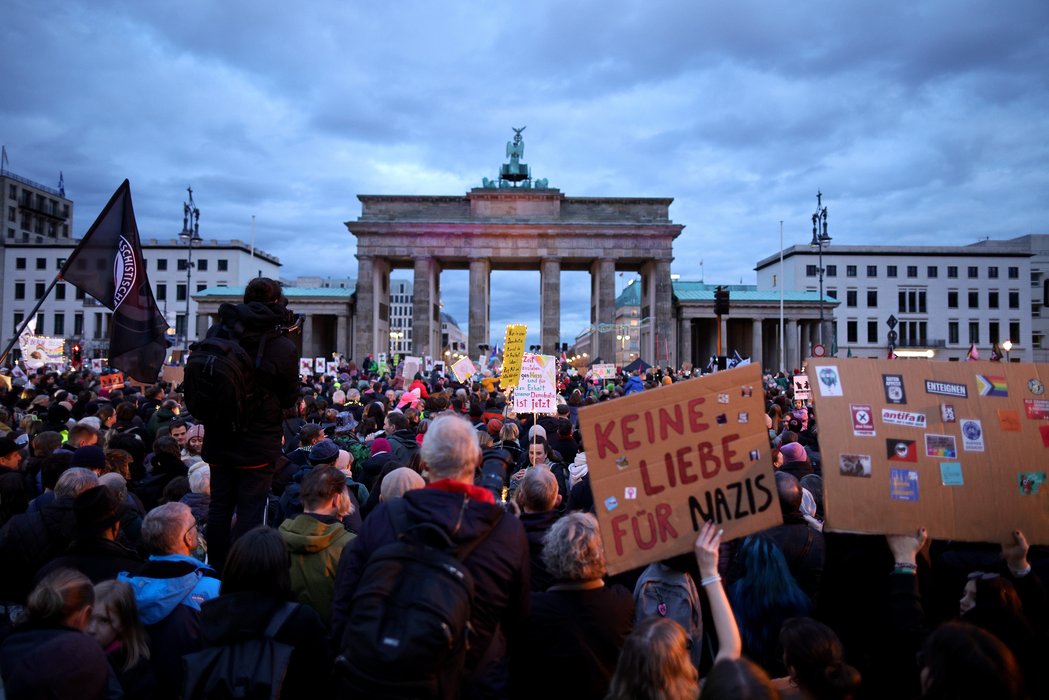
Between December 2024 and February 2025, Germany witnessed numerous demonstrations both for and against the far-right AfD party.
Following the Magdeburg Christmas market attack, perpetrated by a Saudi anti-Islam activist, far-right supporters and counter-protesters held parallel rallies in the city on 23rd December. AfD supporters gathered on the cathedral square under the slogan “Mourning unites – for a secure future”. Party leaders Alice Weidel and Jan Wenzel Schmidt called for a tougher asylum policy in response to the attack, while shouts of “deportation" echoed through the crowd. At the same time, the “Don’t Give Hate a Chance” initiative organised a human chain to commemorate the victims and oppose the political appropriation of the tragedy by the far right.
On 11th January, an estimated 15,000 protesters blockaded an AfD convention where Alice Weidel was nominated as the party’s chancellor candidate, delaying the event’s start by several hours as police moved in to disperse them. The organisers, the Widersetzen (Resist) alliance, condemned the police's actions as “scandalous” and referred to the use of pepper spray, police dogs and threats of water cannon. The authorities also prevented registered demonstrations from reaching the main rally site in front of the AfD conference hall. Nam Duy Nguyen, a member of the Saxon state parliament for the Left Party, said he was knocked unconscious by a police officer, while a companion was struck in the face. Video footage shared on social media showed police using an unmuzzled dog to force a non-violent protester across a road divider.
Proteste gegen AfD-Bundesparteitag: Ein Polizeihund wird auf einen Aktivisten losgelassen, weil dieser auf der falschen Straßenseite gelaufen war. #Riesa #Sachsen pic.twitter.com/4JMqeDBTgi
— Berliner Zeitung (@berlinerzeitung) January 11, 2025
Further nationwide rallies opposing the AfD were held on 26th January, denouncing Elon Musk’s continued public backing of the party. In the run-up to Germany’s 23rd February elections, Musk openly endorsed the AfD, initially declaring that “only the AfD can save Germany.” He then published an op-ed in Welt am Sonntag and hosted a live discussion with Alice Weidel on X. German officials condemned his actions as “election interference”, with Chancellor Scholz urging the public not to “feed the troll.” Legal experts warned that Musk’s amplification of AfD content could constitute an illegal party donation, given his ownership of the platform and ability to artificially boost reach. Analysts noted that while Musk’s support may have contributed to legitimising the AfD and polarising political discourse, polling suggests his interventions had not significantly increased the party’s voter support.
Following CDU/CSU and AfD parliamentary cooperation on a migration-related resolution and a failed bill, hundreds of thousands joined large-scale protests across Germany on 2nd February. Demonstrations took place in multiple cities, including outside the Bundestag and CDU headquarters. A week later, on 9th February, Munich hosted an estimated 250,000 protesters against cooperation with the far right. On 17th February, the “Grannies against the Right” (Omas movement) held another protest.
On 19th February 2025, more than 5,000 people marched in Berlin to commemorate the fifth anniversary of the racist attack in Hanau, where a right-wing extremist murdered nine people of immigrant background before killing his mother and himself. Berlin-Brandenburg public broadcaster RBB reported that participants “included people whom the police classified as being on the left wing, as well as pro-Palestinian activists”, and many people waved Palestinian flags. Police, who deployed around 500 officers and a helicopter, detained 11 people at the demonstration. According to police, there were isolated criminal offences, and participants were briefly detained to establish their identities. Video footage published on social media shows police violently engaging the demonstrators, including officers repeatedly punching protesters in the head.
🟡 BREAKING: Police violently beat protesters in Berlin during a demonstration marking five years since the Hanau far-right attack. Officers threw punches, made targeted arrests, and escalated tensions, turning the memorial protest into a scene of state repression. pic.twitter.com/qrsa6s7YWr
— red. (@redstreamnet) February 19, 2025
On 21st February, around 50 simultaneous rallies were held nationwide in support of LGBTQI+ rights. Demonstrators expressed concern over the AfD’s rise and the CDU/CSU’s willingness to cooperate with the far-right party, particularly given both parties’ plans to repeal the Gender Self-Determination Act, which facilitates changes to legal names and gender.
Crackdown on Palestine solidarity continues
Continued criminalisation and police violence against pro-Palestinian protests
German authorities have continued to severely restrict the right to protest in solidarity with the Palestinian people, with frequent arrests, excessive use of force, and event bans. Since 7th October 2023, Berlin police report nearly 9,000 criminal charges linked to such gatherings in the city.
On 2nd November 2024, around 700 people took part in a pro-Palestinian demonstration in Berlin calling for solidarity with Palestine and an end to arms deliveries to Israel. The march, planned from Platz der Luftbrücke to Oranienplatz, was forcibly dispersed by police after participants allegedly “repeatedly shouted banned slogans” and attacked officers. Police reported expelling 95 individuals, physically removing those who refused to comply, and later filing 36 criminal investigations for offences including incitement to hatred, use of terrorist symbols, and assault on officers. Videos on social media show police using excessive force, including pushing multiple female protesters and dragging another by the neck.
B021124 der Frau, die verhaftet wurde, wird vorgeworfen, sie hätte sich an die Waffe des Beamten festgehalten. Im Video sieht man aber sie hat sich an der Jacke festgehalten. Was sagt ihr dazu? pic.twitter.com/kbaGfSY6dO
— walid021079 (@walid021079) November 4, 2024
🟡 NOW: German police once again brutalize a Palestine solidarity protest in Berlin, violently arresting several protesters. The protest was called off early. pic.twitter.com/VBji5GuyFt
— red. (@redstreamnet) November 2, 2024
On 16th November 2024, hundreds marched in Berlin in a pro-Palestinian demonstration against Israel’s attacks on Gaza, carrying flags and banners. Along the route, a pro-Israel group staged a counter-protest by unfurling Israeli flags, prompting police to intervene to prevent clashes. According to police information, officers temporarily detained 111 demonstrators after fireworks and flares were set off and some refused to disperse. Authorities reported 21 suspected criminal offences, including breach of the peace, incitement and use of banned symbols, as well as 95 administrative violations.
On 25th November 2024, a peaceful demonstration in Berlin-Kreuzberg marking the International Day for the Elimination of Violence Against Women, organised by the Alliance of International Feminists, was met with aggressive police action. Participants, many expressing solidarity with Palestine, were kettled, pepper-sprayed, and in some cases physically attacked by officers, including a woman journalist and a demonstration organiser. In conversation with Novara Media, several participants reported being violently assaulted by the police. One demonstrator claimed that he was beaten to the point of losing consciousness after being detained and taken to a police car. There were also reports that police obstructed access to medical staff trying to provide first aid to injured protesters, which the police denied. According to police, 17 men and 12 women were arrested for alleged breaches of the peace, assaulting or resisting law enforcement and displaying banned symbols, an offence which, according to observers, often refers to the chant “from the river to the sea,” which Berlin police classify as “pro-Hamas”.
Police pushing and hitting protesters during the Berlin demo on the International Day for the Elimination of Violence Against Women pic.twitter.com/6LCQJ3n9vA
— lya cuéllar (@lalittlelya) November 25, 2024
Police in Halle (Saale), Saxony-Anhalt, banned a pro-Palestine demonstration planned for 30th November, having already dismantled an information stand by Students for Palestine the previous week, alleging it displayed Hamas symbols. Despite the ban, the group called for continued protest, framing their actions as resistance to Germany’s alleged complicity in Palestinian oppression.
On 20th January 2025, pro-Palestinian rallies in Berlin-Neukölln and Kreuzberg, marking the ceasefire in Gaza, saw several hundred participants marching in celebration. Police arrested twelve people and dispersed the demonstration early, citing participants allegedly shouting banned anti-Semitic slogans and setting off pyrotechnics.
On 31st January 2025, demonstrators held a silent vigil, the “Mourning March for the Countless Murdered People in Palestine”, at Checkpoint Charlie in Berlin. Organisers reported that police violently arrested five people for allegedly displaying banned symbols, including one woman dragged away for carrying a heart-shaped hand warmer misidentified as a Hamas symbol. Other contested reasons included a triangle keychain, a pink triangle (an LGBTQI+ symbol), and vague claims of participants being “recognised offenders.”
Berlin police impose Arabic language ban on protests
On 8th February 2025, a Palestine solidarity demonstration near Wittenbergplatz in Berlin was violently broken up by police after participants chanted in Arabic. The Berlin police reportedly imposed this language restriction for protests for the first time in April 2024, which meant that only German and English could be used in chants, speeches and slogans. The reasons given were concerns about “public safety” and the fact that there were no translators available for the Arabic language who could check the chants and slogans for illegal content. Footage posted on social media showed many protesters being violently arrested by police as the assembly was broken up for violating the language ban. Rights watchdogs, including Amnesty International, labelled the measure discriminatory and called on Berlin authorities to lift the ban and respect fundamental rights.
🟡 NOW: German police violently shut down a pro-Palestine protest for chanting in Arabic—the first since Germany introduced a new ban on Arabic slogans at demonstrations. Police used force to disperse the crowd, enforcing a rule based on false claims from the Bild newspaper. pic.twitter.com/aV24bQKWCd
— red. (@redstreamnet) February 8, 2025
Political and police pressures on UN Special Rapporteur’s events
In February 2025, two major German universities cancelled public events featuring Francesca Albanese, the UN Special Rapporteur on the Occupied Palestinian Territories, following heavy political pressure. On 16th February, Ludwig Maximilian University in Munich cancelled her lecture on colonialism and international law, citing vague security concerns. Three days later, Free University Berlin cancelled a panel with Albanese and British-Israeli researcher Eyal Weizman after criticism from the Israeli ambassador, Berlin Mayor Kai Wegner, and the German-Israeli Society. The cancellations provoked sharp criticism from academics, legal experts, and organisers, who called them unprecedented acts of censorship and a violation of academic freedom.
Police also maintained a heavy presence at a separate Berlin event relocated in the same week after pressure on its original venue, with officers monitoring speeches and translations on stage. On 18th February, the event “Reclaiming the Discourse: Palestine, Justice, and Truth”, featuring Albanese and several other prominent human rights figures, was forcibly relocated under political and police pressure after the original venue, Kuhlhaus Berlin, withdrew following threats. The event was relocated to the office of the left-wing newspaper Junge Welt, where police deployed 20 vehicles and 100 riot officers, some armed, in what the newspaper described as a show of force intended to intimidate attendees.
Police have stormed the jW newspaper office against the will of the owners https://t.co/8i3oQZQJew pic.twitter.com/uzVqEzInNY
— James Jackson (@derJamesJackson) February 18, 2025
Restrictions on pro-Palestine activism on university campuses
On 7th January 2025, students at Alice Salomon University (ASH) in Berlin staged a pro-Palestinian demonstration, including a lecture hall occupation. University president Bettina Völter de-escalated the situation without police intervention, but faced criticism from politicians and police, including calls for her resignation and accusations of obstructing law enforcement. Jewish members of ASH and human rights observers defended her approach and pointed out that freedom of assembly was being upheld. The incident is emblematic of the growing political pressure on universities in Germany to suppress pro-Palestinian protests.
On 20th January 2025, approximately 30 pro-Palestinian activists attempted to hold a discussion at the Technical University of Munich (TUM) challenging the university’s cooperation with Israeli institutions. According to media reports, when the activists refused to leave the lecture hall after being ordered to do so by TUM security, the police intervened and took their personal details before they were allowed to exit the premises.
The protesters have accused the university administration of setting a “trap” for them. As reported by journalist James Jackson, the protesting students had publicly invited university representatives to a dialogue on campus, and claim that they were waved into the building by TUM administration and security; while the students waited for university officials to arrive, police blocked the entrances and questioned the protesters individually.
Shocking details have emerged - the students were waved into the building by security and uni administrators, then the police turned up. https://t.co/I8FUSHYGHq
— James Jackson (@derJamesJackson) January 23, 2025
On 19th February 2025, despite the Free University of Berlin’s cancellation of a public lecture due to political pressure and alleged security concerns, a speaking event featuring UN Special Rapporteur Francesca Albanese and Eyal Weizman went ahead at an alternative location (see above) and was unofficially live streamed in the originally scheduled lecture hall, with around 200 students attending. When the live broadcast was organised, the FU administration called the police to the campus and threatened to evacuate the premises, but later allowed the streaming to continue after negotiations with the teaching staff. Nevertheless, a large number of police officers were present.
Police officers gather at Berlin’s ironically named “Free University” to watch students entering the projected talk by Francesca Albanese & Eyal Weizman pic.twitter.com/KrheNvkwGa
— James Jackson (@derJamesJackson) February 19, 2025
Freedom of expression
Resolution on combating anti-Semitism seeks to defund anti-Israel groups
On 7th November 2024, the German Parliament passed a resolution on antisemitism that significantly restricts the expression of “antisemitic” views. The Resolution states that any group which “spreads antisemitism, calls into question Israel’s right to exist or calls for a boycott of Israel” should be denied public funding. It also calls for the exclusion from classes, and possible expulsion from schools and universities, of students engaging in “antisemitic” acts. The Resolution adopts the International Holocaust Remembrance Alliance (IHRA) definition of antisemitism, which many regard as controversial.
The Resolution was supported by the then ruling parties SPD, CDU/CSU, the Greens and FDP, who also proposed it, as well as by the far-right AfD. However, several civil society organisations, including Jewish groups, voiced concern. Critics argue that dissent against the State of Israel and its policies could be criminalised under the Resolution as supposed antisemitism. Open letters from Jewish individuals warned that conflating Jewish people with the State of Israel could in fact harm Jewish communities in Germany.
Although not legally binding, the Resolution has already proven influential. The Schelling Architecture Foundation cited it as “pointing the way forward for state institutions and relevant to society as a whole” when rescinding an award from a British artist who had signed an open letter calling for a boycott of Israeli cultural institutions. The Foundation insisted it was not accusing the artist of antisemitism, yet considered the Resolution sufficient grounds to withdraw the award. Similarly, while the Berlinale film festival attempted to reassure participants that freedom of speech would not be curtailed, the Resolution nonetheless had a chilling effect, acknowledged by festival director Tricia Tuttle.
German dual citizenship law under threat
Germany’s law permitting dual nationality for naturalised migrants is facing mounting political opposition. Right-wing and far-right politicians are demanding the power to revoke German citizenship if a dual national commits a crime. In an interview in early January 2025, Chancellor Merz (then CDU party leader) argued that dual nationality should be the exception, not the rule, and endorsed revoking citizenship in cases of criminal offences. Several state governments have also called for the revocation of citizenship in cases of antisemitic acts by naturalised citizens. The Bavarian Interior Ministry went so far as to submit a motion to the Bundesrat, though it has not yet been debated. These proposals raise serious constitutional concerns, as Germany’s Basic Law expressly prohibits the revocation of citizenship.
Constitutional court orders change in police surveillance powers
On 1st October 2024, Germany’s Constitutional Court declared parts of the Federal Criminal Police Office Act (BKA Act) unconstitutional. The BKA Act had granted the Federal Police wide powers to monitor people in contact with terror suspects, including covert data collection. The Court ruled that the thresholds for using such powers were too low, as they did not require a “specific link to the danger being investigated”. It also found the Act’s provisions on data sharing incompatible with “the right to informational self-determination”. Legislators must now amend the law by 31st July 2025.
Attacks and restrictions on the press
Attempts to censor content and prevent publication
On 28th February 2025, Düsseldorf police contacted the Instagram account BlaulichtRheinlandNRW to request the deletion of a video showing a man with a fake gun threatening people during carnival celebrations earlier that day. The footage, filmed by editor-in-chief Sebastian Hansen and a cameraman, captured the man pointing the mock weapon at passers-by and at the journalists themselves, prompting them to call the police, who confiscated the object and removed the man. After the journalists posted the video on Instagram, police asked for its removal, citing an ongoing criminal proceeding, but Hansen refused, arguing it was of public interest. The following day, police told Hansen that the deletion request had been a mistake by a new colleague.
On 27th February 2025, the satirical magazine Titanic reported that former Finance Minister and FDP leader Christian Lindner had taken legal action to stop circulation of its January issue, after his lawyer sent a cease-and-desist letter over a cover featuring Lindner, his pregnant wife, a fake ultrasound and a downward graph, under the headline: “Baby bliss ruined! It’s going to be a low performer! Lindner files an urgent appeal to abolish Paragraph 218.” The lawyer argued this violated the dignity of Lindner, his wife and unborn child, while Titanic refused to withdraw the issue, framing it as political satire linked to the FDP’s weak polling ahead of February’s snap elections and its stance on abortion law (Paragraph 218). On 31st March, Titanic confirmed that Lindner would proceed with a court case after the magazine declined to halt distribution.
On 11th February 2025, Berlin-Lichtenberg district mayor Martin Schaefer filed a criminal complaint against journalist Lars Winkelsdorf over an alleged “online threat” following the journalist’s attempts to seek comment about a disputed rescue operation at the district office the previous day, when the mayor’s employee interrupted first aid to an 84-year-old man who had collapsed. Although Schaefer later denied filing a complaint, Hamburg police visited Winkelsdorf’s home on 18th February for a “risk assessment conversation.” The German Journalists’ Union condemned the move as intimidation, while Tagesspiegel suggested it could amount to swatting by using a false complaint to trigger a police response.
Obstruction of election-related coverage
On 23rd February 2025, the day of Germany’s parliamentary elections, die Tageszeitung (taz) was hit by a major DDoS attack with almost 100,000 access requests in under a second, crippling its website and forcing it to shift election reporting to social media, resulting in losses of reach and revenue.
A number of journalists also faced restricted access at party election night events. At the FDP headquarters in Berlin, accredited reporters were initially denied entry due to alleged space constraints, with party staff citing lack of space and only a few photojournalists being admitted. Reporters were eventually allowed in shortly before 18:00, when polls closed and FDP leader Christian Lindner was due to speak. The elections ended with the FDP failing to pass the 5% threshold for parliamentary representation, confirmed in the early hours of 24th February.
Reporter and satirist Maximilian Schafroth and an NDR extra 3 crew were expelled from the CDU/CSU election night event at the party headquarters in Berlin after Schafroth jokingly presented CSU leader Markus Söder with a mock book titled “Governing for Beginners – 100 Tips from Markus Söder” as party leaders, including Friedrich Merz, arrived. Security escorted the team out despite Schafroth’s protests, and although a CDU press officer later described the incident as a misunderstanding and readmitted them, security again threatened removal over any “missteps”, prompting the journalists to leave voluntarily. The CDU confirmed the incident, citing security concerns and alleging that the journalists had “disturbed” the event.
Meanwhile, a journalist assigned to cover the CDU/CSU election night event on behalf of the ZDF satirical programme “heute show” was denied accreditation. According to host Oliver Welke, reporters from the programme had been systematically denied access to party events for weeks with the justification that the venues had reached maximum capacity. For the election night event, the show tried to circumvent this restriction by accrediting a new colleague who was not yet known to the party representatives. Initially, the journalist successfully registered for the event. However, his accreditation was later revoked after the organisers allegedly concluded that he belonged to the “heute show”.
On 3rd February 2025, Stern reporter Miriam Hollstein and journalist Stephan Detjen faced obstruction while covering the CDU party congress at Berlin’s Protestant Grunewald Church, where a CDU spokesperson initially barred filming despite prior municipal approval, and later insisted only the party’s media team could report. The journalists ignored these restrictions and continued their work. The congress coincided with chancellor candidate Friedrich Merz’s controversial draft migration proposal, which relied on AfD support, and featured church representatives who had publicly criticised Merz’s plan days earlier.
Attacks on journalists and obstruction of coverage of far-right events
On 15th February 2025, during a far-right “commemoration” of the 80th anniversary of the Allied bombing of Dresden, event organiser and known extremist Lutz Giesen attacked and threatened journalists after demanding they move aside, at one point storming into the press group, shouting “Do it, now!” and pushing a reporter before marshals pulled him back. The annual Dresden rallies are routinely used by far-right and neo-Nazi groups to promote historical revisionism and downplay Nazi crimes.
On 25th January 2025, a photographer was attacked by at least three participants, including Austrian far-right extremist Martin Sellner, at a gathering of far-right groups from Germany, Switzerland, and Austria held at the former Institut für Staatspolitik (IfS) in Schnellroda, Saxony-Anhalt. Around 14:00, the assailants approached the journalist across the street from the venue, poking and blocking the camera with umbrellas, before police intervened following alerts from nearby counter-protesters; the photographer was unharmed. The IfS, which operated in Schnellroda from 2000 to 2024, had been officially classified as right-wing extremist, and Sellner is known as a founder and leader of Austria’s Identitäre Bewegung. During the same gathering, a journalist from investigative outlet Recherche Nord was attacked by far-right activist and publisher Götz Kubitschek outside a restaurant. Video posted by Recherche Nord shows Kubitschek repeatedly pushing the journalist backward and slapping their camera from their hands as they tried to film. Police have launched an investigation.
Also on 25th January 2025, freelance journalist Kili Weber was obstructed for an hour while covering a far-right demonstration in Bautzen, Saxony, after police stopped her and her security team on suspicion of a criminal offence. Even after officers determined she had committed no crime, she was prevented from reporting for another half hour and had some equipment temporarily confiscated, which she said restricted her press freedom. Weber, who frequently reports on Germany’s far-right movement, has previously faced multiple press freedom violations documented by the Mapping Media Freedom project.
Obstruction by protesters, private security
On 1st February 2025, Bild reporter Iman Sefati was obstructed while covering a pro-Palestinian rally on Französische Straße in central Berlin, when a protester used a phone flashlight to block his filming for several minutes, as documented in video shared by Sefati and the German Journalists’ Union (dju). Since October 2023, Sefati has regularly reported on these protests and has frequently faced harassment and attacks. The journalist works for tabloid newspaper Bild, which has been criticised for its coverage of the pro-Palestinian movement in Germany.
On 31st January 2025, documentary filmmaker Carmen Eckhardt was physically attacked and obstructed by security personnel from Mundt, acting for energy company RWE AG, while reporting on the clearing of the Sündenwäldchen forest at the Hambach surface mine in North Rhine-Westphalia, sustaining a back bruise after being shoved. Eckhardt later criticised the exclusion of media from the site and the apparent erosion of state control over the use of force. Since 2012, parts of Hambach Forest have been occupied by environmental activists to resist RWE’s brown coal mining, with RWE beginning the Sündenwäldchen clearance on 30th January for sand and gravel extraction.
Public vilification of media by politicians
On 20th February 2025, Israeli government spokesperson Arye Sharuz Shalikar published on X a “Top 10 amplifiers/spreaders of hate against Jews on X in Germany”, naming several German-based media professionals, including journalist and podcast host Tilo Jung, freelance journalist Jakob Reimann, former ZDF correspondent Stephan Hallmann, former DW correspondent Martin Gak, Fabian Goldmann, Kristin Helberg and Hanno Hauenstein. Shalikar accused them of criticising Israel daily since Hamas’s 7th October 2023 attack while failing to post about Shiri Bibas and her two sons, Ariel and Kfir, who were taken hostage and whose bodies were returned to Israel on 20th February 2025 under a ceasefire deal.
On 27th January 2025, AfD politician and Baden-Württemberg state parliament member Miguel Klauß published an email on Facebook responding to a Correctiv journalist’s information request, in which he called the outlet “dirty liar(s)” and threatened that, once AfD is in government, it would lose state funding and the journalist be “guided towards proper employment”, adding, “YOUR TIME WILL BE OVER.” The post’s comments remain unmoderated and contain hate speech and defamatory remarks targeting Correctiv and its journalists.