Freedom of peaceful assembly
Protests and petition in support of former KLA leaders
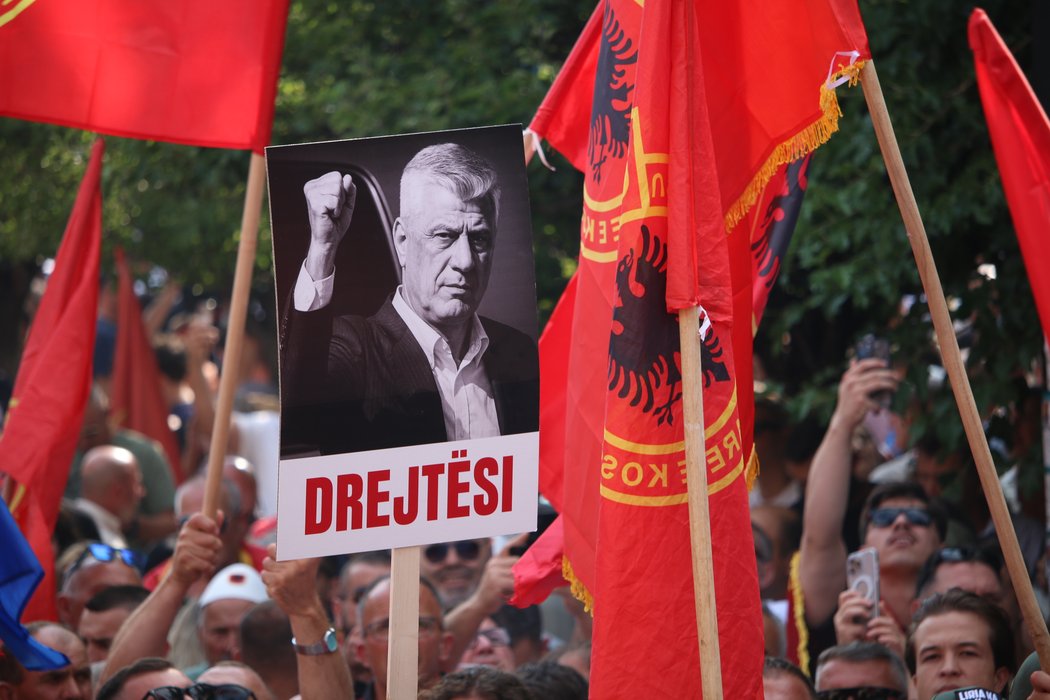
On 17th February, Kosovo's 18th Independence Day anniversary, thousands of citizens gathered in Prishtina for a protest organised by the “Freedom Has a Name” platform in support of former KLA leaders, who are being tried by the Kosovo Specialist Chambers. The court was established under Kosovo law but is based in The Hague, Netherlands. The four leaders, former Kosovo President Hashim Thaçi, Kadri Veseli, Rexhep Selimi and Jakup Krasniqi, were indicted in 2020 and face ten counts of war crimes and crimes against humanity, for acts allegedly committed during and after Kosovo's war with Serbia in 1998 and 1999.
According to the organisers, around 130,000 people took part in the protest, which was held under the slogan “Justice, Not Politics”, reportedly the largest public gathering in Kosovo since gaining independence.The protest called for the judicial process to be based on evidence rather than what protesters describe as political considerations. Ismail Tasholli, director of the platform, said the aim was to show that the former KLA leaders were not alone and continued to have the support of Kosovo's citizens.
In a separate symbolic action on the same day, activists from the platform placed about 5,000 KLA emblems on the NEWBORN monument in Prishtina. The action followed an earlier one by the same platform, in which the monument was surrounded with metal barriers to depict what the activists called the “imprisonment of Kosovo”. Eliza Hoxha, a representative of the platform, said the actions were meant to express opposition to what the platform views as attempts, through the Specialist Chambers proceedings, to “rewrite history” and undermine the liberation war and the foundations of Kosovo's statehood.
On 13th February, members of the University of Prishtina Student Parliament staged a symbolic action in front of the European Union Office in Kosovo under the same slogan. They expressed support for the former KLA leaders and called for a fair judicial process, citing concerns over possible political influence on the proceedings.
On 25th February, the Organisation of War Veterans of the Kosovo Liberation Army (OVL-UÇK) launched a nationwide petition in support of the former KLA leaders. The petition calls for the verdict to be based on the evidence and facts presented at trial and for an impartial process free of political influence. Signatures are being collected across Kosovo and among diaspora communities in Europe and the region. According to OVL-UÇK, more than 83,000 signatures had been collected in Kosovo by mid-March, along with more than 26,000 in the region and the diaspora.
March and symbolic action for women’s rights
On 19th February, the Collective for Feminist Thought and Action staged a symbolic action in front of the Court of Appeals in Prishtina to protest against the acquittal of a former Kosovo Police sergeant in a case concerning the sexual abuse of a minor in Drenas, and a separate civil judgment ordering his reinstatement in the police. Activists placed a banner at the court's entrance reading: “The Court of Appeals acquits and rewards abusers of girls and women”. The Collective demanded his removal from the Kosovo Police, arguing that his reinstatement poses a risk and undermines victims' trust in institutions.
On 8th March, International Women's Day, the “March, Don't Celebrate” collective marched in Prishtina under the slogan “Marching for a Life with Dignity”. About 200 participants called for greater gender equality, justice and stronger protection of women's rights. The organisers said 8th March should not be a day of celebration while women continue to face violence, discrimination and inequality. Representatives of the collective criticised institutional responses to gender-based violence, arguing that victims often face social blame rather than adequate institutional support.
Protests and strike in the education sector
On 12th March, the Organisation for Improving Quality in Education (ORCA) staged a symbolic action in front of the University of Prishtina's Rectorate building to oppose the promotion of a Faculty of Education professor to full professor. ORCA argued that the candidate did not meet the academic advancement criteria, particularly regarding the quality of scientific publications. It challenged the acceptance of one of the candidate’s publications, saying it appeared in a journal which had been included on an archived list of potentially predatory journals. ORCA also alleged a conflict of interest on the commission that assessed the journal's credibility, as one member was an author of the disputed publication. On 1st April, the Senate voted not to promote the candidate, concluding that the criteria had not been met.
In a separate symbolic action in front of the Kosovo Assembly on 27th April, ORCA opposed the process for selecting members of the State Council of Quality (SCQ) of the Kosovo Accreditation Agency, describing it as non-transparent and compromised. It called on the Assembly not to approve the proposed candidates until the transparency of the process and compliance with legal criteria were ensured. ORCA objected to the renewed candidacy of Driton Vela, citing statements made during his 2023 application and his 2019 candidacy for the Assembly on behalf of the ruling Self-Determination Movement (Vetëvendosje, LVV). The Network of Civil Society Organisations for Pre-University Education (ROSCAP) also urged the Assembly not to proceed with the vote, warning that shortcomings in the process could undermine the SCQ's independence and credibility.
On 16th March, a group of dentistry students at the University of Prishtina, supported by the Student Movement for Criticism and Action, protested in front of the Kosovo Accreditation Agency over what they described as excessive admissions to dentistry programmes. They argued that Kosovo has more dentistry graduates and licensed practitioners than the labour market needs. They called on the relevant institutions to reconsider accreditation and admission policies so that enrolment quotas reflect the needs of the healthcare system and employment opportunities.
On 29th April, teaching assistants at the University of Prishtina's Faculty of Medicine protested in front of the Rectorate over the absence of new calls for academic positions in the past three years. They argued that the retirement of several professors has caused staffing shortages in various departments, potentially affecting the accreditation of study programmes. They said the faculty had requested 38 new academic positions but the Rectorate had not approved the request. The staff also submitted a petition to Education Minister Hajrulla Çeku asking for additional recruitment to address the faculty’s staffing needs.
On 27th April, dozens of first-year students at the University of Prishtina protested in front of the Rectorate, demanding access to the April and November exam periods. The Rectorate said these periods had been introduced as a temporary two-year transitional measure exclusively for second- and third-year students. The first-year students, supported by the Student Parliament and other student organisations, called for equal treatment.
On 10th February, teachers at the “Pavarësia” primary school in Prishtina held a two-hour strike after the arrest of a colleague accused of physical violence against a student. The arrest followed the publication of a video showing the teacher hitting the student. The staff condemned any form of violence in educational institutions but argued that the footage in circulation did not show the full sequence of events, and called for a comprehensive assessment of the case. They also demanded greater institutional attention to violence, threats and verbal abuse directed at teachers. Several other schools in Prishtina supported the strike. ROSCAP separately called for stronger school safety mechanisms, including better prevention measures and psychological support for students and education staff.
On 11th March, students and professors of the University of North Mitrovica, which operates within Serbia's education system, protested against the institution’s integration into Kosovo's education system. They also opposed the implementation of the Law on Foreigners and criticised the Government of Serbia for remaining silent on these developments. The protest took place as Kosovo institutions continue efforts to gradually integrate parallel education and healthcare structures into the country’s institutional framework.
Community protests over parking, property disputes, and public services
On 21st January, residents of Simon Shiroka Street in Prishtina held a protest over parking availability in their neighbourhood. They argued that the public enterprise “Prishtina Parking” had issued residential parking permits to people who do not live in the area, reducing the number of spaces available to local residents. In a response to Kallxo.com, “Prishtina Parking” said the permits were issued in line with a Supreme Court decision stipulating that public parking spaces cannot be reserved exclusively for residents of a specific area.
In February, residents of Zajm village in Klina staged three protests demanding institutional action over long-standing property disputes. They first protested in front of the Municipality of Klina and the Basic Court and Prosecution in Peja. During the third protest, they blocked traffic on the Prishtina-Peja main road. The residents alleged that properties owned by several families, purchased in the 1970s, had been unlawfully transferred and registered in the names of other individuals through irregular procedures. They said the dispute involves about 30 properties and that the alleged changes of ownership were linked to efforts to benefit from state compensation for a planned road construction project.
On 13th March, nine families from Prishtina’s Dardania neighbourhood gathered to protest against a municipal order requiring them to vacate several properties near the Central Mosque, which is under construction. The residents said they own the properties and cited documentation showing they were purchased as early as 1963. They disputed the municipality's claim that they were unlawfully occupying municipal land, arguing that the boundaries between their plots and municipal land had never been clearly determined.
On 7th April, residents of several villages in Ferizaj protested in front of the offices of Kosovo Energy Distribution Services, expressing dissatisfaction with the poor condition of the electricity distribution network and frequent power outages. They demanded urgent action to improve the electricity supply and modernise outdated infrastructure, including the replacement of damaged electricity poles.
Protests against proposed electricity tariff increases
On 6th February, the Collective for Feminist Thought and Action, in cooperation with the NGO “Përpjekja”, held a protest in Prishtina against the proposed increase in electricity tariffs. Dozens of citizens joined a march from the Kosovo Energy Distribution Services (KEDS) building towards the Energy Regulatory Office and the Government of Kosovo, carrying banners reading “Not a cent more” and “Electricity is not a luxury”. The protest was peaceful until red smoke was released towards the KEDS building, after which police arrested one participant.
On 5th February, the youth wing of the Democratic Party of Kosovo (PDK) staged a symbolic action on the same issue in front of the Ministry of Economy. Activists presented a symbolic electricity bill and a breakdown of an average household's monthly expenses, arguing that higher electricity prices would place an additional burden on citizens and deepen economic hardship. They called on institutions to reconsider the proposed tariff adjustment and take its potential impact on households into account.
Protests and petition by private and public sector workers
In January, staff at the General Hospital of Mitrovica protested after a nurse and two security workers were attacked in the Orthopaedics Department. Healthcare workers called for those responsible to be held accountable and urged the authorities to strengthen measures to ensure medical staff can work safely. The Chamber of Nurses also condemned the incident, expressing concern over repeated cases of violence against healthcare workers in public health institutions.
In March, employees of the public enterprise "Prishtina Parking" held three protests in front of the company's premises, demanding higher salaries, meal allowances and health insurance. The workers said their demands had gone unresolved for about three years and rejected management's argument that the company lacks the financial capacity to meet them. They warned that, without a response from management, they would escalate their action, including through a general strike.
Also in March, 67 women medical residents from various clinics at the University Clinical Centre of Kosovo submitted a petition to the Ministry of Health, demanding financial compensation for the maternity leave they took during their specialist training.
Social Democratic Party (PSD) symbolic actions
On 26th February, activists from the Social Democratic Party (PSD) staged a symbolic action in front of the Prishtina offices of the Democratic Party of Kosovo (PDK) and the Democratic League of Kosovo (LDK), criticising what they described as the two opposition parties' insufficient opposition to the ruling Self-Determination Movement (LVV). PSD leader Dardan Molliqaj displayed banners portraying PDK leader Bedri Hamza and LDK leader Lumir Abdixhiku as “honorary members” of LVV. Molliqaj accused both parties of failing to oppose the government effectively and claimed they had become “branches of LVV”.
On 17th March, in a separate symbolic action in front of the State Prosecutor's Office in Prishtina, PSD activists opposed the appointment of the new chairperson of the Kosovo Prosecutorial Council (KPC), alleging political interference by LVV. They painted graffiti reading “Captured – VV” on the building's exterior wall. Molliqaj called on political parties and civil society organisations to oppose political interference in independent institutions.
Protest and commemoration related to Kosovo War memory
On 29th March, the Organisation of War Veterans of the Kosovo Liberation Army (OVL-UÇK), together with families of soldiers killed in action and other citizens, protested in front of the Kosovo Assembly against the exhibition “Massacres in Kosovo 1998-1999” (see under Freedom of association). In its call for the protest, OVL-UÇK claimed that the exhibition, displayed in central Prishtina, aimed to “distort the truth” about the Kosovo Liberation War, and criticised the Assembly for financing it. The group raised particular concerns about the methodology used and the accuracy of the information presented regarding the Dubrava Prison massacre.
Earlier in March, survivors and relatives of victims of the Green Market massacre in Mitrovica gathered to commemorate the seven civilians killed and 128 injured in an attack by Serbian forces on 13th March 1999. They called on the competent authorities to ensure a full investigation and to bring those responsible to justice.
Symbolic action against Kosovo’s participation on the Board of Peace
On 21st February, the Collective for Feminist Thought and Action staged a symbolic action in front of the Presidency of Kosovo to oppose the country's participation in US President Donald Trump’s controversial Board of Peace and the involvement of the Kosovo Security Force in its mission. Activists displayed a banner reading: “Not in our name, we stand for the liberation of Palestine”. They argued that participation would help legitimise violations against Palestinians and could make Kosovo complicit in the further colonisation of the Palestinian people. They called on the Assembly not to ratify the agreement enabling Kosovo's participation.
Symbolic action over alleged disrespect to former President Thaçi’s legacy
On 12th March, the youth wing of the Democratic Party of Kosovo (PDK) staged a symbolic action in front of the Ministry of Foreign Affairs and Diaspora after images circulated showing an official presidential photograph of former President Hashim Thaçi among items strewn on the ground inside the ministry. The activists described the incident as disrespectful and displayed a photograph of Thaçi bearing the message: "You can throw away the photographs, but you cannot erase history". They said the handling of the photograph was an attempt to undermine Thaçi's contribution to Kosovo's history.
Freedom of association
During the reporting period, two cases were recorded in which civil society organisations (CSOs) working on politically sensitive issues, particularly war-related topics and transitional justice, faced delegitimising narratives targeting their work and public credibility. Both followed a similar pattern, with narratives portraying the organisations as aligned with Serbian interests and as undermining established national narratives concerning the Kosovo War.
In January 2026, the Youth Initiative for Human Rights (YIHR Kosovo) became the target of a coordinated campaign of attacks after a civic education session on the Kosovo Specialist Chambers at the Xhevdet Doda secondary school in Prishtina. In a statement, YIHR said the session was one of a series of similar activities it had regularly organised since 2018. The organisation reiterated that the session had been held with the school’s permission, and that the information on the Specialist Chambers presented during such sessions was public and impartial.
After VOX Kosova published a report that YIHR described as misleading, Samir Shahini, head of the Education Directorate of the Municipality of Prishtina, distanced himself from the event, saying he had not given permission for it to be held and announced that he would consider possible legal action. YIHR's Executive Director and Board members were then publicly targeted on social media. The organisation's regional links, including its network's presence in Belgrade, were used to portray it as aligned with Serbian interests. In Kosovo's post-war context, such allegations can be particularly damaging, as they are commonly used to question an organisation's national loyalty and legitimacy.
In March, ADMOVERE and INTEGRA organised an exhibition in Prishtina on massacres committed during the Kosovo War. It was based on a book by ADMOVERE director Shkëlzen Gashi, the product of several years of research drawing on international human rights sources, including Amnesty International, Human Rights Watch and the Humanitarian Law Centre. A survivor of one of the massacres criticised the exhibition, stating that several entries had inaccurately represented the status of victims and the circumstances in which they were killed. In response to claims that the inaccurate information was based on its data, the Humanitarian Law Centre published a statement asserting that Gashi had misinterpreted information in its database. The organisers subsequently apologised for the inaccuracies.
Alongside this substantive criticism, however, the public debate, amplified by media reports and social media reactions, shifted towards personal attacks on Gashi and his organisation. These included allegations of political motives, alignment with Serbian interests and distortion of the narrative surrounding the war. The Municipality of Prishtina suspended the exhibition's permit, while the Special Prosecution Office’s Directorate Against Organised Crime and Serious Crimes raided Gashi's home and questioned him for several hours on suspicion of “inciting hatred and intolerance”.
The case raised concerns about the proportionality of the institutional response, including the criminal-law measures and the immediate use of municipal authority to remove disputed civil society content from the public sphere. It also raised concerns that debates over historical issues, or factual inaccuracies in historical research, could shift from professional and public scrutiny towards institutional and legal pressure.
Freedom of expression
Kosovo rises in global press freedom ranking
In the Reporters Without Borders (RSF) World Press Freedom Index 2026, published on 30th April, Kosovo rose 15 places, from 99th in 2025 to 84th. Its overall score increased from 52.73 to 55.89 points. The improvement was driven by higher scores on RSF's political, legal, social and economic indicators, while the security indicator, which assesses journalists' safety, recorded a marginal decline. RSF said attacks and threats against journalists, strategic lawsuits against public participation (SLAPPs), concerns over media regulation and political influence continue to affect media freedom in Kosovo.
CSOs raise concerns over selection of public broadcaster and media regulator boards
In April 2026, the Association of Journalists of Kosovo (AJK), the FOL Movement, the Kosovo Law Institute (KLI) and activist Flutura Kusari criticised the selection of members of the boards of Radio Television of Kosovo (RTK) and the Independent Media Commission (IMC), describing the process as compromised and lacking transparency. In a joint statement, they said it failed to ensure merit-based selection. They cited shortened deadlines, limited time to evaluate candidates, flaws in the interview methodology and the decision not to publish candidates’ interview scores. They also alleged that political considerations influenced the process, questioning the selection of certain candidates for the IMC board, including Besnik Berisha and Luljeta Aliu Krasniqi, because of their alleged links to the ruling Self-Determination Movement.
Threats and attacks against journalists and media outlets
On 21st January 2026, Lirim Mehmetaj, journalist and founder of the online portal Vox Kosova, received a death threat in a Facebook comment. The AJK condemned the threat and urged the Kosovo Police and the Prosecutor's Office to identify the person responsible and take measures to protect the journalist.
On 28th January, Kanal 10 journalist Kushtrim Sadiku reported receiving death threats. The AJK denounced the threats and called on the relevant security institutions to carry out a swift and thorough investigation and to ensure his safety.
On 30th January, journalists from the online portals Nacionale and Betimi për Drejtësi were threatened while reporting from the Gjilan-Viti branch of the Basic Court. Journalists Eriola Cacaj and Flamur Kabashi, together with cameraman Drilon Namani, were threatened inside the courtroom after a hearing in a property dispute. A family member of one of the parties made a threatening gesture towards them, miming a throat being slit. The journalists reported the incident to the Kosovo Police and informed the presiding judge. On 11th March, the Basic Court in Gjilan found the person responsible guilty and imposed a conditional sentence of one year's imprisonment.
Klan Kosova journalist Kron Sadiku received threats after commenting on a Big Brother VIP Kosova contestant's sexual orientation during a television programme. On 9th February, Sadiku made public an audio recording in which a family member of the contestant used offensive and threatening language. The AJK denounced the threats and intimidation and called on the justice institutions to treat the case as a priority and take appropriate legal action.
On 15th February, the AJK criticised the public broadcaster's decision not to renew the employment contracts of journalists Hana Marteti and Edina Avdiu. It said the decision was directly linked to the journalists' refusal to yield to pressure from management and their commitment to professional reporting standards. The association also criticised the absence of a performance evaluation before the contracts lapsed and raised additional concerns about Avdiu's case, saying management was aware of her pregnancy. The AJK said it would provide legal assistance to challenge the decision. The broadcaster said the journalists' fixed-term contracts had expired and that the non-renewals followed regular administrative procedures and internal professional assessments, without external interference.
On 1st March, the AJK condemned the conduct of Peja Mayor Gazmend Muhaxheri towards Betimi për Drejtësi journalist Shpresë Hasimi. She had approached him for comment on allegations of manipulation in the municipality's exchange of a high-value property. Muhaxheri, who had not responded to the outlet's earlier interview request, told her to “get lost” and slammed the door of his official vehicle as she was attempting to ask him a question. The AJK called on the mayor to apologise and urged senior officials at central and local level to respect journalists' work and comply with their legal obligation to provide information on decisions affecting citizens.
Also on 1st March, the online outlet Reporteri reported a series of cyberattacks on its social media accounts. The outlet said the attacks, which temporarily suspended its Instagram and Facebook pages, were accompanied by threats from a Canadian telephone number. On 1st April, Vox Kosova was targeted by a series of cyberattacks originating from Germany, which affected its social media accounts and disrupted the distribution of its content.
On 2nd March, Burim Pacolli, a journalist with the online portal Nacionale, was physically assaulted by several individuals in an incident linked to a critical review he had published about a rapper known as Mossi. Pacolli subsequently received threats from the rapper on social media. Two days after the assault, the prosecution announced that three suspects, including the rapper, had been detained for 48 hours in connection with the assault and threats.
On 9th March, Klan Kosova journalist Vesa Hoda was physically obstructed by members of Prime Minister Albin Kurti's close protection team as she tried to ask questions about the political crisis and the possibility of new elections. The AJK denounced the incident as interference with the media's ability to hold public officials to account and called on the Prime Minister's Office to ensure that journalists can obtain answers on matters of public interest.
In March, Klan Kosova journalist Ardiana Thaçi-Mehmeti was subjected to an online harassment campaign after her personal information was shared in a Discord group with about 70,000 members. She received dozens of sexually explicit messages, which followed her earlier reporting on online groups that share women's personal data.
In a television interview on 12th March, Democratic League of Kosovo (LDK) leader Lumir Abdixhiku referred to “media mercenaries”, accusing the media of spreading slander and acting irresponsibly for financial gain from sponsors. The AJK denounced the remarks, called on him to refrain from derogatory language and urged him to submit any evidence supporting his allegations to the competent authorities. The LDK responded that it upheld the right to criticise the media and that Abdixhiku's remarks referred to what it described as unprofessional media practices, not to journalists or media outlets in general.
On 23rd March, the AJK reacted after LVV officials circulated narratives on social media alleging that journalists in Kosovo were involved in “cash in bags” payments. The officials shared excerpts on Facebook from a programme produced by BIRN Kosovo, which discussed how "disinformation narratives about the Banjska case were also spread in Kosovo television studios". The excerpts included a claim that, in an operation, “money in bags from BIA structures was seized in northern Mitrovica while being handed to an Albanian agent, who was then supposed to deliver it to a journalist”.
According to the AJK, the sharing of these allegations by LVV MPs Adnan Rrustemi and Mefail Bajqinovci, and by LVV Coordinator of Committees Dejona Mihali, formed part of an ongoing campaign to denigrate media outlets and journalists.
The AJK also condemned remarks made by Prime Minister Kurti in an address to the Kosovo Assembly on 2nd April. Kurti referred to reports of media financing through “bags of money” and said Kosovo's enemies were finding domestic “collaborators”. He also called for measures to ensure more transparency in media financing, and presented a controversial law on the media regulator IMC, which press freedom watchdogs had criticised as enabling political control, as a way to “protect media from capture”.
The AJK described the statements as part of a broader pattern of verbal attacks on the media by the Prime Minister, the Government and the ruling party. It noted that they came days after a fact-finding mission by the Council of Europe Platform for the Safety of Journalists, which concluded that media freedom in Kosovo had declined continuously in recent years. The association called for a transparent and inclusive process for drafting the new IMC law, an end to political pressure on public broadcaster RTK and an end to organised campaigns denigrating media outlets and journalists.
On 2nd April, a team from the online outlet Betimi për Drejtësi was obstructed while monitoring a court hearing in Prishtina. During a break in proceedings, defence lawyer Besnik Berisha, who represented one of the accused, turned off and removed the team's recording equipment. The AJK condemned the incident, stating that decisions on media access and recording equipment during public hearings rest with judicial institutions, not with parties to the proceedings. It called on the courts to ensure that journalists and media organisations can report on judicial proceedings without interference or obstruction.