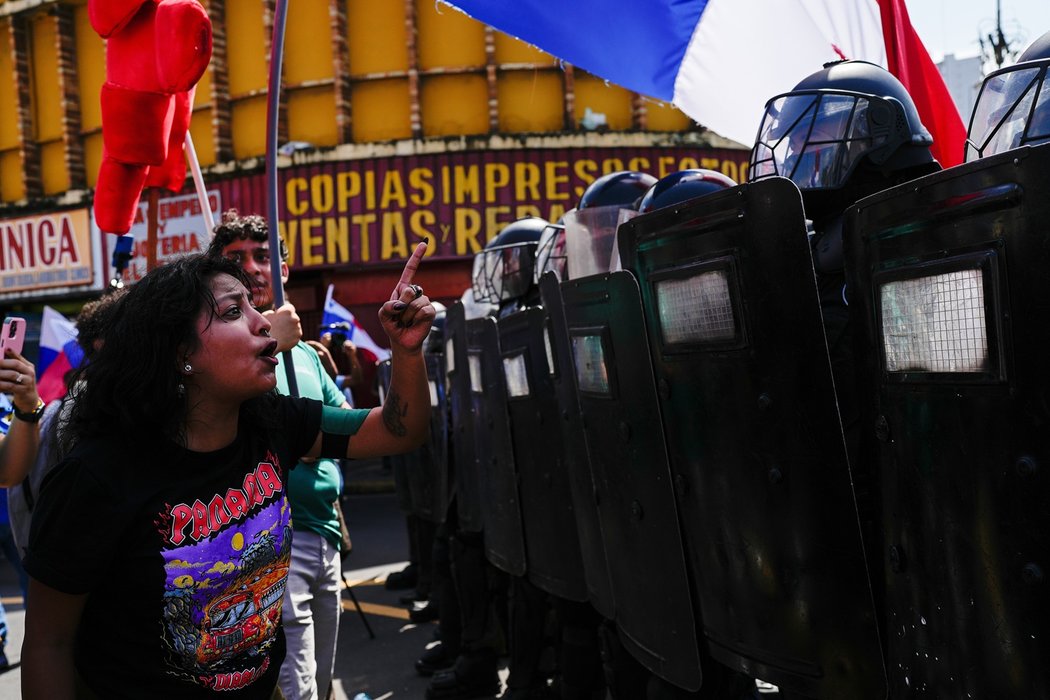
This update covers developments relating to the freedoms of expression, association and peaceful assembly in Panama from November 2024 to October 2025.
Peaceful Assembly
Students and workers sustain protests against proposed social security reforms
On 6th November 2024, students at the University of Panama blocked the Transístmica highway, a major road in Panama City, to protest against the government’s proposed reforms to the Social Security Fund (CSS), Panama’s public social security institution responsible for pensions and other benefits. Riot-control police dispersed the protesters following a brief confrontation. Further protests took place on 7th and 14th November, resulting in additional confrontations between students and police. During the 14th November demonstration, reports indicated that someone had set fire to a police vehicle, and police detained approximately 15 students. On 19th November, the Federación Unitaria de la Clase Trabajadora (FUCLAT), a trade union federation, organised a march to the National Assembly, opposing the proposed reforms. Trade unions and student organisations argued that the legislation threatened pension protections and favoured private business interests.
On 31st January 2025, trade unions, teachers and students held further demonstrations to oppose the proposed social security reforms and to defend the country’s sovereignty ahead of a visit by US Secretary of State Marco Rubio. During a protest outside the University of Panama, protesters occupied part of the Transístmica highway before confrontations broke out with riot-control police, who used tear gas and pepper spray. Police alleged that protesters had attacked and injured an officer as security forces attempted to reopen the road. However, university representatives disputed this account, arguing that the protest had initially been peaceful and that police intervention had escalated tensions. The university subsequently suspended academic and administrative activities at several facilities.
On 4th February, the University of Panama, through its Office of the Ombudsperson for University Rights, which addresses complaints concerning the rights of university community members, filed a complaint with the Public Prosecutor’s Office, alleging abuse of authority, interference with university autonomy and restrictions on freedom of movement during the 31st January confrontation. On 20th February, a judge ruled that police had lawfully arrested five people and imposed precautionary measures that did not involve detention, after prosecutors charged them with alleged personal injuries and obstruction of police duties in connection with the confrontation.
On 12th February 2025, members of the National Union of Construction and Allied Workers (SUNTRACS), a major construction workers’ union in Panama, blocked roads across Panama City and other parts of the country. Riot-control police used tear gas to disperse protesters on Avenida Balboa, a major road in Panama City, near the construction site of the new Hospital del Niño (Children’s Hospital). During the ensuing confrontations, some protesters threw stones, concrete blocks and other objects at police officers, including from the upper floors of the construction site. The National Police reported that 16 officers and five civilians sustained injuries, while protesters damaged seven police vehicles. SUNTRACS secretary-general Saúl Méndez maintained that the demonstration had initially been peaceful and accused police of using excessive force against protesters. Further confrontations occurred near the University of Panama, where students and construction workers blocked the Transístmica highway, prompting the university to suspend academic activities.
Police reported detaining 480 people during the demonstrations, while La Prensa reported over 500 detentions. On 13th February, relatives of those detained protested outside police headquarters, demanding information about their whereabouts and situation. Lawyers raised concerns about the administrative proceedings against some detainees, alleging that authorities had failed to distinguish adequately between people suspected of committing violent acts and others detained during the police operation.
On 15th February, a judge of guarantees, who oversees procedural safeguards during the initial stages of criminal proceedings, accepted the formal presentation of charges against 83 people for alleged offences against public servants, collective security, property, individual liberty and personal integrity. On 19th February, the judge rejected prosecutors’ request to hold the defendants in pre-trial detention, finding that they had not sufficiently demonstrated the defendants’ involvement in the alleged offences to justify detention pending trial. Instead, she imposed non-custodial precautionary measures, including reporting requirements, restrictions on approaching alleged victims and geographical travel restrictions. On 28th February, an appeals court imposed additional restrictions on 16 of the defendants, prohibiting them from attending or participating in gatherings involving road blockades or public-order disturbances.
On 18th March, protests continued following the enactment of Law 462, which amended the legislation governing Panama’s social security system. Opposition to the reforms coincided with demonstrations against a security agreement between Panama and the United States, signed on 10th April. According to the Armed Conflict Location & Event Data Project (ACLED), Panama recorded 70 demonstrations in April, approximately two-thirds more than in March, across ten of the country’s 15 provinces and Indigenous districts. Although most demonstrations remained peaceful, confrontations between protesters and police increased towards the end of April, when officers used tear gas and arrested protesters.
Security operations during protests raise concerns over excessive force and fundamental freedoms
In May 2025, the National Police and the National Border Service (Senafront), a security force responsible for border protection, conducted operations in several Ngäbe-Buglé Indigenous communities amid protests against Law 462, the possible reopening of the Cobre Panamá copper mine and a security agreement between Panama and the United States. On 3rd June, Front Line Defenders reported allegations of excessive use of force, arbitrary detention and intimidation during operations in Ojo de Agua, El Piro Trinidad, Viguí, Tolé, El Prado, San Félix and Horconcito. According to the organisation, Senafront personnel entered residential areas on 14th May and allegedly used tear gas inside homes, schools and churches, assaulted residents and searched houses. Community members also reported surveillance using drones and helicopters, the use of rubber projectiles and firearms, and deliberate electricity cuts.
On 5th May, Senafront detained Indigenous poet and human rights defender Esteban Binns Carpintero while he documented a peaceful protest in Tolé. Front Line Defenders characterised his detention as arbitrary and reported that authorities subsequently released him. On 15th May, Caleb Bejarano, a Ngäbe student, sustained a gunshot wound to his abdomen during a peaceful vigil. Police allegedly shot him, and he required three emergency operations and intensive care.
Separately, Indigenous leaders in Darién province, eastern Panama, faced criminal proceedings following another protest. On 27th May, prosecutors issued arrest warrants against five Indigenous leaders, including Elivardo Membache and Lucrecia Caisamo, over allegations of unlawful deprivation of liberty and bodily injury involving a Senafront officer during demonstrations in Arimae on 20th May. The five leaders voluntarily surrendered on 29th May. Indigenous organisations denounced the proceedings as an attempt to criminalise protest, while prosecutors maintained that the case concerned alleged criminal offences. On 13th June, an appeals court replaced pretrial detention with house arrest for Membache, Caisamo and another Indigenous leader.
Meanwhile, protests intensified in Bocas del Toro, a province in northwestern Panama, where banana workers launched a general strike against the social security reforms (see below). On 27th May, the government declared a state of emergency in Bocas del Toro through Cabinet Resolution No. 48, primarily to authorise exceptional administrative and public procurement measures. As demonstrations and road blockades continued, authorities deployed more than 2,500 security personnel under Operation Omega to reopen blocked roads. On 17th June, a 24-year-old man died after authorities found him injured near confrontations in Rambala, Bocas del Toro. The circumstances of his death remained under investigation.
On 20th June, the government declared a state of urgency throughout Bocas del Toro through Cabinet Decree No. 27, temporarily suspending the effects of eight constitutional provisions, including safeguards for freedom of expression, peaceful assembly, freedom of movement and certain judicial guarantees. Authorities justified the measure by citing prolonged road blockades, threats to public safety and violent incidents. Following the decree, the National Authority for Public Services (ASEP), Panama’s public utilities regulator, ordered the temporary suspension of mobile telephone and residential internet services in the province, while exempting healthcare, commercial and government sectors from the residential internet restriction.
On 23rd June, authorities reported detaining 304 people, including 18 children, and alleged that some detainees belonged to criminal gangs. On 24th June, the government extended the state of urgency until 29th June, while restoring the constitutional safeguard concerning habeas corpus, which allows individuals to challenge the lawfulness of their detention. Authorities also extended the telecommunications restrictions until 29th June, with services beginning to resume on 30th June.
According to ACLED, 13 of the 16 demonstrations recorded in Bocas del Toro in June 2025 involved confrontations between protesters and police. Some incidents also involved looting and damage to public and private facilities, including the airport, stadium and Chiquita's offices in Changuinola. These incidents occurred alongside other demonstrations in which participants exercised their right to peaceful assembly.
On 3rd July, the Ombudsman's Office, the national human rights institution, published preliminary findings from interviews with 186 people deprived of liberty during the security operations. Among 104 testimonies analysed, 92 indicated arbitrary detention, 101 described the use of chemical irritants, 99 reported cruel or inhuman treatment and 26 alleged coercion to obtain confessions. The institution opened 73 complaints concerning possible human rights violations and filed a criminal complaint with the Public Prosecutor's Office. In a subsequent report, the Ombudsman’s Office concluded that security personnel had used excessive and indiscriminate force, including tear gas, pepper spray and rubber projectiles, and recommended investigations into their conduct.
On 11th July, the Inter-American Commission on Human Rights (IACHR) expressed concern about the restrictions authorities had imposed during the state of urgency. The Commission reported that the Ministry of Public Security had confirmed at least 376 arrests. It called on the government to respect judicial guarantees that international human rights law does not permit states to suspend, even during states of emergency, and emphasised that security operations must comply with the principles of legality, necessity and proportionality.
#Panamá: Comunicado 🚨 Alerta ante la violenta represión contra comunidades indígenas y personas defensoras Ngäbe-Buglé en el marco de las protestas sociales Llamamos al Estado panameño al cese inmediato de la violencia https://t.co/sTWNGTxVu1 https://t.co/5ZnP110Elw
— FLD Américas (@FLDAmericas) June 4, 2025
Protesters oppose plans to reopen mine declared unconstitutional
On 23rd March 2025, environmental and civic organisations held a vigil under the slogan “For our water” (Por nuestra agua) on the Cinta Costera, a waterfront promenade in Panama City, to oppose the possible reopening of Cobre Panamá, a copper mine in Donoso, Colón province. The demonstration followed President José Raúl Mulino's announcement that the government would begin discussions on the mine’s future.
Protesters called on authorities to uphold a November 2023 Supreme Court ruling that declared Law 406 unconstitutional. The law had approved the concession contract governing the mine’s operations. Organisations participating in the vigil included Panamá sin Minería, Sal de las Redes, Vigilia Nueva Soberanía, Ya es Ya, the Centro de Incidencia Ambiental and Adopta Bosque Panamá.
The vigil also responded to remarks President Mulino made on 20th March, when he referred to opponents of mining as “five cats” (cinco gatos), an expression suggesting that the movement had little public support. In response, protesters displayed images of cats and carried banners challenging his remarks.
University community marches against police actions and alleged threats to autonomy
On 6th May 2025, students, academics and staff of the University of Panama marched from the main campus towards the Panama Canal Administration Building in Balboa. Led by Rector Eduardo Flores, protesters called for respect for university autonomy and national sovereignty and reiterated their opposition to Law 462 and the US security memorandum. The mobilisation followed repeated confrontations around the campus and disputes over police requests for entry and exit controls, which the rector rejected as incompatible with university autonomy.
On 23rd April, President Mulino had described the university in highly disparaging terms, characterising it as a “den of terrorists” and criticising what he saw as political activity by students. University representatives condemned the remarks as stigmatising. Police maintained that their interventions were intended to preserve public order and traffic circulation.
Chiquita dismisses thousands of banana workers amid nationwide protests against pension reforms
On 22nd May 2025, Chiquita Panamá and Ilara Holding announced the dismissal of approximately 5,000 banana workers in Bocas del Toro, following a strike that began on 28th April as part of nationwide protests against social security reforms introduced under Law 462. The companies cited “unjustified abandonment of work” and reported losses of at least USD 75 million resulting from the disruption to their operations.
The announcement followed a ruling issued on 16th May and notified on 19th May, in which the Labour Court of the Fifth Judicial Section in Changuinola declared the strike unlawful for failing to meet the legal requirements. On 21st May 2025, the Sindicato de Trabajadores de la Industria del Banano, Agropecuaria y Empresas Afines (SITRAIBANA) appealed the decision. The following day, President José Raúl Mulino reiterated that the strike was illegal and criticised union leader Francisco Smith for prolonging the disruption. The International Union of Food Workers (IUF) condemned the mass dismissals, while Smith alleged that they violated domestic labour procedures and sought to undermine trade union organisation.
On 17th July 2025, Chiquita's Panamanian subsidiaries announced the dismissal of a further 1,189 workers, effective 18th July. Unlike the earlier dismissals, the companies justified these terminations on economic grounds, following authorisation by the Ministry of Labour and Labour Development under Article 213(C) of the Labour Code. The companies stated that the affected workers had not abandoned their jobs. The decision ended the employment relationships of the company's remaining daily-paid workforce at the time, following the suspension of its banana operations and the departure of its management from Panama by early June.
Teachers face suspensions and salary deductions following nationwide strike
Following the indefinite national teachers’ strike launched on 23rd April 2025 against social security reforms introduced under Law 462, teachers’ organisations reported disciplinary measures, suspensions from duty and salary deductions affecting educators who participated in the protests.
On 23rd August 2025, Radio Temblor reported that approximately 300 teachers across Panama had been removed from their posts, measures that teachers’ unions denounced as unlawful reprisals for exercising their right to strike. According to the report, affected educators faced severe financial hardship, prompting colleagues and local communities to organise food collections and solidarity fundraisers. Some teachers reportedly sold personal belongings to meet household expenses and mortgage repayments. The report also documented accounts of stress, anxiety and health problems among affected educators. Teachers had initiated legal proceedings seeking reinstatement.
Teachers’ unions also denounced salary deductions and reductions to the thirteenth-month payment. On 6th August, the Ministry of Education announced that teachers who had participated in the strike would receive the August instalment of the thirteenth-month payment proportionally to the days they had worked. The Comptroller General, Anel Flores, justified the deductions on the grounds that teachers had not earned remuneration for the days they were absent from work. Teachers’ organisations disputed the legality of these measures, describing them as punitive. ASOPROF Secretary-General Fernando Ábrego also raised concerns about the disciplinary proceedings against striking teachers and the procedural safeguards governing their suspension and reinstatement.
Residents block highway in Colón over prolonged water shortages
On 6th October 2025, residents of Nueva Italia, in Colón province, blocked the Panamá-Colón highway to protest prolonged interruptions to their drinking water supply. Residents reported having gone more than two weeks without water and demanded a response from the National Institute of Aqueducts and Sewers (IDAAN).
The blockade lasted approximately 15 minutes and caused traffic congestion. Police initially attempted to negotiate with protesters and subsequently deployed riot-control officers after residents refused to reopen the road. However, according to Crítica, protesters reopened the highway before officers intervened, avoiding a confrontation.
Patients receiving haemodialysis block highway over malfunctioning medical equipment
On 7th October 2025, patients receiving haemodialysis at the Comprehensive Care Centre for Kidney Patients (CAIPAR) in Colón blocked the Panamá-Colón highway to protest against the malfunctioning reverse-osmosis water treatment system essential for their treatment. The demonstration caused significant traffic disruption. Colón’s police chief, Hermógenes Argüelles, and Deputy Governor Marysin Cedeño met protesters to negotiate a solution and reopen the road.
Following the demonstration, the CSS announced a contingency plan, including cleaning the osmosis tank and extending treatment hours. The CSS attributed the interruption of the first treatment shift to failures in the external water supply and said it would monitor the contractor responsible for maintaining the equipment.
However, on 16th October, patients and relatives again blocked the highway, alleging that the authorities had failed to replace the defective equipment as promised. Later that day, the CSS announced that treatment had resumed after the contractor replaced a faulty component of the osmosis system.
Medical graduates march over shortage of compulsory internship placements
On 20th October 2025, a group of medical graduates marched to the Ministry of Health (MINSA) in Panama City to demand additional placements for their compulsory two-year medical internships, a requirement for obtaining professional authorisation to practise medicine. The protesters reported that although 451 candidates had qualified for the internship allocation process, known as Viva Voz, authorities offered only 248 placements, leaving 203 graduates unable to continue their professional training. The graduates attributed the shortage to insufficient funding and hospital training capacity.
Following the demonstration, representatives of MINSA and the CSS met with the graduates and agreed to continue discussions in November 2025 to identify additional placements and secure the necessary funding.
Expression
Journalists threatened and robbed of equipment while covering protests in Bocas del Toro
On 14th June 2025, three journalists, Pedro Batista (Telemetro Reporta), Horacio Trottman (Sertv) and Luis Alberto Jiménez (TVN Noticias), reportedly faced threats from individuals armed with spears and had their reporting equipment stolen while covering Plan Omega, a police operation to reopen roads blocked by protesters in Bocas del Toro. At the time, protesters had established roadblocks at more than 20 locations across the province. Reports identified individuals participating in the roadblocks as the alleged perpetrators.
On 16th June, four press organisations, the National Journalism Council (CNP), the Forum of Journalists for Freedom of Expression and Information, the Panamanian Broadcasting Association and the Chiriquí Journalists Association, issued a joint statement condemning the attack.
Supreme Court dismisses USD 1 million damages claim against newspaper La Prensa
In a judgment dated 26th March 2025, subsequently publicised in late July, the First Civil Chamber of Panama’s Supreme Court of Justice dismissed a civil damages claim against the newspaper La Prensa. Former senior prosecutor Argentina Barrera had sought USD 1 million over an article published in August 2005 based on an official Public Prosecutor’s Office statement about her dismissal. She argued that the article’s headline associated her with corruption.
The Chamber, in a judgment authored by Justice Olmedo Arrocha Osorio, found that the claimant had failed to establish the falsity of the relevant facts or conduct falling below the standards expected of journalists. It discussed protection of reporting on matters of public interest and the actual malice doctrine in relation to reporting on public officials. The judgment also cautioned against disproportionate damages claims capable of discouraging legitimate reporting. The precise reach of the doctrine in Panamanian law depends on the judgment’s reasoning and subsequent application; the decision should not be described as creating unconditional immunity for defamatory publications.
On 1st August, the Inter American Press Association welcomed the judgment as an important precedent for press freedom. The decision highlighted the role of judicial safeguards against litigation that may chill investigative reporting, particularly where scrutiny concerns officials exercising public authority.
Association
Government seeks to dissolve Panama’s largest union following months of protests
On 17th July 2025, Panama's Ministry of Labour and Employment Development (MITRADEL) filed a petition before a labour court seeking the dissolution of SUNTRACS. Labour Minister Jackeline Muñoz de Cedeño alleged that the organisation had departed from its legitimate trade union objectives and engaged in extortion, violence, fraud, abuse of power and misuse of resources. The government brought the proceedings under Article 392 of the Labour Code, maintaining that its intervention sought to protect workers' interests and ensure compliance with the law.
The petition followed months of strikes and demonstrations organised by SUNTRACS against Law 462. SUNTRACS rejected the government’s allegations and denounced the dissolution proceedings as a politically motivated attempt to weaken organised labour. The authorities maintained that the allegations concerned criminal conduct unrelated to legitimate trade union activities.
The dissolution petition followed other measures affecting SUNTRACS and its leadership. On 20th May 2025, the Panamanian Autonomous Cooperative Institute (IPACOOP) announced the cancellation of the legal personality of the SUNTRACS cooperative, citing financial irregularities and deficiencies in anti-money-laundering controls. On 21st May, SUNTRACS secretary-general Saúl Méndez sought asylum at the Bolivian Embassy amid criminal investigations involving several union leaders. Bolivia subsequently granted him asylum, and he left Panama on 19th July after the authorities issued a safe-conduct authorisation. However, on 24th July, Bolivian authorities confirmed that he had voluntarily left their territory. Another union official, Erasmo Cerrud, received asylum from Nicaragua on 18th June but remained at its embassy in Panama pending arrangements for his departure. Meanwhile, union leaders Genaro López and Jaime Caballero were placed in pretrial detention in separate criminal proceedings concerning alleged financial offences, which they disputed.