Introduction
EU raises alarm about civil society and the rule of law in Slovakia
On 15th July 2025, a monitoring group of the European Parliament reported that the rule of law in Slovakia is deteriorating, warning that civic freedoms are increasingly restricted and that civil society is under growing threat, in part due to recently introduced legislation on non-governmental organisations (NGOs). The findings followed the European Commission’s Rule of Law Report, published days earlier.
The European Commission’s Rule of Law Report, released on 8th July 2025, also warned of declining liberties in Slovakia. As the report notes, “the civil society environment faces further pressure, and new reporting and information disclosure obligations introduce an additional burden for civil society organisations.” It also noted that no measures have been taken to improve the safety or working conditions of journalists.
Alongside concerns over media freedom and civil liberties, the report highlights the closure of specialised anti-corruption bodies, including the National Crime Agency and the Special Prosecutor’s Office. It also draws attention to the Prosecutor General’s authority to annul final decisions issued by lower-level prosecutors and police, a power that has led to the termination of corruption investigations, including cases involving several high-profile defendants. The report nevertheless notes modest legislative improvements related to EU funds, particularly with regard to criminal liability and conflicts of interest.
Earlier this year, from 2nd to 3rd June 2025, the Democracy, Rule of Law and Fundamental Rights Monitoring Group (DRFMG) of the European Parliament’s Committee on Civil Liberties (LIBE) visited Slovakia to meet with state authorities, civil society and media actors. Following the visit, the group publicly expressed serious concerns about media freedom, corruption and democratic standards. Prime Minister Robert Fico responded by accusing mission leader MEP Tomáš Zdechovský of being a “hired political assassin”, echoing claims by his SMER party’s politicians that a previous MEP visit in May, which examined Slovakia’s use of EU funds, constituted a “hybrid operation.”
Constitutional amendments undermine EU law and fundamental rights
On 26th September 2025, the Slovak parliament narrowly approved a far-reaching constitutional amendment defining only two biological sexes, banning surrogacy, and asserting national sovereignty in matters of “culture and ethics.” The government had long signalled its intention to pursue these changes, prompting strong criticism from civil society organisations and international bodies.
The measure passed with 90 votes, the exact three-fifths majority required, after two opposition MPs unexpectedly supported the governing coalition led by Prime Minister Robert Fico. President Peter Pellegrini signed the amendment into law on 30th September, and it will take effect on 1st November.
Rado Sloboda, Director of Amnesty International Slovakia, described the day of the vote as “another dark day for Slovakia,” warning that the country is already facing “a series of cascading attacks on human rights and the rule of law.”
Prior to the vote, UN Special Procedures mandate holders urged parliament to reconsider the draft, calling on authorities to ensure that any constitutional reform complies with Slovakia’s international human rights obligations. Amnesty International, MEPs serving on the European Parliament’s Committee on Civil Liberties, and Slovak legal watchdog Via Iuris also called on MPs to reject the proposal. On 24th September 2025, the Venice Commission issued an urgent opinion, warning that the amendments could enable the government to arbitrarily disregard international treaties and court rulings.
Freedom of Expression
Attacks on journalists and other threats to media freedom
Between May and October 2025, numerous incidents affecting journalists and media professionals were reported in Slovakia. These included harassment, intimidation, restrictions on access, and resignations linked to editorial interference.
On 27th May 2025, Filip Kuffa, State Secretary at the Ministry of Environment and member of the Slovak National Party (SNS), verbally harassed journalists Martina Töröková from TV Markíza and Barbora Šišoláková from 360tka.sk inside the National Council building. In response to a question about a proposed legal amendment, he began insulting the journalists while recording them with his phone and invading their personal space.
On 2nd June 2025, TV Markíza political reporter Gabriela Kajtárová announced her resignation, stating that she could no longer guarantee the editorial independence of her reporting. Her departure followed the resignations of high-profile anchors Michal Kovačič and Viktor Vincze in May, reflecting increasing political and commercial pressures on the broadcaster, one of Slovakia’s most influential private outlets.
The following day, on 3rd June 2025, Laura Kellö Kalinská of Aktuality.sk disclosed that the Police Inspectorate, the body responsible for investigating police misconduct, had subjected her to legal intimidation in response to her reporting. Authorities opened an investigation suspecting that Kalinská had obtained the personal telephone number of lawyer Valéria Haščáková, the wife of a prominent businessman, from a member of Slovakia’s National Criminal Agency (NAKA). She was repeatedly summoned for interrogation by prosecutors, despite only contacting Haščáková once to request a comment.
On 5th June 2025, a Denník N journalist was prevented from attending a press conference organised by the Ministry of Culture at Spiš Castle, despite the outlet having submitted an accreditation request. Despite this, the official explanation provided for his exclusion was that he had not been accredited.
On 6th June 2025, Aktuality.sk reporter Peter Sabo received a direct threat from Stanislava Gálová, an influencer and co-owner of the biofuel company Glortex, after questioning her about business activities and links to the firm. Gálová reportedly told Sabo by phone that she knew where he lived, confirming the remark as a threat. She has previously been linked to Defence Minister Robert Kaliňák. Aktuality.sk is the same outlet where investigative journalist Ján Kuciak worked before his murder in 2018. The Investigative Centre of Ján Kuciak (ICJK) strongly condemned the threat, citing a wider pattern of journalist intimidation. The incident followed an earlier threat in June 2020, when Sabo found a bullet in his mailbox.
On 8th August 2025, TV Markíza reporter Martina Töröková was again targeted by Environment Minister Tomáš Taraba, who mocked her on Facebook following the publication of an ICJK analysis documenting harassment against her. ICJK recorded at least 16 cases of verbal abuse, intimidation and online discrediting of Töröková since 2023, primarily by senior officials from the Ministry of Environment and SNS. The harassment followed her reporting on the misuse of public funds and ministerial practices. TV Markíza condemned the conduct, while ICJK warned it reflects a broader climate of hostility towards independent journalism.
On 25th August 2025, lawyer and civic activist Martin Landl was assaulted after confronting a group of men performing fascist salutes. Landl alleges that upon arriving at the scene, a police officer shook hands with the most aggressive attacker, and that he was assaulted in front of officers after attempting to photograph the group. Police intervened only afterwards. The Regional Police Directorate denied any misconduct. Landl stated that the attackers claimed affiliation with the pro-Russian extremist network Brat za Brata. In response, Matúš Alexa, leader of Brat za Brata, denied his group’s involvement in the assault, but threatened both Landl and Denník N journalist Daniel Vražda, who reported on the incident, in a video message.
A series of incidents was reported in September. On 3rd September 2025, Denník N journalist Monika Tódová received a threatening email that included references to her home address. On 7th September 2025, TV Markíza journalist Zuzana Čimová resigned after nearly seven years at the station, citing censorship and editorial restrictions.
On 10th September 2025, Milan Mazurek, Member of the European Parliament for the far-right Republika party, published a social-media post accusing Slovak media of fuelling violence following the shooting of U.S. activist Charlie Kirk. “Progressive left-wing terrorism is getting out of control worldwide. Not patriots, not conservatives, but fanatics manipulated by mainstream media are shooting at people, activists, and politicians they disagree with.” On 16th September 2025, Monika Beňová, MEP for the ruling SMER party, criticised media outlets including Denník N, referring to journalists as “agents of hatred and evil.” On 20th September 2025, former Police President Štefan Hamran, now a parliamentary assistant, publicly labelled SME commentator Peter Tkačenko a “star of disinformation.”
On 23rd and 24th September 2025, former MP Romana Tabak repeatedly harassed TV Markíza journalist Martina Töröková, both online and in person, within parliamentary premises.
On 3rd October 2025, Denník N journalists Jana Močková and Tomáš Benedikovič were denied entry to the public opening of the Biennial of Illustrations at the Slovak National Gallery in Bratislava, despite having press accreditation.
Media independence under strain
A Media Pluralism Monitor update, released in June 2025 by the Centre for Media Pluralism and Media Freedom at the European University Institute, identified high risks to editorial autonomy, independence from owners and commercial interests, and the independence of public service media.
Among the most significant developments was the replacement of public broadcaster Radio and Television of Slovakia (RTVS) with Slovak Television and Radio (STVR), reportedly aimed at removing RTVS leadership in violation of the principles of public service media independence.
The report also highlighted the absence of effective regulatory, internal and external safeguards to prevent political interference, alongside weak self-regulatory mechanisms and persistent concerns over commercial influence on editorial content.
The Reuters Institute Digital News Report 2025, also published in June, documented declining public trust in Slovak public broadcasting amid the RTVS/STVR restructuring. It noted that since the changes, weekend political debate programmes have repeatedly featured government representatives without opposition voices. The report also recorded a rise in verbal attacks on journalists, predominantly by government politicians.
In a separate statement released in June 2025, the International Press Institute (IPI) warned that media freedom in Slovakia is facing a deepening crisis as the government tightens control over both public and private media. IPI reported that the ruling coalition has strengthened its grip over STVR and increased pressure on private outlets such as TV Markíza, describing the situation as a “systematic dismantling of media freedom.” In May, STVR’s oversight council elected Martina Flašíková, daughter of a strategist for SMER, as director general in a closed-door vote excluding journalists and the public. The decision followed last year’s media law that dissolved RTVS, replaced its leadership, and expanded political influence over appointments. IPI also cited mounting pressure on TV Markíza. In May, presenter Viktor Vincze resigned after being removed from the main evening news programme, alleging retaliation for his role in the journalists’ union. Staff have previously protested what they described as censorship and government interference, particularly after Fico branded the station part of the “enemy media.”
CSO report finds an increase in gendered disinformation
On 10th July 2025, civil society organisations MEMO 98 and Women in Media (Ženy v médiích) published findings from a joint study on gendered disinformation in Slovakia and Czechia between 2022 and 2025. The research found that mainstream Slovak political parties play a central role in spreading narratives designed to silence critical voices, using dehumanising language, manipulated imagery and conspiracy-driven rhetoric. The study also identified a significant overlap between gendered disinformation networks and pro-Kremlin actors.
These tactics have severe consequences for those targeted, including withdrawal from public life, psychological distress, reputational damage, reduced professional opportunities and sustained harassment. The findings underscore the normalisation of misogynistic rhetoric and hate speech within public discourse.
Freedom of Assembly
Protests continue to spread nationwide
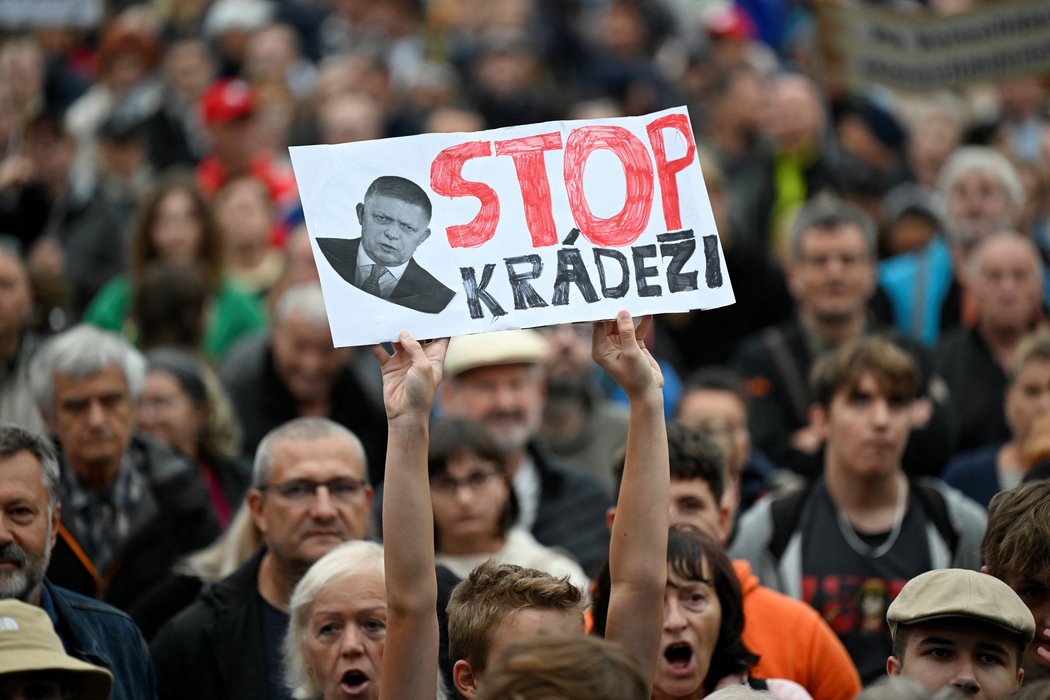
On 23rd September 2025, thousands of protesters gathered in 19 cities across Slovakia to oppose Prime Minister Robert Fico’s austerity measures and pro-Russian stance. The demonstrations, organised by opposition parties, followed mass protests held in 16 cities on 16th September 2025, marking the third consecutive week of nationwide mobilisation.
Following the prime minister’s meeting with Russian President Vladimir Putin on 2nd September 2025, large-scale protests first erupted in Bratislava on 11th September 2025. The government’s proposed economic package, currently under parliamentary debate, includes higher health and social insurance contributions, increased income tax for higher earners, partial rises in food taxes, and the cancellation of up to three national holidays.
Trade unions and opposition parties have announced further protests in the coming weeks, with a major demonstration planned for 17th November, the anniversary of the Velvet Revolution and one of the national holidays the government has proposed to abolish.
Freedom of Association
Constitutional Court reviews “Russian-style” NGO law
The liberal opposition party Progressive Slovakia successfully petitioned the Constitutional Court to review the constitutionality of the government’s amendments to the Non-Profit Organisations Act, unveiled on 28th May 2025. The Constitutional Court declined to suspend the law’s implementation. On 15th August 2025, Slovak Ombudsman Róbert Dobrovodský announced that he had also filed a motion seeking constitutional review, arguing that parts of the amendments undermine freedom of association, restrict civil society participation in public life, and introduce disproportionate state interference amounting to “spying.”
As outlined in the previous CIVICUS Monitor update on Slovakia, the amendments require NGOs to disclose funding sources and the identities of major donors, with penalties including fines and possible dissolution for non-compliance. The legal watchdog Via Iuris has described the law as “Russian-style,” warning that it could be used to silence critical voices, mirroring similar legislation adopted in Russia.