This update covers developments relating to the freedoms of expression, association and assembly in Ecuador from late August to late October 2025.
Peaceful Assembly
Crackdown on Indigenous-led protests
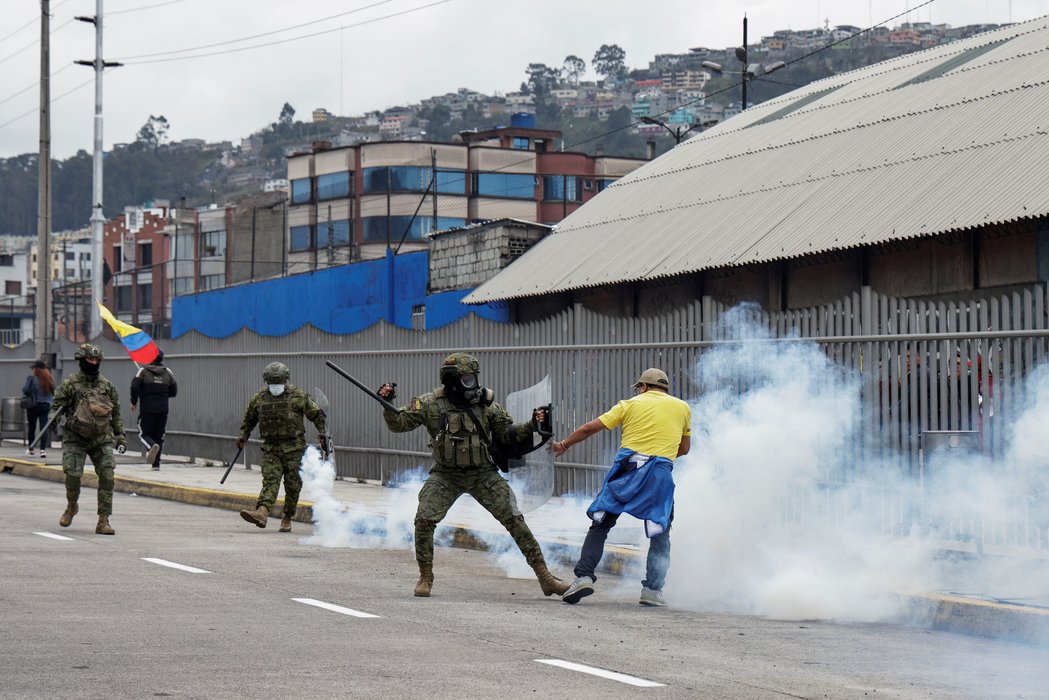
In September and October 2025, peaceful Indigenous-led protests were met with excessive and lethal force after authorities declared emergency powers and deployed thousands of armed forces personnel. The protests formed part of a 31-day nationwide strike (“paro nacional”), a major wave of demonstrations led by Indigenous movements and centred mostly in the Andean highlands, after President Daniel Noboa scrapped the diesel subsidy, raising prices by over 50 per cent and impacting Indigenous and rural communities.
Security forces reportedly killed at least two Kichwa Indigenous community leaders from Imbabura province: Efraín Fuérez, from Cotacachi, shot in the back on 28th September, and José Guamán, from Otavalo, fatally shot in the chest on 14th October. On the same day, Rosa Paqui Seraquive, an older woman from the Kichwa Saraguro people, died from asphyxiation after exposure to tear gas that authorities deployed indiscriminately.
The violent crackdown also left nearly 500 people injured (including at least 25 seriously injured and 12 military personnel), and over 200 arbitrarily detained, while the human rights organisation Alianza de Organizaciones por los Derechos Humanos del Ecuador documented at least 16 cases of short-term enforced disappearance. Authorities also reportedly disrupted internet and mobile services in Cotacachi, Otavalo and La Esperanza.
Alongside the violent repression, public officials and some media outlets promoted narratives linking Indigenous organisations and community guards (“guardias indígenas”, community-based self-protection groups rooted in Indigenous governance systems) to terrorism and organised crime, fuelling stigmatisation and criminalisation.
Association
Indigenous leader Leonidas Iza investigated following community justice proceedings
On 3rd September 2025, Indigenous leader and human rights defender Leonidas Iza appeared before the Cotopaxi Provincial Prosecutor’s Office in Ecuador in connection with a criminal investigation for alleged kidnapping. Iza is a prominent leader of the Confederation of Indigenous Nationalities of Ecuador (CONAIE), one of the country’s main Indigenous organisations.
The case relates to events in August 2025, when members of the Indigenous community of San Ignacio (Toscazo parish, in the Andean province of Cotopaxi) detained three people later identified as officers from the National Intelligence Unit for Citizen Security and Public Order, a state body tasked with intelligence and surveillance operations. According to community members, the officers had repeatedly driven past Iza’s home while filming and taking photographs, which raised concerns about possible surveillance.
Community members held the people for three days under an Indigenous justice process, a system recognised under Ecuador’s Constitution that allows Indigenous authorities to administer justice within their territories according to their own norms and procedures. During the proceedings, community members reportedly examined the officers’ mobile phones and identified material indicating surveillance of Indigenous leaders, including references to monitoring activities targeting Iza.
On 21st August 2025, following a public hearing attended by community members, as well as representatives of the Ombudsman’s Office and the Red Cross, Indigenous authorities found the officers responsible for entering the territory without authorisation and ordered them to issue a public apology before releasing them.
In parallel, the National Police filed a criminal complaint for kidnapping, and the ordinary justice system granted a habeas corpus request on behalf of the officers. Prosecutors subsequently summoned Iza to provide testimony. The Attorney General’s Office confirmed that the officers had operated in the area as part of an investigation but did not clarify its scope.
According to Front Line Defenders, the proceedings take place in a context of repeated legal actions against Iza linked to his role in Indigenous mobilisation and protest. He has faced several investigations and prosecutions in recent years, including detention during the 2022 nationwide strike, a major protest movement led by Indigenous organisations in response to economic policies.
[DENUNCIA PUBLICA]
— Leonidas Iza Salazar (@LeonidasIzaEc) August 19, 2025
La tarde del lunes 18 de agosto, aproximadamente a las 14:40 horas tres agentes de inteligencia fueron interceptados en los exteriores de mi vivienda en la comunidad San Ignacio, sector Planchaloma de la parroquia Toacaso, provincia de Cotopaxi, mientras… pic.twitter.com/Vgi78CeYDF
Bomb threat disrupts Constitutional Court proceedings amid pressure
On 19th September 2025, the Constitutional Court, the country’s highest body for constitutional review, suspended proceedings after the National Police evacuated its premises following an alleged bomb threat. The disruption occurred amid reports of increasing pressure on the Court. Civil society organisations described interference with its normal functioning, public stigmatisation campaigns targeting its members and a reduction in previously granted security measures. These developments have contributed to a climate of intimidation affecting judicial actors.
The events took place as the government advanced plans to hold a referendum to convene a Constituent Assembly, a process intended to draft a new constitution. The proposal has generated debate over compliance with existing constitutional procedures and the protection of judicial independence within Ecuador’s institutional framework.
In response, civil society organisations raised concerns about external pressures on the Court and called for measures to ensure that it can operate independently and without interference, intimidation or threats.
New legal framework expands state oversight of civil society
On 27th August 2025, President Daniel Noboa enacted the Organic Law on Social Transparency (Ley Orgánica de Transparencia Social, LOTS), establishing a new regulatory framework for civil society organisations, with excessive registration and compliance requirements.
For example, the law requires all existing organisations to re-register within 180 days through a newly created Unified Social NPO Information System. As reported by the International Centre for Not-For-Profit Law (ICNL), this requirement, affecting more than 71,000 organisations, places a significant administrative burden on the sector. The law does not specify whether organisations may continue operating if their applications remain pending after the deadline, which creates uncertainty and raises concerns about the risk of suspension of activities.
The framework also introduces broad registration requirements that allow authorities to request detailed legal, financial and operational information without clearly defined criteria. By leaving key aspects to secondary regulation, the law grants wide discretion to administrative bodies and increases uncertainty for organisations seeking to comply.
At the same time, the law expands the powers of the Superintendency of the Popular and Solidarity Economy, which may request information on internal governance, compliance systems and management policies at any time and without defined limits. These provisions enable a level of oversight that may affect organisational autonomy.
The law establishes strict sanctions for non-compliance. Organisations that fail to re-register within the prescribed timeframe risk losing their legal status and may be barred from operating. The framework also allows authorities to dissolve organisations on broadly defined grounds, including alleged threats to “public order” or “state security”, without clearly defined safeguards.
Authorities framed the legislation as strengthening anti-money laundering and counter-terrorist financing controls. However, the law applies uniform compliance obligations across the sector, including requirements to monitor and report “suspicious transactions”. This approach does not follow a risk-based and proportionate model of oversight.
Furthermore, on 27th October 2025, President Noboa issued the General Regulations to the LOTS, introducing specific provisions affecting CSOs, especially those working on environmental and mining-related issues, sectors where social conflict has been significant in recent years. The regulation prohibits organisations from intervening “directly or indirectly” in actions that obstruct or interfere with legally authorised mining projects. For example, under Article 4, authorities may suspend an organisation’s legal status for up to four years for non-compliance.
🇪🇨"As civil society members, we believe this law is unconstitutional and must be challenged" says Vivian Idrovo of @DDHH_Alianza on Ecuador’s new Organic Law on Social Transparency 🔗https://t.co/xTPE2a5tY7 #CIVICUSLens @CorteConstEcu pic.twitter.com/ZahmfLshz6
— CIVICUS (@CIVICUSalliance) September 19, 2025
Dozens of organisations affected by account freezes
Since September 2025, the Superintendency of Banks have frozen the bank accounts of several environmental and Indigenous organisations under alleged anti-money laundering investigations led by the Financial and Economic Analysis Unit (UAFE), often based on confidential “intelligence” reports. Affected organisations said they cannot access or challenge the evidence alleged in these reports, highlighting the risk of financial controls being abused against civil society.
On 27th September 2025, during the 2025 national strike, the Pachamama Foundation reported that its accounts were frozen and a criminal investigation opened against its president. Similar actions have affected at least 27 organisations. According to the European Union System for an Enabling Environment (EU SEE), a consortium of international civil society organisations and network members in 86 countries, “these measures, taken unilaterally and without following the proper judicial procedure, represent a serious violation of the right to freedom of association and assembly; furthermore, they constitute a setback in the protection afforded to Ecuadorian CSOs against external interference and in their ability to access resources.”
⭕ Gobierno de #DanielNoboa bloquea cuentas bancarias de la #CONAIE.
— CONAIE (@CONAIE_Ecuador) September 24, 2025
Denunciamos el bloqueo arbitrario de nuestras cuentas bancarias y organizaciones de nuestra estructura, ejecutada por la @superbancosEC bajo órdenes del gobierno. La medida, sin orden judicial ni debido… pic.twitter.com/MkGmgnas70
Expression
Journalist shot while covering protests
On 14th October 2025, during the nationwide strike (see Peaceful Assembly), community journalist Edison Muenala (Atuk Wayra), a Kichwa journalist and audiovisual producer for APAK TV, was injured by a gunshot to the shoulder while covering demonstrations in Otavalo, a city in the northern province of Imbabura. The incident occurred while he was broadcasting live, and images of the injury circulated on social media. Reports indicated that security forces were responsible for the shooting and that they deployed tear gas, stun grenades and firearms during demonstrations.
Following the incident, responders took Muenala to a health centre in Peguche, a nearby Indigenous community. Access restrictions linked to a military cordon later required his transfer to Cotacachi, another town in the same region, for further treatment.
Press freedom organisations documented a broader pattern of violations during this period. The Ecuadorian press freedom organisation Fundamedios recorded at least 49 attacks against journalists and media workers over 23 days, including harassment, threats, physical assaults, obstruction of reporting and restrictions on access to information.
The Articulation Platform for the Protection of Journalists (MAPP), a coalition of media and civil society organisations, condemned the attack and raised concerns about the risks faced by journalists, particularly those reporting on protests and other matters of public interest.
🔴La @MAPP_EC expresa su más enérgico rechazo y condena por la agresión hacia Edison Muenala, periodista comunitario kichwa y productor audiovisual de @ApakTv, quien transmitía, en vivo, la cobertura del #ParoNacionalEC . https://t.co/7LHFKwyNxo pic.twitter.com/R1TdKcORkT
— Fundación Periodistas Sin Cadenas (@SinCadenasECU) October 15, 2025
Broadcast temporary suspensions of community media
On 23rd September 2025, the Agency for Regulation and Control of Telecommunications (Arcotel) ordered the temporary suspension of broadcasts of the community television channel TV MICC, citing concerns related to “public order and national security”. TV MICC, established in 2009 by the Indigenous and Peasant Movement of Cotopaxi (MICC), operates as the first Indigenous television channel. It broadcasts in Kichwa and Spanish and serves Indigenous communities in the central highlands, including by covering local issues and social mobilisation.
The measure affected Channel 47 (UHF) across several cities in central Ecuador, including Latacunga, Salcedo, Ambato, Cevallos, Quero, Pelileo and Tisaleo. Authorities adopted the decision in the context of a nationwide strike (see Peaceful Assembly). They relied on Article 180 of the Organic Administrative Code, which allows the adoption of provisional protective measures.
Following the suspension, the MICC rejected the measure and stated that it restricts freedom of expression and the right to community communication. The organisation argued that the decision sought to silence Indigenous voices during a period of protest and called for the immediate restoration of the signal. Civil society organisations also expressed concern that broadly defined national security grounds may be used to justify restrictions on community and alternative media.
In October 2025, Arcotel also temporarily suspended the signals of community media outlets Radio Ilumán and Radio Inti Pacha.
Digital outlet reports coordinated online attacks disrupting reporting
On 8th September 2025, the digital news outlet KLN, based in Santa Elena province on Ecuador’s coast, reported coordinated online attacks that disrupted its ability to publish and distribute content. According to its director, Cristian Plúas, networks of inauthentic social media accounts repeatedly reported the outlet’s posts, leading to the rapid removal of videos from Facebook, often within minutes of publication. Plúas stated that the attacks targeted the outlet as a whole rather than specific content, with all material subject to takedown. He also noted that the accounts involved frequently changed names, making it difficult to identify those responsible.
The interference extended beyond content removal. Members of the KLN team reported that their WhatsApp accounts were blocked following waves of messages from foreign numbers, which disrupted internal communication. The incident also affected people who shared KLN’s reporting, including activists.
KLN noted that the attacks coincided with the publication of investigative reports concerning the Santa Elena Prefecture and the Municipality of La Libertad (local government authorities), raising concerns about a possible coordinated effort to restrict reporting on local governance. Earlier in the same month, the press freedom organisation Fundamedios documented the removal of at least 25 pieces of KLN content.