Introduction
Republika Srpska moves to criminalise glorification of Ustasha symbols
On 17th March 2026, the National Assembly of Republika Srpska adopted a resolution condemning and seeking to ban the glorification of Ustasha symbols and the Independent State of Croatia (NDH), a World War II–era puppet state established in occupied Yugoslavia by the fascist Ustasha movement.
The resolution mandated the government to draft amendments to the Law on Cemeteries and the Criminal Code within 60 days, which would legally regulate the removal of monuments and symbols deemed to be glorifying the Ustasha and NDH, as well as introduce criminal responsibility for those who, “through means of public communication in a public place or in another way, publicly promote, glorify, support or encourage positive evaluation or acceptance” of those groups.
While the resolution was adopted unanimously, an MP from the Party of Democratic Action (SDA), a Bosniak minority party, reported that the ruling coalition had refused to add language condemning Chetnik ideology – referring to the Serbian nationalist and royalist guerrilla forces in WWII that had engaged in collaboration with the Axis powers.
The move comes amid tensions over a planned gathering of former Croatian Defence Council (HVO) fighters in the city of Derventa, in Republika Srpska, on 21st March. The commemoration, linked to a disputed monument shaped like the Ustasha “U” symbol, has escalated into a broader political issue. Republika Srpska is a majority-Serb administrative entity within Bosnia and Herzegovina, and the Croatian Defence Council was the main military formation of Bosnian Croats during the 1990s Bosnian war. A number of court verdicts have found Croatian Defence Council fighters guilty of war crimes committed against Serbs in Derventa.
On the other hand, the Croatian community in Derventa sees the monument as commemorating Croats who disappeared, fled, and were expelled from Derventa during the hostilities. Reacting to calls for the monument’s removal, a representative of an association of former HVO fighters told Deutsche Welle the organisation would “not allow the removal of the memorial to Croatian victims, nor the erasure of traces of Croatian survival in these regions.”
Freedom of association
On 2nd February, the Cantonal Court in Sarajevo issued the first final ruling in Bosnia and Herzegovina recognising discrimination based on sexual orientation, gender identity, and sex characteristics. The case, which was brought by CSO Sarajevo Open Centre, concerned statements made by former Sarajevo Canton Assembly member Samra Ćosović Hajdarević.
Commenting on the announcement of the country’s first Pride march in 2019, Ćosović Hajdarević wrote on Facebook: “Everyone has the right to live the life they want, and we also have the right to choose whom we want to live with. I want people like this to isolate themselves and stay as far away from our children and society as possible. Let them go somewhere else and create their own city, state, laws, and rights that no one will challenge. But NOT here!”
Confirming a 2022 ruling by a lower court, the 2nd February decision found these statements constituted discrimination and incitement to hatred. The Centre described the decision as a turning point for human rights protection in Bosnia and Herzegovina, noting that the court confirmed for the first time that sexual orientation, gender identity, and sex characteristics are valid and applicable grounds for protection against discrimination. Although these grounds were introduced into the Law on the Prohibition of Discrimination in 2009, it took nearly 17 years for the first final judgment to be issued.
Freedom of peaceful assembly
Deadly tram accident sparks protests
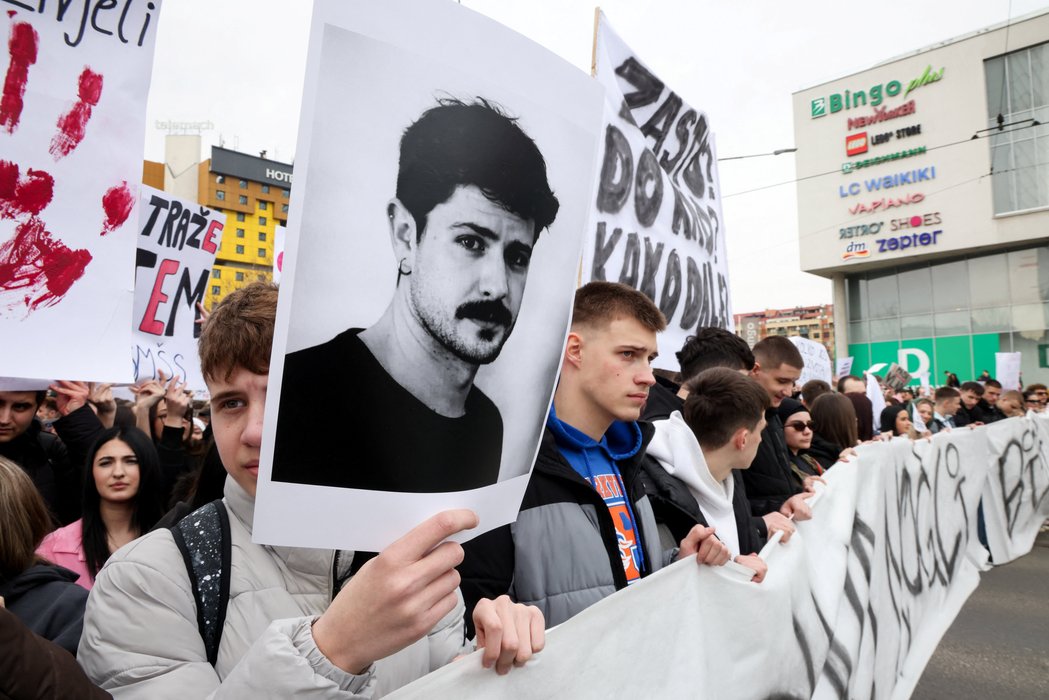
A series of protests took place in Sarajevo in February 2026 after a tram derailed near the National Museum on 12th February, crashing into a station and killing a 23-year-old student, Erdoan Morankić. Four others were injured, including a 17-year-old girl who sustained serious injuries. The day after the accident, several hundred people gathered near the site of the tragedy to lay flowers and light candles.
On 14th February, thousands of citizens, including many young people and students, protested in central Sarajevo, blocking main roads and marching towards the Sarajevo Canton Government, demanding accountability and urgent measures to improve public transport safety. Demonstrators called for resignations, a transparent investigation into the accident, the repair of public transport infrastructure, and broader safety-focused reforms in the municipal public transit company GRAS and the tram system. The Prime Minister of Sarajevo Canton, Nihad Uk, resigned the following day, causing the collapse of the cantonal government. The director of GRAS, Senad Mujagić, also resigned soon after under public pressure.
On 15th February, a court denied prosecutors’ request to remand the tram driver into custody. Fellow tram drivers staged multiple protests in support of their colleague, maintaining that the accident was caused by a technical fault in the tram that caused the vehicle to accelerate and prevented him from slowing down. The driver also professed his innocence, claiming that video footage from onboard the tram would exonerate him. Concerns over the integrity of the investigation further fuelled public anger. Authorities stated that no video footage was available from the tram, as the onboard recording system had reportedly not been functioning since 29th November 2025. Prosecutors reported that dozens of witnesses had been questioned and surveillance footage from nearby buildings had been collected, and that they continued to assert that the accident was caused by human error.
Protests continued in the following days. On 21st February, several thousand people took to the streets again, with the mobilisation largely driven by young people and students. Marching from the National Museum to the Cantonal Prosecutor’s Office, demonstrators demanded full transparency in the investigation and called for independent investigators, chanting “We want truth and justice.”
Patients protest sudden closure of fertility clinic
A group of patients protested on 27th January 2026 in Sarajevo after the sudden closure of a private fertility clinic left their stored embryos inaccessible.
The clinic, which had ceased operations in October 2025 without prior notice, was under investigation for irregularities. At the time, the inspectorate stated that irregularities had been found in meeting the conditions for storing biological material and in the maintenance of health records, while the responsible person at the institution was unavailable to inspectors.
Protesters gathered in front of the Federation Ministry of Health and the inspection authority, demanding that inspection authorities urgently assess the status of the stored embryos, ensure the protection of their biological material, and include patient representatives in decisions regarding the transfer of embryos to another facility.
CSOs raise concerns about anti-abortion protests near hospital entrance
Anti-abortion activists associated with the “40 Days for Life” initiative have been organising continuous gatherings since March 2025 at the entrance to the University Clinical Hospital Mostar. The initiative has announced that, as part of its Lenten campaign, a daily prayer vigil will be held in front of the hospital from 18th February to 29th March 2026. These vigils have been a subject of controversy, as civil society organisations and experts have raised concerns that the presence of protesters in close proximity to the gynaecology department places pressure on women seeking medical services, including abortion, and may interfere with their rights to privacy and access to healthcare.
In October 2025, CSOs, including Helsinki Citizens' Parliament Banja Luka, Transparency International BiH and the Sarajevo Open Centre, called on the Government of the Federation of Bosnia and Herzegovina, as the founder of the University Clinical Hospital Mostar, to take urgent measures to ensure that activities creating pressure on patients and healthcare workers do not take place within hospital premises.
The request proposed that the authorities instruct hospital management to prevent the use of hospital premises for activities that undermine gender equality and patients’ rights, and to issue clear guidelines to protect patients from harassment and discrimination when exercising their reproductive rights. However, the organisations reported that they had not received any institutional response or recommendations to resolve the issue.
In February 2026, the Gender Centre of the Federation of Bosnia and Herzegovina, a public body responsible for overseeing the implementation of the Law on Gender Equality, responded to a request from Helsinki Citizens' Parliament Banja Luka to assess the implications of the case for public institutions’ obligations under the law. The Centre found a violation of the Law on Gender Equality, stating that campaigns against abortion held in or near healthcare facilities can result in “psychological pressure, stigmatisation, harassment and violation of the dignity of women, especially patients who cannot avoid passing by the campaign in order to access lawful abortion services”. It emphasised that, as abortion services are accessed exclusively by women, such activities have a disproportionate negative impact on them and thus can constitute indirect gender-based discrimination.
Freedom of expression
BHRT suspends broadcast to draw attention to funding crisis
On 26th February 2026, Radio and Television of Bosnia and Herzegovina (BHRT), the national public broadcasting service, temporarily suspended its broadcast to draw attention to persistent funding issues. The move followed a deadline set by the European Broadcasting Union (EBU) for authorities to address €11.28 million in outstanding debt.
The funding crisis facing BHRT stems from the fragmented and politically contested structure of public broadcasting in Bosnia and Herzegovina. The system consists of three broadcasters: the state-level BHRT and two entity-level broadcasters – RTV of the Federation of BiH and Radio Television of Republika Srpska (RTRS). Under the Law on the Public RTV System, entity broadcasters are required to transfer 50% of the licence fee revenue they collect to BHRT. However, in practice, this mechanism has largely collapsed. RTRS has refused to transfer its share since 2017, effectively depriving BHRT of a significant portion of its legally mandated income. Meanwhile, collection of the RTV licence fee in the Federation of BiH is inconsistent due to gaps in the legal framework at the entity level.
The EBU has called on the authorities in Bosnia and Herzegovina to urgently find a solution to ensure sustainable funding for BHRT. In a response to Radio Free Europe/Radio Liberty, it stated that extending deadlines beyond 28th February would not resolve the persistent structural issues that have led to the crisis, but would only prolong uncertainty and instability.
Attacks, public discreditation and pressure on media
Regional press freedom watchdog SafeJournalists Network recorded several incidents of physical attacks, discreditation and other pressures targeting media outlets and workers in Bosnia and Herzegovina in early 2026.
On 7th February 2026, journalist and editor-in-chief of the Spin.info portal, Sanja Vasković, was attacked while reporting on the construction of a swimming pool in East Sarajevo. At the construction site of the company “Uniotec”, Vasković was accosted and insulted by Ljubo Sladoje, the father of the company’s owner, who forcibly took her mobile phone.
According to the SafeJournalists Network, the responsible police department stated that Sladoje had been issued a misdemeanour warrant for insulting Sanja Vasković. He accepted responsibility, police said, and they are currently not treating the case as an attack on a journalist because, as they explained, “the threats and insults were not reported by an accredited journalist.”
On 4th February 2026, Mayor Mario Kordić publicly discredited the local outlet Mostar.live during a press conference. Addressing a journalist present in the room, he criticised the portal’s alleged inaccuracies, describing its reporting as irrelevant, and stating: “You are not journalists. You are in the service of some kind of politics and you do it because someone pays you.”
In a statement, the BH Journalists Association condemned the remarks, calling on officials to refrain from “inflammatory and unfounded” rhetoric towards the media and instead foster a more enabling environment for press freedom. The association warned: “Yesterday's verbal attack on journalists in Mostar is just one in a series of increasingly frequent cases in which political officials in Bosnia and Herzegovina use inflammatory and offensive rhetoric towards journalists and the media, deliberately creating an atmosphere of fear, insecurity and self-censorship. The conscious creation of such an environment by government representatives directly threatens the right of citizens to timely, accurate and pluralistic information.”
On 1st February 2026, it was reported that telecommunications company BH Telecom had removed Hayat, a group of television channels, from its offer due to an unresolved legal dispute over exclusive rights to distribute the signal. The decision triggered reactions from the public, media associations and political representatives across Bosnia and Herzegovina.
The BH Journalists Association condemned the move, stating that discrimination against media on political, commercial or similar grounds is unacceptable. It warned that such actions undermine public trust, restrict access to diverse sources of information of general interest, and further destabilise the media financially.
Weeks later, the dispute was resolved, and BH Telecom restored Hayat and other domestic television channels to the Moja TV platform.
On 21st January 2026 in Bijeljina, a crew from BN Television was attacked in front of the headquarters of the electric utility company “Elektroprenos BiH” while filming footage of a power line. Following a series of insults directed at the crew, a security guard physically assaulted the cameraman, S. N., punching him in the face and injuring his left cheek.
After the incident was reported, the Bijeljina Police Department located and fined the attacker for offences under Article 8 (Insulting) and Article 12 (Fighting and Physical Assault) of the Law on Public Order and Peace of Republika Srpska.