This report covers developments affecting freedom of expression, association, and peaceful assembly in Kazakhstan from January to June 2026. It was prepared by International Partnership for Human Rights (IPHR) and Kazakhstan International Bureau for Human Rights and Rule of Law (KIBHR) for the CIVICUS Monitor.
During the reporting period, civic space in Kazakhstan continued to deteriorate amid a constitutional reform process accompanied by increased pressure on critics, growing restrictions on independent media and online expression, and continued persecution of activists and opposition voices.
While the authorities presented the constitutional reform as a new stage of political modernisation, the process was rushed, non-transparent and non-inclusive, providing limited opportunities for meaningful public debate or civil society participation. Individuals who criticised the proposed constitutional changes, sought to promote public discussion about them, or disseminated independent information about the reform process faced intimidation and harassment, including detention, questioning, pressure to remove online content, administrative penalties and, in some cases, criminal charges. Among those targeted for criminal prosecution was lawyer Orazaly Erzhanov, who was sentenced to four years of restricted freedom for advocating a “smart boycott” of the constitutional referendum.
Opposition activist and former political prisoner Yermek Narymbay also faced criminal charges in connection with his public statements on the constitutional reform, while blogger Elmar Uakhit was prosecuted over a social media post inviting public discussion of a proposal put forward by the Minister of Justice during the reform process. The trials of Narymbay and Ukahit began in June 2026.
Journalists covering the referendum, and civil society representatives monitoring the vote reported interference with their activities.
Restrictions on independent media and online expression intensified further during the reporting period. Several independent news websites were targeted by cyberattacks during the constitutional reform campaign, while the websites of Radio Free Europe/Radio Liberty (RFE/RL) became inaccessible across Kazakhstan shortly after the publication of an investigation linking relatives of President Tokayev to a company awarded major government contracts. The authorities denied responsibility for the disruption, but concerns persisted about politically motivated restrictions on access to information.
Independent media, civil society organisations (CSOs) and activists also reported a growing number of incidents involving the removal of online content or suspension of social media accounts following apparently coordinated complaints alleging copyright infringements or other violations of platform rules. These developments reinforced concerns about the use of both state and non-state mechanisms to suppress critical reporting and public debate.
Moreover, the broadly worded Criminal Code provision on the dissemination of “false information” was increasingly used against journalists, bloggers and civic activists. Among those affected was Orda.kz editor-in-chief Gulnara Bazhkenova who was prosecuted on “false information” charges, widely viewed as retaliation for her investigative reporting following a raid of the outlet’s offices in December 2025. Throughout the reporting period, she remained under house arrest. With the trial set to start in early July 2026, she is now facing additional charges of illegal entrepreneurship and embezzlement. A controversial decision to strip lawyer Murat Adam of his licence after he spoke out about procedural violations in Bazkenova’s case was upheld on appeal in March 2026, despite criticism by the legal community.
KazTAG’s editor-in-chief, Amir Kassenov, and the outlet’s director, Aset Matayev, went on trial in June 2026 on charges of the dissemination of “false information” and improper performance of managerial duties, respectively, related to the outlet’s coverage of alleged misconduct by an influential company. Matayev also faced “hooliganism” charges over an incident in which he was himself assaulted by unknown individuals. Only after the trial had begun was he recognised as a victim in that case.
Independent journalist Botagoz Omarova was prosecuted for disseminating “false information” over social media posts concerning a company contracted by the presidential administration, but her case was eventually closed after she published a rebuttal. Civic activist Ayazhan Mameshova and lawyer-blogger Adiletkhan Moldakhan faced “false information” proceedings over public commentary on alleged abuses affecting vulnerable children and allegations of official misconduct, respectively.
The similarly broadly worded provision on “inciting discord” was also used to suppress peaceful criticism and engagement. Following a non-transparent trial, 19 individuals associated with the Atajurt movement were convicted on such charges in April 2026 over a peaceful protest against the persecution of ethnic Kazakhs in China’s Xinjiang region and China’s growing influence in Kazakhstan. The charges against them were initiated following a Chinese diplomatic note, raising serious concerns about external influence on the administration of justice. Eleven activists received prison sentences, while others were handed non-custodial restrictions. Their convictions were upheld on appeal in June 2026 despite criticism of the charges from human rights organisations and international experts.
#Kazakhstan: The conviction of 19 people over a peaceful anti-China protest shows how criminal law is used to suppress legitimate civic engagement. Authorities should urgently review these convictions and ensure justice in the case! 👉See joint IPHR-KIBHR statement: iphronline.org/articles/kaz...
— IPHR (@iphr.bsky.social) 1:45 PM · Apr 14, 2026
[image or embed]
Several other individuals linked to the Atajurt movement have also faced detention, questioning and prosecution. In late June 2026, Batikha Bilashi, the sister of the exile-based founder of the Atajurt movement, Serikzhan Bilash, was detained on spurious fraud charges related to payments she had received on behalf of her brother. The circumstances of the case raised serious concerns that she was being targeted because of her family ties, with her brother being a prominent advocate for the rights of ethnic Kazakhs in Xinjiang.
In another case, Atajurt activist Gulnaz Serikbayeva went on trial in May 2026 on charges of “inciting inter-ethnic discord” linked to her social media activity. The trial concluded with her conviction and a three-year prison sentence, which she and her fellow activists considered to be retaliation for her civic engagement. Shortly before her criminal prosecution, Serikbayeva was given an administrative penalty over a social media post calling on supporters of imprisoned opposition activist Marat Zhylanbayev to gather outside the prison where he is held amid serious concerns about his safety and well-being. Zhylanbayev, leader of the Alga Kazakhstan! party, continued to serve a seven-year prison sentence imposed on extremism-related charges, which human rights defenders consider politically motivated.
In a case mirroring that against Zhylanbayev, his fellow activist Amangeldy Jahin was similarly sentenced to seven years in prison on extremism-related charges in June 2026 following closed proceedings. The same month, another party activist, Elvira Bekzadina, was sentenced to two years’ imprisonment on charges of allegedly insulting and using violence against a law enforcement officer relating to an incident in which police reportedly attempted to take away her daughters without explanation and detained and ill-treated the family when she sought to protect them.
At the same time, Alga Kazakhstan! continued to be denied registration, with the 26th rejection suffered by the movement upheld on appeal in April 2026. As no opposition political parties have yet been granted registration, such parties will be unable to participate in the upcoming elections to the new unicameral parliament introduced under the constitution approved through the March referendum. The election date has been set for 23rd August 2026.
In another criminal case prompting concerns about restrictions on both freedom of expression and freedom of religion, Orthodox priest Yakov Vorontsov was prosecuted on drug-related charges that he and his supporters described as fabricated and retaliatory. The circumstances of the case suggest that he was targeted because of his opposition to Russia’s war against Ukraine and his efforts to establish an independent Orthodox community in Kazakhstan. Initially placed in pre-trial detention, he was forcibly transferred to a psychiatric institution in May 2026 despite the absence of any diagnosis justifying such a measure and amid serious due process concerns.
#Kazakhstan authorities should never use psychiatry as a form of coercion against people and should immediately withdraw the grounds used to justify Yakov Vorontsov’s forced psychiatric detention and mental health examination and release him, HRW said. www.hrw.org/news/2026/05...
— Mihra Rittmann (@mihrarittmann.bsky.social) 10:33 AM · May 29, 2026
[image or embed]
The entry into force in March 2026 of legislation banning so-called LGBTQI+ propaganda, which was adopted despite widespread domestic and international criticism, further narrowed space for free expression and advocacy on LGBTQI+ issues. In a case illustrating the negative implications of the ban, an online resource devoted to information and analysis on LGBTQI+ issues was blocked for allegedly disseminating prohibited propaganda. Organisations and activists working on LGBTQI+ rights also faced increasing pressure. The REQUEST initiative continued to be denied registration, while Feminita co-founder Zhanar Sekerbayeva was fined following a complaint filed by a prominent anti-LGBTQI+ activist.
The reporting period also saw renewed efforts to tighten oversight of CSOs receiving foreign funding. The constitution approved through the March referendum specifically requires CSOs to publicly disclose all foreign funding. In addition, while new regulations that entered into force in January 2026 already increased reporting obligations and expanded the powers of tax authorities to inspect organisations receiving foreign grants, members of parliament called for additional measures to strengthen oversight of such organisations.
During the reporting period, authorities maintained a highly restrictive approach toward peaceful assembly. Requests to hold assemblies continued to be denied on dubious grounds amid a lack of transparency surrounding the consideration of such requests, while monitoring showed that even obtaining official authorisation did not necessarily guarantee that an assembly could proceed without interference. As organised peaceful protests have become increasingly rare due to the persistent clampdown, authorities increasingly targeted individuals expressing grievances in public settings – including on social media – on labour rights, environmental protection, the treatment of political prisoners and other issues of public interest.
Concerns regarding transnational repression persisted during the reporting period. Two years after the killing of opposition journalist Aidos Sadykov in Kyiv, accountability remains elusive, with Kazakhstani authorities failing to cooperate effectively with the Ukrainian investigation. His widow, journalist Natalia Sadykova, continued to report intimidation and surveillance, while legal proceedings initiated against her for alleged defamation raised further concerns about attempts to silence critical voices beyond Kazakhstan’s borders.
Recent developments are covered in more detail in the full update below.
Constitutional reform process
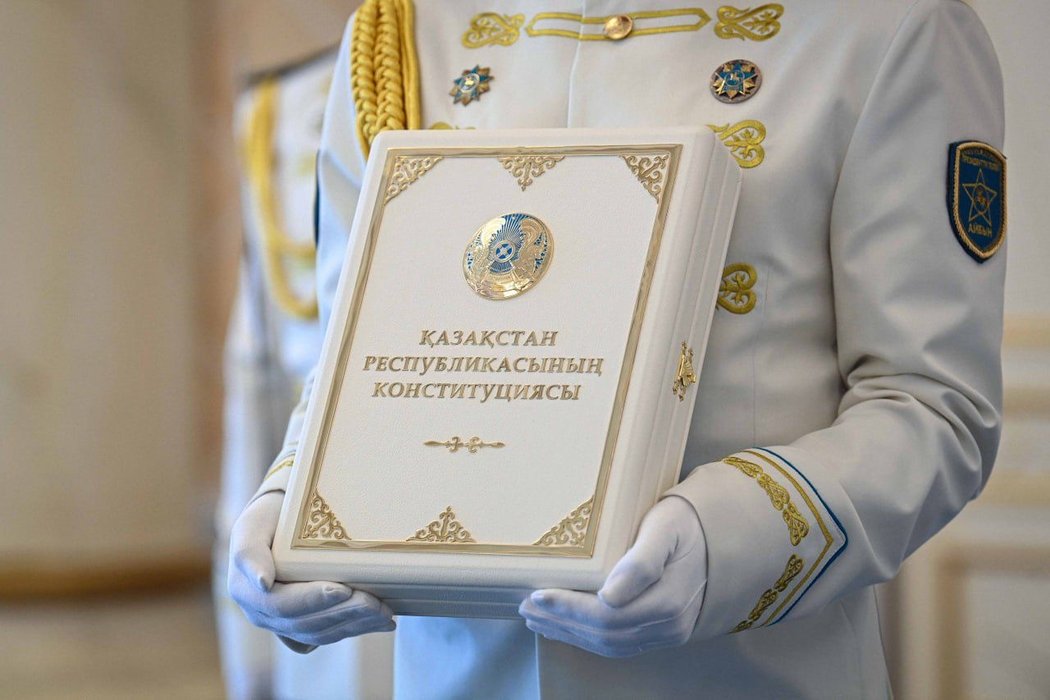
In mid-January 2026, President Kassym-Jomart Tokayev launched a constitutional reform presented as a new step toward political modernisation following earlier reforms introduced after the January 2022 events, when authorities used excessive and lethal force to put down mass protests and unrest (see previous special update). A constitutional commission set up to prepare the new reform swiftly produced a sweeping package of amendments, with a new draft constitution presented on 31st January. Less than two weeks later, a final draft was published and a nationwide referendum scheduled for 15th March.
According to official information, the proposed new constitution was approved by over 87 percent of voters in the referendum. It enters into force on 1st July 2026.
While the new constitution has been described as modernising the political system, commentators have pointed out that it cements powers in the executive branch without providing for adequate checks and balances. The president is also granted strengthened powers in some areas, such as the dismissal of the parliament and the appointment of key officials.
A key change introduced by the new constitution is the merger of the two previous parliamentary chambers into a unicameral parliament. The new parliament will be elected entirely through party lists, without any opportunity for self-nominated candidates to participate, which has prompted concerns that the electoral process will be even more tightly controlled given the absence of any registered opposition parties. The first elections to the new parliament are expected to take place in August 2026.
Human rights defenders highlighted that some provisions of the new constitution risk weakening human rights protections. These include provisions that omit a previous guarantee for the precedence of international law over national law and broaden the grounds for restricting human rights beyond those permitted by international treaties.
Human rights defenders also raised concerns that the rushed, non-transparent and non-inclusive process leading up to the adoption of the new constitution provided little opportunity for meaningful public debate or civil society participation. An assessment mission from the OSCE Office for Democratic Institutions and Human Rights echoed these concerns.
Expression
Attempts to promote debate on constitutional reform met with intimidation, harassment
In an alarming development, individuals who criticised the draft constitution (see more above), sought to promote public discussion about it, or shared independent information about the reform process faced intimidation and harassment. In several dozen documented cases, such individuals were subjected to detention, questioning, pressure to remove online content, as well as prosecution on spurious grounds. Most of those targeted for prosecution were fined or sentenced to short-term deprivation of liberty for alleged administrative offences, such as violations related to public opinion polling or the dissemination of “false information”.
However, in some cases, criminal charges were initiated against critics of the constitutional reform process. In a case of particular concern, lawyer Orazaly Erzhanov was arrested in February 2026 and charged with allegedly “obstructing the exercise of electoral rights” under a Criminal Code provision applied for the first time. These charges related to his efforts to advocate a “smart boycott” of the referendum by encouraging fellow citizens to seek temporary exclusion from voter lists. After being held under house arrest for almost three months, he was convicted on 22nd May 2026 and sentenced to four years of restricted freedom, entailing restrictions on his movement, along with a five-year ban on engaging in public activities.
In another troubling case, opposition activist and former political prisoner Yermek Narymbay was accused of disseminating “provocative materials” related to the referendum and charged with failure to comply with a court judgment over his public statements about the proposed constitutional reform. The criminal charges stemmed from an alleged violation of a ban on engaging in public activities that had been imposed by a court as part of the activist’s earlier conviction on charges of inciting discord, which was widely considered politically motivated. They followed several earlier administrative penalties imposed for the same alleged violation. Narymbay was detained in Kyrgyzstan and returned to Kazakhstan in connection with the new charges against him. The trial against him began in June 2026, while he remained in detention.
In a third case, blogger Elmar Uakhit (Uakhituly) was charged with knowingly disseminating “false information” under a broadly worded Criminal Code provision frequently used against critics (see more below). The charges related to a social media post about a proposal by Minister of Justice Yerlan Sarsembayev to introduce a separate legal status for certain territories of the country as part of the constitutional reform. In the post from January 2026, Uakhit said: “Justice Minister Sarsembayev is proposing a separate legal status for the northern regions. Who knows? What does he mean?”, inviting his followers to comment. Following a complaint from Sarsembayev, Uakhit first faced administrative charges over the post, but a local court dismissed them. However, later criminal proceedings were initiated instead, and the blogger was placed in pre-trial detention in April 2026. His trial began in June 2026.
Moreover, restrictions on online content relating to the constitutional reform process were reported during the pre-referendum period.
On the day of the referendum, several journalists were detained without explanation when covering the vote in Astana, prompting concerns about undue interference with their journalistic activities. They were eventually released without charge. In Almaty, at least four people were rounded up at a central square following a call by exiled opposition figure Mukhatar Ablyazov to his supporters to gather there. One of them was reportedly injured due to the use of force by plainclothes officials detaining him. They were also later released without charge.
In a further worrying development, civil society representatives monitoring the referendum reportedly faced obstruction in a number of cases, including removal from polling stations and intimidation.
Suppression of peaceful expression on matters of public interest
The following cases also raise concerns about the suppression of peaceful expression and engagement on matters of public interest.
In May 2026, opposition activist Marat Zhanuzakov was detained in Astana after publishing a post highly critical of Russian President Vladimir Putin and expressing support for Ukraine on the day of Putin’s state visit to Kazakhstan. The post featured a photo of himself in front of the Ukrainian flag holding a poster saying (in Russian): “Hey, scum! Get out of Kazakhstan! Glory to Ukraine!” He was released later the same day after police reportedly asked him to delete the post. Zhanuzakov declined to do so immediately, stating that he would consider the request.
Environmental activist Abay Yerekenov was detained after attempting to speak at public hearings held in Almaty in May 2026 concerning the controversial Almaty Superski mountain tourism project, which includes the proposed development of a ski resort in the Kok-Zhailau area. Organisers reportedly sought to prevent critics of the project from speaking. When Yerekenov attempted to ask a question, police officers removed him from the venue at the organisers’ request and took him to a police station, where he was held until the evening. Later the same day, he was fined on charges of “disobeying a lawful order or demand of a law enforcement officer.”
Increasing restrictions on online content
During the reporting period, the alarming trend of increasing restrictions on independent online content, highlighted in the previous update, continued.
In February 2026, several independent news sites experienced targeted cyber-attacks in connection with their coverage of the constitutional reform process, rendering their sites temporarily unavailable. For example, the website of the KazTAG news agency became inaccessible shortly after publishing an interview with an expert critical of the proposed changes.
In mid-May 2026, the azattyq.org and azattyqasia.org websites operated by RFE/RL stopped opening across the country following the publication of an investigation linking relatives of President Tokayev to a construction company awarded major government tenders. At the time of writing, the sites remained unavailable. Internet providers stated the disruption was not attributable to their services, while the Ministry of Culture and Information denied any involvement in restricting access.
In another troubling development, the popular independent YouTube channel Airan ceased operations in March 2026 after their sponsors reportedly came under pressure to withdraw their funding.
Moreover, a growing number of independent media outlets, civil society organisations, journalists, bloggers and activists reported the suspension or removal of their social media accounts or content following apparently coordinated and unsubstantiated complaints alleging copyright infringements or other violations of platform rules. In the period leading up to the constitutional referendum, at least 20 such incidents were documented. For example, Respublika.kz.media reported that over 50 of its Facebook posts concerning the new constitution and the referendum process were removed due to alleged copyright violations. KIBHR was also affected: a post on its Facebook page concerning the detention in Almaty of a critic of the referendum – which had garnered around 100,000 views – was removed based on an unfounded complaint.
After the referendum, additional cases of content removal and account restrictions were recorded. For example, in April 2026, the Facebook and Instagram accounts of the KazTAG news agency and the Legal Media Centre were blocked due to alleged violations of community standards. Later, in May 2026, Meta and Google removed materials from their platforms related to the RFE/RL investigation mentioned above, citing complaints about alleged copyright violations.
“False information” cases
The broadly worded offence of “knowingly disseminating false information” (under article 274 of the Criminal Code) has increasingly been used to target independent journalists and bloggers. In practice, authorities often fail to demonstrate either the falsity of the information in question or that those accused knowingly disseminated false information, and such charges have also been initiated in relation to information based on publicly available or official sources.
In a joint letter addressed to President Tokayev in April 2026, a group of international media freedom and human rights groups raised concerns about a recent wave of arrests of journalists and bloggers on “false information” charges. Against the background of reports indicating that the Ministry of Culture and Information is examining possibilities for the partial decriminalisation of the relevant article, the organisations reiterated calls for a full abolition of it.
As covered in the previous update, Orda.kz’s chief editor Gulnara Bazhkenova was prosecuted for the alleged dissemination of “false information” following a raid of the outlet’s offices in December 2025. Human rights defenders expressed serious concern that these charges constituted retaliation for her investigative reporting on corruption and other issues sensitive to those in power. Throughout the reporting period Bazhkenova remained under house arrest, with the trial against her set to start in early July 2026. In accordance with the case handed over to court, she will be tried on charges of illegal entrepreneurship and embezzlement, in addition to “false information”.
In a related development, Bazhkenova’s lawyer Murat Adam was stripped of his licence to practise law in January 2026 after being accused of disseminating “incorrect” information about the case when reporting procedural violations and criticising the “false information” provision under which she was prosecuted. This move drew strong criticism from the legal community, as it was seen as aimed at penalising Adam for his legitimate representation of his client, in violation of international standards protecting the independence of the legal profession. However, despite this, the decision was upheld on appeal in March 2026.
In another case reported in the previous update, KazTAG’s chief editor Amir Kassenov and its general director Aset Matayev were charged with disseminating “false information” in December 2025 over publications alleging that the company Freedom Finance was involved in fraudulent schemes. The charges were initiated following a complaint filed by the company, which is headed by an influential business figure. While Kassenov remained under house arrest on these charges, they were later dropped in relation to Matayev. However, Matayev instead faced other charges in connection with KazTAG’s reporting on Freedom Finance, this time under a Criminal Code provision penalising the failure to properly perform managerial duties in a commercial organisation.
In March 2026, Matayev was additionally charged with “hooliganism” following an incident in which he was physically assaulted and injured by a group of men after an argument outside a bar. Human rights groups called for an impartial and thorough investigation into the incident, including the possibility that the attack was related to Matayev’s work. After initially being remanded to pre-trial detention on these charges, Matayev was transferred to house arrest. It was only in late June 2026 that he was recognised as a victim in the March incident, rather than as an alleged perpetrator.
In mid-June 2026, the trial of Kassenov and Matayev began in Almaty, with the different sets of charges combined into a single case. In addition to Kassenov, a key source of the information about Freedom Finance’s alleged misconduct was also tried on charges of disseminating “false information”. At the first hearing, the court ordered Kassenov to be remanded in pre-trial detention, citing alleged violations of the conditions of his house arrest, in particular a social media post in which he appealed to President Tokayev for support. The trial was ongoing at the time of writing.
Freedom Finance has also sued KazTAG for defamation, with a court ordering the outlet to delete several of its publications in February 2026.
In another case of concern, independent journalist and Telegram channel administrator Botagoz Omarova was charged with dissemination of “false information” and placed under house arrest in March 2026. The charges concerned her social media posts concerning the alleged failure of a company contracted by the presidential office to pay its subcontractors and workers. Later, in May 2026, the criminal case against Omarova was closed after she published a retraction and apology in relation to these posts. The same month RFE/RL’s local websites were blocked following the publication of an investigation concerning the same company (see more above in the section on “increasing restrictions on online content”).
In another case involving the use of the Criminal Code provision on “false information”, civic activist Ayazhan Mameshova went on trial on such charges in March 2026. The charges against her were initiated over social media posts highlighting alleged violations of the rights of children at an orphanage in Almaty. According to the activist’s lawyers, these allegations were based on extensive documentation, including official reports and testimonies from children living at the orphanage. At the same time, the prosecution did not present any evidence demonstrating that the information was false.
Lawyer and blogger Adiletkhan Moldakhan, who has more than one million followers on Instagram, was detained on charges of disseminating “false information” in March 2026. The charges followed his public commentary on a fatal traffic accident in Almaty, including allegations that senior police officials had protected members of the so-called “golden youth” – a term used to refer to privileged children of the political and business elite – from accountability. Two police officials whom he had publicly criticised were recognised as complainants in the case. Moldakhan’s trial began on 1st June 2026. According to media reports, he admitted guilt, and the case was expected to proceed under simplified procedures.
In March 2026, blogger Sanzhar Bokayev —known for his social media campaigning on development projects—was sent to pre-trial detention after being accused of spreading “false information” about tree felling to incite public outrage. He was, however, not charged under the corresponding Criminal Code provision but over alleged fraud and unlawful logging. Although the charges against him are not related to security issues, he is held in the detention facility of the State Committee for National Security. His colleague, video operator Ulan Nusipkozha is being held on the same charges.
As covered above (see the section on the constitutional reform process), blogger Elmar Uakhit faced “false information” charges over a social media post relating to a proposal made by the Minister of Justice during the constitutional reform process. In this post, he merely asked for clarification of what the proposal meant and invited his followers to discuss the issue.
In other cases, bloggers faced administrative penalties, including fines and short-term deprivation of liberty on charges of disseminating “false information”, defamation, or failing to obey the lawful demands of authorities following the publication of critical content.
LGBTQI+ propaganda ban enters into force
The new legislation banning so-called LGBTQI+ propaganda, which was adopted in December 2025 despite widespread criticism by civil society, international experts and the diplomatic community, entered into force in March 2026. Due to its broad wording, the publication of virtually any information relating to LGBTQI+ issues, as well as public expressions of support for people identifying as LGBTQI+ could be deemed prohibited propaganda under the law. Violations may result in restrictions on the operation of media outlets and online resources, as well as fines or short-term administrative detention.
In the first publicly reported case involving the application of the new legislation, lgbtpropaganda.kz, an online resource devoted to monitoring, analysis and awareness-raising about the “LGBTQI+ propaganda law” and broader LGBTQI+ issues was blocked over allegedly unlawful propaganda. The REQUEST organisation reported close attention to the site by law enforcement authorities from the moment of its launch in March 2026, and the organisation’s representatives were summoned for questioning about it. They soon noted problems with access to the site, and in April 2026 the Ministry of Information confirmed that it had been blocked. REQUEST filed a complaint to court over the blocking, with proceedings under way at the time of writing.
Settlement in RFE/RL accreditation case
As covered in the previous update, the Foreign Ministry refused to renew the accreditation of 16 journalists from the Kazakh service of RFE/RL in summer 2025. Authorities claimed they had worked without valid accreditation, while RFE/RL stressed their applications had not been processed within the required two-month period, causing their permits to lapse before a decision was made. Following the earlier rejection of court complaints filed by RFE/RL over the rejections, it was reported in May 2026 that the service had reached a settlement with the Foreign Ministry, allowing most of its journalists in the country to resume their work.
Following recent legislative amendments, foreign media outlets and journalists working without accreditation in the country risk fines.
Association
Enhanced oversight of foreign funded NGOs
As covered in the previous update, national security concerns have been invoked to justify new restrictive measures targeting foreign-funded non-governmental organisations (NGOs). New regulations that entered into force in January 2026 increased state oversight of organisations receiving funding from abroad, including by granting tax authorities broader powers to inspect their activities and expanding their reporting obligations.
In a similar vein, the new constitution approved through the March 2026 referendum requires NGOs to publicly disclose all funding received from foreign sources.
In June 2026, two MPs called for further strengthening the oversight of foreign-funded organisations. In particular, they proposed extending tax authorities’ access to financial data and requiring organisations to publish more detailed information about grants received, including information on specific projects and beneficiaries.
There are concerns that increasing restrictions contribute to increased stigmatisation of NGOs that rely on foreign grants and enhance the risk of undue interference into their activities.
Harassment of LGBTQI+ rights initiatives
CSOs advocating for the rights of LGBTQI+ communities are in an increasingly vulnerable position following the adoption of legislation banning so-called “LGBTQI+ propaganda” (see more under Expression).
Such groups have also repeatedly been denied registration. Since summer 2025, the REQUEST initiative has received seven rejections of its registration applications, with the reasons cited changing each time as previously identified deficiencies were addressed. In response, the initiative filed a lawsuit against Astana’s justice department, seeking to have the most recent rejection declared unlawful and unjustified. However, in a ruling issued on 17th June 2026, the court dismissed the complaint and upheld the rejection. REQUEST announced that it would appeal the decision.
Representatives of LGBTQI+ rights initiatives have also faced harassment, including through criminal proceedings. In April 2026, Feminita co-founder Zhanar Sekerbayeva was convicted and fined approximately EUR 300 on battery charges stemming from a complaint filed by Ziyar Zhumanova, a prominent anti-LGBTQI+ activist. The complaint related to an incident in November 2025, when Zhumanova interrupted a private gathering of Sekerbayeva and her fellow activists and subjected them to verbal harassment, after which Sekerbayeva allegedly pushed her. Sekerbayeva described the case as politically motivated retaliation for her long-standing LGBTQI+ and broader human rights advocacy, noting that the authorities had failed to act on her own complaints concerning Zhumanova’s harassment.
Opposition activist imprisoned, opposition movement denied registration
In June 2026, a new political party called Adilet (Justice) was officially registered in Kazakhstan. Shortly after its registration, Adilet absorbed the country’s long-ruling party, Amanat, with the merger being described as necessitated by the public perception of the ruling party as a “legacy of the past.” Adilet thereby became the new leading political force, expected to dominate the upcoming parliamentary elections. The elections have been scheduled for 23rd August 2026.
Six other political parties are also registered in the country. However, all of them are de-facto pro-government forces, while real opposition parties continue to be denied registration.
The Alga Kazakhstan! party has been denied registration a total of 26 times on alleged technical grounds. In April 2026, an appeals court in Astana upheld the most recent rejection by the Ministry of Justice, leaving unchanged a decision issued by a local court in December 2025. The rejection was issued based on the alleged inclusion of deceased individuals among the required number of signatories for registration, although the court did not clarify who these individuals were.
Activists from the Alga Kazakhstan! party have also faced ongoing persecution.
As covered in the previous update, Amangeldy Jahin, a leading figure in the Alga Kazakhstan! party, was arrested in November 2025 on charges of involvement in a banned extremist organisation and financing extremist activities. On 10th June 2026, he was sentenced to seven years in prison following closed proceedings. The case against him mirrored that against the party’s leader, Marat Zhylanbayev, who is serving a seven-year prison sentence imposed on similar charges in 2023.
The charges against Jahin were reportedly based largely on an expert study concluding that the positions taken by the Alga Kazakhstan! party on issues such as anti-corruption efforts and social policy were identical to those of opposition movements previously banned as “extremist”. On this basis, Jahin’s involvement in the initiative was characterised as “extremist”. He was also accused of transferring small sums of money to Zhylanbayev prior to his conviction on “extremism”-related charges, as well as to a fellow activist who allegedly later transferred the funds to the Democratic Choice of Kazakhstan (DVK), one of the movements banned as “extremist”. However, the activist in question has not faced any charges in connection with the alleged transfers.
In another case, on 1st June 2026, Alga Kazakhstan! activist Elvira Bekzadina was sentenced to two years’ imprisonment on charges of allegedly insulting and using violence against a law enforcement officer. The charges related to an incident in December 2025, when Bekzadina and her family were on their way to lay flowers at a memorial commemorating the victims of the December 1986 events, during which anti-Soviet protests were violently suppressed in Kazakhstan. According to Bekzadina, police approached them outside their home and attempted to take away her two daughters without explanation. When she tried to protect them, she was forcibly detained together with her husband and children. Bekzadina also alleged that she was physically assaulted during the detention and that her children were separated from their parents, undressed and filmed. While the family were eventually released, police reportedly returned to their home later the same day, threatened to place the girls in an orphanage and again took them away, returning them only several hours later. Despite repeated complaints and medical evidence documenting injuries sustained by Bekzadina and her daughters, the authorities failed to conduct an effective investigation into the conduct of the police officers involved and instead initiated criminal charges against the activist.
Bekzadina rejected the charges as politically motivated and announced that she would appeal the sentence, the execution of which was suspended due to her having a minor child. She has previously faced intimidation and harassment on multiple occasions, including administrative detention for participating in peaceful protests.
Atajurt activists convicted
In April 2026, 19 activists associated with the Atajurt movement were convicted of “inciting national discord” (under article 174 of the Criminal Code) over a peaceful protest against the persecution of ethnic Kazakhs in China's Xinjiang region and China's growing influence in Kazakhstan. While the activists burned small Chinese flags and a portrait of the Chinese president and shouted slogans against the Chinese government, the November 2025 protest remained peaceful throughout and did not include any calls for violence, hostility or discrimination, rendering the charges against them unfounded and inconsistent with international human rights standards.
Following a non-transparent trial, 11 activists were sentenced to five years’ imprisonment, while the remainder received non-custodial sentences involving restrictions on their movement for similar periods. They were all banned from public and political activities for three years. The fact that the criminal case was initiated following a Chinese diplomatic note raises serious concerns about external influence on the administration of justice.
The charges against the Atajurt activists were criticised by both human rights groups and representatives of the international community, including the UN Special Rapporteur on the rights to freedom of peaceful assembly and of association. Despite this, on 9th June 2026, the activists' convictions were upheld unchanged on appeal. The appeal hearing also took place behind closed doors, and international observers were not allowed to attend. In addition, those activists who had previously been sentenced to imprisonment were reportedly neither brought to the courtroom nor provided with an opportunity to participate remotely, undermining their right to mount an effective defence.
In a separate case, in March 2026, Atajurt activist Gulnaz Serikbayeva was detained on similar charges of inciting inter-ethnic discord due to social media posts allegedly aimed at fostering negative attitudes toward Russians and Chinese people. These charges were initiated against her shortly after she received an administrative penalty over a social media post in support of an imprisoned opposition activist (see more under Peaceful Assembly) and her co-activists deemed them further retaliation for her civic engagement. Serikbayeva insisted that she had merely exercised her constitutionally protected right to express her opinion on developments of concern. However, the trial, which began in May 2026, concluded with her conviction and she was sentenced to three years in prison in July 2026.
Atajurt activists have also been subjected to other forms of intimidation and harassment. For example, on 25th May 2026, police detained five activists – including two wives of activists imprisoned in connection with the November protest – while they were on their way to a meeting at the US embassy in Astana at the invitation of embassy officials. The activists were held for several hours and questioned before being released.
In a further worrying development, on 25th June 2026, police detained Batikha Bilashi, the sister of Serikzhan Bilash – the founder of the Atajurt movement, who fled Kazakhstan in 2020 – following a search of her home in the Almaty region. Bilashi is facing fraud charges based on alleged complaints relating to payments she received on behalf of her US-based brother as compensation for online lectures he delivered. A court later sanctioned her continued detention pending further investigation, although the offence she is charged with is considered less serious. Her lawyer appealed this decision.
The circumstances of the case raise deep concerns that Bilashi is being targeted because of her family ties, with her brother being a prominent advocate for the rights of ethnic Kazakhs in Xinjiang. Bilashi herself has reportedly refrained from active involvement in the Atajurt movement due to intimidation. Amnesty International stated that Bilashi's detention “on apparently politically motivated and fabricated fraud charges” is “deeply alarming” and called for her release.
According to Bilashi’s family, she suffers from severe chronic heart disease and fainted several times during the search of her home and her questioning, reinforcing concerns about her well-being in detention.
Authorities Must End Apparent Reprisals Against Relatives of Atajurt Activists www.amnestyusa.org/press-releas...
— Ben Nelson (@bennelson.bsky.social) 9:09 AM · Jun 28, 2026
[image or embed]
Due to the repressive actions taken against its members, Atajurt activists also expressed concern that the authorities might be seeking to designate the Atajurt movement as “extremist”, which would result in its banning in the country. According to the activists, questions asked during interrogations and the confiscation of religious materials during searches suggested that the authorities were attempting to find pretexts for portraying the movement as “extremist”. For example, during the search of Batikha Bilashi’s home, police reportedly confiscated copies of the Quran and other religious books.
Targeting of Orthodox priest opposing the war against Ukraine
In February 2026, police detained Orthodox priest Yakov Vorontsov following a search of his home, during which prohibited substances were allegedly found. He was subsequently sentenced to 10 days’ administrative arrest on charges of non-medical drug use. When this sentence expired, he was not released but remained in detention on criminal drug-related charges.
Vorontsov has denied the accusations against him and described the criminal case as fabricated. The circumstances of the case suggest that he has been targeted in retaliation for his opposition to Russia's war against Ukraine — for which he was defrocked in 2023 — and his efforts to establish an independent Orthodox community in Kazakhstan. His detention came shortly after he announced that he had filed a lawsuit against the Department of Justice over its refusal to register this community.
The impression that the case is retaliatory in nature is reinforced by the fact that Vorontsov previously faced a criminal investigation for allegedly inciting discord due to a social media post sharply critical of the Russian Orthodox Church’s teaching on the war against Ukraine as “holy”. That investigation was eventually closed.
After spending nearly three months in pre-trial detention, Vorontsov was forcibly transferred to a psychiatric institution in mid-May 2026 despite the absence of any diagnosis justifying such a measure and amid serious due process concerns. At the time of writing, he remained in this institution.
In addition to human rights defenders, representatives of the international community have expressed concern about the case against Vorontsov, including UN special rapporteurs and the US Commission on International Religious Freedom.
Lack of accountability in transnational repression case
Two years after the killing of Kazakhstani opposition journalist Aidos Sadykov in Kyiv, meaningful accountability remains elusive. Kazakhstani authorities have failed to effectively cooperate with the Ukrainian investigation despite the identification of two Kazakhstani nationals as suspects.
Meanwhile, Natalia Sadykova, who continues to run her and her late husband’s YouTube channel, has reported ongoing intimidation and surveillance. A defamation lawsuit brought against her in Ukraine by a prominent Kazakhstani businessman, whom she has publicly linked to her husband’s killing, raises further concerns about efforts to intimidate and silence her. Freedom for Eurasia stated that it regards the lawsuit as an attempt to silence, exhaust, and intimidate the journalist for her reporting on those responsible for her husband’s death and called on Ukrainian courts to reject it due to its abusive character. In June 2026, a local court in Kyiv ruled to postpone the consideration of the lawsuit until August, at the request of the plaintiff’s lawyer. Sadykova believed this might be a deliberate attempt by the businessman to drag out the consideration of the case.
Peaceful assembly
Authorities continued to routinely deny authorisation for holding peaceful protests on various pretexts amid a lack of transparency surrounding such decisions, as illustrated by the following case:
In May 2026, a court in Astana upheld the city administration’s refusal to disclose information about applications and approvals for peaceful assemblies, citing personal data protection legislation. The case was brought by Diana Okremova, Director of the Legal Media Center, who sought access to information about the use of designated assembly venues after the city administration’s website indicated that all such venues were fully booked for extended periods without disclosing who had reserved them or for what purpose. The ruling reinforced concerns about the lack of transparency surrounding the use of designated assembly sites, particularly as authorities frequently deny requests to hold assemblies on the grounds that the available venues are already occupied.
At the same time, obtaining official authorisation did not necessarily guarantee that an assembly could proceed without interference, as seen in the following case:
In April 2026, a protest in the city of Arkalyk against proposed amendments to animal welfare legislation concerning the elimination of stray dogs was disrupted despite having been approved by the local authorities. According to the organiser, Tatyana Chokan, she was prevented from reaching the venue on time after first being delayed by an unidentified individual, who stopped her from getting into a taxi outside her home and claimed that his daughter had been bitten by dogs, and later by police officers. After being called to the scene, the police took both Chokan and the man to a local police station, where they were reportedly held for about an hour. When Chokan eventually arrived at the designated assembly site, it was occupied by unannounced construction work, and other participants had been instructed to disperse. The construction activities reportedly ceased shortly after the authorised protest period had expired, raising concerns that they had been used to obstruct the assembly.
Due to the persistent clampdowns, peaceful assemblies as a means of public engagement with the authorities have become increasingly rare. At the same time, authorities apply assembly regulations broadly to penalise individuals expressing grievances in public settings, even without any intent of holding assemblies. The following two cases illustrate this trend:
In February 2026, Abdurazak Baibolatov, a former construction company executive, was fined after he and another former company director visited the Almaty Prosecutor’s Office to raise concerns about unpaid wages owed to workers involved in the construction of facilities for the 2029 Asian Winter Games. The two men also gave a brief statement to journalists outside the prosecutor’s office. Officials from the prosecutor’s office called the police, as a result of which Baibolatov was detained and subsequently fined the equivalent of approximately EUR 360 for allegedly violating regulations on peaceful assemblies.
In another case, Atajurt activist Gulnaz Serikbayeva was sentenced to 10 days’ administrative detention for allegedly violating regulations on public assemblies in February 2026. The charges concerned a Facebook post in which she called on the relatives and supporters of prominent opposition activist Marat Zhylanbayev to gather outside the prison where he is held and seek a meeting with him in order to prevent him from facing the same fate as other political prisoners who have died behind bars. Her call came amid serious concerns about Zhylanbayev's health and well-being and restrictions on his contacts with the outside world. The court resorted to deprivation of liberty of the activist even though she has a small child and lives with her elderly mother. Shortly after serving out the administrative sentence, Serikbayeva faced criminal prosecution on charges of allegedly inciting “inter-ethnic discord” through social media posts (see more under Association).