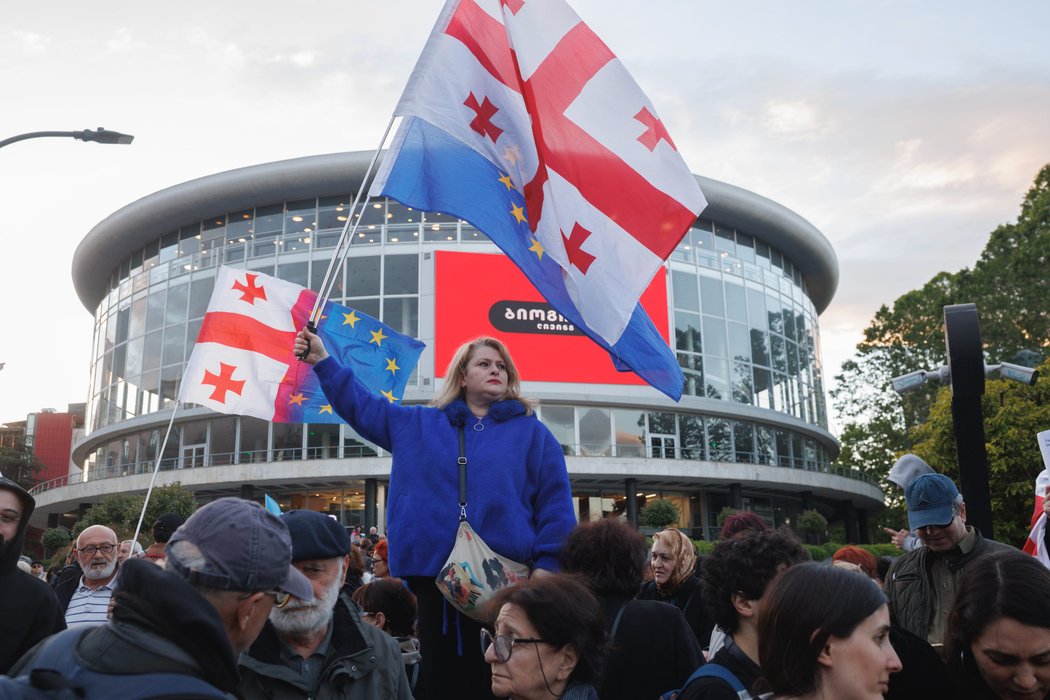
This update covers developments relating to the freedoms of expression, association and assembly in Georgia from April to July 2026.
Introduction
Civil society publishes list of over 90 political prisoners currently detained
On 21st July 2026, the civil society organisation Transparency International Georgia (TI-Georgia) published a list of 91 people currently detained in the country whom it identified as political prisoners, applying criteria established by the Parliamentary Assembly of the Council of Europe (PACE). The watchdog said the high number “once again points to the existence of politically motivated justice” in the country.
The list includes people convicted in connection with anti-government protests since 2024, opposition politicians, and former business associates of Georgian Dream party founder Bidzina Ivanishvili. According to TI-Georgia’s assessment, 13 individuals meet all five PACE criteria, including journalist Mzia Amaghlobeli and opposition politician Elene Khoshtaria, whose cases were previously reported on by the CIVICUS Monitor.
The ruling Georgian Dream party has rejected accusations that the country holds any political prisoners.
CoE Committee of Ministers calls on Georgia to uphold right to free assembly following ECtHR ruling in 2019 protest arrests
In June 2026, the Council of Europe’s (CoE) Committee of Ministers urged Georgia to revise its legislation on freedom of assembly.
The statement followed a meeting on the implementation of the European Court of Human Rights’ judgment in the case of Makarashvili and Others v. Georgia. The Committee called on the authorities to revise national legislation to align with European human rights standards in order to prevent disproportionate arrests and excessive sanctions against protesters. It also urged the government to ensure an enabling environment for civil society organisations monitoring assemblies and providing legal assistance to protesters.
The case of Makarashvili and Others v. Georgia concerned the arrest and conviction of three activists during protests outside Parliament in November 2019, after demonstrators blocked the building’s entrances. In its September 2022 judgment, the European Court of Human Rights found no violation of the rights of two applicants, ruling that the authorities had pursued the legitimate aim of preventing disorder and protecting public safety. However, it found that the rights of the third applicant, Irakli Kacharava, to freedom of assembly and a fair trial had been violated because there was no evidence that he had organised or taken part in blocking the Parliament building or interfering with police operations.
Freedom of association
Restrictions on foreign-funded civil society
Since 2024, the Georgian government has introduced numerous repressive laws targeting foreign-funded civil society organisations, subjecting them to administrative harassment and threatening their survival.
As previously reported by the CIVICUS Monitor, amendments to the Law on Grants, passed in March 2026, require government approval for any funding from abroad deemed intended to “exert influence” over public policy, regardless of the amount, with non-compliance punishable by imprisonment. Earlier, the controversial Law on Transparency of Foreign Influence, first proposed and withdrawn following protests in 2023 before being adopted in May 2024, required organisations to register under stigmatising labels and provide the government with sensitive data on their beneficiaries. In 2025, the authorities also passed another “foreign agent” law, modelled on the US Foreign Agents Registration Act, extending registration requirements to individuals and introducing criminal liability, including imprisonment, for non-compliance.
Together, these laws have had a severe chilling effect on Georgian civil society, making civil society organisations’ (CSOs) financial sustainability increasingly untenable. According to research published by Human Rights Watch (HRW) in July 2026, citing an unpublished survey of Georgian CSOs, 96 percent of organisations reported acute financial difficulties, and 94 percent had reduced their activities, with some ceasing operations altogether.
HRW’s report also highlighted several instances where the Georgian government has directly intervened to block civil society organisations from accessing funding. In 2025, 12 non-governmental organisations and initiatives had their bank accounts frozen as part of a criminal investigation linked to their support for protesters. HRW also documented several cases in which the authorities refused to approve grants for election monitoring and for healthcare and harm reduction services for the LGBTQI+ community.
The Georgian government’s goal has been to suppress critical voices and dismantle the country’s vibrant independent civil society, and it is making frightening progress. The authorities are creating a system in which independent groups cannot operate safely, sustain funding, or support the communities that need and have relied on them.
- Hugh Williamson, Europe and Central Asia director at Human Rights Watch
ECtHR begins examining challenge to Foreign Agents Registration Act
On 1st April 2026, the CSO Georgian Young Lawyers’ Association (GYLA) announced that the European Court of Human Rights (ECtHR) had begun examining a legal challenge to Georgia’s Foreign Agents Registration Act (FARA). GYLA stated that the court has formally communicated the case to the Georgian government, sending the authorities a written enquiry regarding the alleged rights violations.
Together with a group of civil society organisations and media outlets, GYLA is seeking a ruling that the law violates several rights protected under the European Convention on Human Rights, including freedom of expression, freedom of assembly, the right to an effective remedy and protection against discrimination. GYLA also stated that the Court may grant the case priority status because of its broader significance for Council of Europe member states.
As previously reported, the FARA law, passed in April 2025, built on the existing stigmatisation of civil society under the Law on Transparency of Foreign Influence by extending registration and reporting requirements to individuals deemed to be “working under the direction of a foreign power”. Failure to comply is punishable by up to five years’ imprisonment, a fine of up to GEL 10,000 (approximately USD 3,600), or both. The government maintains that the law is an exact translation of the United States’ Foreign Agents Registration Act and introduced it after the previous law was criticised as being modelled on Russia's infamous “foreign agent” legislation.
Fundraising campaign highlights continued civic mobilisation in Georgia despite restrictions
In May 2026, an online fundraising marathon raised more than GEL 2 million (around USD 750,000) for children with Duchenne muscular dystrophy following months of protests by families demanding access to newer treatments for the condition.
Prime Minister Irakli Kobakhidze initially dismissed the families’ demands, arguing that funding the treatment would be irresponsible towards taxpayers and would only enrich “the pharmaceutical mafia”. His comments appeared to galvanise public support: more than 100,000 people took part in the fundraising campaign, which ultimately contributed to the government announcing plans to procure the requested medication in June.
An analysis by OC Media argued that the campaign provided a safer form of civic engagement amid growing repression of the right to peaceful assembly. It also highlighted the resilience of Georgian civil society, demonstrating its ability to mobilise despite increasing restrictions on protests and civic activism.
MMA fighter announces ‘people’s movement’ to fight ‘foreign-funded’ groups
On 27th July 2026, Georgian MMA fighter and government supporter Giorgi Kartvelishvili announced the launch of a “people’s movement” aimed at defending Georgian “values and traditions” and opposing what he described as “foreign-funded” groups promoting a “pseudo-liberal ideology.” Kartvelishvili said the initiative would seek to counter perceived threats to Georgian identity and culture, adding that its members would be prepared to “go to prison if necessary”.
Georgian Dream MP Archil Gorduladze, head of the parliamentary committee on legal affairs, welcomed the initiative, citing freedom of association, but stressed its activities must remain within the law. Meanwhile, opposition figures and civil society organisations warned that the initiative appeared to signal that government supporters would be given free rein to use violence against outspoken critics. Lawyers consulted by independent media outlet Netgazeti argued that the proposed group could constitute an illegal formation, and that establishing, leading or joining such an organisation may constitute a criminal offence under Georgian law. Some also expressed the view that such an initiative could not be launched without the consent of the security services.
According to JAM News, Kartvelishvili has previously been accused by some activists of mobilising so-called titushky – a term popularised during Ukraine’s Maidan revolution to refer to thugs hired by the government to provoke or attack protesters and opponents. Such groups were allegedly deployed against journalists, opposition politicians and protesters during the 2024 anti-government protests in Georgia. Notably, the announcement came days after comedian and anti-government protester Onise Okriashvili was assaulted following a pro-government media campaign over a joke involving Georgian writer Nodar Dumbadze (see Freedom of expression). Kartvelishvili was also reportedly described as a friend of the comedian’s attacker.
Freedom of peaceful assembly
600 Days on: Protests in Georgia continue despite restrictions
The civic space situation in Georgia continues to deteriorate amid a prolonged crackdown on pro-European protests, which began in 2024, and the authorities’ crackdown on civil society.
In June 2026, Amnesty International published a report warning that Georgia is experiencing “one of the most serious erosions of human rights since independence”. Amnesty’s report, “Anatomy of Repression – Georgia: 500 Days of Protest, Crackdown and Resilience” found that the authorities have “effectively criminalised peaceful dissent” by using disinformation, restrictive legislation, police violence and the courts to target protesters, civil society organisations, independent media and political opponents.
Amnesty documented widespread police violence during protests in 2024 and 2025, including arbitrary arrests, torture and other ill-treatment. According to Amnesty, protesters described being trapped by police cordons, exposed to chemical irritants, forced individually through “beating corridors” and severely beaten while detained and inside police vehicles. The report also tracks excessive punishments for peaceful protests under amendments to protest legislation adopted in response to the anti-government mobilisations. They note courts “have been co-opted by the government to rubber-stamp prosecutors’ motions against protesters” and enforce restrictive laws, with judges arbitrarily imposing “ruinous fines, administrative detention and prison sentences in protest-related cases following unfair trials”, with over 150 people currently detained.
Protests have continued daily despite the restrictions. On 18th July, protesters marked the 599th consecutive day of demonstrations with rallies in Tbilisi and Batumi. In Batumi, parents of protesters imprisoned over previous demonstrations travelled to join the action, but police reportedly delayed their train over protest banners.
Parents of imprisoned protesters are taking train to Batumi to distribute newspapers with letters of their loved ones from prison. Because they had protest banners with them, police held the train which eventually left 20 minutes late than scheduled. pic.twitter.com/Pn8GP2uJeD
— Mariam Nikuradze (@mari_nikuradze) July 19, 2026
Even outside the daily anti-government demonstrations, protests still face obstruction from the police. For example, in April 2026, parents of children with Duchenne muscular dystrophy appealed to the Prosecutor’s Office over police restrictions on their protest. According to the parents, officers prevented them from bringing tents, blankets and pillows into the park outside the government administration, where they had been holding a 24-hour protest for seven days, leading to health risks. Two of the parents reportedly required medical assistance on 26th and 27th April.
First arrests announced over police violence during 2024 protests
On 7th May 2026, Georgian prosecutors announced the first arrests of police officers accused of using violence against protesters and journalists during the anti-government protests which began in late 2024. Two of the suspects were already in custody on separate charges, while the remaining three were arrested that day. Although the authorities did not disclose their identities, it has been reported that the suspects include three former officers and one serving officer from the Interior Ministry’s Special Tasks Department, as well as an active duty officer from the Security Police Department.
The cases relate to the assaults on Formula TV journalist Guram Rogava, opposition politician Levan Khabeishvili and protester Zviad Maisashvili, who was filmed being repeatedly kicked by police after losing consciousness during a pro-EU protest in November 2024.
All five were charged with exceeding their official authority through the use of violence under Article 333, Part 3(b) of Georgia’s Criminal Code, while one defendant, who was involved in the attack on Rogava, faces an additional charge under Part 2 of Article 154 of the Criminal Code of Georgia for unlawful interference with the professional activities of a journalist, committed with the use of violence.
These proceedings mark the first time police officers are being held accountable for abuses committed during the protests, following months of criticism from domestic and international human rights organisations over the authorities’ failure to investigate widespread allegations of excessive force. Prosecutors said investigations were continuing to identify those responsible for other incidents of police violence.
Footage of police brutality sparks spontaneous protest
In June 2026, the broadcast of footage showing police officers brutally beating two detainees inside a Georgian police station sparked public outrage and renewed concerns over torture and ill-treatment by law enforcement. The footage, released as a preview of an investigation by opposition broadcaster TV Pirveli, was reportedly filmed by the officers themselves, after which they shared it in a work group chat.
The revelations prompted a spontaneous late-night protest outside the Interior Ministry in Tbilisi on 12th June, where demonstrators demanded accountability for police violence. Soon after the broadcast, the Ministry and the Prosecutor’s Office confirmed the authenticity of the footage, stating that it depicted an incident in Kobuleti in 2022 and that three police officers had already been arrested in February 2026 in connection with the case. However, the authorities did not explain why it had taken almost four years for the abuse to come to light, prompting further criticism.
The Georgian Young Lawyers’ Association (GYLA) said the footage provided further evidence of the “systemic and systematic” nature of police violence in Georgia, arguing that the authorities had normalised torture and ill-treatment by failing to ensure accountability for abuses against protesters since 2024. The organisation described the prosecution of the officers as little more than a “symbolic measure” that fails to address the structural causes of police abuse.
Judgments delivered against more than 60 protesters over October 2025 protests and clashes
Throughout May and June 2026, courts delivered judgments against more than 60 people charged over protests and clashes on 4th October 2025. The unrest, which coincided with the municipal elections, erupted after some opposition politicians and public figures called for a “peaceful revolution”. Protesters attempted to enter the Presidential Palace but were repelled by riot police.
The charges include organising or participating in “group violence”, “incitement against the constitutional order” and “attempting to seize facilities of strategic importance”. Of the 64 people charged, 29 people, including both alleged protest organisers and participants, received full prison terms, including three people sentenced in absentia, while others received partially or fully suspended sentences through plea agreements. Six people were sentenced to seven years in prison, 22 others received five-year sentences, and one person received a two-year sentence.
A 72-year-old doctor, paediatrician Giorgi Chakhunashvili, who claims he was only providing medical assistance to protesters amid clashes with police, was sentenced to five years in prison. At her trial in June, Nana Sander, a woman protester who was sentenced to seven years in prison for “organising group violence” alleged ill-treatment and sexual harassment in detention, stating that she attempted suicide because of her imprisonment and was subsequently fined for it by prison management. She also alleged denial of medical care and delayed access to essential medication. She previously began a hunger strike in January over unmet health needs, but was forced to abandon it after doctors warned her she was at serious risk of falling into a coma.
First prison sentences for peaceful protest under draconian new laws
As previously reported by the CIVICUS Monitor, in an attempt to quell the protests, the authorities have pushed through a series of amendments tightening restrictions on protests and increasing penalties for non-compliance. Successive amendments to protest legislation since 2024 have made an ever-expanding list of common protest acts – such as covering one’s face, blocking traffic, or “obstructing people’s movement” in pedestrian areas – punishable by immediate administrative detention. Repeating the same offence triggers criminal charges and can result in a prison sentence of up to two years.
On 29th May 2026, 61-year-old Zurab Menteshashvili became the first person to receive a criminal sentence solely for peaceful protest activity under these draconian new laws, after being convicted for repeatedly blocking roads. He was sentenced to nine months in prison, having already spent seven months in pre-trial detention. He was released on 31st July after completing his sentence.
Zurab Menteshashvili, 61-y-o protester, who was sentenced for blocking the road during protest, was released from prison today after serving 9 months. pic.twitter.com/itDNVDsrUs
— Mariam Nikuradze (@mari_nikuradze) July 31, 2026
On 20th June, the second protester prosecuted under these provisions, Shalva Esartia, received a three-month prison sentence, which he had already served, along with a one-year suspended sentence under a plea agreement. As previously reported, Esartia was arrested on 17th March 2026 while on his way to a demonstration. He was initially accused of a minor traffic violation, which was later escalated to “disobeying police orders” following a dispute with officers. Authorities subsequently upgraded the case to a criminal charge, citing his prior administrative penalties for similar offences.
Aside from imprisonment, protesters also face draconian fines under the tightened protest laws. Opposition figure and opera singer Paata Burchuladze, who was sentenced to seven years in prison in the 4th October case, has reportedly accumulated fines totalling GEL 710,000 (approximately USD 270,000) for blocking roads during protests. In April, several people reported having their bank accounts seized over protest-related fines of which they had not previously been notified, amounting to tens of thousands of USD per person. Two journalists, TV Pirveli’s Maka Chikhladze and Formula TV’s Liza Tsitsishvili also reported having their bank accounts seized due to fines received for covering anti-government demonstrations.
Protesters jailed for placards mocking ruling party founder
On 26th July 2026, Georgian police detained 10 anti-government protesters outside the Tbilisi City Council building after they displayed posters asking, “Is Bidzina a dick? Yes or No” in reference to Bidzina Ivanishvili, the billionaire founder of the ruling Georgian Dream party.
Police initially arrested activist Tornike Toshkhua over the banner before detaining other demonstrators who raised identical posters in solidarity. The next day, on 27th July, police arrested another protester at the same location who was holding a banner with the same wording. Authorities charged the protesters with petty hooliganism and disobeying police orders.
The protesters appeared before Tbilisi City Court on 28th and 29th July. As reported by Civil.ge, the court fined five activists between GEL 3,000 and GEL 6,000 (approximately USD 1,100–2,200) and sentenced five others to between four and ten days in detention.
During the proceedings, bailiffs reportedly used force to remove some defendants and their supporters from the courtroom. As reported by OC Media, activist Ruska Mchedlidze was filmed being escorted out by several bailiffs and later shared footage showing severe bruising on her arm. Lawyer Marika Arevadze, who frequently represents activists, also said that one of the bailiffs assaulted her.
Freedom of expression
Press freedom and freedom of expression continue to deteriorate
The press freedom situation in Georgia continued to deteriorate in 2026, amid political pressure, intimidation of journalists and increasing restrictions on public expression.
Georgia fell 21 places in the Reporters Without Borders (RSF) 2026 World Press Freedom Index, ranking 135th out of 180 countries and territories, down from 114th the previous year.
In the Index, published on 30th April, RSF noted that press freedom globally is at its lowest point since the organisation began monitoring 25 years ago. The watchdog highlighted Georgia as one of the countries with the steepest recorded decline, with the country’s rating falling 75 places since 2001.
RSF classifies Georgia’s media environment as “difficult”, citing a hostile environment for independent and opposition media, as well as restrictive laws targeting foreign funding and seeking to protect “family values”, with a “growing number of verbal and physical attacks against journalists”. In November 2025, the watchdog warned that press freedom violations in the country had reached “unprecedented levels”, with 600 attacks on the press documented in one year since the start of the anti-government protests in October 2024.
Between April and July 2026, the Media Freedom Rapid Response Mechanism documented 34 incidents affecting press freedom in Georgia, including two physical attacks on journalists. On 9th May, Gela Mtivlishvili, the founder and editor of independent media outlet Mtis Ambebi, reported that he was attacked by a fellow participant in a Formula TV talk show after they went off air. On 6th June, photojournalist Levan Zazadze was attacked by an unknown assailant while covering a rally in Tbilisi.
In April 2026, Formula TV journalist David Tchabashvili reported repeated and escalating death threats via Facebook Messenger and phone calls from someone who appeared to know his home address. In July, the General Prosecutor’s Office of Georgia informed the Council of Europe’s Platform for the Safety of Journalists that the Interior Ministry had initiated an investigation into the threats and that “all necessary investigative and procedural measures are being actively carried out”.
In June 2026, the Parliament of Georgia denied or suspended the accreditation of five journalists from government critical outlets TV Pirveli, Formula TV and Publika. Four journalists had their accreditations revoked for breaching rules introduced in 2023 which require journalists to terminate interviews with MPs, staff, or visitors if they refuse to be recorded and allow accreditations to be revoked at MPs’ request, while a photojournalist from Publika did not receive a response to an official request for a one-time special accreditation.
Government-critical broadcaster fined for alleged breach of standards
On 17th July 2026, Georgia’s National Communications Commission (GNCC) fined government-critical broadcaster TV Formula GEL 5,000 (approximately USD 1,900) for allegedly violating broadcasting rules on impartiality and fairness in its news coverage. The commission cited evaluative language used by journalists and presenters, including references to the “Georgian Dream government” and “repressive laws”, which it said reflected personal views rather than objective reporting.
The fine was the latest in a series of sanctions against Formula over its coverage. The broadcaster received a GEL 2,500 (approximately USD 950) fine on 21st May and a verbal warning in April over similar alleged violations. The penalties followed 2025 amendments to the Law on Broadcasting, granting the Communications Commission authority to sanction broadcasters directly for breaches of broadcasting standards, a role previously handled through self-regulatory mechanisms.
On 25th June, another broadcaster, TV Pirveli, was also fined GEL 2,500 for its critical coverage. According to reports, the GNCC took issue with the use of the term “prisoners of conscience” to refer to jailed protesters, and the use of “oligarch” to refer to Georgian Dream founder Bidzina Ivanishvili.
In parallel, TV Formula is facing possible criminal charges and legal harassment over its reporting on film director and former government minister Giorgi (Goga) Khaindrava. On 16th June, the Prosecutor’s Office announced it had opened a criminal investigation against Formula on charges of “false denunciation” on the basis of a statement submitted by Khaindrava’s lawyers. The case reportedly concerns a programme where it was alleged that Khaindrava had been part of a corruption scheme that facilitated the entry of foreign nationals into Georgia in exchange for money. The director successfully sued Formula for defamation over the report, with the Tbilisi City Court ordering the broadcaster to pay GEL 10,000 (USD 3,800) in moral damages on 14th July 2026.
Georgia deports Azerbaijani journalist despite risks of persecution
On 5th April 2026, Georgian authorities deported Azerbaijani journalist Afgan Sadigov to Azerbaijan, where he faces a “credible risk of politically motivated prosecution and ill-treatment”, according to Human Rights Watch (HRW). Sadigov, editor-in-chief of the independent media platform Azel.tv, had been living in Georgia since 2023. In Azerbaijan, Sadigov had been repeatedly detained in retaliation for his reporting on government corruption. After being pardoned and released early from a seven-year prison sentence on dubious extortion charges, he fled Azerbaijan and sought asylum in Georgia, but his applications were rejected despite concerns for his safety.
In August 2024, Sadigov was detained in Tbilisi on an extradition request from Azerbaijan. In February 2025, the European Court of Human Rights issued an interim measure ordering Georgia not to extradite him pending review of his case. He was released from detention in April 2025, and subsequently took part in anti-government protests in Tbilisi, accumulating over USD 100,000 in fines and being repeatedly sentenced to administrative detention under draconian protest laws.
On 1st April 2026, Azerbaijani authorities informed their Georgian counterparts that they were discontinuing criminal proceedings against Sadigov. Three days later, Georgian authorities arrested Sadigov at his home after midnight for allegedly insulting a police officer on social media. After he was assigned a public defender instead of his chosen legal representatives, Tbilisi City Court delivered judgment against him at 4:00 am on 5th April, fining him GEL 2,000 (around USD 845) and ordering his expulsion to Azerbaijan together with a three-year ban on entering Georgia. He was deported to Azerbaijan later that same day. Now back in Azerbaijan, Sadigov was detained by masked individuals in civilian clothes on 8th June despite previous assurances that the case against him had been closed.
Two other worrying cases of administrative measures against foreign journalists were recorded in recent months. On 25th March, a French photographer who had documented anti-government protests had his residence permit revoked under provisions relating to foreigners who “pose a threat to the state security of Georgia.” On 11th May, German-Ukrainian freelance journalist Marina Klimchuk was denied entry to Georgia due to an unpaid administrative fine she was unaware of, but which she believes relates to her presence near a protest site. Klimchuk, who was eight months pregnant at the time of her detention, was held for nearly 24 hours in a temporary detention room without blankets or pillows before being transported to Germany.
Prosecutions, fines and prison sentences: new department to combat “hate speech” cracks down on government critics
From 1st June 2026, the Georgian Interior Ministry announced the establishment of a new Division for Combating Hate Speech within the Human Rights Protection Department which will be able to monitor and prosecute public statements deemed to “insult human dignity and contain hate speech”.
The Council of Europe Safety of Journalists Platform warned that the development posed a threat to press freedom, noting that amendments to the Code of Administrative Offences adopted in February 2025 penalised “verbal insults, swearing, offensive slurs, or other abusive behaviour” directed at political or public officials in the performance of their duties. Under the amendments, such conduct is punishable by fines or administrative detention of up to 45 days for a first offence and up to 60 days for repeat offences.
While the provision has frequently been used to target critics of the Georgian Dream government since its introduction, the new department has been empowered to initiate cases proactively on the basis of comments made on social media, without requiring the alleged victim to file a complaint. This has enabled the authorities to drastically expand enforcement against outspoken critics. In its first month of operation, the department referred 150 cases to the courts, with several resulting in fines of more than USD 1,000 for insults directed at political figures. According to media reports, courts across Georgia now hear several such cases each day, with some hearings lasting only a few minutes.
On 15th June, Tbilisi City Court fined lawyer Shota Tutberidze GEL 4,000 (around USD 1,500) over a social media comment directed at Parliament Vice-Speaker Nino Tsilosani.
On 22nd July, the same court sentenced journalist and Formula TV presenter Vakho Sanaia to 14 days’ administrative detention over Facebook posts that prosecutors said insulted Parliament Speaker Shalva Papuashvili and Georgian Dream MP Lado Bozhadze. Sanaia was detained at his home following the ruling and taken into custody as supporters gathered outside to show solidarity. Earlier, on 10th July, the court had fined him GEL 6,000 (around USD 2,300) over the same posts, in which he appeared to sarcastically urge others not to refer to the two politicians as “dicks”– language the Interior Ministry described as “an ironic and ostensible form of insult”.
On 25th July, Tbilisi City Court sentenced doctor and anti-government activist Giorgi Akhobadze to 25 days’ administrative detention over social media posts allegedly insulting Prime Minister Irakli Kobakhidze, Georgian Dream MP Levan Makhashvili and a police investigator.
Comedian attacked after pro-government smear campaign over joke
On 22nd July, Georgian comedian and vocal government critic Onise Okriashvili was attacked and beaten outside his home in Tbilisi by two assailants. The attack followed a smear campaign against him by pro-government media outlets over a profane joke involving renowned Georgian writer Nodar Dumbadze. Okriashvili told police that the attackers had referenced his alleged insult to Dumbadze during the assault.
Before the assault, pro-government outlets and social media accounts circulated a shortened version of a joke Okriashvili had made on a YouTube comedy show, framing it as though the comedian had directed profanity at the late Dumbadze. Members and supporters of the ruling party then shared the manipulated clip more widely and presented it as an attack on national values. In response to the attack, government officials and supporters condemned the violence but also appeared to blame Okriashvili for bringing it on himself. For example, as reported by OC Media, Georgian Dream MP Irakli Zarkua commented that, while violence is unacceptable, police will not be able to protect those who “joke about the Church, the Patriarch, or writers”, because “society will have its own reaction”.
The suspect, Niko Khurtsilava, was charged with “violence” under Article 126 of Georgia’s Criminal Code and released on GEL 5,000 (approximately USD 1,900) bail by Tbilisi City Court on 25th July. The decision to release him on bail drew further criticism from civil society groups, which warned that continued campaigns by pro-government media against critics risked encouraging further intimidation and violence. Meanwhile, ruling party officials and pro-government figures expressed support for Khurtsilava, with Georgian Dream MP Dimitri Samkharadze posting on Facebook that the man is a “true patriot” and offering to act as a guarantor for his release.