Introduction
2026 election campaign approaching
With the ruling Fidesz party polling consistently lower than Péter Magyar’s centre-right opposition party Tisza, Prime Minister Viktor Orbán has intensified his reliance on enemy creation as a political strategy ahead of the 2026 election. His latest target is Ukraine, with anti-Ukrainian rhetoric becoming a central tool to consolidate support and deflect from domestic discontent.
This escalation followed the death of József Sebestyén, an ethnic Hungarian conscript who died in Ukraine on 6th July. The incident has further strained relations between Budapest and Kyiv. Tensions had already intensified in May following allegations of espionage, which led to arrests and mutual expulsions of diplomats, as well as the Hungarian government’s “national consultation” on Ukraine’s EU membership bid, which took place between April and June.
The use of scapegoats is a well-worn tactic for Fidesz. In previous election cycles, Orbán has targeted ‘Brussels’, NGOs, and the LGBTQI+ community to mobilise his base through fear and grievance.
Hungary leaves the International Criminal Court
On 20th May 2025, the Hungarian Parliament voted to leave the International Criminal Court (ICC). Péter Szijjártó, Minister of Foreign Affairs and Trade, claimed that by issuing an arrest warrant for Israeli Prime Minister Benjamin Netanyahu, the ICC had discredited itself with an “openly anti-Semitic decision” and Hungarians did not want to be part of a “politically motivated court system”.
Hungary previously welcomed Netanyahu with full military honours in a visit on 3rd April 2025, defying the ICC order to arrest the Israeli prime minister. As previously reported by the CIVICUS Monitor, Orbán announced at the time that he intended for Hungary to withdraw from the ICC and criticised the court as political.
LGBTQI+ restrictions under legal scrutiny
On 5th June 2025, the Advocate-General of the European Court of Justice issued a non-binding opinion saying that a 2021 Hungarian anti-LGBTQI+ law was a breach of EU law. The rules were “based on a value judgment that homosexual and non-cisgender life is not of equal value or status as heterosexual and cisgender life”, the statement said. The opinion is non-binding but often indicates which way the court will decide.
The opinion comes ahead of the publication of the Court’s final ruling on Hungary’s 2021 anti-LGBTQI+ provisions, which the Court has been deliberating since December 2022, when the European Commission brought the case before the Court. If the Court finds that the 2021 provisions violate the law, Hungary could be fined a significant amount and be required to repeal them.
Assembly
Budapest Pride 2025
Background
As previously reported by the CIVICUS Monitor, on 18th March 2025, Hungary passed a ‘child protection’ law which, under the guise of protecting minors, banned gatherings that display or promote homosexuality. The law also authorised the use of facial recognition to monitor attendees at prohibited events. A month later, on 14th April 2025, the restrictions were followed by a constitutional amendment enabling the banning of LGBTQI+ events and a provision stating that there were only two genders—male and female—intended to curtail the rights of trans individuals.
These new pieces of legislation provoked widespread domestic, European, and global criticism. For example, ahead of the EU General Affairs Committee (GAC) meeting on 27th May 2025 in Brussels, twenty member states signed a petition demanding a reversal of the Pride ban. Nevertheless, the Hungarian government stood firm, and the police went ahead with their ban on the event.
Pride as a city event instead of an ‘assembly’
After several attempts by civil society to secure police acknowledgement for an assembly on 28th June 2025, Budapest Mayor Gergely Karácsony, on 16th June 2025, designated Pride as an official municipal “Day of Freedom” event, thereby removing the need for police acknowledgement.
The mayor said that the message of Budapest Pride was clear: that people should not suffer disadvantage because of who they love or where they were born, and that the city takes pride in its diversity. Organiser and spokesperson Máté Hegedűs said: “This fight is not only for the LGBTQ community, but for everyone. Together with Budapest, we will protect ourselves, and also those who are now afraid, who are now silent, who are now in danger: civil society, Hungarian citizens.”
Karácsony’s decision to turn the march into a municipal event did not stop the police from banning it as illegal, saying they did not recognise Budapest Pride as a municipal event. On 19th June 2025, Karácsony said the police’s declaration was “irrelevant” and that there was no law that could ban a municipal event. "The Budapest Police Headquarters has issued a prohibition order on a non-existent meeting, and could have used the same force to ban unicorns”, Karácsony said in that interview.
On 24th June 2025, Justice Minister Bence Tuzson warned that the organisers of the Pride could face imprisonment and the participants fines. On 25th June 2025, European Commission President Ursula von der Leyen called on Hungary to reverse the Pride ban and announced her alliance with the LGBTQ+ people of Hungary following weeks of silence on the topic. Orbán immediately responded on social media, asking her to refrain from interfering with Hungarian law enforcement.
Two far-right marches on the same day as Budapest Pride were not banned by police: the 64 Counties Youth Movement and Our Homeland Movement were both permitted to hold events in Budapest on 28th June 2025 at different sites along the Pride march route.
Pride attracts record participants
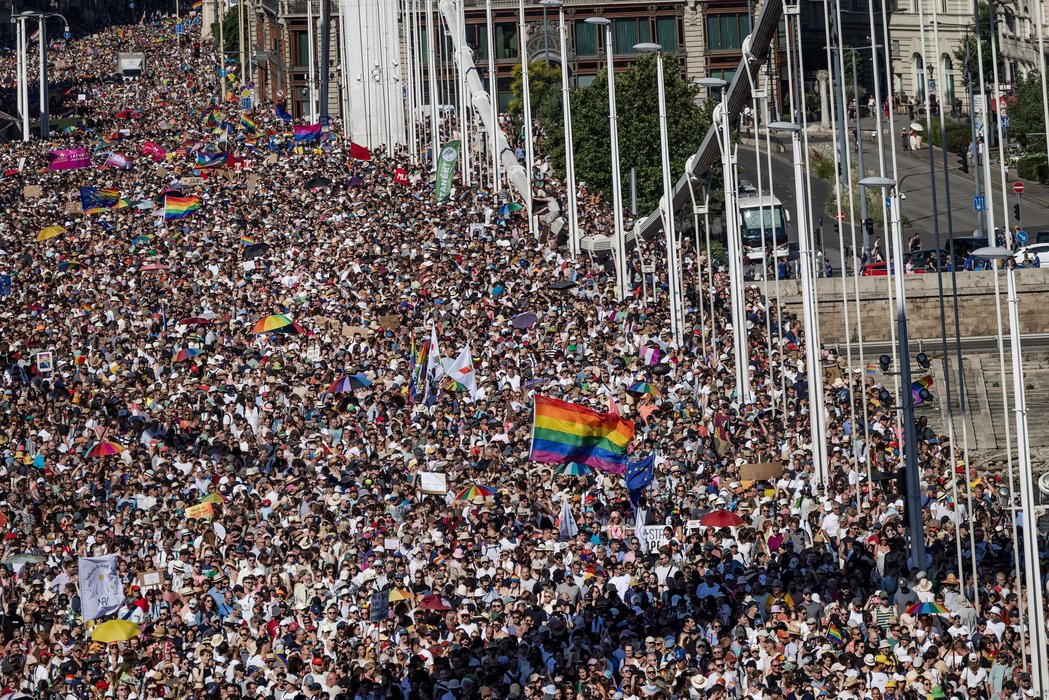
On 28th June 2025, the Budapest Pride parade attracted the largest crowd in the event’s history. The 30th annual march turned into a broader political symbol of opposition to the Fidesz government following legislative and police attempts to suppress the event, with protesters expressing concern at the state of Hungarian politics and the rollback of LGBTQI+ rights in Hungary. “We made history here today,” organiser Viktória Radványi told the crowd as the event wound down. “We cannot be stopped, we cannot be intimidated, because we will take to the streets.”
Organisers estimated between 180,000-200,000 people marched, despite the police declaring the event illegal. Mayor Karácsony told attendees: “The government is always fighting against an enemy against which they have to protect the Hungarian people. This time, it is sexual minorities that are the target […] we believe there should be no first- and second-class citizens, so we decided to stand by this event.”
To show solidarity with the Hungarian LGBTQI+ community, around 70 progressive Members of the European Parliament attended the march. Opposition leader and MEP Péter Magyar did not attend, but issued a statement calling for peaceful protest.
Pride participants will not be prosecuted, Budapest mayor investigated
In a joint press release on 4th July 2025, Amnesty International Hungary, the Háttér Society, the Hungarian Helsinki Committee, and the Hungarian Civil Liberties Union said that many uncertainties remained around Pride, including whether participants would be prosecuted. “By illegally restricting freedom of assembly and the resulting uncertainty, the government has put not only people exercising their fundamental rights, the human rights organisations representing them, and the organisers of Budapest Pride, but also the police in an almost impossible situation”, the statement said. The four organisations established a joint legal aid service for anyone prosecuted.
On 7th July 2025, Budapest police announced they will not press charges against participants of this year’s Budapest Pride. Although the march was officially banned, the city’s designation of it as a municipal event created legal ambiguity, leading police to forgo proceedings.
Despite this announcement, individuals already charged following reports by private citizens were still being prosecuted. Prominent student activist Lili Pankotai was charged by police in her hometown of Mohács on 1st July 2025, after someone saw Facebook posts about her Pride participation. The charges were dropped on 9th July 2025, but her lawyer Adrienn Laczó (former president of the Budapest Court) said she disagreed with the police’s reasoning. Police argued that Pankotai had no way of knowing whether the event was illegal. Laczó countered that the Pride march was not prohibited, as it had been authorised by the local government.
While the police announced they will not press charges against Pride participants, the National Bureau of Investigation is probing the organisers. Mayor Gergely Karácsony said he takes full political and legal responsibility and is ready to defend Budapest in court, adding he expects no substantive investigation as Fidesz has no interest in keeping the issue on the agenda.
On 1st August 2025, Budapest Mayor Gergely Karácsony was questioned as a suspect by the National Bureau of Investigation over the banned Pride march. Around 200 people, including opposition politicians, protested outside in the building in support. Karácsony said the case was about defending freedom in Budapest and Hungary, while Pride organisers and speakers framed it as resistance to rights restrictions.
Gov’t announces AI surveillance to monitor Pride; NGOs raise alarm
As previously outlined on the CIVICUS Monitor, the legislation introduced on 18th March 2025 to ban Pride also permitted the use of biometric cameras to monitor and identify participants.
In late April 2025, European Commission spokesperson Thomas Regnier told POLITICO that the Commission was currently assessing whether the Hungarian law breaches the bloc’s recently introduced Artificial Intelligence Act.
However, as no action was taken, on 6th May 2025, four watchdog organisations, the Hungarian Civil Liberties Union, the Civil Liberties Union for Europe, the European Digital Rights network (EDRi), and the European Center for Non-Profit Law published a statement calling on the EU to urgently scrutinise Hungary’s new law expanding facial recognition use, arguing it violates the AI Act and EU fundamental rights. They urged the European Commission’s AI Office to act swiftly to uphold legal safeguards and protect democratic freedoms.
On 26th June 2025, Telex reported that temporary surveillance cameras had been installed along the planned route of the Pride march. The organisers of the march said they didn’t think participants could be prosecuted but would provide legal and financial support if they were.
The European Commission remained silent. Upon the publication of a POLITICO article on the matter, spokesperson Regnier said that they had requested clarifications from the Hungarian authorities.
Supreme Court finds violation of rights over “mini-Pride” ban
On 26th May 2025, the police banned a “mini-Pride” march organised by five NGOs to celebrate five years since Hungary made it possible to change one’s official gender. The ban was issued under the child protection law, which prohibits the promotion of homosexuality. The march had been scheduled for 1st June 2025. The organising NGOs—Amnesty International Hungary, the Háttér Society, the Hungarian Helsinki Committee, the Rainbow Mission Foundation (organiser of Budapest Pride), and the Hungarian Civil Liberties Union—expressed confusion, noting that another LGBTQI+ rights demonstration on 17th May 2025 had been safeguarded by police.
“It is clear that the current decision is arbitrary, the police banned the rally due to political expectations”, the organisers said in a joint statement. They announced they would take the police to court over the ban.
In its first application of the amended child protection law, the Hungarian Supreme Court ruled on 31st May 2025 that restrictions on the mini-Pride march organised by Amnesty and others were unfounded. The police had failed to provide any evidence that the march would affect children, or explain why it differed from the LGBTQI+ demonstration held two weeks earlier, which had been authorised by police. The ruling applied only to the mini-Pride scheduled for 1st June 2025, not the main Pride march on 28th June 2025. The court annulled the ban.
Police ban on planned rally with gay and trans speakers
András Léderer, leading human rights activist and advocacy head at the Hungarian Helsinki Committee, in a personal capacity, planned a non-Pride-related summer rally in support of the European Charter of Human Rights. After an in-depth interview about the rally’s purpose, police banned the event, claiming it would violate child protection laws by promoting homosexuality, similar to the banned Pride parade.
This reasoning was largely upheld by the Hungarian Supreme Court. According to its decision, “the claimant explicitly and deliberately invited transgender and homosexual individuals to speak at the event, who openly identify with their gender identity. (...) The organiser did not intend to exclude persons under the age of eighteen from the event. Overall, the manner of presentation, prohibited under the law, is an essential element of the assembly. In light of all this, the defendant prohibited the assembly from taking place at the time and location indicated in the notification.”
In a Facebook post on 15th July 2025, Léderer said he would appeal the decision upholding the ban. “We will not stop here; we will use all legal and advocacy tools at our disposal to throw this regulation, which is a twentieth-century garbage dump, out of our country's legal system once and for all.”
Protests against new anti-NGO bill
On 13th May 2025, a Fidesz MP filed a draft law that would significantly restrict the work of foreign-funded civil society organisations and independent media organisations (see more under Association). Under the proposal, groups deemed by the Sovereignty Protection Office to “threaten national sovereignty” could be blacklisted, barred from receiving 1% income tax donations, and required to obtain formal declarations from all donors proving domestic origin of funds, including EU grants. Leaders of listed organisations would be subject to asset declarations and treated as high-profile public figures.
NGOs immediately protested the restrictive ‘Transparency of Public Life’ bill with a demonstration on 16th May 2025. A coalition of NGOs hung a banner from a tunnel in Budapest reading “We are with you. We stay for you.” Afterwards, opposition party Momentum threw red paint on the fence of the National Sovereignty Protection Office and blockaded the building.
In another protest against the bill on 18th May 2025, around 10,000 people chanted “Viki, it’s over” in the square outside the Hungarian Parliament. Students, journalists and NGO representatives spoke at the protest and flew Hungarian and EU flags.
During a discussion on the Bill by the Justice Committee on 27th May 2025, protesters held up a banner reading “Free Press, Free Civil Society”. The committee chair, Imre Vejkey, called a break and told the protesters signs were not allowed in the chamber.
On 1st June 2025, protesters marched against the bill silently with their mouths taped shut in protest at the government’s attempt to muzzle NGOs and media organisations. The organisers of the protest said the bill was an attempt by the government to silence all those who disagree with them.
On 11th June 2025, thousands gathered in Budapest’s Kossuth Square to protest against the anti-NGO law, despite it being postponed by the government. As reported by HVG, attendance estimates vary: Megafon, an influencer network of self-proclaimed “right-wing digital freedom fighters” who support the ruling Fidesz party, stated that only a few hundred people had attended, while independent opposition MP Ákos Hadházy spoke of up to 40,000 people.
Independent MP clashes with police over weekly protests
On 22nd April 2025, independent Budapest MP Ákos Hadházy’s weekly Tuesday protests on Elizabeth Bridge against the Orbán government’s attacks on civil liberties were banned by the Hungarian Supreme Court. The decision stated that the protests constituted obstacles to the daily life of the city.
On 25th April 2025, the police subsequently banned many of Hadházy’s weekly bridge marches on grounds of traffic disruption, including one planned for May Day. They also accused the MP of misleading people by claiming the May Day demonstration was not illegal. While police had authorised a gathering in Kossuth Square, they had not permitted a subsequent march. Hadházy insisted that if a march spontaneously began after the rally, it was legal.
The May Day protest drew thousands to Kossuth Square on 1st May 2025. Police charged four participants with violations related to pyrotechnics, one with failure to produce ID, and one with abusing the right to assemble.
Hadházy continued his weekly protests and said on 8th July 2025 that the fact there were no fines for marching at Pride showed “there is no risk, but there is profit” if people gathered to oppose the government.
Magyar campaign launches with tour
Péter Magyar’s campaign launched on 5th July 2025, and the Tisza leader began touring regions of Hungary traditionally considered Fidesz strongholds. Hundreds of supporters attended the rallies. In Székesfehérvár, his supporters packed the town square waving Hungarian flags, and Magyar delivered a pro-Europe speech in which he said Hungary should not “flirt with Russia.”
Romanian ultra-nationalist rally banned by police
A rally planned for 3rd August 2025 in Kossuth Square by the Romanian ultra-nationalist group Calea Neamului was banned by police under the Assembly Act. The event aimed to commemorate the Romanian occupation of Budapest in 1919. Police reasoned that the event would threaten public order and could “violate the dignity of the Hungarian nation.”
Protesters fined an average of €320
HVG reported on 28th April 2025 that anti-government protesters from January to April 2025 were fined an average of €320 (137,000 forints) for creating traffic disruptions. The data was collected by opposition party Momentum’s free legal aid service, based on 80 people who contacted them. Some of the fines were reportedly issued to protesters who were not doing anything other than standing in the road.
Readers of the news site 444 also reported that the most common fine they had received was €212.
ASSOCIATION
Law to strip citizenship from dual nationals who pose a ‘threat’
On 11th June 2025, Parliament passed a law that allows dual citizens to be stripped of their citizenship for up to ten years if they are deemed to pose a threat to public order, safety or national security.
The law is widely regarded as a thinly veiled threat against opinion-leaders, politicians, academics and human rights defenders who are dual nationals and express criticism of the government.
The law has been criticised by experts as deliberately vague and a violation of human rights. Central European University professor emeritus Boldizsár Nagy said the law was incomprehensible and incompatible with fundamental rights. Another academic, Gábor Mészáros from the University of Pécs, noted that the law allowed anyone to file a report about a “suspicious citizen” to the minister responsible for implementing the law, with no requirements to disclose the reporting person’s identity.
Due to the vague wording, it is unclear whether the law applies only to Hungarian dual nationals whose second nationality is that of a country outside the European Economic Area—comprising the 27 EU member states plus Iceland, Liechtenstein, and Norway. There are suspicions it would target those with US-Hungarian citizenship—it has been nicknamed “Lex Soros” in reference to Hungarian-born American philanthropist George Soros, who has long been a target of the Fidesz government.
Earlier in the year, when the law was first proposed on 11th April 2025, Hungarian international law experts signed a statement condemning the proposal as “unprecedented” and “easily misused”. “The expulsion of a state's own citizens from their home country may amount to a form of exile and inhumane treatment, and may be contrary to the human rights conventions binding the state concerned”, the group wrote in the letter.
Transparency bill
Hungary tables Russia-inspired bill to silence critical voices
As already outlined above, on 13th May 2025, an MP from Orban’s Fidesz party submitted a bill to Parliament, which would have allowed the Sovereignty Protection Office to blacklist NGOs and media organisations and determine whether they could receive overseas funding. The bill, titled On the Transparency of Public Life, would have allowed the authorities to seize materials from the NGOs and severely limit their financial resources. In its targeting of foreign-funded NGOs, it has drawn comparisons with Russia’s notorious “foreign agents” law.
In an article on 20th May 2025, Telex outlined how broad the bill was, encompassing anything that “offends, portrays unfavourably or supports activities against” the values set out in its Fundamental Law, including critiques of the government and support of LGBTQI+ rights. The Hungarian media outlet pointed out that most of its reporting could qualify for inclusion on the list compiled by the Sovereignty Protection Office. The editorial noted that “the Sovereignty Protection Office could find fault with anything and put anyone on the watchlist.”
NGOs and judges warn against “transparency” bill
On 19th May 2025, Transparency International warned that the proposed law “aims to annihilate civil society organisations”. It noted that the bill was framed so broadly it could encompass politically engaged private citizens as well as media outlets and NGOs. Transparency’s Board Chair François Valérian called it a “dark turning point for Hungary”.
Human Rights Watch described the bill as an attempt to “eviscerate democracy” on 21st May 2025. Europe and Central Asia director Hugh Williamson said the bill was an escalation in the campaign to “silence dissent and dismantle independent civil society”.
On 21st May 2025, the Hungarian Association of Judges criticised the powers proposed for the Sovereignty Protection Office as a “threat to the rule of law”. Their letter cautioned that the bill could undermine justice and democratic institutions and was “contrary to its name […] not transparent”.
The Hungarian Helsinki Committee named the law “Operation Starve and Strangle” in a statement on 22nd May 2025. “The Bill comes amidst a wider effort to stigmatise and threaten organisations critical of Hungary’s democratic erosion, and PM Orbán’s threat to carry out a ‘spring cleaning’”—referencing the PM’s tirade against NGOs, which the CIVICUS Monitor has previously reported on. A briefing paper issued jointly with other organisations in Hungarian civil society described the law as a new step in the legal machinery of repression. It outlined the serious financial consequences of being blacklisted with fines of up to €5000 for non-compliance. The law borrows provisions from anti-money laundering regulations to mislead and weaponise, in a way that could allow genuinely dangerous transactions to go unnoticed.
In an open letter published on 23rd May 2025, 300 civil society groups outlined the main ways the bill targeted NGOs. It would grant the Sovereignty Protection Office powers to propose a list of NGOs and media organisations deemed to “influence public life” with foreign funding. Once listed, organisations would face severe restrictions: they could only accept foreign funds with prior authorisation, would be excluded from the domestic 1% tax donation scheme, and their Hungarian donors would face onerous requirements. The bill misuses anti-money laundering rules to justify transferring foreign funds to a state-controlled body, and reclassifies civil society leaders as “politically exposed persons.” Decisions would be issued by government decree without judicial oversight, raising serious concerns about due process and legal remedies.
The letter warned the Bill would provide the government with the “tools to effectively and completely silence the remaining independent voices in the country” ahead of the 2026 election. The same day, Prime Minister Orbán claimed on state-aligned radio station Kossuth Radio that the law was “mild”.
Vote postponed until autumn after criticism
On 4th June 2025, the government announced that it would postpone the vote on the bill until autumn. Fidesz leader Máté Kocsis said the government still wanted to take action to protect national sovereignty, but needed more time to consider expert submissions from the Hungarian Banking Association, Publishers’ Association, and Bar Association, among others.
On 19th June 2025, Telex reported that State Secretary Levente Magyar said he was not sure whether the bill would ever re-emerge after the controversy.
EXPRESSION
Pro-Palestine rap group barred from entering Hungary
On 25th July 2025, Northern Irish rap group Kneecap were barred from entering Hungary over their views on Palestine, where they were scheduled to perform at the Sziget Festival. All three members of the group were issued a ban on entering Hungary for the next three years. The members were banned by authorities on the grounds that they were a national security risk who “glorify terrorists and use anti-Semitic rhetoric”. Representatives of the Sziget Festival said the ban was “unprecedented, unnecessary, and regrettable”. The group had previously made headlines over their statements about Israel and Palestine during performances at Coachella in the United States and Glastonbury in the United Kingdom. One member of the three-person group is currently under investigation in the United Kingdom over allegations that he held a Hezbollah flag during a performance in 2024, which he denies. Hezbollah is a Lebanese militant group and political party proscribed as a terrorist organisation in the United Kingdom.
Economic analysis shows €1.1 billion to pro-Orban media
On 13th May 2025, Telex reported that independent newspaper Magyar Hang has submitted a complaint to the European Commission claiming the Hungarian government has violated competition law by subsidising pro-government media. The “cumulative damage”, according to the complaint’s economic analyst, is €1.1 billion. The complaint alleges the government has increased its advertising resources in favour of pro-government outlets, giving them an unfair advantage over other media.
Honorary consul to Estonia dismissed over views on Ukraine
In a Facebook post on 11th July 2025, István Bán, Hungary’s honorary consul to Estonia, announced that he had been dismissed from his post. Online media outlet 444 reported he was dismissed not because of his work or any violation of the rules, but because of his support for Ukraine and criticism of Orbán. He had held the unpaid, voluntary role for 18 years and said the government should have more pressing issues than a “single Hungarian in Estonia”.
Researchers who supported Pride face ethical proceedings
In July 2025, three psychology lecturers—Judith Gabriella Kengyel, Ágnes Zsila and Máté Szondy—who penned an opinion piece in support of LGBTQI+ parents ahead of the banned Pride march, faced ethical proceedings at Pázmány Péter Catholic University. Although the lecturers had received prior approval, the university claimed they had misled leadership about the article’s content and had presented views incompatible with Catholic doctrine. They were not dismissed, but were required to attend training on Catholic values.
The disciplinary action sparked widespread protest. Over 6,000 students signed a petition supporting the lecturers, and many said they were prepared to demonstrate if dismissals had occurred. In addition, more than 700 social science researchers signed a petition in support of the academics and Associate Professor Bognár Bulcsu, who was dismissed in a restructuring but whom the petition authors believe was dismissed for his research into the relationship between religion and LGBTQI+ attitudes.