GENERAL
BRUSSELS GOVERNMENT FORMED AFTER 600+ DAYS OF DEADLOCK
Brussels ended nearly two years of political deadlock following the June 2024 election, the longest in the capital’s history. Divided along language lines, the tax-cutting liberal Reformist Movement (Mouvement Réformateur, MR) emerged as the dominant francophone party, while the Flemish Greens (Groen) led among Dutch-speaking voters. Coalition talks were slowed by institutional rules that reserve a fixed number of ministerial posts for each language group to protect the Dutch-speaking minority in the officially bilingual capital. The stalemate finally broke in mid-February 2026 with the formation of a seven-party Brussels-Capital Region government, comprising three French-speaking and four Dutch-speaking parties.
BELGIAN PRISONS HIT RECORD OVERCROWDING
On 30th March 2026, Belgian prisons reached a new record of overcrowding, with 710 inmates forced to sleep on floors. The problem affects facilities across the country: 306 prisoners in 10 Flemish prisons, 247 in 9 Walloon prisons, and 157 at Haren prison in Brussels. Union representatives called the situation “an alarm signal,” highlighting conditions that make humane detention impossible and warning of a possible increase in “tensions, aggression, and unpredictable incidents.”
Belgium’s prison overcrowding is a longstanding issue. In 2014, the European Court of Human Rights ruled in Vasilescu v. Belgium that poor prison conditions reflected a structural problem requiring redress. The Council of Europe’s Committee for the Prevention of Torture confirmed in 2022 that overcrowding remained widespread. Current governmental measures include an emergency law extended through 2027 to relieve overcrowding, while proposals such as renting Estonian prison capacity and a floating prison project were explored, though the Estonian plan was later rejected.
FREEDOM OF ASSOCIATION
COUNCIL OF STATE CRITIQUES GOVERNMENT POWERS IN “ANTI-ACTIVISM” BILL TARGETING “RADICAL” ORGANISATIONS
As reported on 8th January 2026, Belgium’s Council of State (the country’s supreme administrative court and advisory body on legislation) issued a critical opinion at the end of 2025 on the controversial “Anti-Activism” bill. Proposed by Interior Minister Bernard Quintin in July 2025, the bill would allow the federal government to dissolve organisations deemed “radical” without judicial oversight, based solely on a security service report. The Council of State, however, stated that while the government may temporarily suspend an organisation’s activities, any permanent ban or dissolution requires a judicial decision.
The “Anti-Activism” bill not only seeks to grant the government the power to dissolve organisations considered extremist, radical, or dangerous without court approval, but also proposes bans on the use of their symbols or slogans, participation in activities of dissolved associations, and the re-establishment of such organisations. The penalties outlined in the bill are severe, ranging from fines of up to €50,000 to prison sentences of up to five years.
The bill has faced criticism for ambiguity, lack of legality, and disproportionate measures. The Federal Institute for Human Rights issued a formal opinion in September 2025, while the “Right to Protest” coalition, which includes Amnesty International Belgium, the League of Human Rights, and Liga voor Mensenrechten, and other organizations, published an opinion piece on 3rd November 2025 warning that the draft poses a threat to freedom of association in Belgium and the country’s rich civil society.
Despite opposition, the Minister of Interior announced the bill would remain on the legislative agenda, with adjustments to be made in accordance with the Council of State’s opinion.
CUT IN DONATION TAX BENEFITS RAISES CONCERNS FOR NGO FUNDING
On 11th December 2025, Parliament passed the “Miscellaneous Provisions” law, introducing significant changes to the tax regime for donations to approved organisations. Under the new rules, donors who contribute at least €40 per beneficiary per year may claim a tax reduction of 30%, down from the previous 45%. As a result, a smaller portion of the donation can be recovered through the tax return: for example, from a €100 donation, a donor receives €30 as a tax reduction instead of €45. Furthermore, the measure applies retroactively to all donations made since 1st January 2025.
This change is widely viewed as unfavourable for non-governmental organisations (NGOs). By lowering the tax incentive to give, it may discourage donations or reduce their size, ultimately affecting the funding available to these organisations. The measure has been broadly criticised: in March 2025, more than 470 Belgian organisations described it in an open letter as “an attack on generosity.”
FREEDOM OF EXPRESSION
FABRICATED AI INTERVIEWS EXPLOIT JOURNALISTS’ CREDIBILITY FOR FRAUDULENT SCHEMES
Recent incidents show how AI-generated content is being used to misuse the identity and credibility of journalists and other well-known media or political figures in fraudulent financial schemes.
As reported by VRT NWS on 28th September 2025, a fake video appeared to show its journalist Goedele Devroy interviewing Belgian Prime Minister Bart De Wever on the political programme Villa Politica. The fabricated interview promoted a fictitious government initiative allegedly linked to the National Bank of Belgium, claiming it could quickly provide financial benefits to citizens. According to VRT NWS, existing images were altered and the voice and dialogue were generated using AI.
A similar scam emerged on 13th February 2026, when a fabricated interview article featuring RTBF journalist Justine Katz circulated on Facebook, falsely attributed to Le Monde. In the article, the journalist appeared to promote an investment platform claiming to generate income without credit or debt for a minimum investment of 275 euros. In reality, scammers used real photos of the journalist and manipulated them with AI. As this was the second time Katz’s identity had been used in a scam (the first occurring on 9th August 2025 in a similar fake article), she later told the news portal SoirMag that she felt powerless against the growing number of such scams, which increasingly exploit recognisable media personalities to deceive potential victims.
POLICE VIOLENCE AGAINST JOURNALIST AT PRO-PALESTINIAN DEMONSTRATION
Erika Di Benedetto, a journalist with the Organised Crime and Corruption Reporting Project, was attacked twice by police while covering a pro-Palestinian protest in Brussels on 2nd October 2025. The demonstration followed Israel’s interception of the humanitarian Global Sumud Flotilla to Gaza the previous day. The first incident occurred when a police officer wrestled Di Benedetto to the ground as she was filming the dispersal of protesters. The second happened later, when she attempted to document the police beating of a woman. Despite identifying herself as a member of the press and shouting for the officers to stop the violence, a police officer struck her on the lower back with a baton. According to a medical assessment at Etterbeek-Ixelles Hospital on 3rd October 2025, Di Benedetto sustained contusions to her right shoulder, left leg, and upper buttock, along with additional bruising. She subsequently filed a complaint with the Standing Police Monitoring Committee.
BELGIAN POLITICIAN GEORGES-LOUIS BOUCHEZ REPEATEDLY ATTACKS PUBLIC BROADCASTER RTBF
A few months after the July-August 2025 incident in which Georges-Louis Bouchez, president of the Reformist Movement, Belgium’s leading French-speaking party, threatened an RTBF journalist following an article exposing his use of a disabled person’s card to avoid parking fines, Bouchez again targeted the public broadcaster. On 13th October 2025, via his X (formerly Twitter) account with 73,000 followers, he called RTBF a “supplier of left-wing fake news” in response to an article covering unions’ call for a national strike on 14th October 2025.
In late February 2026, another incident involving Bouchez and RTBF occurred. Bouchez reposted a tweet on X referring to journalists at the public broadcaster as “civil servants-activists-Gestapo agents” who should “sign on for unemployment,” accompanied by the hashtag #DefundRTBF.
The comparison to the Gestapo sparked widespread controversy and condemnation due to its historical gravity. Critics across the political spectrum denounced the remark as inflammatory and inappropriate, including Media Minister Jacqueline Galant, who called the comparison unacceptable.
As with the previous incidents in August and October 2025, the General Association of Professional Journalists of Belgium (AGJPB/AVBB) condemned Bouchez’s attacks on journalists.
JOURNALISTS ATTACKED WHILE REPORTING ON PARKING ISSUES IN ANDERLECHT
On 27th October 2025, a camera team reporting on the lack of parking enforcement in the Anderlecht area was attacked by masked assailants. For more than a decade, parking inspectors had reportedly avoided the neighbourhood due to safety concerns and the risk of assault. When BX1, a French-speaking Belgian news outlet, visited the area to investigate, their team encountered immediate hostility. According to the BX1 journalist, tension was apparent from the moment of arrival, and approximately five minutes into an interview with the parking.brussels spokesperson, three masked individuals armed with broken glass approached the BX1 team. Recognizing the danger, the team quickly fled the scene.
In response, BX1 condemned the attack, stating: “Our journalists were simply doing their job, informing the public. The freedom of the press is a cornerstone of democracy, and nothing can justify violence against those who bring reality from the ground.”
MEDIA OFFICES IN LIÈGE TARGETED DURING PROTESTS LINKED TO MR CONFERENCE
On 26th November 2025, the offices of La Meuse and RTL Info in Liège were vandalised during protests linked to a Reformist Movement (MR) conference. According to local media reports, although police had set up a security perimeter around the Liège Convention Centre, around 500 protesters moved toward the media offices and threw objects, paint, and rubbish at the building. The group then continued to the city centre, where they also attacked the town hall, breaking several windows with stones. Police later dispersed the crowd, and Mayor Willy Demeyer announced that eight people, including a suspected leader, had been arrested.
APPROVED ANTI-SLAPP DRAFT LAW LEAVES GAP IN VICTIM PROTECTIONS
On 23rd December 2025, the Council of Ministers approved the draft law transposing Directive 2024/1069 on the protection of persons participating in public debate against manifestly unfounded legal claims or abusive legal proceedings, known as the EU “SLAPP” (strategic lawsuits against public participation) directive. Although the full text of the draft law had not yet been published, critics inferred from the press release that anti-SLAPP protections would apply only in civil proceedings.
In its opinion of 30th September 2025, the Federal Institute for Human Rights highlighted that, although the EU Directive does not require such a safeguard, this was a missed opportunity to protect SLAPP victims in criminal proceedings, while defamation and insult remain criminal offences in Belgium. A similar position was upheld by the High Council of Justice in its opinion of 1st October 2025.
FREEDOM OF PEACEFUL ASSEMBLY
OVER 8,000 PEOPLE PROTEST IN NAMUR OVER EMPLOYMENT AND SOCIAL ISSUES
More than 8,000 people marched in Namur, capital of the French-speaking Wallonia region, on 24th September 2025 in a demonstration for “quality employment” organized by trade unions. The protest took place one year after the formation of a coalition government between MR and the centrist Les Engagés party and reflected growing concern over the lack of social dialogue and forward-looking projects for Wallonia, as well as rising unemployment and the increasing cost and privatisation of childcare and elderly care. The demonstration also led to significant disruptions to the public transport network and postal services.
RESTRICTIONS ON PRO-PALESTINE PROTESTS
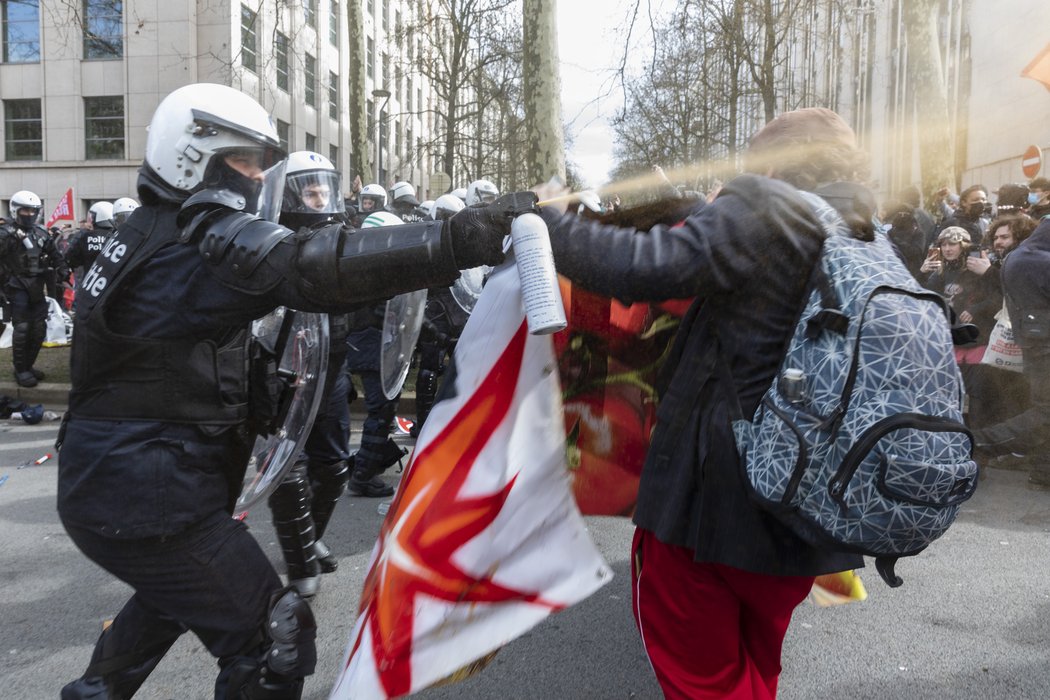
Following the interception of the Global Sumud humanitarian aid flotilla by the Israeli army, which included Belgian activists among others, over 4,000 people took to the streets in Brussels on 2nd October 2025, with demonstrations also held in other cities. Protesters gathered at the Foreign Affairs Ministry and marched to the European Parliament, condemning the interception and calling on the Belgian government to denounce Israel’s actions. According to Amnesty International Belgium, police used batons, tear gas, water cannon, and physical force to disperse the crowd. Amnesty noted that the protest was peaceful and questioned the order to disperse it as potentially illegitimate, calling for an investigation into what they described as “unnecessary and illegal” use of force. The next day, 3rd October 2025, around 300 protesters returned to continue their demonstration in front of the Foreign Affairs Ministry. A further protest took place on 8th October 2025, when around 600 people gathered again at the Ministry, calling for the immediate release of Belgian nationals on board the intercepted flotilla and urging diplomatic action.
On 11th October 2025, around 400 activists entered the Industeel plant in Charleroi, owned by the Arcelor Mittal group, to protest alleged steel shipments to Israel. The action, organised by groups including Code Rouge and Stop Arming Israel Belgium, aimed to disrupt supply chains and denounce what protesters described as corporate complicity. The demonstration ended without major incidents, though it caused temporary rail disruptions nearby.
On 19th October 2025, activists from across Europe established The People’s Encampment outside the European Commission’s Berlaymont building in Brussels to call for the termination of the EU-Israel Association Agreement, a military embargo on Israel and an end to economic and political cooperation with Israel. According to reports, police carried out identity checks and seized some demonstrators’ equipment and belongings even before the encampment began. The activists remained under constant police presence until police forcibly dismantled the encampment on 21st October, citing security concerns, and arrested several protesters.
On 3rd November 2025, a demonstration organised by the Antwerp Coalition for Palestine near City Hall faced significant police intervention after authorities banned protests at that location, redirecting demonstrators to a permitted area at Steenplein. Police used water cannon and pepper spray to disperse those who remained near City Hall, resulting in at least three administrative arrests. Organisers, opposition groups, and local politicians criticized the police violence, calling for greater respect for the right to peaceful assembly. A similar situation occurred again during a protest on 10th November 2025.
Thousands of people gathered in Brussels on 16th November 2025 to protest what they called the “illusion” of a ceasefire agreement signed in October 2025 by Israel and Hamas. In speeches, protesters condemned Israel for “colonisation, apartheid, and genocide” against Palestinians and warned they would continue demonstrating until sanctions against Israel are implemented.
On 15th January 2026, Antwerp Mayor Bart Van Doesburg received court approval to ban pro-Palestine demonstrations at the city’s historic square Grote Markt. The ruling dismissed protesters’ appeals and confirmed the mayor’s authority to restrict gatherings in the public square, citing safety reasons.
PRISON STAFF PROTEST OVER CHRONIC OVERCROWDING
On 2nd October 2025, hundreds of prison staff and directors protested for the first time in front of prison facilities in Brussels to draw attention to the worsening overcrowding crisis in Belgian prisons and to urge the government to take action. Protesters emphasised the unprecedented scale of the problem, calling for temporary release quotas and funding based on actual inmate numbers – according to them, over 13,000 detainees are currently held in facilities designed for around 11,000.
Belgium has long been among the most overcrowded prison systems in Europe. For years, prisons have held far more detainees than available places, forcing many to sleep on mattresses on the floor and placing a severe strain on staff and resources.
IKEA WORKERS PROTEST STAFFING SHORTAGES AND WORKLOADS
At the end of September 2025, IKEA employees began protesting against excessive workloads and chronic understaffing at the Hognoul store near Liège, culminating in the blockage of the store’s entrance on 6th October 2025 by approximately 200 workers. The strike quickly spread to other locations, including Wilrijk, Mons, Anderlecht, and Zaventem, causing varying disruptions to store operations. IKEA employees reported unsustainable workloads, difficulties taking vacation time, and broader frustrations with internal organisation. After several days of protests and mediation talks, management and trade unions at the Liège branch reached an agreement on 9th October 2025, ending the strike there. The agreement included measures to reduce workloads, streamline work organisation, conduct regular evaluations of working conditions, and convert some fixed-term and student contracts into permanent positions.
NATIONWIDE PROTESTS AGAINST AUSTERITY MEASURES
As covered in the previous CIVICUS Monitor update, the Belgian government, formed at the beginning of 2025, faced a deepening budget deficit and mounting debt pressures, following an excessive deficit procedure launched by the Council of the European Union in July 2024. To address this, the government began pushing a package of austerity and budget‑saving measures, arguing that structural reforms were necessary to restore fiscal sustainability and comply with EU requirements. These measures included changes affecting pensions, social services, and public‑sector wages. Massive national protests opposing the austerity measures began in early 2025 and continued through October and November 2025, as well as in March 2026.
Trade unions and workers took to the streets of Brussels on 14th October 2025, with between 80,000 and 140,000 people taking part in the mobilisation. The demonstration encountered police violence, including the use of physical force, tear gas, and water cannon, resulting in the arrest of at least five people and the detention of 20 to 30 others. The Standing Police Monitoring Committee reported receiving at least 13 complaints regarding the legitimacy of the force used by police officers during the 14th October demonstration. At the end of November 2025, trade unions continued their protests against the austerity measures with a three-day national strike from 24th to 26th November 2025. Approximately 80,000 to 100,000 protesters gathered again in Brussels for a demonstration on 12th March 2026. According to police, around 50 people were administratively detained during the protest to prevent damage caused by a small group targeting the Beobank building on Regentlaan near Madou. As during the 14th October demonstration and the November three-day strike, the 12th March demonstration caused significant disruptions to transport services, including Brussels Airport, and public institutions.
CONFRONTATION BETWEEN POLICE AND PROTESTERS DURING EVICTION IN ANDERLECHT
On 17th October 2025, a police operation in a second attempt to evict undocumented people from a former trade union building on Aviation Square in Anderlecht triggered significant tensions between law enforcement and around 300 activists. Police used water cannon, tear gas, and batons to disperse demonstrators and clear access to the building. Some activists had chained themselves to entrances or erected obstacles, such as a bouncing castle, to delay the intervention. Nevertheless, police secured entry and, by midday, all occupants had been removed. The mayor of Anderlecht stated that he lacked the legal authority to halt an eviction mandated by court order, while expressing regret over the situation.
The building had been occupied since March 2025 by around 70 undocumented migrants, including families with children, and also hosted social and cultural activities for the neighbourhood. The owner, Staring Real Estate, plans to redevelop the site into a hotel. A first eviction attempt scheduled for 27th August 2025 was stopped by strong mobilisation from supporters.
PROTESTS IN BRUSSELS AGAINST EDUCATION AND SOCIAL SECTOR BUDGET CUTS
Alongside nationwide protests against austerity, the education and social-professional integration sectors mobilised against planned budget cuts by the Wallonia-Brussels Federation government.
On 10th November 2025, around 120,000 teachers were called on to strike to protest increased teaching hours without pay, reduced sick leave, and limits on early retirement. The action combined work stoppages and symbolic demonstrations in Brussels, Liège, Namur, Mons, and Walloon Brabant.
In the social and professional integration sector, symbolic demonstrations and brief work stoppages took place in November and December 2025. On 12th November 2025, about fifty workers protested in front of the Walloon Parliament, opposing €6.5 million in cuts and a shift to annual funding. On 11th December 2025, over 1,600 protesters marched in Namur, warning that subsidy reductions threatened programmes serving 16,000 participants.
The protests peaked on 15th December 2025 in Brussels, when 5,000-7,000 teachers, students, artists, and childcare workers marched from Place du Luxembourg to the Wallonia-Brussels Federation government headquarters. The demonstration coincided with a strike affecting schools, nurseries, and public services, causing major disruptions.
Mobilisations continued on 25th January 2026, when several thousand parents, students, and union representatives marched from Brussels North Station to Place Surlet de Chokier, denouncing measures perceived as austerity-driven, including increased tuition fees, cuts to meals for disadvantaged students, reductions in extracurricular programmes, and delayed measures against school dropouts.
MR PARTY MEETINGS IN SAINT-GILLES AND LIÈGE MET WITH PROTESTS AND HEAVY SECURITY
The Reformist Movement (MR), Belgium’s leading French-speaking party, held meetings in Saint-Gilles on 19th November 2025 and in Liège on 26th November 2025, both accompanied by protests and heavy security.
In Saint-Gilles, around 150-250 demonstrators, organised by the Brussels Antifascist Front, gathered in Bethlehem Square to denounce the MR as drifting toward far-right ideology. The 150 police officers, equipped with riot shields and a water cannon, were deployed. No disturbances occurred, and demonstrators marched peacefully to the MR headquarters. MR president Georges-Louis Bouchez acknowledged the financial and logistical burden of such security measures but framed them as necessary to maintain civic order.
In Liège, approximately 500 protesters assembled outside the Palais des Congrès ahead of a conference on education reform attended by Bouchez and Minister of Education Valérie Glatigny. Police deployed a large presence and placed containers to secure the venue. While the conference remained peaceful, some protesters vandalised nearby buildings, including the offices of La Meuse and RTL Info, as well as the municipal town hall.
BELGIAN FARMERS PROTEST EU-MERCOSUR TRADE DEAL
Belgian farmers staged a series of protests in December 2025 and January 2026 against the EU’s proposed trade agreement with Mercosur countries (Argentina, Brazil, Paraguay, and Uruguay) citing unfair competition and risks to food safety, animal welfare, and European standards.
On 18th December 2025, thousands of farmers from across Europe gathered in Brussels during a European summit. The demonstration escalated near the European Parliament, where protesters threw potatoes, stones, and smoke bombs, set multiple fires, and uprooted trees with tractors. Masked individuals unaffiliated with agricultural unions were also reported. Police used water cannon, tear gas, and pepper spray to disperse the crowd and formed a cordon in the Luxembourg square. The march was cut short for safety reasons. Smaller demonstrations took place at other locations in Belgium. Police made at least six administrative and seven judicial arrests, and four officers were injured. Over 50 tonnes of waste, including potatoes, beetroot, burnt bins, and tyres, were cleared by cleaning teams, while equipment, vehicles, and infrastructure suffered extensive damage.
Protests resumed in mid-January 2026 with farmers partially blocking roundabouts and key roads across the country. Despite opposition from Belgian unions calling for the Mercosur deal to be rejected, the EU Council officially signed the EU-Mercosur Partnership Agreement and Interim Trade Agreement on 17th January 2026.
FIVE-DAY TRANSPORT STRIKE IN WALLONIA
TEC (Walloon public transport company) and SNCB (Belgian National Railways) unions staged a five-day strike from 26th January 2026 to oppose austerity measures imposed by the Walloon government on TEC’s umbrella organisation, the Walloon Transport Operator (OTW), as well as a draft bill from the Minister of Mobility that would end permanent recruitment for new SNCB/NMBS and Infrabel employees from 1st June 2026 and change labour consultation rules. The strike largely concluded on 30th January 2026, although TEC unions continued protests in several areas into early February 2026, causing significant disruption to transport services. On 5th February 2026, TEC unions and OTW management agreed to freeze the proposed reforms and set a deadline at the end of the year to reach a final agreement on public transport reform in Wallonia.
PRO-KURDISH PROTEST
On 7th February 2026, around 150 people gathered at Patrice Lumumba Square in Ixelles to demand “Freedom for Kurdistan” and the release of Abdullah Öcalan, the historic leader of the Kurdistan Workers’ Party, who had been imprisoned in Turkey for 26 years. Organised by Kurdish groups in Belgium, the rally was part of ongoing nationwide mobilisations.
WOMEN’S DAY
On 8th March 2026, thousands of people took to the streets across Belgium to mark International Women’s Day. With 8,500 participants in Brussels, around 2,500 in Liège, about 700 in Antwerp, and over 300 in Charleroi, protesters highlighted persistent gender inequalities, calling for fair pensions, an end to femicides, and stronger measures against toxic masculinity and gender-based violence.
CLASHES DURING NATIONALIST PROTEST AND COUNTER-DEMONSTRATION IN LEUVEN
On 26th March 2026, demonstrations by nationalist groups in Leuven turned violent, forcing significant police intervention. Around 500 participants joined a march organised by the far-right Nationalist Student Association (Nationalistische Studentenvereniging, NSV) under the slogan “Save our nation, remigration!”, while approximately 600 anti-fascist demonstrators gathered earlier that day to oppose the event. The situation escalated shortly after the start of the NSV march at Herbert Hoover Square, when some passersby expressed their displeasure by honking their horns and giving the middle finger, prompting nationalist protesters to launch fireworks into the crowd. Police deployed over 100 officers, using charges and dogs to separate the groups, with drones and water cannon on standby. Around twenty arrests were reported, and several people were injured.