This update covers developments relating to the freedoms of expression, association and peaceful assembly in Costa Rica from 1st February to 31st October 2026.
Context
New government takes office after decisive election and civil society warns of deteriorating judicial independence
On 1st February 2026, Costa Rica held presidential and legislative elections. Laura Fernández Delgado, candidate of the conservative Sovereign People’s Party (PPSO) and former minister under President Rodrigo Chaves, won the presidency in the first round with 48.3 per cent of the valid vote. The PPSO secured 31 of the 57 seats in the Legislative Assembly, obtaining an absolute majority. On 8th May 2026, Fernández took office, succeeding Chaves, whom she appointed Minister of the Presidency and Minister of Finance, maintaining political continuity with the previous administration.
Fernández’s campaign focused on public security and the promise of an “iron fist” to tackle record levels of violence, largely linked to drug trafficking, and since taking office, the new administration has prioritised security and criminal justice reforms. For example, on 15th June, the President presented six legislative proposals aimed at tackling organised crime and increasing criminal penalties, including measures concerning repeat offenders, membership of criminal organisations, policing and the penitentiary system.
Costa Rica 🇨🇷 deja de ser la excepción democrática de Centroamérica. La victoria de la “mano dura” consolida un giro que normaliza la concentración de poder y debilita los contrapesos institucionales ⚠️. Cuando incluso una democracia sólida valida este modelo en las urnas, el mensaje se expande por la región: el autoritarismo también puede ganar elecciones 🗳️. Sigue el hilo 🧵 (1/3) ✍🏻 @jovannagarcon
— Festivales Media (@festivalesgt) February 10, 2026
These initiatives have coincided with growing concerns about judicial independence, the separation of powers and access to justice, particularly delays in judicial appointments, cuts to the judiciary’s budget and pressures affecting the judiciary’s institutional and financial autonomy. Following the expiry of substitute magistrates’ mandates in December 2025, the Legislative Assembly failed to appoint nine substitute magistrates to the Constitutional Chamber, despite repeated voting rounds. On 14th July, the Chamber reported that 123 constitutional proceedings, covering matters such as healthcare, employment rights, social protection and access to public information, remained unresolved because it could not assemble the necessary judicial panels.
On 30th July, the Constitutional Chamber invalidated the legislature’s decision to return the list of candidates to the Supreme Court and ordered the appointment process to resume. As an exceptional interim measure, it extended the mandates of former substitute magistrates for urgent and indispensable proceedings. But the dispute continued. On 29th September, ruling party legislators voted to return the list to the parliamentary Appointments Committee, prompting opposition legislators to announce further constitutional challenges. On 5th October, the Supreme Court completed a list of 24 candidates for 12 substitute positions, although the appointments remained unresolved at the time of writing.
On 10th August, at least 34 civil society organisations, including CIVICUS and WOLA, warned about the deterioration of judicial independence and democratic institutions. The organisations identified public attacks on judges and judicial authorities, delays in judicial appointments, financial pressures and reported stigmatisation of journalists and human rights defenders as interconnected concerns affecting the rule of law and civic space.
On 26th October, the Costa Rican Association of the Judiciary (Asociación Costarricense de la Judicatura, ACOJUD), Center for Justice and International Law (CEJIL), Due Process of Law Foundation (DPLF), and other organisations presented their concerns to the Inter-American Commission on Human Rights (IACHR) about political interference, attacks against judges, obstacles to judicial appointments and restrictions on judicial resources. The Costa Rican state rejected the allegations.
Association
Judges face physical attacks, death threats and public vilification
On 17th April 2026, Kattia Carballo Chaves, a judge in Alajuela, was physically assaulted outside her home in Heredia. A neighbour allegedly incited his dog to attack her before beating, kicking and dragging her along the pavement, causing multiple injuries. Two days earlier, Carballo had reportedly received a death threat from the same individual, following several months of alleged harassment. On 18th April, the suspect was arrested and placed in pre-trial detention while authorities investigated allegations of attempted homicide, aggravated threats and injuries.
The assault followed a period of public criticism of Carballo’s judicial decisions concerning the rights and detention conditions of prisoners. During 2024 and 2025, then-President Rodrigo Chaves and other executive officials had reportedly criticised her rulings in official press conferences, including by identifying her publicly. Carballo subsequently reported receiving threats and harassment directed against herself and members of her family. In response, on 16th April, the International Association of Judges condemned the incident and called for an independent investigation and protection measures.
On 21st September, the Costa Rican Association of the Judiciary (ACOJUD) informed the Supreme Court that three judges, two in Alajuela and one in Cartago, were on medical leave because of threats and pressures. The association attributed some of these pressures to the executive branch and called for stronger protection measures. On 15th October, criminal judge William Serrano Baby disclosed that he and his family had received death threats while he was handling a high-profile extradition proceeding. Some threats reportedly originated abroad and were communicated through social media and other channels. Serrano confirmed that protection measures had been provided and stated that the threats had not influenced his judicial decisions.
These incidents occurred amid increasing confrontation between the executive branch and senior judicial authorities (see Context). On 29th January 2026, then-President Chaves publicly questioned the impartiality of Constitutional Chamber justices ahead of a ruling concerning the allocation of radio and television frequencies, warning that the judges would continue hearing from him for years if they ruled against the government. On 22nd April, Chaves publicly insulted Supreme Court President Orlando Aguirre Gómez, describing him as either a criminal or a fool following his public response to the assault against Carballo. On 29th April, the judicial workers’ union SITRAJUD filed a criminal complaint against Chaves concerning repeated statements directed at Aguirre and other judicial authorities.
The confrontation continued under President Laura Fernández. On 31st July, President Fernández reportedly accused four Constitutional Chamber justices (Fernando Cruz Castro, Paul Rueda Leal, Ingrid Hess Herrera and Jorge Araya García) of participating in what she described as a judicial coup against the Legislative Assembly. Her statements followed a Constitutional Chamber ruling that provisionally extended the mandates of substitute magistrates to prevent the paralysis of constitutional proceedings (see Context). On 3rd August, ruling party legislators, accompanied by Fernández, filed a criminal complaint alleging prevarication against the four justices, arguing that the Court had exceeded its constitutional powers.
On 17th August 2026, the UN Special Rapporteur on the independence of judges and lawyers, Margaret Satterthwaite, expressed concern about reported attacks and pressures affecting judicial officials. The communication described allegations involving gunfire directed at judges’ vehicles, bomb threats, death threats against relatives, armed attacks and physical harassment, alongside campaigns of public vilification targeting judges and senior judicial authorities. The Rapporteur expressed particular concern that statements by senior public officials might contribute to a hostile environment.
Indigenous land defender Pablo Sibar Sibar reports arson attacks on recovered ancestral land
On 18th February 2026, neighbours alerted Brörán Indigenous rights defender Pablo Sibar Sibar to a suspected arson attack on Finca San Andrés, land he had occupied for more than 13 years in the Indigenous territory of Térraba, Puntarenas province. The University of Costa Rica’s Kioscos Socioambientales programme reported that unidentified individuals had allegedly deliberately set the fire, damaging recently planted trees and hoses supplying water to Indigenous households. Community members and firefighters subsequently contained the blaze. The incident followed a territorial dispute in August 2025, when two non-Indigenous individuals allegedly attempted to occupy the property, claiming authorisation from the Térraba Integral Development Association (ADI).
On 20th February 2026, Sibar alleged that the incident formed part of a pattern of harassment and attacks against Indigenous land defenders. He reported having submitted a complaint requesting an investigation and criticised what he considered an inadequate institutional response to repeated threats. Sibar is a beneficiary of IACHR precautionary measures granted in April 2015 to protect members of the Teribe (Brörán) and Bribri Indigenous peoples facing serious risks associated with territorial disputes.
On 16th March, Kioscos Socioambientales reported another suspected deliberate fire on land associated with Sibar in the Indigenous territorial recovery of Crün Shurín, Térraba. The fire reportedly began around midday, one day after the Festival Madremonte, a cultural event celebrating the community’s territorial recovery. Community members and firefighters contained the blaze before it spread further. According to the organisation, Crün Shurín, recovered in 2018, was home to approximately 25 Indigenous families, comprising around 80 people.
Following these incidents, on 30th March, the National Indigenous People’s Front (FRENAPI) warned of continuing risks to Sibar’s life and physical integrity, and called on the authorities to strengthen protective measures, investigate threats and address persistent violence against Indigenous land defenders.
Other fires were reported, affecting Indigenous land recovery efforts in southern Costa Rica. In April 2026, the University of Costa Rica reported that four fires had affected recovered Indigenous lands in San Andrés, Crün Yaigó and Crün Shurín between January and March 2026. The university also cited monitoring by the Coordinadora de Lucha Sur Sur documenting 35 allegedly deliberate fires in recovered Indigenous territories between 2020 and 2022. Indigenous communities have responded by establishing local firefighting brigades and undertaking environmental restoration initiatives to protect their territories and livelihoods.
According to media reports, the incidents also occurred amid longstanding conflicts over land ownership and recovery. Indigenous organisations have questioned the role of Integral Development Associations (ADI) in administering Indigenous territories, arguing that these structures can undermine traditional authorities and Indigenous self-determination.
Environmental defender Ricardo Muñoz receives death threats over wetland conservation work
On 5th October 2026, environmental defender Ricardo Muñoz, known as Ilustre, publicly reported repeated death threats allegedly linked to his work protecting the Coris-Bermejo wetland in Cartago province. Muñoz, associated with the Ornithological Association of Costa Rica and Asociación Nido de Halcón, stated that he had received at least three threats over approximately two years, including warnings that he would be killed and his remains concealed if he entered properties connected to his environmental complaints. Muñoz confirmed that he was receiving protection from the judiciary’s Office for Attention and Protection of Victims of Crime, as well as assistance from an international organisation supporting environmental defenders.
In response, the Association for the Preservation of Wild Flora and Fauna (APREFLOFAS) and 41 other environmental, community and academic organisations condemned the threats and requested protective measures for Muñoz and other environmental defenders.
Since 2024, Muñoz and other environmental defenders have documented the wetland’s biodiversity and denounced alleged drainage, earthworks, waste disposal and industrial development affecting the ecosystem.
On 17th February 2026, the Environmental Prosecutor’s Office carried out searches as part of criminal proceedings concerning suspected drainage and filling of wetlands, encroachment on protected water-source areas and possible non-compliance with administrative suspension orders. On 26th June, the Constitutional Chamber upheld a constitutional complaint concerning SETENA’s handling of the environmental authorisation, and ordered SETENA to maintain the precautionary suspension of construction and exercise its powers to protect the site’s environmental integrity pending completion of the administrative proceedings.
Maleku Indigenous women attacked during territorial recovery in Guatuso
On 18th June 2026, members of the Maleku Indigenous community reported physical attacks during efforts to reclaim disputed land at Viento Fresco de Guatuso, in Alajuela province, northern Costa Rica, near the Indigenous community of Palenque Tonjibe. The action had begun several days earlier on a six-hectare property locally known as Cujo John. According to media reports, individuals whom community members identified as non-Indigenous landholders or occupiers arrived at the property in the morning and allegedly threatened participants.
An initial confrontation reportedly involved a person armed with a machete, prompting police intervention. Early in the afternoon, a second confrontation occurred involving people carrying wooden sticks. Videos circulated by local media showed physical violence and an injured Indigenous woman leader receiving assistance. Several people reportedly sustained injuries, including a Maleku woman leader who suffered a head wound, while others reported cuts and bruises.
Community members questioned the police response, alleging that officers failed to prevent the second confrontation despite their presence at the scene. They also alleged that a police officer had pushed an older Indigenous man. The Indigenous Student Community of the University of Costa Rica (COEI) condemned the violence, particularly the reported attacks against Indigenous women involved in land recovery, and called on authorities to guarantee their safety.
The reported attacks renewed concerns about the safety of Indigenous land defenders, particularly women leading land recovery efforts. Civil society organisations have raised similar concerns about threats and violence in other Indigenous territories, including Salitre, Térraba, Cabagra and China Kichá, calling for stronger protection, access to justice and effective implementation of Indigenous collective land rights.
Trade unions denounce alleged retaliatory dismissal and obstacles to collective bargaining at Dos Pinos
On 30th July 2026, the Federation of Public University Workers’ Unions (FESITRAES) denounced the reported dismissal of Ricardo Fallas, a trade union delegate at the animal-feed concentrate plant of the dairy cooperative Dos Pinos. The federation alleged that the dismissal constituted retaliation for his trade union activities and that the company had invoked Article 85(d) of the Labour Code, which permits termination of employment at the employer’s initiative, subject to applicable legal safeguards. FESITRAES demanded Fallas’s immediate reinstatement, payment of outstanding wages and respect for trade union protections. The precise date of his dismissal and the outcome of any subsequent legal proceedings could not be independently established.
On 3rd August, the Union of Employees of the Dos Pinos Cooperative (UDECO) denounced additional alleged interference with trade union rights. The union reported having submitted three complaints to the Ombudsperson’s Office concerning alleged shortcomings in labour inspections and investigations. According to UDECO, the Ministry of Labour had indefinitely delayed verifying its membership, a procedure the union considered essential for advancing collective bargaining. UDECO also alleged that Dos Pinos had requested the identification of four union officials enjoying statutory protection against dismissal, raising concerns about possible retaliation against union representatives.
Labour Ministry orders investigation into alleged retaliation against ANEP union leaders
On 4th May 2026, the Ministry of Labour and Social Security (MTSS) authorised further investigation into allegations of workplace harassment and anti-union retaliation against three officials working in the Legal Advisory Unit of the National Treasury, part of the Ministry of Finance. The officials also served as representatives of the National Association of Public and Private Employees (ANEP). According to media reports, the workers alleged that senior Ministry of Finance officials, including officials who served under former President Chaves, had systematically excluded them from institutional restructuring processes, reduced their responsibilities and attempted to intimidate them in retaliation for their trade union activities and criticism of administrative decisions.
The complaint, submitted on 12th December 2025, alleged that the authorities had established a parallel legal advisory structure that undermined the unit’s functions and technical independence. The workers also reported that their administrative objections and requests for information had been ignored or rejected. In January 2026, they requested urgent protective measures after an allegedly unjustified decision to relocate their offices, which they considered retaliatory and detrimental to their working conditions. They also opposed an internal investigation by the Ministry of Finance, citing concerns about impartiality because senior officials implicated in the complaint occupied positions within the institution’s management structure.
Proposed anti-money laundering reforms raise concerns on freedom of association
In 2026, the Legislative Assembly continued to examine Bill No. 25.129, introduced on 5th August 2025, to amend Law No. 7786 on money laundering and terrorist financing. The government presented the bill partly to implement Recommendations 8 and 35 of the Financial Action Task Force (FATF), an international body that sets standards to combat money laundering and terrorist financing.
The proposal would establish a risk-based regulatory framework for non-profit organisations (NPOs). Under proposed Article 15 quinquies, NPOs identified as presenting a higher risk of terrorist-financing abuse would have to register with the General Superintendency of Financial Institutions (SUGEF), the financial sector regulator, and comply with additional financial transparency and due diligence requirements, including identifying significant donors and beneficiaries. These obligations would not automatically apply to all NPOs.
Lawmakers approved a substitute text in April 2026 and continued examining amendments in October. On 22nd October, the Legislative Assembly’s Security and Drug Trafficking Committee unanimously approved changes to the proposed sanctions regime, including reductions in penalties affecting NPOs. As of early November 2026, the bill remained under legislative consideration.
The potential impact of the bill on civic space will depend on its final provisions and implementation, particularly the criteria for identifying higher-risk organisations, safeguards against arbitrary or discriminatory enforcement, and protections for organisational autonomy. The FATF’s revised Recommendation 8 calls for targeted, proportionate and risk-based measures, warning that inappropriate implementation can disrupt legitimate non-profit activities.
Constitutional Chamber rules against government interference in trade union representation at CCSS
On 13th August 2026, the Constitutional Chamber annulled the Government’s rejection of Rocío Alfaro Molina, who had been elected by trade union organisations in June 2026 to represent workers on the Board of Directors of the Costa Rican Social Security Fund (CCSS). The Chamber unanimously found that the Government had exceeded its legal authority by rejecting the unions’ choice, contrary to Article 6 of the CCSS Constitutive Law, which protects the autonomy of sectoral representation.
In a further judgment issued on 24th September, it ordered the Government to take the necessary steps to appoint Alfaro within eight days. Although the Government maintained that it was entitled to verify candidates’ legal qualifications, the Chamber found that this did not authorise it to substitute its own assessment for the unions’ decision.
Environmental defender acquitted of criminal defamation charges but continues to face civil lawsuit
On 26th June 2026, a court acquitted environmental defender and digital content creator Juan Bautista Alfaro Rojas, known as Juanba Caminando, of two criminal defamation charges brought by Enjoy Hotels & Resorts S.A., the company developing the Bahía Papagayo tourism and real-estate project in Playa Panamá, Guanacaste province. The charges stemmed from videos Alfaro published on Instagram and TikTok in April 2025, in which he raised concerns about the project’s potential environmental impact, including the destruction of tropical dry forest and possible effects on mangroves and bodies of water. The company alleged that his statements were false and had damaged its reputation and commercial relationships.
The court relied on technical reports from the National Environmental Technical Secretariat (SETENA), the environmental assessment authority. The reports documented forest cover and bodies of water, including watercourses connected to nearby mangroves, in the project area. The court found that this evidence weakened the company’s claims that Alfaro had published false information. It also considered that administrative challenges and other factors could have contributed to project delays and concluded that the evidence did not sufficiently establish a causal link between Alfaro’s publications and the alleged reputational damage.
Despite the acquittal, Alfaro continued to face a separate civil lawsuit seeking approximately USD 342,000 in compensation for alleged reputational damage. As previously reported, in 2025, the company had also obtained a precautionary attachment of his financial assets, a court-ordered measure restricting access to certain funds while legal proceedings continued.
On 17th August, the Southern Zone Civil and Labour Appeals Court ordered the lifting of the precautionary attachment on funds derived from employment benefits and savings held through a workers’ solidarity association. The court found that these funds retained their legal protection against attachment even after transfers between Alfaro’s bank accounts. However, it did not examine the defence’s arguments concerning freedom of expression or the allegedly intimidating nature of the lawsuit, as the funds’ protected legal status provided sufficient grounds to resolve the appeal.
Peaceful Assembly
Nationwide demonstrations defend judicial independence amid stigmatisation
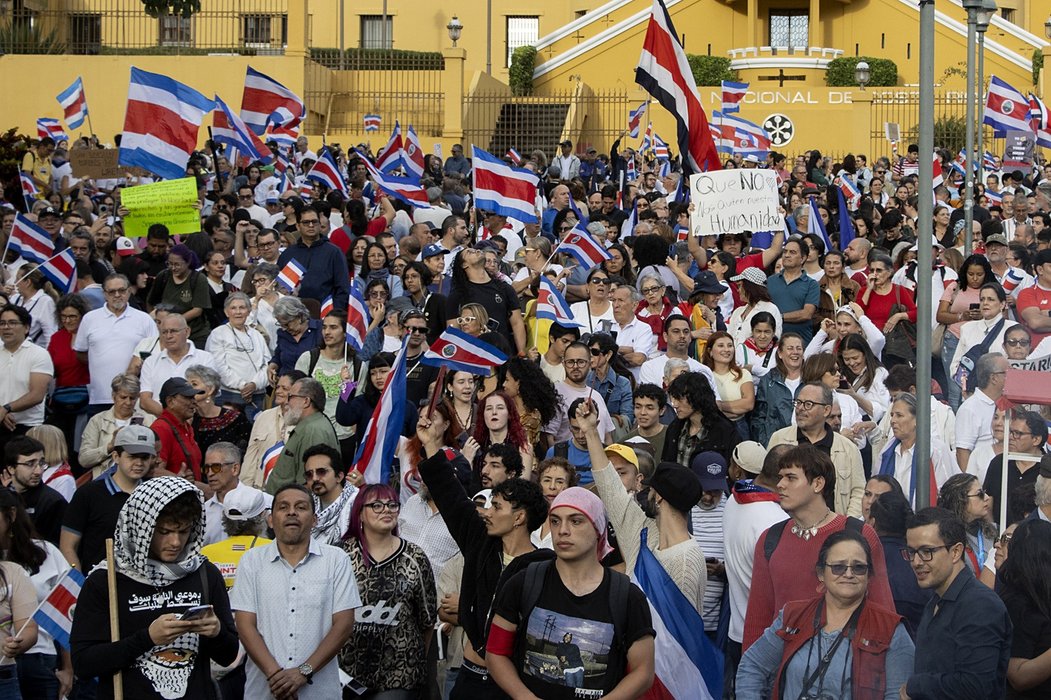
On 6th August 2026, thousands of people peacefully demonstrated in San José, the capital city, in support of judicial independence, the separation of powers and democratic institutions, amid growing tensions between the government and the judiciary (see Context). Some mobilisations began in the Plaza de la Democracia, a central public square, while others marched from Montes de Oca, in the San José metropolitan area, towards the city centre.
Protesters carried Costa Rican flags and placards calling for respect for the judiciary and the Constitution. Participants included judicial employees, students, civil society representatives, opposition legislators, former presidents and other citizens. Attorney General Carlo Díaz and senior judicial officials also attended. Similar demonstrations took place in several other locations, including Liberia, Nicoya, Cartago, Quepos, San Ramón, Limón, Pérez Zeledón and Turrialba.
Ahead of the demonstration, on 5th August, Minister Rodrigo Chaves publicly criticised prospective protesters, describing them as naïve, masochistic or politically motivated, and suggesting that some were defending judicial privileges or acting on behalf of opposition groups.
Following the demonstration, ruling party parliamentary leader Nogui Acosta questioned the scale of the mobilisation. On 7th August, President Fernández acknowledged the protest as an expression of democratic freedom while defending her electoral mandate and maintaining her criticism of the Constitutional Chamber. On 13th August, PPSO legislator Cindy Murillo attracted criticism after referring to opposition legislators Claudia Dobles and Abril Gordienko as ‘escorts (“damas de compañía”), in remarks associated with their political participation and the 6th August protest.
Police restrict access to Independence Day celebrations and remove journalists amid allegations of discrimination
On 14th September 2026, police restricted access to Plaza Mayor, the central square in Cartago, during official Independence Day celebrations and a meeting of the Council of Government, attended by President Fernández and government officials. Officers established security perimeters, requested identification and searched people attempting to enter the square. Protesters, trade union members and journalists alleged that police selectively restricted access to individuals critical of the government.
The Association of Secondary School Teachers (APSE), a teachers’ trade union, filed a constitutional protection action after officers reportedly searched its members and denied them entry, despite their intention to participate peacefully in the celebrations. APSE president Dennis Javier Solís Cruz stated that officers had cited orders from their superiors without identifying who had issued them. Human rights activist Janekeith Durán Barberena also filed a constitutional protection action challenging the police operation, including the treatment of protester Dahian Barahona, whom officers reportedly removed from the gathering, transported in a police vehicle and released shortly afterwards. According to the complaint, police instructed Barahona not to return to the restricted area, without explaining the legal basis for the measure. By 18th September, the Constitutional Chamber had received six legal challenges.
The police operation also affected journalists covering the celebrations (see Freedom of Expression).
On 15th September, the Ombudsperson’s Office, the national human rights institution, requested information from the Ministry of Public Security about the legal basis and proportionality of the operation. On 29th September, La Nación reported that an internal police operational plan had instructed eight intelligence officers to monitor groups critical of the government and identify potential agitators during the celebrations. The Ministry of Public Security maintained that the monitoring formed part of preventive security operations rather than surveillance targeting political opponents.
Legislator proposes increased criminal penalties for protesters who conceal their identity
On 22nd October 2026, ruling party legislator Robert Junior Barrantes Camacho introduced Bill No. 25.860, proposing amendments to the Criminal Code to increase penalties for certain offences committed during public demonstrations or gatherings by individuals deliberately concealing their identity. The proposal would amend Article 229 to classify property damage committed in these circumstances as aggravated damage, punishable by six months to four years’ imprisonment. It would also increase by one-third the existing penalties under Article 263 bis for obstructing public roads and Article 394(1) for placing unauthorised signs, drawings or inscriptions on property. The proposed aggravating circumstances would apply only where the individual committed one of the specified offences while intentionally covering their face to avoid identification. The bill would not criminalise the wearing of masks, hoods or other facial coverings in itself.
The initiative followed demonstrations on 20th October 2026 against proposed education budget cuts, during which damage to public monuments was reported. Barrantes argued that the reform was intended to protect public and private property and prevent individuals from using anonymity to evade accountability for unlawful acts. Although protecting property and public safety constitutes a legitimate objective, the proposed aggravating circumstances raise questions concerning necessity and proportionality under international standards. The bill remained under legislative consideration as of early November 2026.
On 20th October, thousands of students, university employees, teaching staff and trade union representatives marched through San José to protest proposed reductions in public education funding. Convened by the National Council of Rectors (CONARE) and student federations, the mobilisation brought together representatives of the country’s five public universities and other civil society organisations. Protesters marched from the Fuente de la Hispanidad in San Pedro de Montes de Oca to the Legislative Assembly and Plaza de la Democracia, demanding that lawmakers reconsider proposed reductions to the 2027 national budget. The demonstration followed the Legislative Assembly's Public Finance Committee’s approval of a proposed ₡8.048 billion reduction to the Special Fund for Higher Education (FEES). University authorities warned that the reductions could affect student scholarships, academic programmes and regional campuses.
The demonstration proceeded largely peacefully, with some temporary road closures and traffic disruption, including near Plaza de la Democracia, where protesters remained despite heavy rain. Some graffiti and other markings were reported on the monument to former President José Figueres Ferrer. On 21st October, the National Museum filed a criminal complaint against unidentified individuals over damage to the monument and other cultural heritage structures.
University students allege police intimidation during protest over education funding
On 26th October 2026, students from the National University (UNA), a public university in Heredia, near the capital, San José, demonstrated against proposed cuts to public education funding, particularly funding for public universities through the FEES. Student groups organised the protest under the slogan ‘March for a Dignified Life (“Marcha por la Vida Digna”). Protesters gathered near the university before blocking a major road into Heredia, causing significant traffic congestion.
During the afternoon, authorities deployed officers from the Public Force, the national police service, the Operational Support Group (GAO), riot-control units and the municipal police. Students alleged that more than 60 officers had gathered near one university entrance, while additional police reportedly positioned themselves at other access points. Protesters said they felt surrounded and feared that officers would use tear gas to disperse them. According to media reports, an officer warned protesters that police would use force unless they cleared the road within ten minutes. Students subsequently left the roadway and entered the university campus, where they said they had sought refuge from the police presence.
Randall Rodríguez, president of UNA’s Sociology Students' Association, maintained that the demonstration had remained peaceful and questioned the need to deploy riot police. He acknowledged that some protesters had burned cardboard and discarded materials. Enrique Arguedas, director of the Public Force in Heredia, stated that police began negotiations with protesters and that students voluntarily ended the blockade without officers having to use force.
Student detained during protest against electricity reform amid allegations of excessive police force
On 26th May 2026, police detained Elián Xavier Jiménez Campos, a sociology student at the National University (UNA), during a demonstration outside the Legislative Assembly in San José opposing Bill No. 23.414, the proposed Law on Harmonisation of the National Electricity System. Students, trade union representatives and other protesters had gathered to oppose reforms which they feared could facilitate the privatisation of electricity services. The demonstration coincided with the bill’s approval in first debate. Video recordings circulated by media outlets showed several officers restraining Jiménez Campos and placing him in a police vehicle. Jiménez Campos was released after nearly 48 hours in custody.
On 27th May, the Federation of Students of the University of Costa Rica (FEUCR) and the UNA condemned the incident. FEUCR alleged that officers had pursued, struck and arrested the student, while UNA expressed concern about reported physical and verbal aggression against other protesters. Both organisations questioned the legality, necessity and proportionality of the police response and called for an independent investigation.
The Ministry of Public Security defended the detention, alleging that Jiménez Campos had been damaging part of the Legislative Assembly’s premises and had resisted police intervention, causing an officer to sustain a knee injury. The student’s defence disputed the allegations, maintaining that he had not intentionally injured the officer and questioning the proportionality of the police intervention.
Health workers strike over salaries and pension reforms amid disputes over social security autonomy
On 25th March 2026, thousands of healthcare workers in Costa Rica participated in a nationwide strike to demand salary adjustments, payment of outstanding employment benefits and improved working conditions. The strike affected the Costa Rican Social Security Fund (CCSS), the public institution responsible for administering social security and providing healthcare services. Trade unions, including the National Union of Employees of the CCSS and Social Security (UNDECA), the Union of Medical Science Professionals (SIPROCIMECA) and the Pharmacy Workers’ Union (SINTAF), criticised prolonged salary freezes and demanded adjustments to compensate for the loss of purchasing power. They also opposed proposed changes to the Invalidity, Old Age and Death (IVM) pension scheme, particularly the possibility of raising the retirement age. Workers demonstrated outside the CCSS headquarters in San José, while employees at hospitals and healthcare facilities across the country joined the strike. According to the CCSS, participation rose from 4,462 employees in the morning to 6,015 by the afternoon.
The institution reported the cancellation of 197 scheduled surgeries nationwide, including 15 of 16 elective surgeries at the National Children’s Hospital, where emergency and urgent procedures continued. During the demonstration outside the CCSS headquarters, protesters and police officers reportedly pushed one another following a dispute over access to the building by a trade union delegation. The CCSS subsequently asked the Labour Court to order striking employees to return to work and postponed negotiations with union representatives, citing the need to maintain essential healthcare services.
On 28th August, a coalition of 48 civil society and trade union organisations announced a demonstration to demand respect for the CCSS’s constitutional autonomy, payment of the government’s outstanding debt to the institution and Rocio Alfaro’s appointment (see Association). On 3rd September, dozens of citizens, trade union members and civil society representatives gathered outside the CCSS headquarters before marching through parts of San José. Protesters carried flags and banners calling for the protection of public healthcare, respect for the CCSS's autonomy and recognition of the trade unions’ chosen representative.
On 17th September, five health-sector unions launched another nationwide strike, this time over delayed, incomplete and irregular salary payments linked to the implementation of the Integrated Personnel Management System (SIPE), the CCSS’s personnel and payroll management system. Trade unions alleged that errors had prevented some employees from receiving their full salaries, and criticised the administration’s handling of the system. By mid-afternoon, the CCSS reported 4,355 employees participating in the strike, alongside the cancellation of 202 of 409 scheduled surgeries during the first shift and the closure of 31 Basic Comprehensive Healthcare Teams (EBAIS), which provide primary healthcare services.
Protest against proposed restrictions on emergency contraception for survivors of sexual violence
On 23rd October 2026, hundreds of people from feminist collectives, university students and youth political groups peacefully held a demonstration outside the Legislative Assembly in San José to protest proposed changes to legislation concerning the treatment of survivors of sexual violence. Protesters carried placards, chanted slogans and participated in artistic activities, calling for the protection of women’s sexual and reproductive rights. The march caused temporary traffic disruption.
The mobilisation followed the Legislative Assembly Women’s Committee’s approval on 21st October of a substitute text for Bill No. 23.633, which seeks to establish statutory guarantees for comprehensive medical, psychological and institutional care for survivors of rape during the first 72 hours following an assault. The committee approved the amendment, removing emergency contraception from the minimum services expressly guaranteed by the bill.
Transport workers demonstrate over proposed regulation of digital ride-hailing platforms
On 28th July 2026, taxi drivers, tourism transport operators and bus-sector representatives marched through central San José towards the Legislative Assembly demanding legislation to regulate ride-hailing platforms such as Uber and DiDi. The demonstration began near the headquarters of the CCSS and proceeded along Avenida Segunda, a major road in the capital. Organisations including the National Chamber of Transport (CANATRANS), the National Commission of Taxi Organisations and tourism transport representatives organised the mobilisation. Protesters expressed concerns about declining incomes, mounting debts and competition from digital transport services. Taxi drivers argued that the lack of comprehensive regulation had created unequal operating conditions and threatened their livelihoods.
The protesters called on lawmakers to advance Bill No. 23.736, which legislators introduced in May 2023 to regulate paid passenger transport through digital platforms. On the day of the demonstration, the Legislative Assembly’s Government and Administration Committee completed its examination of 282 proposed amendments, approved nine and returned the revised bill to the full Assembly for further consideration.
Drivers working through digital platforms opposed several provisions of the proposed legislation. On 29th July, Uber, DiDi and other platform drivers organised slow-moving vehicle protests through San José towards Casa Presidencial, the presidential offices. They demanded amendments to Bill No. 23.736 and greater participation in parliamentary discussions. Their representatives criticised proposed restrictions on collecting passengers at airports and transport terminals, financial penalties and rules governing the suspension of drivers' access to digital platforms.
The mobilisation also took place amid financial pressures on conventional taxi operators. On 21st May, the Public Services Regulatory Authority (ARESEP), the regulator of public service tariffs, approved an extraordinary increase in taxi fares of between 1.39 and 2.82 per cent following higher international fuel prices. ARESEP stated that fuel represented approximately 12 per cent of taxi operating costs and that the adjustment sought to maintain the financial sustainability of regulated transport services.
Nicaraguan exiles commemorate the 2018 uprising and demand justice
On 19th April 2026, dozens of Nicaraguans living in exile in Costa Rica gathered in San José to commemorate the eighth anniversary of the 2018 popular uprising against the government of Daniel Ortega and Rosario Murillo and demand justice for victims of state repression. The commemoration, organised by Nicaraguan civil society and human rights organisations in exile, included a memorial service at the Church of San Francisco de Asís in Goicoechea, cultural performances, testimonies from victims’ relatives and the public display of photographs of people killed during the 2018 protests. Participating organisations included the Colectivo de Derechos Humanos Nicaragua Nunca Más, the Asociación Madres de Abril and the Red de Mujeres Pinoleras.
During the gathering, relatives of victims denounced continuing impunity and called for truth, justice, reparations and guarantees of non-repetition. Protesters also demanded the release of political prisoners, respect for fundamental freedoms and international support for democratic change in Nicaragua. The event formed part of a broader programme of commemorations organised by Nicaraguan exile communities in Costa Rica and other countries.
Mobilisation against tree felling for Bahía Papagayo tourism project
On 17th April 2026, the environmental collective Salvemos el Bosque de Playa Panamá announced demonstrations in San José and Guanacaste to oppose the planned removal of hundreds of trees for the Bahía Papagayo tourism and real estate development promoted by Enjoy Hotels & Resorts in Playa Panamá, Carrillo, Guanacaste province. The mobilisation followed a decision by the National System of Conservation Areas (SINAC) in early April 2026 authorising the removal of 748 trees from land within the Papagayo Tourism Development Area.
On 21st April, environmental activists gathered outside the Constitutional Chamber in San José to demand judicial protection of the affected ecosystem. On 22nd April, community and environmental organisations demonstrated in Playa Panamá against the proposed tree felling and the potential environmental consequences of the project. Participating groups included Salvemos Playa Panamá, Salvémonos, Antigentrificación Costa Rica and the international environmental collective Savage Lands. Protesters raised concerns about the loss of forest cover, increasing pressure on water resources and the fragmentation of coastal habitats. They also questioned whether environmental compensation measures, including reforestation, could adequately replace the ecological functions of existing forests.
Cuban exiles demonstrate outside embassy in support of diplomatic measures against Havana
On 21st March 2026, Cuban nationals residing in Costa Rica held a peaceful demonstration outside the Cuban Embassy in Sabana Norte, San José, to express opposition to the government of Miguel Díaz-Canel and support Costa Rica’s decision to reduce diplomatic relations with Cuba. Protesters demanded political freedoms and the release of political prisoners, denounced alleged human rights violations and called for greater international pressure on the Cuban authorities. The mobilisation was organised with the participation of Cuban exile activists, including Luis Michel Céspedes, a representative of the Christian Liberation Movement in Costa Rica.
The protest followed the Costa Rican government’s announcement that it would close its embassy in Havana and request the withdrawal of Cuban diplomatic personnel accredited in San José, while allowing consular services to continue.
Constitutional Chamber finds police arbitrarily detained students displaying Palestinian flag during presidential inauguration
On 8th May 2026, police arbitrarily detained UCR students Aren Daniel Vindas Álvarez and Yoilyn Carolina Bermúdez Morales after they displayed a Palestinian flag during President Fernández’s inauguration at the National Stadium in San José. According to the students, police officers approached them in the stadium’s stands and ordered them to remove the flag, claiming that only Costa Rican flags were permitted. The students questioned the restriction, pointing out that other attendees were displaying Israeli and other foreign flags without police intervention. They reported that some spectators directed insults and threats towards them and alleged that officers pushed and struck them during their removal from the stadium. One student also alleged that an officer attempted to seize a mobile telephone being used to record the intervention. Both were subsequently arrested and transferred to judicial detention facilities in Goicoechea, where they remained until the afternoon of 9th May 2026, when the Flagrancy Criminal Court ordered their release after prosecutors did not request precautionary measures. The same day, students, university staff and activists gathered outside the courthouse in solidarity with those detained.
Following this, the Ministry of Public Security refused to answer questions from La Nación concerning the legal basis for restricting flags, the identity of officers involved and the instructions governing police intervention.
On 8th September, the Constitutional Chamber declared that the students’ detention had been arbitrary and disproportionate and had violated their rights to personal liberty, equality and freedom of expression. After examining video recordings, the Court found no evidence that either student had engaged in violence, threatened other attendees, disrupted the ceremony or actively resisted police officers, contrary to assertions contained in police reports. Although it recognised that the authorities could impose general security restrictions during an official event, the Chamber found that these had been applied selectively, as other attendees displaying foreign flags and political symbols had not faced comparable intervention. The Court further emphasised that hostile reactions from other spectators could not justify restricting peaceful expression and that the police had a duty to protect those exercising their rights rather than suppress their message.
Court acquits three protesters and orders investigation into possible false police accusations
In late June 2026, the Criminal Court of the First Judicial Circuit of San José acquitted Ana Carolina Marín Durán, Mar Fournier Pereira and Valeri Salas Solís of aggravated resistance, a criminal offence involving resistance to public authorities, following their arrest during a demonstration against police violence outside the Legislative Assembly on 9th September 2023. The criminal proceedings had lasted nearly three years. Prosecutors alleged that the three protesters had physically assaulted police officer Yessenia Porras Carballo after she fell to the ground during confrontations between demonstrators and police. However, the Public Prosecutor’s Office ultimately requested their acquittal, acknowledging that the evidence did not establish their responsibility for the alleged assault.
According to media reports, the court identified significant inconsistencies between police accounts and video recordings presented during the trial. The court found that Fournier could not have committed the alleged assault because the recordings showed Fournier lying on the ground beneath the officer. It also determined that Salas had not participated in the confrontation as police had alleged. The court acquitted both defendants on the basis of evidence contradicting the accusations against them. In Marín’s case, the recordings did not establish beyond reasonable doubt whether her movements during the confrontation constituted an assault.
The court ordered prosecutors to investigate whether the accusations against Fournier and Salas constituted a knowingly false criminal complaint (denuncia calumniosa), an offence involving deliberately making false criminal allegations against another person. The judgment followed earlier proceedings in which the Constitutional Chamber found that police had unjustifiably detained a protester during the 9th September 2023 demonstration, after reviewing video evidence that contradicted the police account.
Expression
Repeal of century-old legislation imposing custodial penalties on journalists
On 3rd February 2026, the Legislative Assembly unanimously approved Law No. 10.853, repealing Articles 7 and 8 of the 1902 Press Law (Law No. 32), which had authorised prison sentences of between one and 120 days for journalists, authors and responsible editors in connection with offences of defamation and insult committed through the press, as well as publications intended to subvert public order or undermine friendly relations with other states.
On 5th February, the Inter American Press Association (IAPA) welcomed the reform as an important step towards strengthening press freedom and reducing the chilling effect of criminal sanctions on public interest journalism. The Institute for Press and Freedom of Expression (IPLEX) also welcomed the repeal, describing the provisions as outdated punitive restrictions incompatible with democratic standards. On 27th March 2026, the law entered into force following publication in the Official Gazette.
Costa Rica da un paso histórico por la libertad de prensa. Asamblea Legislativa aprobó el expediente 24.185, “Ley para la libertad del ejercicio periodístico”, que deroga los artículos 7 y 8 de la centenaria Ley de Imprenta. https://t.co/mmT4wVakh5
— IPLEX (@IPLEXcr) February 6, 2026
Constitutional Chamber annuls radio and television frequency auctions to protect media pluralism
On 27th February 2026, the Constitutional Chamber annulled three public tenders administered by the Superintendence of Telecommunications (SUTEL) for the allocation of AM, FM and free-to-air television frequencies. The Chamber upheld a constitutional protection action challenging the use of the highest financial bid as the sole criterion for awarding broadcasting concessions, finding that the process failed to guarantee media pluralism and diversity of content. The tenders, launched in September 2025 under President Rodrigo Chaves’s administration, had faced criticism from media organisations, universities and press freedom groups over their potential to exclude smaller, regional, community, educational and religious broadcasters. The Chamber had previously ordered their precautionary suspension in November 2025, because of possible consequences for access to information during the February elections.
The Court ordered the competent authorities to guarantee the continuity of existing broadcasting services while establishing new allocation procedures incorporating effective safeguards for media pluralism and equitable, transparent and non-discriminatory access to the radio spectrum. The decision followed public criticism of the Constitutional Chamber by then-President Chaves in January 2026 (see above). On 2nd March, the IAPA welcomed the judgment as an important safeguard for media diversity and freedom of expression.
Electoral Tribunal rules that blocking citizen from presidential candidate’s Instagram account violated voting rights
On 25th February 2026, the Supreme Electoral Tribunal (TSE) upheld an electoral protection action (recurso de amparo electoral) filed by Mia Fink Uleth against then-presidential candidate Laura Fernández Delgado, after Fink was temporarily blocked from Fernández’s public Instagram account. Fink alleged that the blocking followed critical comments about the candidate and her party during the electoral campaign. The Tribunal established that the account had been used almost exclusively to disseminate campaign messages, political positions and other electoral information. It concluded that unjustifiably restricting an individual voter’s access to such information infringed the fundamental right to cast an informed vote.
Fernández maintained that the blocking may have occurred inadvertently, an explanation the Tribunal did not dismiss, but the majority held that the restriction’s effect on electoral rights was relevant regardless of intent. As Fink had already been unblocked following notification of the proceedings, the Tribunal granted the application solely for the purposes of costs, damages and compensation, with any amounts to be determined in subsequent civil enforcement proceedings. The judgment included a dissenting opinion.
Constitutional Chamber orders Ministry of Health to unblock citizen from official Facebook page
On 21st April 2026, the Constitutional Chamber upheld a constitutional protection complaint against the Ministry of Health for blocking a citizen from its official Facebook page. The complainant, who filed the action in February 2026, argued that the restriction prevented access to information about public health policies and government decisions, as well as opportunities to scrutinise the Ministry’s activities. Then-Minister of Health Mary Munive Angermüller justified the restriction by referring to allegedly offensive comments directed against her on social media. However, the Chamber found that the Ministry had failed to demonstrate that the individual had engaged in conduct on its official institutional page sufficient to justify blocking access.
The Court distinguished between personal social media accounts operated by public officials and institutional communication channels used to disseminate information of public interest. Referring to its previous jurisprudence, it reiterated that public institutions must establish clear rules governing online interactions, ensure that restrictions are reasonable and proportionate, and inform users of alleged violations before excluding them. Finding no objective and constitutionally valid justification for the restriction, the Chamber ruled that the Ministry had violated the complainant’s fundamental rights. It ordered the authorities to restore access within three days of notification and required the state to cover legal costs and damages.
Journalists report intimidation and police restrictions during Independence Day celebrations
On 14th September 2026, Ignacio Ortiz, a photographer and journalist with Semanario Universidad, reported that government supporters surrounded and verbally harassed him while he covered Independence Day celebrations in Plaza Mayor, the central square in Cartago. According to Ortiz, members of the group insulted him and demanded that he leave. After he approached nearby police officers, an officer intervened and advised him to leave the area for his safety. Separately, police reportedly ordered Cristian Mora, a journalist with La Nación, to move from an area where he was filming demonstrators whom authorities had denied access to the official celebrations, despite having initially received permission from event organisers to remain there.
Local radio journalist Juan García Martínez faces defamation lawsuit brought by mayor
On 2nd March 2026, the College of Journalists and Communication Sciences Professionals (Colegio de Periodistas y Profesionales en Ciencias de la Comunicación Colectiva, Colper) expressed concern over legal proceedings brought against Juan García Martínez, a radio journalist based in Limón, by the municipality’s mayor, Ana Matarrita McCalla. According to Colper, the proceedings followed García’s criticism of decisions taken by the municipal administration and included a civil damages claim that the organisation considered potentially prohibitive for a regional media professional. Colper warned that the financial and legal burden could discourage García and other local journalists and citizens from scrutinising public officials.
Threats and surveillance targeting journalists and human rights defenders in exile
On 8th July 2026, the Foundation for Freedom of Expression and Democracy (FLED) reported that at least seven Nicaraguan journalists living in exile in Costa Rica had experienced threats, surveillance and intimidation between April and June 2026. The reported incidents included monitoring near journalists’ homes, threatening messages on social media, disclosure of personal information, photographs of vehicles, intimidation in public places and suspicious telephone calls. Some journalists reportedly relocated within Costa Rica, while at least one left the country because of security concerns.
FLED warned that the harassment reflected the growing risks of alleged transnational repression affecting independent Nicaraguan journalists who continued reporting from exile. During the same quarter, the organisation documented 24 aggressions against independent Nicaraguan journalists and media outlets overall, including 21 verbal, written or digital aggressions, two forced displacements and one incident involving the alleged abuse of state power.
For example, on 28th May 2026, journalist Aníbal Enrique Toruño Jirón reportedly received death threats accompanied by photographs of his vehicle, indicating that unknown individuals were monitoring his movements. Journalist Hanssel Manuel Vásquez also reported repeated surveillance, suspicious telephone calls, photographs of his residence and vehicle, and incidents of being followed by motorcycles between February and May 2026, eventually prompting him to relocate.
Journalist Tania Jeanneth López Rodríguez also reported surveillance near her home and threatening communications linked to her work with DaríoMedios. The threats reportedly extended to relatives of journalists, including presenter Miurel Cuarezma and her young daughter, who had allegedly been subjected to surveillance and death threats. On 30th April, environmental defender Amaru Ruiz received an intimidating message through Fundación del Río’s Facebook account.
On 20th September 2026, the IACHR adopted Resolution 73/2026, granting precautionary measures to ten Nicaraguan exiles in Costa Rica, including Toruño and two relatives, López Rodríguez, Ruiz, Vásquez Ruiz, Eliseo Fabio Núñez Morales along with his immediate family, and a Nicaraguan journalist whose identity is being withheld. The Commission concluded that the beneficiaries faced serious and urgent risks of irreparable harm to their rights to life and personal integrity. Although it acknowledged the measures undertaken by Costa Rican authorities, it found insufficient evidence that the identified risks had been effectively mitigated. The IACHR requested that Costa Rica conduct comprehensive, individualised risk assessments, agree appropriate protection arrangements with the beneficiaries and ensure that they could continue their journalistic and human rights activities safely.
The threats reportedly continued after the IACHR decision. According to media reports, journalist Vásquez alleged that several armed, masked individuals attempted to force entry into his residence on 21st September, one day after the Commission adopted its resolution. He reported that the individuals subsequently examined the surrounding area before leaving. On 13th October, FLED documented that at least 14 journalists in exile lost their jobs, while a suspended assistance programme affected another ten. The organisation also expressed concern that four journalists previously identified as being at risk had reportedly been notified by Costa Rican authorities of the closure of their investigative cases.
On 21st October, the Institute on Race, Equality and Human Rights warned that existing protection arrangements could require journalists and defenders to suspend professional activities, restrict communications or relocate, potentially interfering with their ability to continue their work. The organisation called for specialised protection mechanisms capable of addressing transnational threats without undermining freedom of expression or human rights work.
📢 Ya se encuentra disponible nuestro tercer Informe Trimestral 2026 sobre la situación de la libertad de prensa en Nicaragua, en el que FLED documentó 38 agresiones contra periodistas y medios independientes entre julio y septiembre. El documento aborda, entre otros temas, la inseguridad y las dificultades migratorias y laborales que enfrentan periodistas nicaragüenses exiliados en Costa Rica. 📄 Lee el informe completo : https://t.co/8xQ4h2g6FR
— FLED (@FLED_ong) October 13, 2026
Government restricts access to national security information through state secrecy decree
On 27th July 2026, the government issued Executive Decree No. 45870-MSP, which classified extensive categories of information relating to national security and intelligence as state secrets. The decree covered information concerning the National Public Security Council, the Directorate of Intelligence and National Security (DIS), and security operations coordinated by the Presidency. Its scope extended beyond operational plans and intelligence methods to include administrative records, public procurement procedures, contracts, budgetary information and other activities involving public resources. The government defended the measure as necessary to protect sensitive operations, criminal investigations and the lives and security of officials and other individuals.
According to media reports, the decree prompted four constitutional challenges, which the Constitutional Chamber consolidated in proceedings admitted in September 2026, without suspending the decree's general application. The applicants, including a group of 15 legislators, argued that the extensive classification of public information undermined constitutional guarantees of transparency, accountability and access to information, particularly concerning government expenditure and procurement. They also questioned whether the executive branch could establish such extensive restrictions through a decree and whether confidentiality obligations affecting public officials, contractors and other individuals could interfere with freedom of expression and press freedom.
On 19th October 2026, the government published Executive Decree No. 45962-MSP, amending Articles 2 and 3 of the original regulation. The reform expressly excluded ordinary public procurement, general budget execution, general expenditure and financial oversight from automatic secrecy. It also required authorities to justify individual restrictions through an assessment of necessity, suitability and proportionality, demonstrating a real, imminent and direct risk to personal safety or police operations. The amendment further prohibited authorities from invoking confidentiality to withhold information formally requested by constitutionally authorised oversight institutions, the Legislative Assembly, courts or prosecutors.
Although the amendments introduced additional safeguards, the general declaration of state secrecy remained in force, and operationally related procurement documents, contracts and budgetary information could still be restricted where the prescribed conditions were met. The reform also provided for periodic reconsideration of classification without establishing a fixed maximum duration. These provisions continued to raise questions about compatibility with international human rights standards.
Proposed broadcasting fees raise concerns about media pluralism and freedom of expression
On 27th August 2026, the Legislative Assembly approved at first reading Bill No. 24.461, proposing amendments to the 1954 Radio Law to update the fees paid by radio and television broadcasters for the use of public frequencies. The revised proposal, approved by 48 votes to three, would replace longstanding fixed charges with progressive annual fees calculated on gross revenue generated through the use of licensed frequencies, reaching marginal rates of 7.73 per cent for television broadcasters and 3.13 per cent for radio stations. Broadcasters below a specified revenue threshold would be exempt, while additional exemptions and special provisions would apply to certain public, cultural and non-profit broadcasters. The government and supporters of the reform argued that existing fees were outdated and that broadcasters should contribute proportionately to their use of the public radio spectrum.
In response, on 26th August, the Committee to Protect Journalists (CPJ) and the IAPA warned that inadequately justified or disproportionate charges could threaten broadcasters’ financial viability, potentially forcing some outlets to cease operations and restricting access to freely available information, particularly in rural and lower-income communities.
CPJ and IAPA urge that any fee tied to spectrum use should be based on objective, technical and proportional criteria, and should not create conditions that force stations off the air. The statement notes that free broadcast signals remain a critical source of news for households with lower incomes, rural communities and the public during emergencies, elections and natural disasters.
-
On 27th August, IPLEX acknowledged the need to modernise the regulatory framework but called for transparent technical studies, an assessment of the differentiated impact on broadcasters, and safeguards to protect media sustainability and pluralism. On 9th September, opposition legislators submitted the bill to the Constitutional Chamber, questioning the proportionality of the proposed fees, the sanctions regime and provisions permitting the executive to terminate broadcasting concessions under exceptional circumstances for reasons of public interest. The legislators warned that insufficiently defined regulatory powers and financial obligations could undermine legal certainty, due process and freedom of expression. The constitutional challenge prevented the scheduled second reading, and the bill remained under legislative consideration as of early November 2026.
Ruling party legislators face criticism over alleged pressure on university newspaper
On 14th September 2026, ruling party legislator Nayuribe Guadamuz requested information covering 2024-2026, including the newspaper’s budget, expenditure, salaries, staffing, operating costs, revenues, audits and assessments of financial efficiency from the University of Costa Rica’s (UCR) newspaper, Semanario Universidad. The newspaper’s director, Laura Martínez, acknowledged the legitimacy of parliamentary scrutiny of public resources but expressed concern that the request could be used to exert pressure on the newspaper's editorial independence. She argued that the initiative should be considered in the context of repeated criticism by ruling party representatives of the newspaper’s investigative reporting and editorial positions. Guadamuz rejected these allegations, maintaining that her request concerned transparency and accountability in the use of public funds rather than interference with journalistic content.
On 24th September, members of the UCR University Council expressed solidarity with Semanario Universidad and Martínez. Council members raised concerns that financial scrutiny could become a mechanism for exerting pressure on editorial decisions, particularly in the context of previous threats and intimidation affecting university media personnel. They referred to threatening communications directed at journalists and administrative staff, including incidents involving Adrián Zúñiga and Ignacio Ortiz, as well as police intervention during Ortiz's reporting of Independence Day celebrations in Cartago on 14th September.
Cybersecurity expert denounces alleged surveillance after seeking information about government intelligence technology
On 13th August 2026, cybersecurity expert and digital rights advocate José Sánchez Pérez demanded that the Directorate of Intelligence and Security (DIS), the state intelligence agency, cease alleged surveillance and harassment targeting him and those close to him. In a letter addressed to DIS director Pablo Martínez Bertozzi, Sánchez alleged that unidentified individuals, whom he suspected of having links to state institutions, had monitored his movements, followed him in vehicles, stationed cars near his residence and monitored his social media activities.
The allegations followed a June announcement by Minister of Finance Rodrigo Chaves concerning the possible acquisition of Israeli intelligence-related technology to combat tax evasion. On 25th June, Sánchez requested information from the Ministry of Finance about the legal basis for the proposed technology, its potential use of artificial intelligence and personal data, information-sharing arrangements with intelligence agencies, and safeguards against unlawful surveillance. Following an inadequate response, he filed a constitutional protection application. On 30th July, the Constitutional Chamber upheld the application, finding that the Ministry had violated his constitutional rights to petition and access public information. The Ministry subsequently indicated that no specific technological system had been selected and that the initiative remained under consideration.
On 8th October, the Constitutional Chamber upheld a second constitutional protection application filed by Sánchez, finding that the Ministry of Finance had failed to respond adequately to further requests concerning data-protection impact assessments and possible coordination with the Data Protection Agency (PRODHAB).
Reuters Institute highlights sustained deterioration in Costa Rica's press freedom environment
On 24th July 2026, the Reuters Institute for the Study of Journalism at the University of Oxford published an analysis documenting the deterioration of press freedom in Costa Rica. Drawing on interviews with journalists, media editors and press freedom experts, the analysis identified increasing hostility towards independent journalism, particularly during the administration of former President Rodrigo Chaves (2022-2026).
Journalists interviewed by the Reuters Institute described repeated public stigmatisation of critical media outlets, online harassment, restrictions on access to public information and alleged discriminatory allocation of state advertising. They warned that such practices had contributed to a hostile environment for independent reporting, increased economic pressures on media organisations and heightened risks of self-censorship.
According to the World Press Freedom Index published by Reporters Without Borders (RSF), the country fell from 5th place globally in 2021 to 38th in 2026, a decline of 33 positions over five years.