Watchlist March 2026
March Watchlist 2026
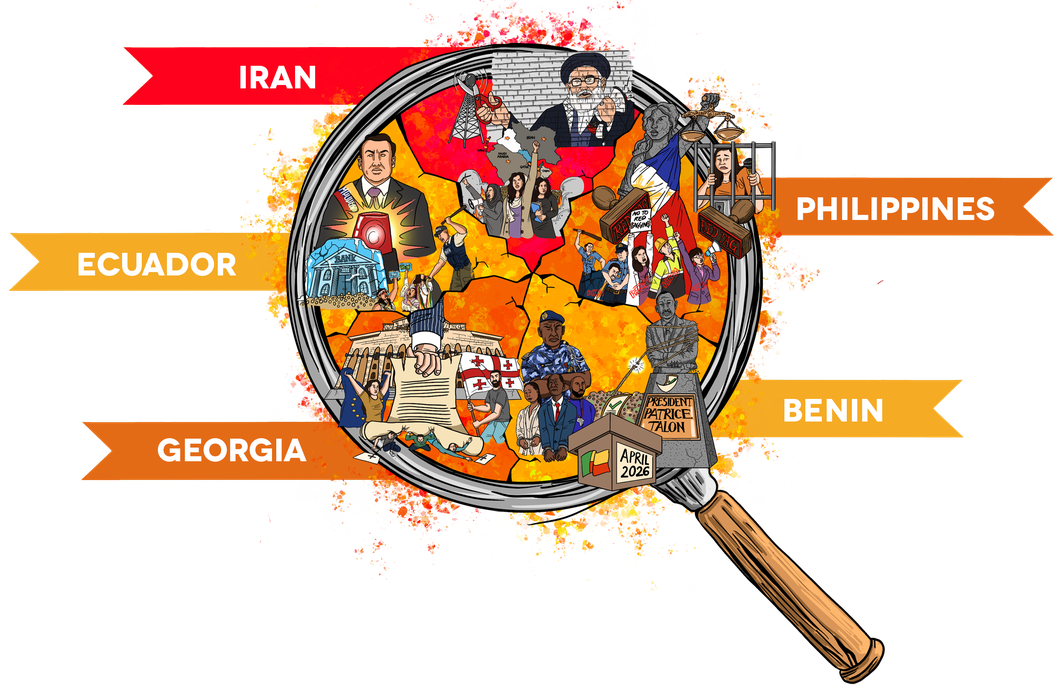
Latest Update: 25 March 2026 - The new CIVICUS Monitor Watchlist highlights serious concerns regarding the exercise of civic freedoms in Benin, Ecuador, Georgia, Iran and the Philippines.
The Watchlist draws attention to countries where there is a serious decline in respect for civic space, based on an assessment by CIVICUS Monitor research findings, our research partners and consultations with activists on the ground. In the coming weeks and months, the CIVICUS Monitor will closely track developments in each of these countries as part of efforts to ensure greater pressure is brought to bear on governments. CIVICUS calls upon these governments to do everything in their power to end the ongoing crackdowns immediately and ensure that perpetrators are held to account. Descriptions of the civic space violations happening in each country are provided below. If you have information to share on civic space in any of these countries, please write to monitor@civicus.org

ECUADOR'S CIVIC SPACE RATING: OBSTRUCTED
Civic space conditions in Ecuador have rapidly deteriorated as the government has relied on a militarised security response to address organised crime violence, expanding military powers and limiting fundamental freedoms. From January 2024 onwards, authorities began invoking the existence of an alleged “internal armed conflict” to justify exceptional measures that fall short of international human rights standards. The growing militarisation of public security has been accompanied by credible reports of serious human rights violations. The CIVICUS Monitor has categorised the country’s civic space as “obstructed” since 2020.
In September and October 2025, peaceful Indigenous-led protests were met with excessive and lethal force after authorities declared emergency powers and deployed thousands of armed forces personnel. The protests formed part of a 31-day nationwide strike (“paro nacional”), a major wave of demonstrations led by Indigenous movements and centred mostly in the Andean highlands, after President Daniel Noboa scrapped the diesel subsidy, raising prices by over 50 per cent and impacting Indigenous and rural communities.
Security forces reportedly killed at least two Kichwa Indigenous community leaders from Imbabura province: Efraín Fuérez, from Cotacachi, shot in the back on 28 September, and José Guamán, from Otavalo, fatally shot in the chest on 14 October. On the same day, Rosa Paqui Seraquive, an older woman from the Kichwa Saraguro people, died from asphyxiation following exposure to tear gas. A fourth victim, Edison Farinango, died on 27 December after spending two months in critical condition. He was struck by a tear gas canister during protests in Imbabura. The violent crackdown also left nearly 500 people injured (including at least 25 seriously injured and 12 military personnel), and over 200 arbitrarily detained, while the human rights organisation Alianza de Organizaciones por los Derechos Humanos del Ecuador documented at least 16 cases of short-term enforced disappearance. Authorities also reportedly disrupted internet and mobile services in Cotacachi, Otavalo and La Esperanza.
Alongside the violent repression, public officials and some media outlets promoted narratives linking Indigenous organisations and community guards (“guardias indígenas”, community-based self-protection groups rooted in Indigenous governance systems) to terrorism and organised crime, fuelling stigmatisation and criminalisation, with authorities opening investigations against at least 61 Indigenous leaders and environmental defenders for offences including terrorism, terrorism financing and illicit enrichment.
Since 2025, this pattern of criminalisation has become more entrenched, with the National Anti-Mining Front (FNA) reporting over 200 social leaders investigated or prosecuted across several provinces with significant rural and Indigenous populations (Imbabura, Cotopaxi, Bolívar, Los Ríos and Azuay). On 23 February 2026, three defenders were sentenced to four years’ imprisonment for the offence of violating private property, in connection with their opposition to the Curipamba-El Domo mining project in Bolívar province. Thirty-two defenders remain under investigation in Bolívar and Los Ríos, linked to the same fight against mining projects.
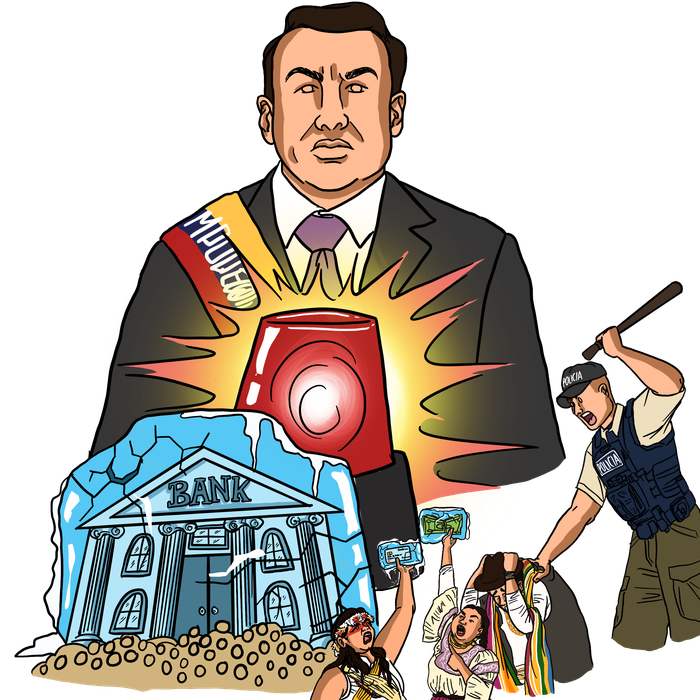
Freedom of association is also under growing threat. After securing a full four-year mandate in April 2025, President Noboa’s administration promoted sweeping legislation tightening state control over civil society organisations, much of it adopted by the National Assembly through fast-track emergency procedures. A clear example is the Social Transparency Law adopted in August 2025 and its implementing regulation issued in October 2025. The new law and regulation imposes burdensome reporting obligations on civil society organisations, allowing administrative bank-account freezes, and limiting advocacy against state-approved mining projects, which is particularly concerning in a country where oil and mining exacerbate environmental and land conflicts. Although several constitutional challenges were filed in 2025, the Constitutional Court has not yet ruled on whether the law is in line with the Constitution.
Civil society organisations reported that the new legal framework is already being used to target them. Since September 2025, authorities have frozen the bank accounts of several environmental and Indigenous organisations under alleged anti-money laundering investigations led by the Financial and Economic Analysis Unit (UAFE), often based on confidential “intelligence” reports. Affected organisations said they cannot access or challenge the evidence alleged in these reports, highlighting the risk of financial controls being abused against civil society.
For example, on 27 September 2025, during the national strike, the Pachamama Foundation reported that its accounts were frozen and a criminal investigation opened against its president. Similar actions affected at least 27 organisations, including Alianza Ceibo, the FNA, the Confederation of Indigenous Nationalities of Ecuador (CONAIE), the Indigenous and Peasant Movement of Cotopaxi (MICC), and Yasunidos. In December 2025, Human Rights Watch warned that these unjustified freezes are disrupting civil society operations and raised serious concerns about due process.
Alarm persists over violations of freedom of expression and press freedom, as reflected in the killing of at least five journalists in 2025, according to the press freedom organisation Fundamedios. On 20 November 2025, unknown assailants shot and killed journalist Robinson del Pezo in La Libertad, a coastal city in Santa Elena province.
Del Pezo founded and directed the digital media outlet La Voz del Pueblo, where he reported on alleged corruption involving municipal contracts, land transactions and public works projects. Furthermore, during the 2025 national strike, press freedom organisations documented 55 attacks against journalists across at least five provinces.
Press freedom has further eroded amid the arbitrary suspension or closure of at least seven radio stations, particularly community broadcasters, a stalled broadcast frequency allocation process, and regulatory measures that threaten the financial viability of independent media. The latter is illustrated by the February 2026 administrative intervention ordered by Ecuador’s corporate regulator against GRÁFICOS NACIONALES S.A. (GRANASA), publisher of the national newspapers Diario Expreso and Diario Extra, two of the country’s most widely circulated privately owned newspapers based in Guayaquil, which placed the company under temporary state supervision.
These developments have been unfolding amid weakening judicial independence. Recently, the Observatorio de Derechos y Justicia (ODJ) reported a crisis in the judiciary, marked by political interference, corruption allegations and the infiltration of organised crime. Violence against justice officials is also concerning. Between 2020 and 2025, at least 40 attacks targeted judges, prosecutors and court personnel, including the killings of 12 prosecutors and three judges, as well as armed attacks on judicial offices.

GEORGIA'S CIVIC SPACE RATING: REPRESSED
Civic space in Georgia is rapidly unravelling. After being downgraded from “narrowed” to “obstructed” in 2024, the CIVICUS Monitor further lowered the country’s rating to “repressed” in December 2025. In an attempt to suppress mass protests and subdue a deepening political crisis, Georgian authorities have introduced a range of laws expanding restrictions on fundamental freedoms and political participation, threatening the survival of civil society and media in the country.
Beginning on 28 November 2024, protests sparked by the Georgian Dream administration’s decision to suspend EU accession negotiations until 2028 were met with excessive force, including tear gas, water cannons, arbitrary arrests, and violence from both police and masked individuals suspected of being affiliated with the government. One year after the protests began, civil society organisations (CSOs) reported that, by their estimates, around 160 people had been subjected to criminal investigations, 300 to torture and ill-treatment, more than 600 were administratively detained and over 1,000 fined.
As smaller gatherings continue daily, the authorities are still targeting protesters with heavy fines and detentions under restrictive new laws. Since 2024, successive amendments to protest legislation have made an ever-expanding list of common protest acts, such as covering one’s face, blocking traffic, or “obstructing people’s movement” in pedestrian areas punishable by immediate administrative detention. Repeating the same offence triggers criminal charges and can result in up to two years in prison. In February 2026, 12 people reported having had their bank accounts seized over unpaid fines for participating in protests, despite having appealed the decisions.
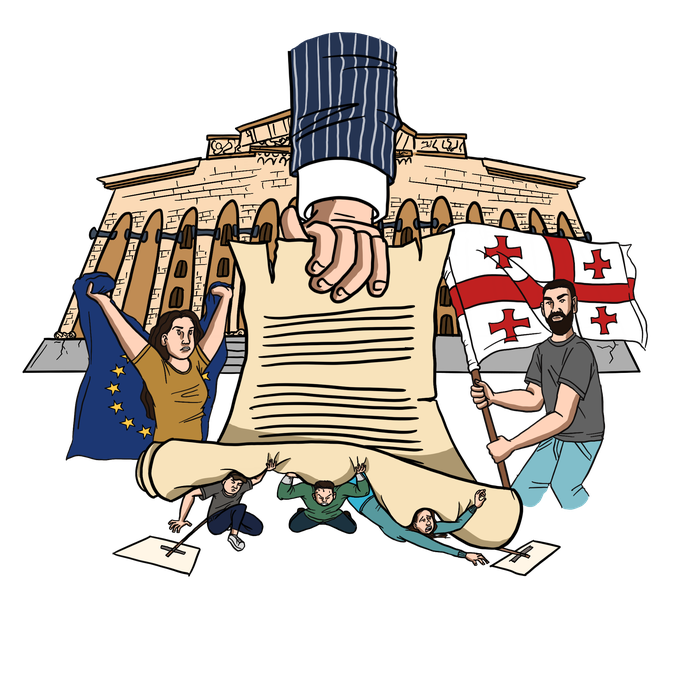
In parallel, Georgian authorities continue to tighten restrictions on funding for civil society and media, subjecting them to administrative harassment and threatening their survival. After adopting a “foreign agents” law in 2024 in spite of mass outcry, a further such law was passed in April 2025, a direct translation of the US Foreign Agents Registration Act, which extends to individuals and imposes criminal liability for non-compliance. Other new restrictions introduced in 2025 include a ban on broadcasters receiving funding from “foreign powers” and requirements for CSOs to secure government approval before accepting foreign grants.
As a result of this crackdown, numerous CSOs and media outlets have been faced with inspections from anti-corruption authorities, criminal investigations on spurious grounds and frozen bank accounts. In February 2026, a broadcaster critical of the government reported being subjected to administrative proceedings over a single donation from the United States, seemingly from a Georgian living abroad.
Marking the latest development in this torrent of repressive legislation, in March 2026, amendments were passed radically expanding the definition of “foreign grants”. A “foreign grant” now encompasses any funding or material support received from abroad deemed intended to “exert influence” over public policy. It also expands the definition of “foreign donors” to include private individuals, without setting a minimum threshold, meaning even minor financial contributions from foreign citizens could trigger criminal liability, with failing to obtain approval for foreign grants being punishable by six years in prison.
Another law passed in the same session has introduced criminal liability for “extremism against the constitutional order”, threatening imprisonment for anyone aiming to “establish the perception” that Georgian authorities are illegitimate—a provision widely understood as targeting criticism of the October 2024 parliamentary elections. Also included in the legal package were provisions imposing an eight-year ban on political party membership for anyone previously employed by an organisation representing “foreign interests,” essentially excluding anyone with a background in foreign-funded civil society or media from participating in political life.
Alongside protesters, CSOs and the press, the government has also cracked down heavily on the political opposition. In November 2025, the Georgian Prosecutor General’s Office announced criminal charges against eight leading opposition figures on charges including sabotage, aiding foreign interests and calling for the overthrow of the government, seeking up to 15 years in prison for some. The majority of them are already in prison, having been sentenced to jail terms and two-year bans on holding public office for refusing to testify before a parliamentary commission investigating alleged crimes committed by government officials between 2003 and 2012, when the United National Movement (UNM), currently in opposition, was in power.
The commission was formed exclusively from MPs aligned with Georgian Dream, as four opposition parties had refused to take up their seats or participate in parliamentary activities after disputing the fairness of the October 2024 election. CSOs have criticised the commission’s composition and mandate as incompatible with the constitution and parliamentary procedure, viewing the investigation as a pretext for Georgian Dream to punish its political opponents and dismantle political pluralism in the country.
In October, the commission’s findings were used to petition the Constitutional Court to outlaw the UNM and two other opposition parties the government deemed its satellites, just as a law was passed to ban individuals affiliated with banned parties from standing in elections or holding public office. After an alliance of nine opposition parties including UNM was formed in March 2026, Prime Minister Irakli Kobahidze announced the lawsuit could be expanded to encompass them all.
IRAN'S CIVIC SPACE RATING: CLOSED
Civic space in Iran is rapidly deteriorating. After the authorities unleashed a deadly crackdown on mass protests, the US and Israel’s unlawful attack on the country has led to even more restrictions. With neighbouring countries curbing freedoms as well amid Iran’s retaliation, the conflict is threatening further deterioration of fundamental freedoms in the region.
Nationwide demonstrations which have been described as the country’s biggest since 2009, when millions of demonstrators protested against disputed elections, began on 28th December 2025 over deteriorating economic conditions since the sudden depreciation of the country’s currency, general economic instability, and larger political reforms.
On 8th January 2026, authorities plunged the country into a complete internet blackout and shut down phone and mobile networks. Between 8th and 11th January 2026, state forces reportedly mass-killed thousands of protesters using overwhelming firepower, with authorities reportedly imposing martial law-like restrictions on public activity and movement. On 19th January 2026, Reuters reported that authorities had verified that at least 5,000 people had been killed in the protests, including about 500 security personnel. According to the Iranian Human Rights Activists News Agency (HRANA), more than 24,000arrests were made during the period. Some protesters are now facing the death sentence, in a worrying insight into an imminent brutal retaliation for the protests. Earlier, Iran’s head of judiciary Gholamhossein Mohseni Ejei, threatened that consequences for demonstrators would be “decisive, maximum and without any legal leniency.”
The civic space situation in Iran has further deteriorated since the protests, after United States and Israeli forces launched coordinated airstrikes on 28 February 2026, killing at least 1,255 people and injuring about 10,000 as of 10 March 2026, according to Iran’s officials.
Authorities imposed a nationwide internet blackout, the second in only two months. Major platforms and VPN access have also been blocked or disrupted, severely limiting communication and the sharing of potentially lifesaving information. Journalists have been forced to rely on satellite links, encrypted apps, and smuggled footage, often using banned tools such as Starlink despite the severe risks involved.
Meanwhile, serious concerns remain over the safety of protest detainees, forcibly disappeared protesters, and other imprisoned activists, including women human rights defender Narges Mohammadi, recently sentenced to an additional seven years. The need to protect and ensure the safety of detained HRDs, journalists and protesters caught inside active conflict zones cannot be overemphasised under these circumstances.
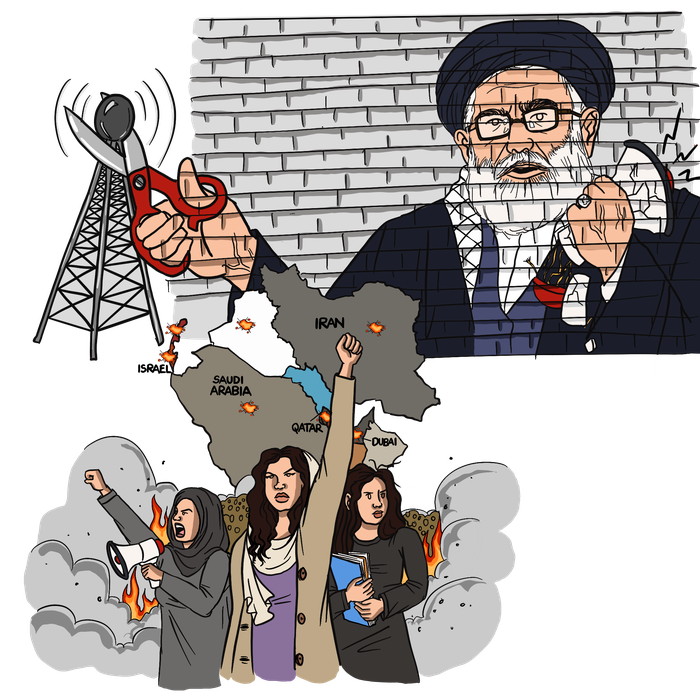
Despite the risks, thousands of Iranians have continued to peacefully gather in the streets to express their diverse views regarding the death of Supreme Leader Ali Khamenei in the airstrikes and the subsequent appointment of Mojtaba Khamenei as his successor, underscoring the urgent need for all parties to respect the rights of the Iranian people to peaceful assembly, expression, and association, and to operate within the confines of international human rights law, including in the protection of civilians.
As the conflict expands, with Iran targeting Israel and neighbouring countries hosting US forces, such as Bahrain, UAE, Kuwait and Qatar, a wider securitisation of civic space is emerging across the region. All the afore-mentioned governments have warned citizens against filming or sharing images of military activity, raising concerns about a further deterioration of civic freedoms in a region where they are already tightly restricted.
THE PHILIPPINES' CIVIC SPACE RATING: REPRESSED
Nearly four years since President Ferdinand Marcos Jr came to power, serious concerns have been raised by civil society groups and activists about efforts by the authorities to restrict civic space and silence dissent.
In September 2025, anti-corruption protests were met with arrests and excessive force. Police arbitrarily arrested and detained more than 200 individuals including 91 children and denied arrested individuals access to lawyers and their families.
Protesters also suffered physical abuse – including violations that may amount to torture and other ill-treatment – by state forces. Victims described how police punched, kicked and hit people – including children – with batons as they were arrested, with appalling ill-treatment continuing in detention. No one has been held to account for these violations.
At least 97 protesters were targeted for further criminal prosecution by the Department of Justice (DOJ) on 3 November 2025 with 72 persons charged with sedition and inciting to sedition in connection with the Anti- Cybercrime Prevention Act of 2012. Protesters have also faced harassment. Among those who received DOJ subpoenas was Renato Reyes Jr, the President of Bagong Alyansang Makabayan (BAYAN) - an alliance of left-wing organisations. At least four student leaders also received summonses to appear before the DOJ.
Human rights defenders and activists continue to be targeted. On 25 February 2026, human rights defenders Edel Parducho and Three Odeña, were arrested and detained by the police in Mandaluyong City, during the 40th anniversary of the People Power Revolution commemoration march near the EDSA Shrine, a memorial of the revolution. Parducho is the Human Rights Education Officer at the Philippine Alliance of Human Rights Advocates (PAHRA), and Odeña is a youth activist.
There were also reports of anti-mining protesters, being arrested in Dupax del Norte, Nueva Vizcaya in January 2026 and farmers and residents detained for protests around long-standing land disputes in Laguna in February 2026.
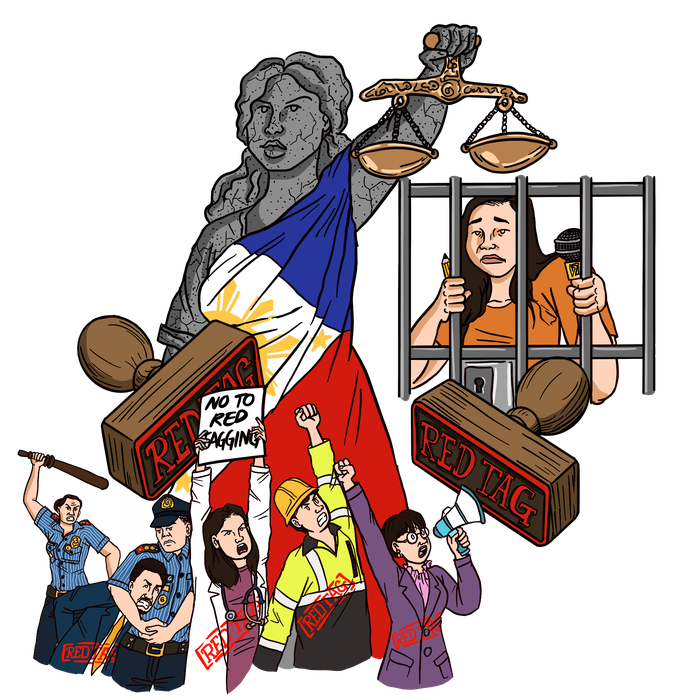
In November 2025, land rights defenders were arrested or attacked in Negros Occidental and Cagayan Valley, provinces which were impacted by typhoons Tino and Uwan.
The Philippine authorities are also filing baseless terrorism-financing charges against civil society groups and activists. In December 2025, activists were arrested on fabricated charges of financing terrorism including Carmilo Tabada, former staff of Central Visayas Farmers’ Development Center (FARDEC) and Michael Cabangon, a Cordillera labour leader and cultural worker.
There have also been ongoing reports of the red-tagging of activists - accusing government critics of being communist sympathisers as a pretext to target them - a serious concern that has been highlighted by UN experts. In December 2025, environmental lawyer Antonio La Viña was red-tagged by retired Army officer Antonio Parlade Jr. while in February 2026, two labour leaders and five mass movement leaders were red-tagged in posters distributed in Bicol.
Journalists also remain at risk. In January 2026, journalist Frenchie Mae Cumpio and human rights defender Marielle Domequil were found guilty of financing terrorism and sentenced to at least 12 years in prison, after spending nearly six years behind bars in pre-trial detention. A regional trial court in February 2026 denied their petition for bail.
BENIN'S CIVIC SPACE RATING: OBSTRUCTED
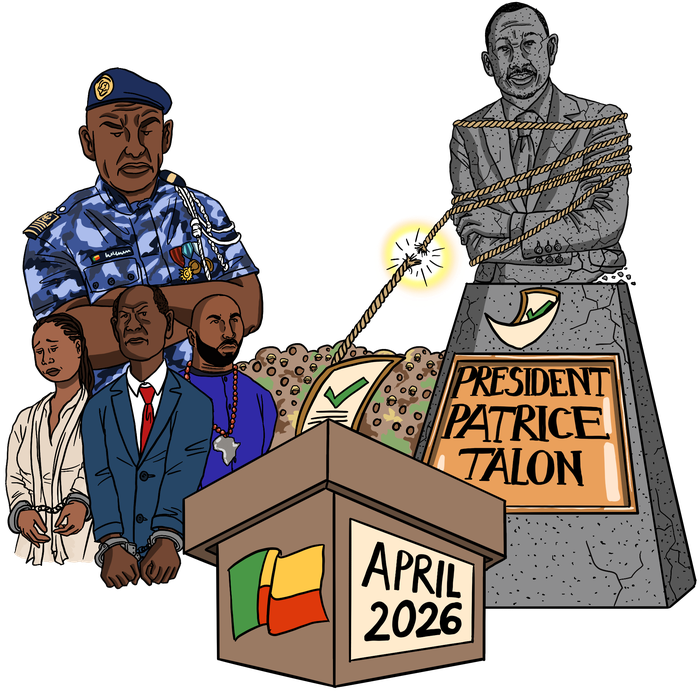
Ahead of presidential elections in Benin, scheduled to take place on 12 April 2026, Benin is placed on the CIVICUS Monitor’s Watchlist due to eroding democratic and civic space, evidenced by arbitrary arrests and prosecution of journalists and critics, transnational repression, suspension of media outlets and the frequent ban on protests.
While president Patrice Talon is stepping down, respecting the constitutional two-term presidential limit, only two candidates were qualified by the Constitutional Court to run for president - current president Patrice Talon’s successor, Romauld Wadagni, current Minister of Finances, for the presidential majority coalition, and Paul Hounkpè of Forces cauris pour un Bénin émergent (FCBE), who positioned himself as a “moderate” opponent. Candidates from other parties, including opposition party Les Démocrates, had been barred from running due to the stringent requirements contained in the 2024 Electoral Code.
Democratic space and space for political opposition to participate in elections has substantially eroded under President Patrice Talon, with the 2024 Electoral Code increasing thresholds for political parties to have representation in the National Assembly and sponsorship quota for candidates to run for president or vice-president, among other stringent requirements. A previous Electoral Code, adopted in 2019, saw the introduction of some of these requirements, which was made more stringent in 2024.
Consequently, legislative and municipal elections, which took place on 11 January 2026, have resulted in a National Assembly with no representation of political opposition. Power has been increasingly concentrated in the executive, including through the constitutional amendment of November 2025. Furthermore, the aftermath of a foiled coup d’état attempt in December 2025 has seen further erosion of the respect for fundamental freedoms.
Authorities have frequently used restrictive provisions in the Digital Code (Law 2017-20) against critics since its adoption in 2018, in particular article 550 which criminalises “publication of false news” and “harassment via electronic means”. Journalists, activists and critics are often prosecuted before a specialist court, the Repression of Economic Crimes and Terrorism Court (CRIET). On 12 January 2026, the CRIET prolonged the pre-trial detention of journalist, whistleblower and known Talon critic Huguès Comlan Sosoukpé by six months, violating national laws on the duration of pre-trial detentions, among other due process violations. Sosoukpé, journalist and director for media outlet Olofofo and Secretary General of the Beninese Association of Web Activists (ABWA), was arrested on 11 July 2025 in Abidjan, Côte d’Ivoire, where he was exiled, and was transferred to Beninese authorities. He faces charges of “harassment by electronic means” under the Digital Code, “incitement to rebellion” and “condoning terrorism”, among other charges. Sosoukpé’s lawyer, Dossou Stanic Adjacotan, was arrested in January 2026 at the airport upon arrival in Cotonou and released, pending investigation, after having been brought before the CRIET on accusations of “condoning of a coup d’état”.
Other journalists and critics have been arrested and/or prosecuted, including digital activist Steve Amoussou, who was abducted from Lomé, Togo, and sentenced in June 2025 to two years in prison and a fine for “politically motivated insult” and “spreading false information” on a Facebook page critical of the government. Djobo Bio, reporter for community radio station Nonsina, was arrested in July 2025 in Sinendé on accusations of “spreading false news” over a story on the outlet’s Facebook page on an attack on a herder and his wife. On 15 July 2025, agents of the National Center for Digital Investigations (CNIN) arrested journalist and editor-in-chief for newspaper La Boussole, Cosme Hounsa, on charges of “harassment by electronic means” following a complaint from a Minister.
The aftermath of a foiled coup d’état attempt on 7 December 2025 has seen further arbitrary arrests, including of social media users. Journalist and influencer Angèle Kpeidja was reportedly arrested after comments made on social media on the attempted coup.
Media regulator Haute Autorité de l’Audiovisuel et de la Communication (HAAC) regularly suspends media outlets and withdraws press accreditation for journalists. In March 2025, HAAC suspended online media outlet Bénin Web TV and revoked the press card of its director, Paul Arnaud Deguenon, on accusations of inconsistencies in its reporting on the HAAC’s budget presentation to the parliament’s budget committee. This came after the suspension, in January 2025, of five media outlets. In November 2025, the HAAC withdrew the frequencies of five radio stations and removed multiplex slots of three television channels. In December 2025, it informed that radio, television, print media and digital platforms were required to broadcast any public service announcement issued by the Government immediately, as is, without editing or delay. Any breach of this obligation exposes the media outlets to penalties.
The freedom to protest has also been curtailed. The Criminal Code prohibits “any unarmed gathering that could disturb public peace”, vague grounds to ban protests. Protests and political meetings by opposition parties are frequently banned. On 22 March 2025, police violently disrupted a training organised by opposition party Les Démocrates at their headquarters in Dassa-Zoumè. Police reportedly dispersed participants, seized equipment and briefly detained members. On 9 February 2025, police prohibited a political rally organised by the same party in Abomey-Calavi.
Meanwhile, there has been no accountability for the crackdown on protests against the exclusion of opposition in the 2019 legislative elections which saw four people killed.
In this increasingly restricting environment, many activists and journalists have said they resort to self-censorship. CSOs have further indicated they hesitate to call for citizen mobilisation and apply extreme caution when writing articles covering reforms, governance, or human rights violations so as to avoid accusations of provocation or public disorder.