Freedom of association
New law increases administrative strain on CSO operations
In early February 2025, the Dutch Parliament debated the so-called WTMO law in the House of Representatives. The draft law—an acronym that translates as “the law on transparency and counteracting subversion by civil society”—imposes extensive transparency obligations on civil society organisations (CSOs) concerning their funding. Mayors, the Public Prosecutor’s Office, and other government bodies would be authorised to request information on foreign donations, including the donor’s identity if the contribution exceeds a certain threshold.
Although the stated aim of the law is to protect democracy from foreign influence and subversion, it applies to all CSOs regardless of their size or mission. This broad scope places a heavy administrative burden on organisations, particularly smaller ones that may lack the capacity to monitor and report every donation and donor in detail.
On 4th February, a joint letter by a coalition of Dutch CSOs called on Members of Parliament to reject the bill.
Dutch Parliament introduces motion targeting Extinction Rebellion
On 28th January, the Second Chamber of the Dutch Parliament adopted a motion (by 69 votes to 67) labelling climate group Extinction Rebellion (XR) an “unlawful, society-disrupting and vandalistic organisation” that does not serve the public interest. The motion further urged the government to revoke XR’s ANBI (public benefit organisation) status. Losing this status would significantly affect XR’s funding, as donations would no longer be tax-deductible for donors, nor would the organisation be exempt from paying taxes on those donations. These measures follow earlier expressions of anti-XR sentiment and action in the Dutch political environment, previously reported by the CIVICUS Monitor.
Freedom of peaceful assembly
Parliamentary motions restricting the right to protest
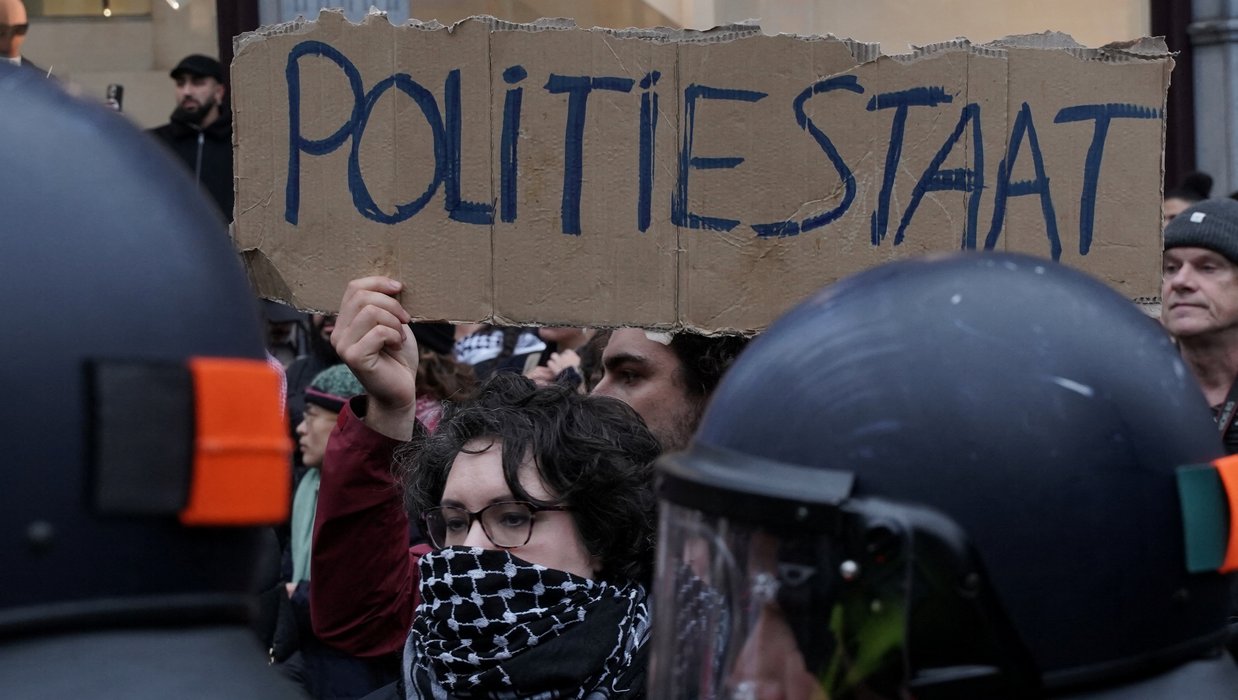
On the same day as the above motion targeting Extinction Rebellion, the Second Chamber also adopted several additional motions to crack down on “disruptive” protests. These include prohibiting such protests during national commemorations, enabling damage claims against protesters, and criminalising the blocking of key infrastructure. These motions stemmed from earlier parliamentary debates in which other restrictive measures, such as a ban on face coverings, were discussed.
Extinction Rebellion civil disobedience actions continue, police respond with hundreds of arrests and excessive force
On 14th December 2024, nearly 100 Extinction Rebellion activists were arrested at Schiphol Airport after a protest behind security checkpoints. The demonstrators poured 200 litres of a brown liquid on the floor, symbolising last year’s floods in Valencia, Spain. Security forces, including the Royal Marechaussee (Royal Military Constabulary), broke up the action, arresting 99 people. XR said the protest targeted Dutch airline KLM’s rewards programme, claiming it incentivises extreme flying behaviour to the detriment of the environment. Demonstrations outside Schiphol Plaza proceeded without any arrests, as local authorities had not imposed restrictions there.
On 21st December 2024, Extinction Rebellion staged a climate protest inside Amsterdam’s Rijksmuseum, targeting the institution’s sponsorship ties with ING Bank, which they call the “largest fossil fuel financier in the Netherlands”. Around 200 activists joined the peaceful action, which began at 2:30 p.m., with several later gluing themselves to each other and a bench in the Gallery of Honour near Rembrandt’s The Night Watch. Police ended the protest around 6:30 p.m., removing nine activists who refused to leave. It was XR’s third protest at the museum in recent months.
On 11th January 2025, Extinction Rebellion blocked the A12 motorway in The Hague to demand an end to fossil fuel subsidies. Despite a municipal ban and police barriers, hundreds of activists reached the road. Police used water cannon and arrested over 700 protesters who refused to leave, bussing them outside the city. Twelve others were detained for offences including assault and sedition. XR condemned the police response as excessive, calling the use of water cannon in freezing weather “madness.”
On 25th January 2025, around 190 Extinction Rebellion activists were arrested near the A10 ring road in Amsterdam after staging a demonstration on a ramp near VUmc hospital, close to ING’s former headquarters. Dozens had attempted to block the highway and surrounding roads, demanding that ING end its fossil fuel investments. Police ordered the protesters to leave; those who refused were taken away by bus. The mayor had banned the protest, citing risks to safety and the road’s importance for emergency services.
Unrest in Amsterdam following football match against Israeli team, protests met with bans, excessive force
In November 2024, following a UEFA Europa League match in Amsterdam between Israeli club Maccabi Tel Aviv F.C. and Dutch side AFC Ajax, violence involving football ultras escalated into wider unrest and a crackdown on pro-Palestinian protests. Authorities imposed extensive protest bans, expanded police powers, and detained hundreds of demonstrators.
On the evening of 6th November, the day before the match, Maccabi Tel Aviv supporters who had come to Amsterdam to support their club were filmed rioting in the city centre, removing Palestinian flags from homes, chanting racist anti-Arab and anti-Palestinian slogans, as well as engaging in vandalism and physical attacks on bystanders. Subsequently, those videos began to circulate in WhatsApp groups, on Telegram, and on Snapchat, accompanied by messages calling for attacks on Israeli fans and some expressing antisemitic sentiment. Following the match, Maccabi fans were ambushed and assaulted across Amsterdam’s city centre.
The attacks on Israeli supporters were condemned as antisemitic by Amsterdam mayor Femke Halsema, Prime Minister Dick Schoof, King Willem-Alexander, and several international leaders. However, many criticised media coverage for portraying the incidents as unprovoked antisemitic violence, overlooking the behaviour of Maccabi fans, who include known violent right-wing ultras. This framing was enabled by the rapid spread of misinformation; for example, Dutch photographer Annet de Graaf captured Maccabi supporters attacking locals, but many prominent global media outlets misreported the footage as showing an “antisemitic mob” attacking Israelis.
In response, Amsterdam authorities issued an emergency ordinance banning demonstrations for three days following the overnight attacks and granting police stop-and-search powers. Security was also increased at Jewish institutions across the city. On 10th November, the ban was extended for four more days.
On 10th November, riot police forcefully detained more than 100 pro-Palestinian protesters who gathered in Amsterdam’s Dam Square despite the official ban. Demonstrators insisted their action opposed Israeli military operations in Gaza rather than being antisemitic. Dutch activist Frank van der Linde sought an urgent permit to allow the protest to proceed, but a court upheld the authorities’ decision. He was reportedly among those arrested.
On 13th November, another pro-Palestinian protest in Dam Square was violently dispersed by police, resulting in 281 arrests. Most—265 people—were detained for failing to follow police instructions to disperse. Detained protesters were put on buses and were driven to a location on the outskirts of town, where they were released. Footage circulated on social media appeared to show police beating protesters with batons after releasing them. Mayor Halsema confirmed that a high-priority investigation had been launched into the incident to determine whether police actions complied with official protocol. She lifted the protest ban on 14th November, describing its continued enforcement as “untenable”.
Dutch police are being investigated following video footage showing officers beating pro-Palestine protesters in Amsterdam after a rally was broken up on Dam Square on Wednesday evening. pic.twitter.com/ad6JYvEtY6
— Middle East Eye (@MiddleEastEye) November 14, 2024
A coalition of more than 100 organisations called on the Dutch public to protest at Dam Square on 30th November, under the slogan “We are all Palestinians.” The demonstration aimed to condemn the Dutch government’s support for Israeli actions in Gaza and increasing repression of Palestinian solidarity activists. This protest was also banned from going ahead on Dam Square, with officials citing safety concerns due to anticipated crowds and recent unrest. Organisers sued to overturn the ban but lost, forcing them to move the demonstration to another location.
Protests against cuts to university funding
In late November, thousands of students, academics, and supporters protested across the Netherlands against government plans to cut more than €1 billion from higher education and research budgets. The proposed reductions, part of wider public spending cuts, threaten university closures, job losses, and an end to key research programmes. Demonstrations culminated in a large rally in The Hague after smaller protests in cities including Utrecht and Leiden. Protesters condemned the cuts as a blow to the country’s future, warning they would accelerate a “brain drain” and undermine Dutch science and innovation.
A planned demonstration in Utrecht on 14th November, organised by unions FNV and AOb alongside the WOinActie movement, was cancelled after the city’s mayor, Sharon Dijksma, claimed she could not guarantee participants’ safety. Authorities suggested pro-Palestinian groups might “hijack” the protest, framing them as a potential threat. Instead, unions livestreamed speeches from the House of Representatives in The Hague, while smaller gatherings took place at universities nationwide. At Amsterdam’s Vrije Universiteit, according to an open letter from an anonymous staff member, participants were subjected to strict security checks, with some students and staff questioned or blocked from participating over pro-Palestinian symbols and signs criticising austerity, colonialism and militarism.
Freedom of expression
Parliamentary motion to track “cultural norms and values” of migrants
On 4th December 2024, the Dutch parliament passed a motion requiring government bodies to research and record the “cultural and religious” values of Dutch citizens with an immigration background. Proposed by People’s Party for Freedom and Democracy (VVD) MP Bente Becker, the plan instructs the socio-cultural think-tank SCP to publish regular reports on this issue. GroenLinks-PvdA – an alliance between GroenLinks (GL; GreenLeft) and the Labour Party (PvdA) – Denk, Volt, the PvdD (Party for the Animals) and the Democrats 66 party were the only parties to vote against the motion.
Critics argue the motion is discriminatory and unconstitutional. Historian Nadia Bourassa warned it reflects a “dystopian vision of integration”, warning “the government [acts] as Big Brother to control personal convictions and possibly suppress them.” Immigration expert and professor Leo Lucassen criticised the motion as hypocritical, commenting “While the ‘real’ Dutch are pelting local officials who want to help refugees with fireworks, migrants and their descendants remain permanently under suspicion and are only conditionally Dutch.”
Dutch court overturns entry ban on Islamic preachers
On 20th February, a Dutch court overturned the government’s decision to deny three Islamic preachers entry to the Netherlands. The preachers had been invited to speak at the Ramadan Expo in Utrecht, an annual fair explaining the practices and significance of Ramadan.
According to then-Minister of Migration Marjolein Faber and then-Minister of Justice David van Weel, the preachers’ previous speeches contained extremist language and incitements to violence against women and LGBTQI+ groups. They argued that allowing the preachers to speak at the fair could therefore pose a threat to public order.
The court rejected this reasoning, ruling that the government’s decision to deny entry was insufficiently substantiated. While the Ministers expressed their disappointment online, they accepted the court’s judgment. However, following the ruling, the presiding judge became the target of online abuse, death threats, and a doxing campaign.
Press freedom watchdogs record several cases of threats, one physical attack
Between November and January, the Media Freedom Rapid Response mechanism recorded several cases of threats and harassment against journalists and media, as well as one case of physical assault and one arrest.
On 3rd November 2024 a Dutch media outlet reported to PersVeilig (PressSafe), a joint initiative of the Dutch Association of Journalists (NVJ), the Dutch Society of Editors-in-Chief, the police, and the public prosecutor's office, that threatening banners targeting one of its reporters had appeared at Vitesse Arnhem’s Gelredome stadium. PersVeilig and the Dutch Association of Journalists (NVJ) issued a joint statement urging the club to act and expressing support for the targeted journalist.
On 6th November 2024 a freelance journalist was assaulted in Schiedam, reporting to PersVeilig that he had been shoved from behind due to his work, causing him to hit a door frame and suffer head, neck, and wrist injuries. The journalist chose to remain anonymous for safety reasons.
On 14th November 2024 the Dutch Association of Journalists (NVJ) announced it would file a complaint against the police for arresting a photographer during a banned pro-Palestinian protest on Amsterdam’s Dam Square on 10th November. The journalist, who held a valid press card, was detained for nine hours. NVJ secretary Thomas Bruning called the arrest “unlawful and heavy-handed.” The photographer, speaking anonymously, said she was shocked by the police’s treatment of journalists.
On 20th November 2024 a Dutch journalist received a threatening letter containing BDSM images depicting sexual assault, accompanied by the message: “Your behaviour is outrageous, your attitude needs correction.” The journalist, whose identity remains confidential for safety reasons, reported the threat to PersVeilig.
On 29th November 2024 the North Netherlands Public Prosecution Service opened a criminal investigation after YouTuber Jan Roos urged Ameland residents to mobilise “with pitchforks and torches” and attack journalists who came to cover the island's local Sunneklaas festival. Roos was referring to the 2023 festival, where journalists from the broadcaster PowNed were attacked, threatened, and chased by a group of local residents while trying to cover the event. In the 28th November episode Roos said: “Fuck them. Finish them off. Shoot them down before they even get off the boat.” He was questioned by Friesland police; the prosecutor said incitement to violence would not be tolerated, and YouTube removed the episode. For his part, Roos defended the comments, stating “It was a joke, an obvious joke, in a satirical programme.”
On 3rd January 2025 freelance crime journalist Bjorn Thimister published The Gino Case, an investigative book on the 2022 murder of a child in Limburg. Following its release, the victim’s sister criticised the book online, claiming it was published without the family’s consent. Publisher TIC Publishers denied this but reported widespread intimidation and serious threats directed at Thimister, leading it to withdraw the book from sale.