Freedom of association
Ukraine approves 2025–2026 plan to implement civil society strategy
In March 2025, the Ukrainian government approved the Action Plan for 2025–2026 to implement the National Strategy for Promoting Civil Society Development, originally adopted in 2021 prior to the full-scale invasion. The updated plan aims to strengthen civil society institutions, boost citizen participation, and align Ukraine’s democratic processes with European standards.
The plan sets out measures to enhance local governance, expand public engagement, and support the growth and operation of civil society organisations (CSOs), including through digital platforms and financial incentives. It also seeks to improve legislation on public consultations, humanitarian aid, and the provision of socially important services, fostering a more participatory and resilient civic space.
Development of the action plan involved collaboration between government bodies, civil society organisations, and international partners, with groups such as ISAR Ednannia and the Ukrainian Center for Independent Political Research playing a key role in shaping its design and implementation.
Freedom of peaceful assembly
Despite martial law in Ukraine since February 2022 and restrictions on public gatherings, several protests took place in April 2025. On 10th April, veterans’ organisations in Zhytomyr staged a demonstration against decisions by the local administration.
Protesters gathered outside the regional government building to oppose the appointment of the new head of the Zhytomyr Regional Medical Centre of Vertebrology and Rehabilitation. They criticised the decision, stating it was made without consulting veterans or public representatives, and expressed their opposition to the centre’s potential privatisation, which would prevent their access to quality rehabilitation. Tensions escalated, with some demonstrators physically confronting and attacking the hospital director, Serhiy Demus, who had signed the order to reorganise the department. Veterans and military personnel told public broadcaster Suspilne they would continue protesting unless the reorganisation was cancelled. According to Suspilne, the director cancelled the order the same day, following the tense protests. At the end of March 2025, the media reported that patients of the Zhytomyr Multi-Profile Support Hospital in Novoguyvin Village were protesting against the merger of the neurological department with the therapeutic department.
LGBTQI+ film festival met with far right protest
On 19th April 2025, police in Kyiv dispersed a far-right rally in Podil targeting the Sunny Bunny LGBTQI+ film festival at the Zhovten cinema. According to media reports, police detained all participants to verify their identities, though it remains unclear whether any charges will be filed.
A correspondent from public broadcaster Suspilne, who was at the scene, reported that members of the group “Prava Molod” (“The Right Youth”) gathered outside the venue in support of what they described as “traditional values.” Hostility towards the festival grew in right-wing circles online after information circulated that its opening would coincide with Good Friday. In response, festival organisers emphasised that the dates had been set in advance and criticised attempts to link the event to religious holidays as a pretext for homophobia.
Festival director Bohdan Zhuk told the Kyiv Independent that organisers had received threats prior to the event and expressed gratitude to the police for their swift response in dispersing the rally. He also reported an incident in which a festival visitor was assaulted by far-right radicals near the cinema, denouncing the attack as unacceptable in a democratic country that should protect the rights of all citizens and prevent discrimination.
Freedom of expression
Victoria Roshchyna’s body returned to Ukraine
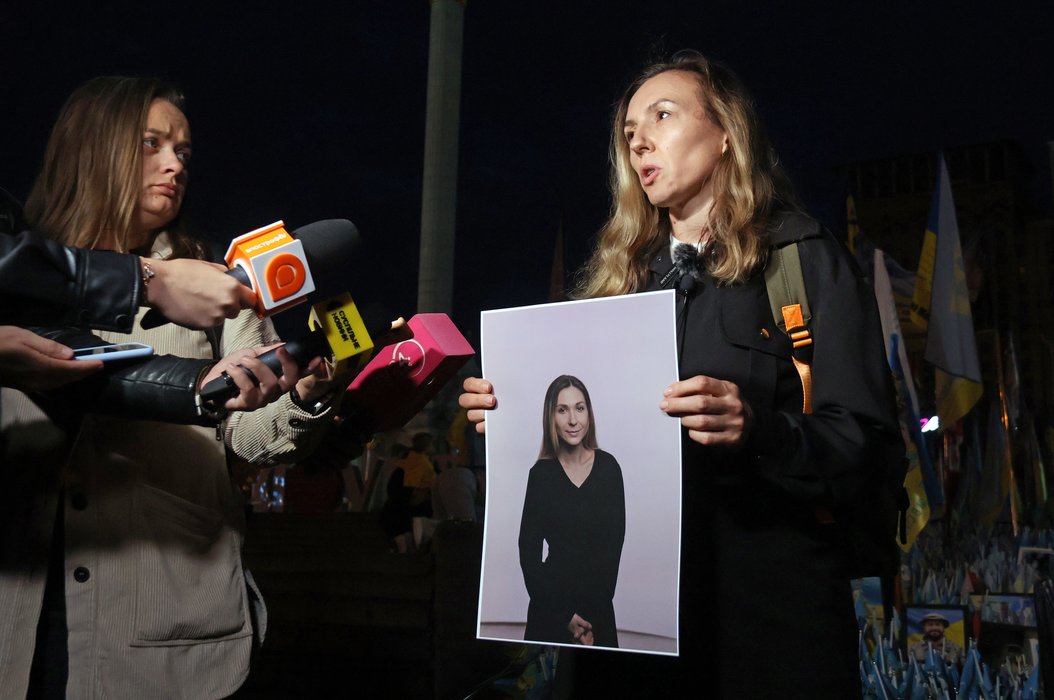
In April 2025, the body of journalist Victoria Roshchyna was returned to Ukraine, seven months after her death in Russian captivity. As reported in the previous CIVICUS Monitor update, Roshchyna, who had been reporting on the full-scale Russian invasion of Ukraine, was detained by Russian authorities in the occupied territories in 2023 and reportedly tortured.
She last contacted colleagues on 3rd August 2023, after which she disappeared. Almost nine months later, in May 2024, the Russian Defence Ministry confirmed that she had been detained and was being held in Russia. Investigators later established that she had been held in occupied Energodar and Melitopol before being transferred to the FSB-controlled Pre-trial Detention Center No. 2 in Taganrog. In October 2024, it emerged that she died during a transfer from Taganrog to Moscow, with the Ministry of Defence citing 19th September 2024 as the date of death.
According the War Department of the Prosecutor General's Office, Roshchyna’s body bore numerous signs of torture and ill-treatment, including abrasions, haemorrhages, a broken rib, and possible evidence of electric shocks. Ukrainian investigators confirmed that her body showed signs of an autopsy performed in Russia, and law enforcement sources noted the absence of certain internal organs, including the brain, eyeballs, and part of the trachea.
According to the Viktoriia Project, an international pathologist has suggested that the missing organs may indicate an attempt to conceal that her death was caused by strangulation. The Viktoriia Project, initiated by French outlet Forbidden Stories and joined by 12 other outlets including The Guardian, The Washington Post, Le Monde, Die Zeit, Der Spiegel, ZDF, Paper Trail Media, IStories, France 24, Ukrainska Pravda, and DerStandart, sought to investigate the circumstances of Roshchyna’s stay in Russian captivity, as well as to continue her work researching the abduction and systematic torture of Ukrainian civilians by Russia.
Attacks on journalists by Russian forces
Ukrainian media and journalists have continued to be targeted by Russian strikes and attacks, causing damage to offices, equipment, and newsrooms, though journalists have avoided death and injury.
On 21st March 2025, Inform.zp.ua’s office in Zaporizhia was damaged in a Russian drone attack, according to the Institute of Mass Information (IMI). No one was injured. A ceiling partially collapsed after a Shahed-type drone exploded roughly 300 metres from the building. Editor-in-chief Erik Brynza said work offices, the studio, and equipment remained intact. Local authorities reported that the same attacks damaged at least 24 multi-storey buildings and 20 private homes across the city.
On 23rd March 2025, Oboz.ua’s Kyiv office was damaged in a Russian drone strike, according to the National Union of Journalists of Ukraine (NUJU). No casualties were reported. The attack broke windows and doors, destroyed the office’s central entrance, and damaged the TV studio and equipment.
On 4th April 2025, a Ukrainian Witness film crew came under Russian fire in the Kharkiv region, around 30 km from the front line. The journalists, traveling with Ukrainian soldiers, were unharmed when their vehicle was hit by a Russian FPV drone.
On 6th April 2025, a Russian missile strike severely damaged the Inomovlennya office building in Kyiv, used by Ukraine’s state foreign broadcasting service. The three upper floors were destroyed, lower floors rendered unusable, and a large crater formed outside. No casualties were reported. The attack destroyed a newsroom recently used by TV channel Freedom and affected other state media outlets. This was the second strike on Inomovlennya newsrooms in less than two months.
On 13th April 2025, a Russian strike on Sumy damaged several media offices, including Cukr and the Sumy Press Club, shattering windows and causing minor structural damage. No media workers were injured. The attack on the city centre killed at least 34 civilians, including two children, and injured over 100 others.
On 22nd April 2025, the office of local outlet Poltavska Khvylya in Poltava was damaged in a Russian drone strike, the outlet reported. Photos showed a destroyed ceiling, damaged wiring, and partial structural collapse. No staff were injured, though six people were wounded elsewhere in the city during the same attack.
Cyberattacks, hacking and bomb threats continue
Following a series of bomb threats and cyberattacks in January and February, Ukrainian media outlets continued to report cyberattacks, threats, and other concerning incidents online.
On 10th March, the website of Kremenchuk Telegraph was taken offline by a Distributed Denial of Service (DDoS) attack. Editor-in-chief Lesya Nazarenko told the Institute of Mass Information (IMI) that she suspected Russian involvement, though technical details and the timing of the site’s restoration were not disclosed.
Three days later, journalists Maria Puntus and Yevheniya Bykova of Pershiy Krivorizkiy in Kriviy Rih received emailed bomb threats, including a short video claiming a device had been placed at the office. Police inspections found no explosives. The outlet had previously faced similar threats, raising concern among staff and press freedom groups about the safety of media workers.
On 15th March, the website of PTV, a Poltava-based channel, was hacked. The attackers uploaded an AI-generated video urging Ukrainians to overthrow President Zelensky. The technical team quickly restored operations and worked to recover original content.
Incidents continued in April. On 8th April, Kremenchutska Gazeta editor-in-chief Oleh Bulashev reported that a Facebook page published an AI-generated video falsely showing him commenting on a city council declaration. The same day, IMI reported a phishing campaign by Russian hacker group UAC-0050, in which emails disguised as “accountants” contained malicious files designed to access devices and documents. A similar attack targeted an IMI representative on 25th April.
On 18th April, Kirovohradska Pravda faced phishing and hacking attempts, with unknown actors trying to access its email and Telegram accounts, while staff received suspicious phone messages regarding credit card bonuses.
Smear campaigns, discreditation and intimidation target Ukrainian media
Ukrainian media outlets also continued to face coordinated disinformation and attempts to discredit journalists. On 1 March 2025, Ukrainian data journalism outlet Texty.com.ua was targeted in a smear campaign on X, formerly Twitter. American right-wing activist Laura Loomer and Romanian blogger Iosefina Pascal spread false claims that Texty had compiled “hit lists” of Americans and interfered in Romanian elections. The messages were widely shared, including by high-profile accounts such as Elon Musk. Texty denied the allegations, stating the claims misrepresented its 2024 reporting on Russian propaganda narratives in the context of the Romanian presidential race.
On 9th April 2025, Zaporizhia TV channel VIKKA was sued for defamation by Bishop Luka of the Ukrainian Orthodox Church. The lawsuit followed an interview with Cherkasy mayor Anatoly Bondarenko, who claimed the bishop “works in the interests of the enemy.” Both Bondarenko and VIKKA are named as defendants in the upcoming court case.
On 16th April 2025, Rivnenski Novyny published an article accusing Chetverta Vlada journalist Olha Pidhorodetska of allegedly receiving a bribe from MP Dmytro Solomchuk of Volodymyr Zelensky’s Servant of the People party. In an interview published in April 2025, Solomchuk of Servant of the People claimed he had “fed buckwheat” to Chetverta Vlada journalist Olha Pidhorodetska, apparently insinuating a bribe. The comment, made in response to unrelated questions about vote-buying, was amplified by Rivnenski Novyny, which repeated the claim. The claim was denied by both Pidhorodetska and Chetverta Vlada, who said the allegations sought to discredit them.
Physical attacks on journalists
Physical attacks on journalists while performing their professional duties were also recorded. On 24th March 2025, a volunteer journalist for Svoi.Kryviy Rih was seriously injured in Kryviy Rih after being attacked by two unidentified men. The assault, linked to a recent article on local funeral service companies, left the journalist with a broken nose, crushed retina, fractured ribs, and a concussion. On 25th March, police announced they had opened a criminal investigation and identified one of the attackers.
On 8th April 2025, journalist Diana Lavryk was physically assaulted while covering a church ownership dispute in Verkhni Stanivtsi, Chernivtsi region. Lavryk, reporting on the first service after the Orthodox Church of Ukraine took control of the church, was attacked by supporters of the banned Ukrainian Orthodox Church. She sustained injuries, had her ID torn off, and equipment threatened. The incident was documented on video by local outlet NTK.
On 24th April 2025, online outlet Dumska reported that one of its journalists was physically assaulted while investigating conditions at a publicly funded retirement home in Odesa. The journalist, invited by residents, was attacked by staff after attempting to photograph food served at the facility. Dumska said it would not file a police complaint to avoid causing distress to residents.
Obstruction and denial of access to information
On 12th March 2025, Suspilne Chernihiv, the regional branch of Ukraine's public broadcaster, reported that Dmytro Bryzhynskiy, head of the Chernihiv city military administration, refused to provide journalists with a full list of employees, citing that the information was "official" and could not be published. According to Suspilne Chernihiv editor-in-chief Andriy Titok, the information was requested to verify the administration’s budget spending.
On 10th March 2025, several Ukrainian media outlets were barred from attending a court hearing in the case of Mykyta Vasylenko, a lecturer at Kyiv’s Taras Shevchenko University contesting his dismissal over sexist remarks made in December. Hromadske and the Institute of Mass Information (IMI) reported that Vasylenko’s lawyer requested the exclusion of journalists, citing that only “technical issues” would be addressed during the hearing.