Introduction
On 27th March, the European Union imposed a new package of sanctions on 25 individuals and seven entities in Belarus, citing their involvement in undermining democracy and committing human rights abuses within the country and supporting Russia’s war against Ukraine. Those listed include members of the Central Election Commission involved in organising the 2025 presidential elections, judges issuing politically motivated sentences, and companies linked to President Alexander Lukashenko’s regime. In addition, the targets also include companies in the military-industrial sector and an agricultural company owned by a German far-right politician which has been accused of using forced prison labour. The measures include asset freezes and travel bans for the individuals sanctioned. In a statement announcing the sanctions, the EU reaffirmed its support for the Belarusian people’s struggle for a free, democratic, and independent Belarus.
On 7th May, President Alexander Lukashenko’s press service announced the pardon of 42 more political prisoners. Earlier, US authorities had secured the release of Yury Ziankovich, a Belarusian-American political prisoner. According to the Viasna Centre, the total number of people released in this way since July 2024 has now exceeded 300. Although the announcement framed the pardons as acts of compassion, noting that many of those released suffer from chronic illnesses or have young children, analysts view the moves as an attempt by Lukashenko to signal a willingness to improve relations with the West amid the country’s worsening economic situation and expectations of an eventual end to the war in Ukraine.
Freedom of association
Repression of civil society in Belarus continues unabated, despite repeated attempts by the international community to exert political and discursive pressure on the authorities. Dozens of civil society leaders, trade unionists, and journalists remain in detention or are being tried in absentia.
Forced and self-liquidation of CSOs, re-registration of religious organisations continue
According to Law Trend, the crackdown on civil society organisations (CSOs) in Belarus continued throughout April and May 2025. Since the 2020 protests, nearly 2,000 CSOs have been dissolved, severely undermining pluralism and civic participation in the country. In this climate, the registration of new non-profit organisations has become extremely rare.
Government data show that from January to April 2025, only seven new non-profit organisations were registered, focusing on creative industries, animal welfare, continuing education, and sports. No new public associations were established during this period. In May, two new public associations were finally registered—the first in 2025—one a felinological association and the other a sports association.
As previously reported, forced liquidation of CSOs has become increasingly rare simply because so few remain active. In April and May, only two organisations were forcibly dissolved, while at least 17 opted for self-liquidation.
The re-registration of religious organisations has also continued since July 2024. Authorities have ordered all religious communities to re-register by 5th July 2025, threatening hundreds of parishes with closure for non-compliance. By May, 40 parishes in Vitebsk and six in Minsk had already been shut down. Religious leaders remain among the many political prisoners detained in the country, with several facing politically motivated charges linked to their opposition to Russia’s war in Ukraine.
Authorities continue to abuse extremism charges against activists and critics
Authorities persist in prosecuting activists on charges such as “facilitating extremist activities” or “participating in banned groups”. Independent media, educational initiatives, diaspora groups, and websites are routinely labelled “extremist”.
Foreign funding for non-governmental organisations (NGOs), portrayed as a threat to state security, is restricted to a narrow list of specific purposes and is subject to prior approval under penalty of liquidation. This repressive environment has paralysed most NGOs, both inside Belarus and in exile. Meanwhile, according to Law Trend, the government has stepped up efforts to attract foreign aid for state-aligned initiatives, including those implemented in cooperation with NGOs. In April alone, it organised at least five events aimed at securing grants under the Action Plan for Organising Work with Foreign Grant Aid by Government Agencies for 2024–2025.
The criminalisation of solidarity through misuse of the “extremist” label has broadened further. A 47-year-old woman from Salihorsk is set to stand trial for transferring commissary money to political prisoners, accused of “facilitating extremist activities” linked to the Dissidentby initiative, the Viasna Human Rights Centre, and Letters of Solidarity Belarus 2020. Prosecutors claim she made around 70 small transfers totalling $183 to detainees accused of “extremism-related crimes”. Her case, filed under Article 361-4 of the Criminal Code (promoting extremist activities), was sent to the Minsk Regional Court in April.
In late May, the Investigative Committee (IC) announced a criminal investigation into members of an “extremist group” linked to the “New Belarus” platform. The authorities claim that more than 1,000 users registered on the app and its related services, including individuals residing in Belarus, can be considered participants in the project, which was designated as “extremist” in 2023.
Originally launched to provide medical and legal aid to those affected by repression, “New Belarus” has since developed into an online platform supporting the Belarusian diaspora. It includes initiatives such as free online medical consultations for people in Belarus, legal assistance for those facing persecution, a directory of Belarusian-owned businesses abroad, and event listings for the diaspora community.
Earlier in May, two Belarusian women who had promoted their emigration-related businesses on the platform were compelled to release “penitential videos” on Instagram, seemingly coordinated with law enforcement. In one such video, a young woman explained that she had registered her services on “New Belarus” while studying in Tbilisi, believing her data to be secure. After returning to Belarus, authorities searched her mother’s home. She added that the video had been coordinated with law enforcement and expressed hope that “everything will end well”.
Article 361-4 of the Criminal Code, which criminalises the “promotion of extremist activity”, was also used to target users of other digital platforms. As of the end of May, at least 15 individuals were detained for alleged involvement with the Belaruski Hajun project, which monitors Russian military movements in Belarus. As previously reported, the project’s Telegram channel was infiltrated by security services in February 2025, likely resulting in a leak of user data and forcing its shutdown.
Viasna Human Rights Centre volunteer released
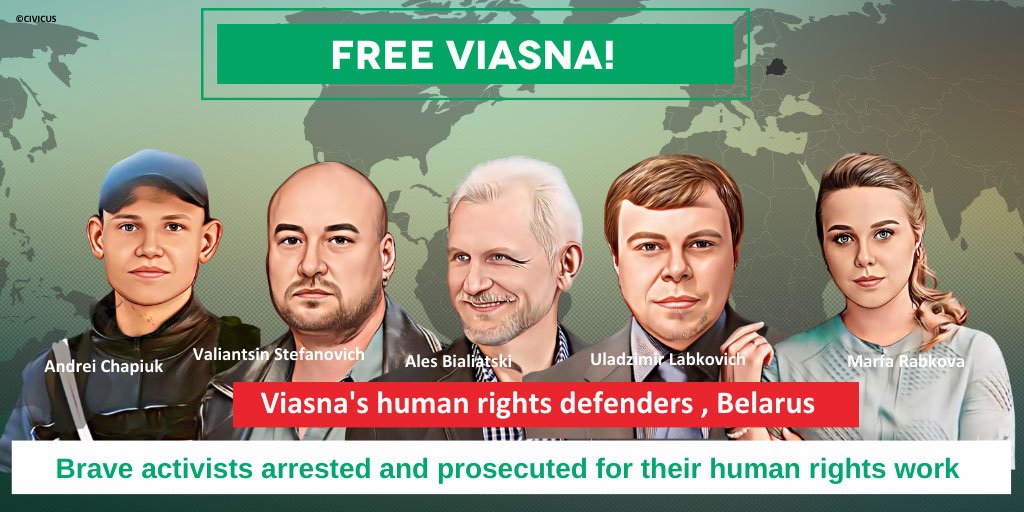
Viasna Human Rights Centre volunteer Andrei Chapiuk completed his full sentence and was released from a penal colony on 18th April 2025. On 6th September 2022, he had been sentenced to six years in a medium-security penal colony and fined more than $6,300. On 28th February 2023, the Supreme Court reviewed the appeals of Marfa Rabkova, the coordinator of Viasna’s volunteer network, and Andrei Chapiuk behind closed doors, commuting their sentences by three months. Chapiuk’s final sentence was therefore reduced to five years and nine months of imprisonment in a medium-security penal colony. Immediately after his release, he was interrogated and released again. Rabkova, whose sentence after commutation was 14 years and nine months, remains imprisoned. In March 2025, the UN Working Group on Arbitrary Detention recognised her detention as arbitrary and called for her release.
New case against released activist Palina Sharenda-Panasiuk
In April, it was reported that new criminal cases were opened against Belarusian opposition activist and former political prisoner Palina Sharenda-Panasiuk, now living in exile in Lithuania. Her husband, Andrej Sharenda, said the charges were filed under Articles 422 and 361 of the Criminal Code, accusing her of “evading preventive supervision” and “calling for sanctions and other actions harming national security.” As reported in a previous CIVICUS Monitor update, Sharenda-Panasiuk was released from prison in February 2025 after four years in detention. On 11th March, she spoke to the European Parliament about her experience, addressing the issue of coerced video confessions that she and others were forced to record, and called for stronger enforcement of sanctions against Belarus by the international community.
Freedom of peaceful assembly
Belarusian authorities continue to treat all forms of protest as criminal offences. No peaceful opposition assembly has been authorised since August 2020, and the authorities have continued prosecuting participants in the 2020 post-election protests.
New wave of arrests and searches connected to 2020 events
The Viasna Human Rights Centre reported another wave of arrests and searches in Dziaržynsk at the end of April. The detentions were linked to participation in the 2020 post-election protests, with individuals charged under Article 342 of the Criminal Code after being identified through photos or videos. Around five people were reportedly detained, though the total number of those prosecuted remains unclear. Earlier that same month, the European Parliament condemned the ongoing persecution of participants in the 2020 protests in its resolution “on the immediate risk of further repression by Lukashenko’s regime in Belarus”. The resolution called for strengthened sanctions and greater international support for victims of the Belarusian regime’s repression.
78-year-old activist convicted for repeated protest offences
On 30th May, 78-year-old activist Nina Bahinskaya was tried in a closed session at the Pieršamajski District Court in Minsk. She was charged under Part 2, Article 342-2 of the Criminal Code for repeated violations of the law on holding mass events. The Associated Press described her as “one of the most recognisable faces of Belarus’s pro-democracy movement”, known for her solitary pickets in Minsk, where she carried the white-red-white opposition flag or wore a T-shirt reading “No war!”. During the investigation, Bahinskaya was reportedly subjected to multiple psychiatric examinations. According to Belsat, she was found guilty but not sentenced to imprisonment; instead, the court placed her under “preventive supervision”.
UN Special Rapporteurs urge release of prisoners with disabilities
On 5th May, a group of UN Special Rapporteurs condemned the ongoing detention and ill-treatment of people with disabilities or serious medical conditions, imprisoned for acts of civil disobedience following the 2020 election, and called for their release. The experts expressed particular concern over the cases of Andrei Navitski and Dzianis Salmanovich, both of whom have disabilities and have been deprived of liberty since 2021. Navitski, whose conviction reportedly stems from taking part in a peaceful assembly, was convicted of public order offences, insulting the President, and possessing gunpowder. Salmanovich is serving a sentence for producing films for the Cyber Partisans hacktivist collective, under charges of terrorism and extremism. The UN experts described these practices as a flagrant violation of international standards on humane treatment in detention.
According to Viasna, as of 12th March 2025, human rights defenders had identified at least 219 high-risk political prisoners. These include 78 individuals with serious health conditions, eight people with disabilities, 32 older prisoners over 60 (many with significant medical issues), and 10 with mental health problems. The group also includes 39 parents of multiple children, with at least 10 cases where both parents are imprisoned.
Freedom of expression
Ministry of Information expands list of banned books
On 1st April, the Ministry of Information expanded its list of prohibited printed publications to include 27 new titles, among them Cloud Atlas by David Mitchell and Coin Locker Babies by Ryū Murakami. The list already featured Pulitzer Prize-winning works such as Andrew Sean Greer’s Less and Anne Applebaum’s Gulag: A History, and now includes a total of 92 books, including works by contemporary Belarusian authors.
The list is maintained under amendments to the Law on Publishing Business that took effect in July 2023. Under these provisions, the Ministry of Information compiles and updates a register of printed materials deemed to contain information or messages that may “potentially compromise the national interests” of Belarus. The inclusion of a publication is based on the findings of the National Commission, and publishers that issue such works risk having their state registration certificates revoked by ministerial decision.
Political prisoner dies in detention following imprisonment for critical speech
On 21st May, the eighth death of a political prisoner detained since 2020 was reported, that of Valiantsin Shtermer. He had been sentenced to five years in prison in 2023 for his comments opposing Russia’s invasion of Ukraine. According to the Viasna Centre, in the same month, it was reported that three political prisoners had died shortly after their release: Hanna Kandratsenka, Tamara Karavai, and Valery Bohdan. Human rights activists attribute these deaths to harsh detention conditions, inadequate medical care, limited nutrition, and forced labour.
Targeting of exiled journalists intensifies
The campaign of intimidation has extended beyond Belarus’s borders. According to data from the Committee to Protect Journalists, as of May 2025, Belarusian authorities have opened over 60 criminal cases against journalists in exile. They are accused of “collaborating with extremist organisations” or “spreading false information”, charges widely seen as attempts to silence critical reporting, even from abroad.
On 3rd June, a Belarusian court sentenced exiled blogger and journalist Anton Matolka to 20 years in prison and fined him approximately $29,000 in absentia. The Hrodna Regional Court found him guilty under 13 articles of the Criminal Code, including attempting an unconstitutional seizure of power, organising mass unrest, inciting hatred, and state treason. Matolka, a media strategist and founder of the banned monitoring project Belaruski Hajun, has lived in exile since 2020 after documenting protests against President Lukashenko’s regime. His Telegram channels and followers have since been labelled “extremist” by the Belarusian authorities.
Raids on regional media outlets accused of receiving foreign funding
Repression against the media has intensified inside Belarus as well. In May, Belarusian security forces raided several regional media outlets, accusing them of “collaboration with Germany.” A state TV segment broadcast on 28th May showed armed officers storming the offices of Vecherny Bobruisk and airing interrogations of editors from babruisk.info, Volnaje Hlybokaje, and UzHorak. Authorities alleged that the outlets had received funding from the German Embassy since 2020, though some were not designated as “extremist” at the time. The raids mark another escalation in the crackdown on remaining independent media outlets in Belarus, but it remains unclear whether any criminal cases have followed.
Journalist sentenced to administrative detention for distributing “extremist” materials
Individual journalists have continued to face detention and harassment. On 31st March, Belarusian journalist Anatol Sanatsenka was sentenced to 15 days of administrative detention for allegedly distributing “extremist” content. Sanatsenka, former editor-in-chief of the now-shuttered Babrujski Kurier, was detained after police searched his home in Babruysk. The Committee to Protect Journalists condemned his imprisonment, calling for his immediate release and an end to the authorities’ ongoing crackdown on the press. Sanatsenka had previously been detained in 2022, when Babrujski Kurier was blocked and labelled “extremist” by the authorities.
Imprisoned journalist pressured to appear in propaganda
Reports of mistreatment of detained journalists have also emerged. Several, including Dzmitry Semchanka, have reportedly been subjected to psychological and physical pressure to appear in propaganda films aimed at discrediting the democratic movement and independent media. In April, human rights group Viasna reported that Semchanka, imprisoned since 2022, was being coerced to take part in such a film while serving his sentence at Ivatsevichy Correctional Facility No. 22. He allegedly faced repeated punishments and was offered interviews with pro-government media. Once a prominent state TV host, Semchanka resigned after the 2020 presidential election in protest against state violence and propaganda. He was later convicted of “inciting social hatred” and recognised as a political prisoner. Human rights organisations warn that such practices violate detainees’ fundamental rights and undermine any semblance of a fair trial.
PEN Belarus publishes report on cultural rights violations
Censorship and restrictions on independent culture have continued as a method of intimidation against artists and writers. A report by PEN Belarus released in May highlights that repression now extends beyond the press to the cultural sphere. In the first quarter of 2025, the organisation recorded 319 violations of cultural and human rights affecting cultural figures, including censorship of at least two events related to traditional Belarusian culture — a field once considered relatively safe for creative expression.
For the first time since PEN Belarus began monitoring, the labelling of cultural content or cultural figures’ social media accounts as extremist was the most frequent type of violation (115 cases), followed by censorship (49) and violations of the right to a fair trial involving cultural figures or organisations in the cultural sphere (36). At least 12 cultural figures faced criminal prosecution, and nearly half of them were being tried for the second or third time since the events of 2020 — underscoring the persistence of state repression against Belarus’s cultural community.