General
IACHR warns of human rights deterioration amid austerity measures and attacks on civic freedoms
In its 2024 annual report, published in March 2025, the Inter-American Commission on Human Rights (IACHR) warned that Argentina faced serious human rights setbacks in 2024 linked to state reorganisation and downsizing measures. These policies weakened institutional responses to gender-based violence and discrimination and undermined economic, social, cultural and environmental rights. It also noted regression in policies on memory, truth and justice, which are essential for addressing past human rights violations.
Between January and September 2024, the IACHR documented repeated use of excessive force by security forces during protests. The IACHR’s Office of the Special Rapporteur for Freedom of Expression also reported a sharp decline in press freedom, citing stigmatising rhetoric by senior officials, restrictive protest regulations, and decrees reducing access to public information without parliamentary debate, measures that weaken transparency and democratic oversight.
As documented by the CIVICUS Lens, civil society in Argentina is facing a growing anti-rights movement, aligned with global trends. Experts warned that the government’s austerity agenda is being used to justify ideologically motivated rollbacks of equality measures.
“It has been shown that cutting funding for policies to prevent and respond to gender-based violence ends up costing the state 22 times more. Reduced investment in programmes to prevent unwanted teenage pregnancies, for example, leads to school drop-outs, employment difficulties and the intergenerational reproduction of poverty”, said Natalia Gherardi, Executive Director of the Latin American Team on Justice and Gender (ELA), an Argentinean civil society organisation that works at the regional level.
#CIVICUSLens: After #Argentina 🇦🇷 President @JMilei denounced ‘radical feminism’ & ‘gender ideology’ in a speech, LGBTQI+ & women’s rights groups mobilised in major cities to protest.
— CIVICUS (@CIVICUSalliance) March 2, 2025
We discuss this with @NataliaGherardi, Exec. Director of @EquipoELA🔗 https://t.co/REXTGzEH8I pic.twitter.com/i0xTS6gAQr
Judicial independence under scrutiny as Argentina’s president bypasses Senate in court appointments
On 6th March 2025, the UN Special Rapporteur on the independence of judges and lawyers addressed concerns to the Argentine government over the President’s appointment of two Supreme Court judges through Decree No. 137/2025, without the Senate’s two-thirds approval required under article 99(4) of the Constitution. The communication recalled that national law provides for a transparent, participatory selection process and mandatory Senate confirmation, as established by Decree No. 222/2003.
The President justified the appointments under Article 99(19), which allows temporary appointments “in commission” during congressional recess. However, legal experts have disputed the article’s applicability to the Supreme Court. The candidates had undergone public hearings in August 2024 but failed to obtain the required Senate majority before the end of both ordinary and extraordinary sessions.
Peaceful Assembly
Police crackdown on pension protest marks most violent repression under Milei government
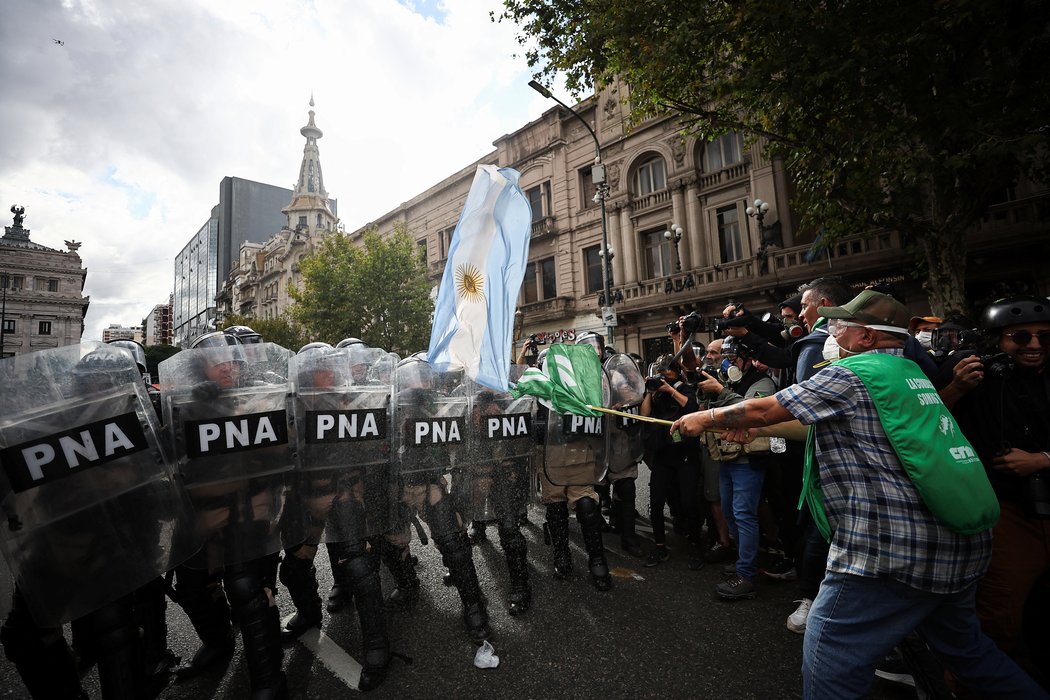
On 12th March 2025, violent clashes broke out in Buenos Aires when security forces cracked down on a mass protest led by retirees and football fans demonstrating against pension cuts and austerity measures. Earlier that day, Minister of Security Patricia Bullrich announced that security forces were “deployed to enforce the anti-picketing protocol”, which criminalises demonstrations involving street or road blockades.
The weekly “march for the retired”, held every Wednesday to denounce reductions in pensions and access to medicines, drew thousands of protesters, including supporters from major football clubs such as River, Boca, Independiente, Racing, San Lorenzo, Vélez and Huracán. What began as a peaceful mobilisation in front of the National Congress turned into one of the most violent police operations since President Javier Milei took office, as documented by ACLED.
According to civil society organisations and UN Experts, law enforcement officers used indiscriminate and excessive force long before the scheduled start of the protest. The repression continued for nearly five hours, spreading through several streets around the National Congress, with police deploying tear gas launchers, rubber bullets, hand grenades, pepper spray and water cannon. Motorised units were seen firing kinetic projectiles horizontally into the crowd, injuring both protesters and bystanders, including human rights activists and journalists monitoring the protest (see expression).
Around 700 people were injured, including hundreds of elderly persons, three minors, and 14 police officers, while 114 people were detained, some over the age of 70. The Centre for Legal and Social Studies (CELS) reported that the detentions served solely to punish the protest and create a climate of intimidation and deterrence against those demanding their rights. Detainees reported being arrested while leaving the protest or simply filming the events. Among those detained were students, workers, journalists, elderly people, passers-by unaware of the demonstration, and even two schoolchildren.
The National Committee for the Prevention of Torture (CNPT) also documented patterns of arbitrary detentions, where protesters and bystanders were surrounded, pepper-sprayed, and held for hours in outdoor “monitoring centres” without access to toilets, medical care, or communication. Detainees were reportedly forced to sit through the night, and several women were subjected to humiliating strip searches by male doctors.
On 13th March 2025, Judge Karina Andrade ordered the release of 114 protesters, citing unlawful detentions and procedural irregularities. She reaffirmed that the right to protest, particularly for vulnerable groups, is constitutionally and internationally protected. Senior officials from the Ministries of Security and Justice later announced plans to seek her removal and filed criminal complaints (see association).
Following the events, on 14th March 2025, the Ministry of Security filed criminal complaints for sedition and other offences against alleged organisers, including opposition mayors and trade union leaders. Under Argentina’s Criminal Code, sedition is broadly defined as “publicly rising to prevent the enforcement of national or provincial laws or the decisions of national or provincial public officials.” Human Rights Watch warned that this vague and expansive definition can be used to criminalise free expression and punish critics disproportionately. After the crackdown, Minister Bullrich stated that the government would not investigate the role of security forces, praising them for “protecting democracy, institutions and citizens”.
On the same day, Jan Jarab, the Regional Representative for South America of the UN High Commissioner for Human Rights, urged Argentine authorities to conduct a prompt and thorough investigation into the events. Jarab emphasised that isolated acts of violence do not justify the indiscriminate use of force against peaceful protesters exercising their right to assembly. He recalled that the use of force must comply at all times with international principles of legality, necessity, proportionality, non-discrimination, and accountability, and warned that less-lethal weapons such as tear gas must be deployed strictly in accordance with international standards, as their misuse can result in lethal outcomes.
Some isolated violent incidents were reported, including the burning of rubbish containers, a private vehicle, and a police patrol car, as well as stone-throwing and attacks on journalists covering the protest. There were also reports suggesting the presence of infiltrated individuals who may have committed violent acts to provoke a police response. The bicameral intelligence commission of the National Congress subsequently launched an investigation into the possible involvement of federal security and intelligence agents in these incidents.
The brutal repression and official stigmatisation of protesters sparked renewed mobilisation across the country. According to ACLED, at least 40 demonstrations were recorded nationwide during the second half of March, the highest number since 2018, mostly in response to the government’s handling of the pension crisis and police violence. Since President Javier Milei took office in December 2023, Argentina has seen over 2,000 protests, with security forces intervening in at least 60. The 12th March crackdown remains the most violent intervention to date.
Mass march in Buenos Aires commemorates 49 years since military coup
On 24th March 2025, tens of thousands marched in Buenos Aires alongside the Mothers and Grandmothers of Plaza de Mayo to mark 49 years since the 1976 coup d’état, under the banner “Memory, Truth and Justice”. The Day of Remembrance brought together human rights organisations, trade unions, student groups and opposition parties, filling the streets of the capital in a peaceful mobilisation. Protesters chanted “Madres de la Plaza, el pueblo las abraza” (“Mothers of the Plaza, the people embrace you”) as they honoured those still searching for disappeared relatives.
During the rally, Estela de Carlotto, President of Grandmothers of Plaza de Mayo, urged continued support to locate the estimated 400 grandchildren stolen during the dictatorship and reaffirmed that “the appropriation of identity is a continuing enforced disappearance”. Human rights organisations estimate that 30,000 people were forcibly disappeared during the 1976–1983 military regime.
Many protesters carried banners denouncing the “government’s denialism” and criticised President Javier Milei’s austerity measures, which have cut jobs in the Human Rights Secretariat and memorial sites.
Association
Environmental defenders criminalised for opposing mining project in Mendoza
On 24th February 2025, environmental defenders Federico Soria and Mauricio Cornejo were formally charged by the Mendoza Provincial Prosecutor’s Office with belonging to a group engaged in ideological coercion and committing aggravated coercive threats under Articles 149 and 213 bis of Argentina’s Criminal Code.
The latter provision, introduced during the 1976–1983 military dictatorship and never previously applied in Mendoza, penalises anyone who “organises or takes part in groups seeking to impose their ideas by force or fear”, with prison sentences ranging from three to eight years. Civil society organisations and defence lawyers denounced the arbitrary and politically motivated use of this article, warning that its vague language enables the criminalisation of peaceful protest and contradicts democratic and human rights standards.
Soria and Cornejo are members of the Assembly of Self-Convened Neighbours of Uspallata, a grassroots environmental movement that has peacefully opposed the San Jorge Mining Project since 2008. The project, promoted by the Swiss-based Solway Investment Group and supported by provincial authorities and local business associations, has raised serious concerns over its environmental impact on Mendoza’s water sources.
As documented by Front Line Defenders, the charges originated from a 24th January 2025 protest during the inauguration of the Chamber of Mining Suppliers of Uspallata, where isolated acts of violence took place and three protesters were detained. Although neither Soria nor Cornejo organised or participated in the unrest, prosecutors alleged that they used environmental activism to “instil fear” and obstruct the mining project.
Cornejo was arrested on 24th February and held for 23 days without medical care for a pre-existing injury before being placed under house arrest. Soria, declared wanted by provincial authorities, surrendered voluntarily on 31st March and was detained. On 3rd April 2025, a provincial judge ordered their release, ruling that the case fell under federal jurisdiction, as the alleged offences were beyond the competence of the provincial court. She found that the defenders’ detention had been based on an incorrect legal interpretation.
Nuestros compañeros Federico Soria y Mauricio Cornejo recuperaron su libertad. #LucharNoEsDelito, hoy se hizo un poco de justicia para los defensores del #agua y el #territorio en #Mendoza.
— Asamblea No a la Mina - Esquel ✊🏼💧 (@NoalaminaEsquel) April 3, 2025
✊🏼💦✊🏼💦✊🏼💦✊🏼💦✊🏼💦 pic.twitter.com/9nLNVvKQDq
On 1st April 2025, over 160 civil society organisations called for the defenders’ immediate release and denounced the broader pattern of criminalisation and harassment against environmental defenders resisting large-scale, export-oriented mining projects in Mendoza and across Argentina. Earlier, on 27th March 2025, Front Line Defenders had expressed concern that the prosecution represented a reprisal for legitimate environmental advocacy, warning that the case could have a chilling effect on human rights defenders working against extractive projects, discouraging them from exercising their civic freedoms without fear of reprisals or judicial harassment.
#Argentina Los dos defensores son los únicos acusados del proceso con orden de prisión preventiva, a pesar de no haber cometido ninguna acción violenta, y fueron incluidos en el proceso por pertenecer a la Asamblea de Vecinos Autoconvocados de Uspallata.https://t.co/ZVgC56OirB pic.twitter.com/WmheG8lFE1
— FLD Américas (@FLDAmericas) March 27, 2025
Government targets judges who upheld rights during March protests
Judges who defended constitutional guarantees following the 12th March 2025 protests in Buenos Aires have reportedly faced retaliation from the government.
On 13th March 2025, Judge Karina Andrade of the Criminal, Misdemeanour and Offences Court No. 15 ordered the release of 114 detainees, ruling that the arrests lacked legal justification and violated due process (see peaceful assembly). Following her decision, on 17th March 2025, senior officials from the Ministries of Security and Justice publicly announced plans to seek her removal and file criminal complaints, while government spokespersons launched an online smear campaign accusing her of promoting impunity.
Judge Andrade has reportedly received threats of death and sexual violence, raising grave concerns about the erosion of judicial independence and the chilling effect such reprisals may have on judges tasked with upholding the rule of law and protecting civic freedoms in Argentina.
In early April 2025, Judge Roberto Andrés Gallardo ordered that responsibility for policing pensioners’ marches lies with the Buenos Aires City Police, citing limits on federal jurisdiction. The Ministry responded by accusing him of overstepping his authority and interfering with federal operations.
These incidents reflect a pattern of intimidation against the judiciary and efforts to undermine oversight of state abuses.
Mapuche rights defender Victoria Núñez Fernández released after two months of arbitrary detention
On 7th April 2025, a federal judge ordered the release of environmental and Mapuche rights defender Victoria Núñez Fernández, concluding that there was no evidence of flight risk after almost two months under house arrest.
As previously reported, Núñez Fernández was arbitrarily detained in February 2025, accused without evidence of involvement in arson attacks linked to the Patagonian wildfires, which have devastated large parts of southern Argentina. Her case, widely described by civil society as fabricated, has been denounced as part of a broader criminalisation campaign against Mapuche communities and their allies defending land, water, and life in Patagonia.
According to media reports, proceedings were conducted behind closed doors, with no access for journalists or human rights organisations. The federal judge has now imposed restrictions on Núñez Fernández’ movement, prohibiting her from leaving Esquel without judicial authorisation or returning to her community, Lof Pillan Mahuiza. Her case will be reviewed in May 2025.
New “anti-mafia” law in Argentina raises alarm over threats to due process and potential creation of de facto states of emergency
On 20th February 2025, the Argentine Congress approved Law No. 27.786, known as the “Anti-Mafia Law”, granting the Ministry of Security and public prosecutors the power to designate “special investigation zones” where individuals can be detained, with prior judicial authorisation, for up to 30 days in complex cases (article 6). The measure, published in the Official Gazette on 10th March 2025, was introduced by President Javier Milei’s administration and presented as the Argentine equivalent of the USA RICO Act. UN Experts warned that the law could enable the establishment of de facto states of emergency, posing risks to civic freedoms and undermining constitutional guarantees and due process.
Article 1 expanded the definition of criminal organisation, “understood as groups of three or more people who, over a certain period of time, operate in specific geographical areas and under defined methods, acting in coordination with the intent to commit particularly serious offences.”
CELS argued that the law’s vague definitions of “criminal organisation” are susceptible to arbitrary application, disproportionately targeting marginalised communities rather than addressing systemic corruption or financial networks sustaining criminal operations. Legal experts and civil society cautioned that the law could be used to suppress dissent, criminalise protest, and entrench state-driven surveillance and control mechanisms under the guise of combating organised crime.
Expression
Photojournalist critically injured during pensioners’ march in Buenos Aires
During the coverage of protests near Argentina’s National Congress on 12th March 2025 (see peaceful assembly), several journalists were physically assaulted while reporting on the demonstration. The most serious case involved photojournalist Pablo Grillo, who was shot in the head by a tear gas canister fired horizontally by an officer of the National Gendarmerie, causing a severe brain injury that left him in intensive care.
Other journalists were also attacked with chemical agents sprayed directly in their faces while documenting detentions. According to press reports, Gabriela Navarra (freelance) was injured by rubber bullets, a TN cameraman suffered an eye injury, and Carla Ricciotti (LN+) was forced to go off air due to tear gas exposure. Some journalists, such as Manu Jove (TN), were assaulted by protesters amid the chaos. The assault occurred during a pensioners’ protest near the National Congress, where security forces used tear gas launchers, hand grenades, pepper spray, rubber bullets, and at least four water cannon trucks, injuring hundreds of journalists and protesters (see peaceful assembly).
Human rights organisations condemned the incident as part of a wider pattern of excessive force during pensioners’ demonstrations in 2025, where security forces repeatedly resorted to tear gas, pepper spray, water cannon, and batons under an unconstitutional security protocol introduced by the Ministry of Security.
#Argentina🇦🇷: el fotoperiodista Pablo Grillo lucha por su vida tras un ataque policial
— FIP - América Latina y El Caribe (@FIP_AL) March 13, 2025
Pablo Grillo se encontraba cubriendo una masiva protesta junto a otros cientos de trabajadorxs de prensa frente al Congreso, cuando recibió un disparo con una granada de gas lacrimógeno. pic.twitter.com/zOucuCIdby
Women journalists sexually harassed
On 21st March 2025, two women journalists were subjected to acts of sexual violence inside the Government House of Tucumán Province, in northern Argentina, by political supporters attending a swearing-in ceremony for new members of Governor Osvaldo Jaldo’s cabinet.
One journalist, waiting outside the press room to go live, was surrounded by a group of militants who pressed their bodies against hers and touched her without consent. In a separate incident, another journalist stationed near the press enclosure was forcibly groped by several men, who touched her intimate parts when she attempted to move away. A government official eventually intervened to help her escape.
The Argentine Journalism Forum (FOPEA) noted that this is not the first time such incidents have occurred inside the Tucumán Government House. In November 2021, two women journalists were similarly assaulted by political supporters during an official event.
Journalist faces threats and xenophobic harassment after reporting on local official
On 13th March 2025, Journalist Javiera Nasser faced threats, intimidation, and xenophobic messages from municipal officials and political militants in Río Gallegos after reporting that a local government official had caused a car accident while having alcohol in his blood. According to FOPEA, the incident triggered a wave of online harassment by alleged individuals linked to Mayor Pablo Grasso’s political movement.
Among them, Maximiliano Pisani, the city’s Director of Culture, publicly accused Nasser of spreading “false information” and warned her that she could face “serious legal problems”. Others posted messages saying she “would not be able to work on the streets” and telling her to “go back to your country”.
Nasser, a Chilean journalist who settled in Río Gallegos during the pandemic, expressed fear for her safety but reaffirmed her commitment to independent journalism.
Presidential adviser intimidates photojournalist during public event
On 29th April 2025, presidential adviser Santiago Caputo intimidated photojournalist Antonio Becerra from the outlet Tiempo Argentino by seizing his press credential and photographing it with his mobile phone. The incident took place as Caputo arrived to attend a debate between legislative candidates and was approached by journalists and photographers carrying out their professional duties.
Eviction threats against independent media at historic memory site
On 23rd April 2025, civil society organisations condemned the administration’s attempt to evict the communication cooperative El Grito del Sur from the Virrey Cevallos Memory Site in Buenos Aires, where the independent outlet has operated for over eight years. The building, once a clandestine detention centre run by the Air Force Intelligence Service during Argentina’s last dictatorship (1976–1983), is protected under Law 26.691 on Memory Sites, which promotes educational, cultural, and human rights activities in such spaces.
Members of the cooperative reported receiving threatening messages from government representatives demanding they leave the premises, describing the move as part of a broader campaign to dismantle memory and human rights institutions. They denounced the eviction order as an attack on freedom of expression aimed at silencing independent journalism and undermining public engagement with historical memory.
The Mothers of Plaza de Mayo expressed solidarity, declaring that “memory belongs to the people, no to the eviction”, while the International Federation of Journalists (IFJ) condemned the measure as “a clear affront to press freedom and the right to journalistic work, and a violation of the Argentine Constitution and international human rights treaties.”
#Argentina🇦🇷: La FIP rechaza el intento del gobierno de Javier Milei de expulsar de sus oficinas al portal El Grito del Sur, ubicada en un sitio de memoria que funcionó como centro clandestino de detención durante la última dictadura en el país. https://t.co/sSIdwEvsgR
— FIP - América Latina y El Caribe (@FIP_AL) April 23, 2025
Government restricts media access during presidential address
On 2nd March 2025, journalists faced restrictions on access to information during President Javier Milei’s opening address to Congress, after authorities imposed new seating arrangements that limited space and visibility for reporters and photographers. FOPEA stated that these measures hampered adequate media coverage of a key democratic event, despite prior appeals from press organisations urging the government to reconsider.
Following the speech, security personnel prevented journalists from moving within the premises to cover the President’s exit. Instead of acknowledging these obstacles, President Milei accused journalists of being “bribers and liars” on social media, referring to an incident between Congressman Facundo Manes and presidential adviser Santiago Caputo.
Attacks on journalists rise 53% amid growing hostility from government officials
The 2024 Annual Freedom of Expression Monitoring Report by FOPEA, published in April 2025, recorded a 53 per cent increase in attacks against journalists, documenting 179 cases nationwide. More than 58 per cent of incidents occurred in Buenos Aires City, followed by Buenos Aires Province (7.8 per cent), Tucumán (5.6 per cent), Córdoba (3.9 per cent), and Río Negro (3.9 per cent).
The report highlights a sustained escalation of stigmatising discourse against journalists, primarily originating from the executive branch and its digital networks. FOPEA found that public vilification and restrictions on access to public information registered the sharpest annual increases, rising from 23 to 76 cases, and 14 to 21 cases between 2023 and 2024, respectively. These trends reveal the growing use of aggressive rhetoric, online harassment and administrative opacity to intimidate journalists and curtail scrutiny of those in power.
The organisation also reported increased misuse of state advertising and limited access to public information, with many journalists citing fear of job loss or withdrawal of public advertising as reasons for self-censorship. FOPEA warned that the combination of verbal aggression, digital harassment, legal intimidation, and economic pressure undermines press freedom and weakens democratic accountability. It urged authorities to adopt measures that protect independent journalism, ensure transparency, and preserve pluralism in Argentina’s media landscape.