The state of civic space in Sri Lanka is rated as ‘repressed’ by the CIVICUS Monitor. Ongoing concerns include restrictions and disruption of peaceful protests - at times with excessive use of force - and the stifling of journalists. Activists have also been targeted and criminalised using defamation and counter-terror laws, and there has been a systematic failure to address past crimes against them.
A report published by the UN Human Rights Office in August 2025 called on Sri Lanka’s government to seize the historic opportunity to break with entrenched impunity, implement transformative reforms, and deliver long-overdue justice and accountability for serious violations and abuses committed in the past, including international crimes. The report detailed civic space restrictions and reprisals under President Anura Kumara Dissanayake as well as arbitrary detention, torture, and deaths in custody.
In September 2025, CIVICUS published a brief marking a year since President Anura Kumara Dissanayake took office. It highlighted the continued harassment of activists and journalists, crackdown on protests and the failure to reform restrictive laws and to address accountability for past crimes.
On 6th October 2025, the UN Human Rights Council extended for at least two more years, the UN Sri Lanka Accountability Project established in 2001 to gather evidence of human rights violations and war crimes associated with Sri Lanka’s civil war. The resolution, adopted by consensus, offers a ray of hope to victims of abuses and their families that they may one day see justice, despite the efforts of successive Sri Lankan governments to block accountability.
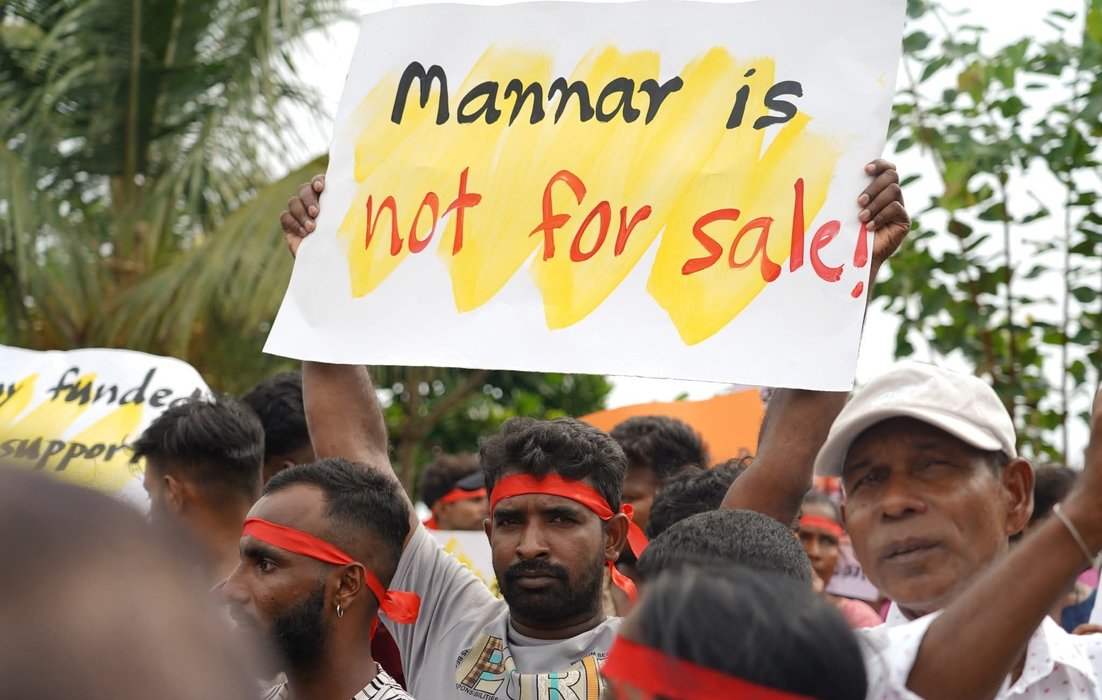
In recent months, police used excessive force against a protest in Mannar and continue to prosecute Tamil protesters for a 2021 march. A Tamil memorialisation activist was summoned again, while the UN issued a report highlighting restrictions facing civil society and surveillance and intimidation by security forces. Police have also continued to target families of the ‘disappeared’. Counter-terrorism police summoned a Tamil journalist documenting mass graves while a legal group submitted concerns around the Online Safety Act.
Peaceful Assembly
Police unleash brutal assault on Tamils in Mannar
🪧 50 days of defiance in Mannar - Protest against wind turbines and sand mining continues
— Tamil Guardian (@TamilGuardian) September 23, 2025
Tamil protests in Mannar against the installation of wind turbines and the excavation of mineral sands entered their 50th consecutive day yesterday, with demonstrators taking part in a… pic.twitter.com/HrapnCntOc
According to FORUM-ASIA, fishing and farming communities, religious leaders, and civil society have been urging authorities to stop the wind farm construction and mineral sand mining operations in Mannar due to its negative impacts on both the environment and people’s livelihoods.
On 26th September 2025, protesters learned that wind turbines were, in fact, being transported to the construction site and blocked its transport into Mannar. When they mobilsed, they were then violently dispersed by the police, followed by a second crackdown on 28th September. Several protesters were hospitalised, including priests and female demonstrators reportedly beaten by the police.
Police filed a case in the Mannar Magistrate’s Court against nine protesters, including three who were injured in the assault.
Several people including women in Mannar were injured and admitted to hospital after police brutally assaulted protesters led by Mannar Citizens' Committee who tried to block transporting of turbine spare parts for a wind farm that threatens the environment and livelihoods. pic.twitter.com/5Io3hgSGfN
— LankaFiles (@lankafiles) September 27, 2025
On 29th September 2025, community members staged a general strike. Residents closed shops, halted transport services, and suspended fishing, with many marching to the Mannar District Secretariat.
A letter was handed to the government, demanding the immediate suspension of the project as well as accountability for police violence. No official response had been given as of early October.
Civil society group, the Law & Society Trust expressed ‘grave concern regarding the violence unleashed against residents of Mannar who were peacefully protesting the ongoing wind turbine project that threatens their environment and livelihoods’. They called for full accountability for the police brutality and an independent investigation to ensure justice for the victims
Since 2024, local communities have been staging peaceful protests against destructive mineral sand mining operations and the construction of wind turbines in Mannar. They raised concerns over increased flood risks and the destruction of agricultural and fishing livelihoods, among other ecological impacts.
A month prior to the protests, a delegation of Mannar’s religious and civil society leaders met with President Dissanayake, who promised to review the project. The project was put on a one-month suspension to review community concerns. However, residents claimed that no concrete action was ever taken. By late September, demonstrations intensified as turbine equipment started arriving under police escort.
State pursues Tamil protesters in court over peaceful march
🚨 Sri Lankan state pursues Tamil protesters in court over peaceful Pottuvil to Polikandy march
— Tamil Guardian (@TamilGuardian) August 7, 2025
A Sri Lankan court resumed proceedings today against 19 Tamils, including local traders and youth from Mallavi, who participated in the Pottuvil to Polikandy (P2P) protest march, a… pic.twitter.com/I7eXwunPzi
In August 2025, a court resumed proceedings against 19 Tamils, including local traders and youth from Mallavi, who participated in the Pottuvil to Polikandy protest march, a landmark peaceful demonstration calling for Tamil rights and justice in 2021.
The hearing was held at the Mankulam Magistrate’s Court on 6th August 2025, where the defendants stood accused under case number B/229/21, filed by the occupying Sri Lankan police in Mallavi.
The charges stem from the march held on 3rd February 2021, which saw thousands of Tamils take to the streets from Pottuvil in the Eastern Province to Polikandy in the Northern Province, demanding accountability for genocide, justice for the disappeared, and the recognition of Tamil political aspirations. As the march passed through Mallavi, dozens of local youth, traders, and activists joined in solidarity.
Authorities moved to prosecute the protesters, and 19 individuals were issued with court summons by Mankulam police.
Association
Tamil memorialisation activist summoned again
Sri Lanka's counter terrorism police have summoned Tamil activist & @TnpfOrg member K. Sinthujan (35) of Trincomalee to present himself at CTID office on Tuesday (15) for an inquiry about an event organised in memory of Thileepan in 2023, which was attacked by Sinhala extremists. pic.twitter.com/6pB9w6tUp4
— JDS (@JDSLanka) July 15, 2025
In September 2025, the Counter Terrorism and Investigation Division (CTID) summoned Tamil activist K. Sinthujan of Trincomalee for questioning for the second time in two months.
Sinthujan, an activist linked to the Tamil National People’s Front (TNPF), was ordered to appear at the Trincomalee CTID office on 4th September 2025 for what police describe as an “investigation” related to “terrorism.”
This latest summons follows an earlier order in July 2025, when the CTID questioned Sinthujan in connection with a remembrance event held in 2023 for Thileepan. The event, organised in Trincomalee, was violently disrupted by a Sinhala mob at Sardhapuram as the procession made its way through the town.
Tamil activists say the repeated targeting of Sinthujan underscores the government’s ongoing criminalisation of Tamil memorialisation and political activity.
UN report highlights restrictions facing civil society
#SriLanka needs accountability and reform, and to end the division that has "poisoned politics for generations," @UNHumanRights chief @volker_turk told the @UN Human Rights Council at its 60th session at @UNGeneva.
— UN Human Rights Council (@UN_HRC) September 8, 2025
Statement▶️https://t.co/Coamn5PWmY#HRC60 pic.twitter.com/WqOCrZ97hC
According to the Office of the United Nations (UN) High Commissioner for Human Rights (OHCHR), activities and funding sources of CSOs are closely monitored by intelligence services, particularly in northern and eastern Sri Lanka where the minority Tamil population predominantly lives and where the civil war was concentrated.
It is concerned about persistent restrictions faced by non-governmental organisations (NGOs), including limitations on access to funding and imposition of onerous bureaucratic requirements, which continue to constrain their operating environment, particularly in northern and eastern Sri Lanka.
In December 2024, the National Secretariat for NGOs, which has been under the Ministry of Public Security’s authority since July 2022, re-issued a directive requiring all foreign and national organisations to register with the Secretariat under the Voluntary Social Services Organisations Act, regardless of whether they are already registered under other laws. The directive stipulates that registration is conditional upon prior receipt of a security clearance from the Ministry of Defence. Such security oversight of civil society organisations risks repression of dissenting voices and reflects the militarisation of civilian administrative functions highlighted in previous reports. In cases where security clearance from the Ministry is not provided, registration is refused, with no avenues for appeal.
Surveillance and intimidation by security forces
The OHCHR also reported that the surveillance apparatus, especially in the north and east, has remained largely intact, with minimal oversight or direction from the central Government. OHCHR observed continued patterns of surveillance, intimidation and harassment of families of the disappeared, community leaders, civil society actors, especially those working on accountability for enforced disappearances and other conflict-related crimes, land seizures, environmental issues, and those working with former combatants in Sri Lanka’s north and east.
Military and civilian intelligence officials, including from the Criminal Investigation Department or the Terrorism Investigation Division, often summon them or visit them at their homes or offices to question their programmes, funding, staff contacts, and international travel, without legal basis. Some received police summons and faced legal harassment for participating in protests.
Since August 2024, OHCHR has received reports of harassment and intimidation by state security officials against seven human rights defenders and families of the disappeared in north and east Sri Lanka, who had engaged with the United Nations or other international actors. Three other human rights defenders were summoned by the Terrorism Investigation Division and questioned about their alleged participation in events and demonstrations, both domestically and abroad, including at United Nations Human Rights Council sessions in Geneva. Another one allegedly received veiled death threats from a police officer following a visit to Europe.
Police target families of ‘disappeared’
In August 2025, Human Rights Watch reported that security forces still harass families of victims of forced disappearances.
In the predominantly Tamil Northern and Eastern Provinces, the areas most affected by the war, there has been no apparent reduction under the Dissanayake administration in police and intelligence agencies’ efforts to monitor and intimidate victims’ families and human rights defenders.
HRW reported that a woman - whose son was forcibly disappeared in army custody in 2008 - said that in June 2025, Terrorism Investigation Division police officers questioned her at her home for three hours. They asked her about her visits to Geneva, where she has engaged with the Accountability Project and the Human Rights Council.
Attack on political party office
A Frontline Socialist Party (FSP) office in Yakkala came under attack on 2nd September 2025 with at least four persons suffering injuries. The FSP, an offshoot of the ruling Janatha Vimukthi Peramuna party (JVP), blamed a group of JVP politicians for the attack, demanding that the police arrest them. According to information received the group assaulted the people present there, dragged them out and took over the office. The FSP activists said the attackers were forcibly occupying their office and named the JVP politicians who had allegedly led the attack. However, police have allegedly ignored their demands.
Expression
Counter-terrorism police summon Tamil journalist documenting mass graves
#SriLanka
— Front Line Defenders (@FrontLineHRD) August 15, 2025
HRD Kanapathipillai Kumanan, a photojournalist documenting violations against Tamil civilians by security forces in the heavily militarised north and east of the country, has been served a summons by the CTID to appear for an inquiry on 17 August 2025.
We believe… pic.twitter.com/cDOEAohalB
In August 2025, the counterterrorism police summoned photojournalist Kanapathipillai Kumanan for questioning.
A police notice, reviewed by CPJ, ordered Kumanan to appear in the northern town of Alampil’s Counter Terrorism and Investigation Division (CTID) office to provide a statement in connection with an unspecified “inquiry.” The police notice does not state the reason for the inquiry, although he was informed by telephone that it was in connection with his social media posts.
Based in Sri Lanka’s Northern Province, Kumanan is president of the Mullaitivu Press Club, and a human rights defender, who documents violations against Tamil civilians by security forces in the heavily militarised north and east of the country.
Kumanan, an ethnic Tamil, has posted updates and photos on social media documenting 41 days of mass grave excavations, in which he said more than 140 skeletons were identified, at the Chammani and Kokkuthodvai sites in the Tamil-majority north. His photos have been widely shared and published by advocacy and news outlets.
The mass graves are the latest of dozens unearthed across the country, following the end of Sri Lanka’s 26-year civil war in 2009, in which tens of thousands were forcibly disappeared.
Kumanan and other Tamil journalists have been repeatedly harassed by authorities over their reporting on the war, ethnic tensions, and human rights violations.
Kumanan has previously faced direct reprisals, including threats against his family in 2024 aimed at silencing his work.
Legal group submits concerns around the Online Safety Act
On 12th September 2025, the International Commission of Jurists (ICJ) submitted observations on the widely criticised Online Safety Act, No. 09 of 2024, in response to the Sri Lankan Government’s call for public input on amendments.
The ICJ urged the government to repeal the Act in its current form or substantially revise it to bring it into compliance with Sri Lanka’s international human rights law obligations, and to ensure that the revision process involves full and inclusive consultations with stakeholders.
The Act, which came into force in February 2024, is elaborated in a manner likely to undermine human rights guarantees and lead to further shrinking civic space. As the Act has begun to be implemented over the past year, these human rights risks have materialised in practice.
According to ICJ, the first arrest under the Act occurred in February 2024, when a suspect was accused of conducting online smear campaigns against the Government under the alleged instructions of a politician. Since then, public authorities and parliamentarians have invoked the Act to accuse individuals of spreading vaguely defined and overly broad “prohibited statements.”
In its submission, the ICJ emphasised that several provisions of the Act threaten the enjoyment of rights to freedom of expression, opinion, and information guaranteed under Article 14(1)(a) of the Constitution of Sri Lanka and Article 19 of the International Covenant on Civil and Political Rights (ICCPR), to which Sri Lanka is a party.
Key concerns include: the overly broad powers of the Online Safety Commission and appointed “experts”; vague and overbroad offences; disproportionate sanctions and punishments; lack of adequate judicial oversight; and disproportionate impact on transgender and gender-diverse persons.
Sri Lanka’s Ministry of Public Security and Parliamentary Affairs has appointed a committee to review the Act and consider amendments, which were published in the Gazette on 31st July 2024. According to the Minister of Public Security, the committee is chaired by the Solicitor General and includes representatives from the Attorney General’s Department, the Ministries of Justice, Public Security, and Media, as well as a Senior Deputy Inspector General of Police from the Criminal Investigation Department.