Civic space is rated as ‘narrowed’ by the CIVICUS Monitor. Among concerns previously documented are threats to ban Facebook in the country and attempts to vilify civil society as well as LGBTQI+ groups. The authorities have also restricted access to information, including requests from the media. Peaceful protests have also been dispersed and protest leaders charged.
In recent months, a parliamentarian was forced to quit an international group advocating on human rights in China, two politicians are awaiting trial for 2021 anti-China protests, while a report highlighted media faces interference and restrictions on access to information.
Association
Minister forced to leave group advocating on human rights in China
There are serious concerns around efforts by China in the Pacific to silence advocacy and criticism of its human rights record.
In May 2025, China's Embassy in Solomon Islands was involved in a foreign interference controversy after it allegedly forced a newly appointed minister to quit an international group pushing back against Beijing's growing global influence.
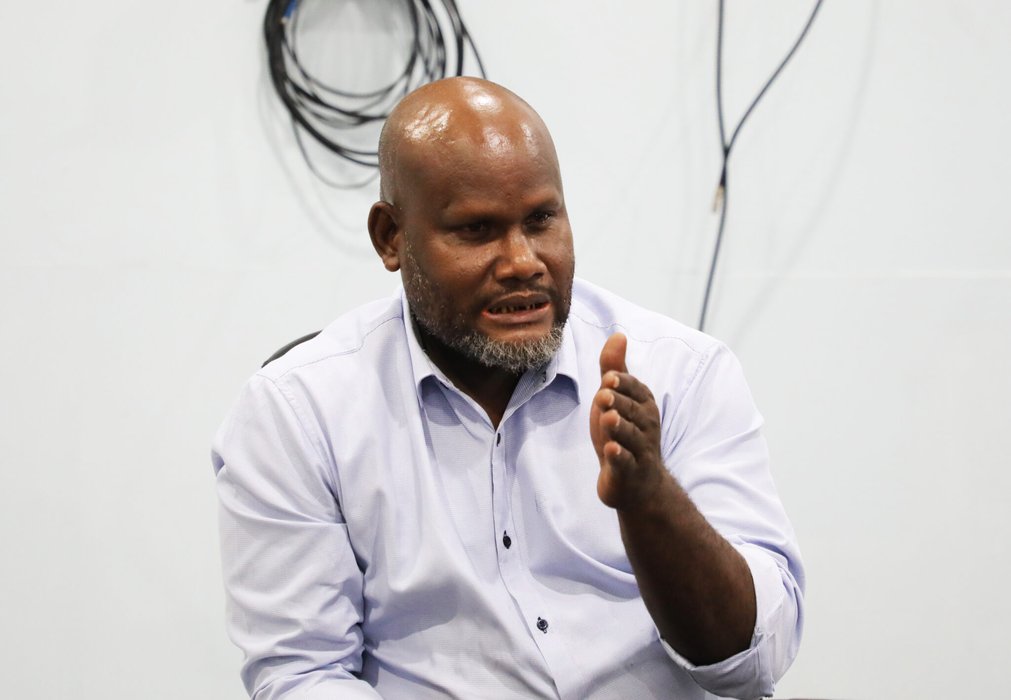
According to RNZ Pacific, Rural Development Minister Daniel Waneoroa (pictured above) announced he had left the Inter-Parliamentary Alliance on China (IPAC) - which draws in politicians from more than three dozen countries.
That drew a furious response from IPAC, which accused China of "bullying behaviour", saying Beijing had issued a "direct and shocking challenge" to the sovereignty of Solomon Islands. Waneoroa was appointed Rural Development Minister in the same month.
Prime Minister Manele reportedly offered him the position to coax him away from a broad coalition of MPs - including both government defectors and opposition MPs - which had coalesced to challenge the prime minister's hold on power.
China was reportedly angered by Waneoroa's position with IPAC, which has tried to build international pressure on Beijing over human rights abuses, including in Hong Kong and Xinjiang. The group has previously accused China of resorting to threats and blackmail to stop MPs from several developing countries joining an international IPAC conference hosted in Taiwan in June 2024.
Peaceful Assembly
Politicians on trial for holding peaceful protests against China
News from the #SolomanIslands | Outspoken former Malaita province premier Daniel Suidani has been arrested and charged in relation to unlawful assemblies and protests in 2021: https://t.co/p1indHJ8c5
— CSIS Southeast Asia (@SoutheastAsiaDC) October 7, 2024
Two politicians continue to face trial for anti-China protests held four years ago
Outspoken former Malaita province premier Daniel Suidani was arrested and charged in October 2024 in relation to unlawful assemblies and protests in 2021. The Malaita provincial leader was arrested, along with his then political advisor Celsus Talifilu. Both men are alleged to have masterminded a number of unlawful assemblies and protests in Auki, the Malaita provincial capital, in 2021.
The protests were carried out by the Malaita for Democracy (M4D) movement against the decision by the former government to sever diplomatic ties with Taipei in favour of Beijing. The duo face two counts of unlawful assembly, contrary to section 74 and section 21 of the Solomon Islands Penal Code. Both have pleaded not guilty to the charges.
As previously documented, Suidani has been one of the most outspoken critics of the country’s relationship with China and objected to the national government signing a controversial security pact with China in 2022, as well as the decision to break ties with Taipei. He had previously banned Chinese companies from the province. The premier also repeatedly pushed for Malaita to declare independence from the Solomon Islands.
The trial was scheduled to begin in June 2025 but according to reports it has now been rescheduled to September 2025.
Expression
Media faces interference and restrictions to access information
In March 2025, a study on the state of the media in the Solomon Islands was published by ABC International Development (ABCID), informed by our Pacific partners. The report noted that due to the geography of the Solomon Islands, radio remains the preferred daily information source. As a national broadcaster, Solomon Islands Broadcasting Corporation (SIBC) is the only provider of nationwide shortwave radio services.
Despite the rise of online media platforms, over 80 per cent of audience member respondents expressed high levels of trust in Solomon Islands’ print media, which covers both the Solomon Star and Island Sun newspapers.
The study highlighted that since the Solomon Islands recognised the “One China” policy in 2019, there were instances where locally produced stories on the Taiwanese presidential elections led to inquiries by both the Solomon Islands and Chinese governments, expressing concern on the views represented.
The study noted that although the Constitution provides for freedom of expression and publication in the right to seek, receive, and impart knowledge and ideas, there is no specific right to information law in Solomon Islands.
Accessing information from government officials is still a hurdle. Individuals interviewed said “it is always hard to obtain credible information from government officials”. Another said: “It’s very difficult to access information from government officials unless someone leaks them to you or provides them to you in confidence”. Compounding the above is the absence of media officers in certain government ministries and departments.
As previously documented, there have been concerns about press freedom and access to information. In July 2024, Facebook temporarily blocked posts published by independent online news outlet In-Depth Solomons, which had published three stories on Prime Minister Manele’s return from China. In May 2022, journalists in the Solomons faced numerous restrictions while trying to report on the visit to the region of China’s Foreign Minister Wang Yi. The government also threatened to ban or deport foreign journalists deemed disrespectful of the country’s relationship with China.