Freedom of association
Golos co-chair sentenced to five years in prison
On 14th May, Grigory Melkonyants, co-chairman of the independent election-monitoring organisation Golos, was sentenced to five years in prison by a Moscow court on charges of collaborating with an “undesirable” organisation.
The charges arise from Golos’s membership in an international consortium, the European Network of Election Monitoring Organisations, which Russian authorities have designated as “undesirable”. Defence lawyers argued that Golos was no longer a member of the consortium when the European organisation was given this status, as it had already been dissolved; however, Melkonyants was found guilty despite this.
The conviction has drawn sharp international criticism from the UN, Amnesty International, and Human Rights Watch, which condemned it as a blatant attempt to silence critical voices.
In July 2025, the group announced it was ceasing operations due to Melkonyants’ conviction. “This court ruling leaves us no choice. It places not only every participant in Golos at risk of criminal prosecution, but even those who simply sought consultations or legal assistance,” the group said, according to Meduza. Restrictions placed on organisations declared “undesirable” expose anyone who has shared material from the Golos website or social media to the risk of prosecution. The organisation has also announced it will shut down its regional branches and that all its information resources will be taken offline.
Amnesty International labelled “undesirable”
On 19th May, Amnesty International was labelled an “undesirable” organisation, with Russian prosecutors accusing it of propagating “pro-war” content, as well as supporting extremist organisations and designated “foreign agents”. The Russian Prosecutor General’s Office said in a statement that Amnesty’s London office has acted as a “centre for the preparation of global Russophobic projects paid for by accomplices of the Kyiv regime”.
The designation means Amnesty must stop any work in Russia, and those accused of cooperating with or supporting it, or even those sharing its work on social media, could face criminal prosecution.
Amnesty has vowed to continue undeterred, despite the label and associated restrictions. “We will continue to work relentlessly to ensure that all those who are responsible for committing grave human rights violations, whether in Russia, Ukraine, or elsewhere, face justice […] Amnesty will never give up or back down in its fight for upholding human rights in Russia and beyond”, said Agnes Callamard, Amnesty International’s secretary general.
Freedom of peaceful assembly
Acts of protest and defiance persist despite repression
In May 2025, small but significant anti-war protests took place in Russia, showing continued defiance despite relentless state repression.
On 6th May in Moscow, 68-year-old activist Grigory Saksanov staged a rare and dramatic protest near the Kremlin, standing on the Bolshoy Moskvoretsky Bridge with a placard reading “Putin Hitler” on one side and displaying a swastika on the other. After holding the sign aloft, he jumped into the Moscow River, floating face-up in what appeared to symbolise a corpse. Paramedics later rescued and treated him, though his condition remains unclear. Known as “Uncle Grisha”, Saksanov has been repeatedly detained for anti-war demonstrations, including one in 2022 where he carried a similar poster near the Alexander Garden. Police reportedly plan to detain him following examination in hospital.
On 9th May, Victory Day, as a military parade was planned on Red Square in Moscow, the wives and mothers of mobilised soldiers issued a public call for a silent protest, demanding the withdrawal of their loved ones from the front. The grassroots group Put’ Domoi (“Way Home”) was formed several months into the full-scale invasion, after the “partial” mobilisation of 300,000 reservists was announced in September 2022. Since 2023, the group has held weekly silent protests by laying flowers at war monuments while wearing their signature white headscarves.
Also on 9th May, 18-year-old activist Alexander Klevitov was reportedly beaten by police after staging a solo protest in Pushkin Square, holding a placard reading “No to War! Fascism will not pass”. According to his lawyer, Natalia Tikhonova, Klevitov was detained and spent the night at the Tverskoy District Police Department, where officers allegedly denied him access to his lawyer. Despite suffering from a disability, he was repeatedly denied medical attention, and an ambulance was called to the station several times. Later, doctors at an emergency unit diagnosed him with a suspected concussion. He now faces charges of “discrediting the Russian army.”
Москвич вышел 9 мая с плакатом «Нет войне. Фашизм не пройдет». Его обвинили в «дискредитации» российской армии
— Дождь (@tvrain) May 14, 2025
18-летнего Александра Клевитов оштрафовали по соответствующей статье на 30 тыс. рублей, сообщает SOTAvision.
«Согласно протоколу, сотрудники вбили в поисковой строке… pic.twitter.com/G9Lhch5d6J
Elsewhere in the capital on 17th May, activists placed placards on a restored Stalin sculpture in the metro featuring quotes from Vladimir Putin and Dmitry Medvedev, criticising the dictator and the repressive nature of the Soviet Union. The placards rhetorically asked whether Moscow’s Transport Department “agreed” with Putin and Medvedev’s remarks on Stalin. Authorities swiftly removed the display, but images circulated widely online. According to Novaya Gazeta, the action came as cities across Russia are increasingly embracing the idea of restoring or erecting monuments to Stalin amid authorities’ ongoing campaign to reshape historical memory.
Freedom of expression
Authorities pursue “extremism” case against publishing house for “LBGTQI+ propaganda”, 11 detained
On 14th May, Anatoly Norovyatkin, distribution director of the country’s largest publishing group Exmo, and around ten others were detained in Moscow in a criminal case alleging “extremism” linked to supposed LGBTQI+ propaganda. According to TASS, the investigation concerns a title published by Popcorn Books, a publishing house in which Exmo acquired a 51% stake in 2023. Speaking to BBC Russia, Exmo representatives said the main company is not implicated and that the charges relate solely to Popcorn Books.
Those detained reportedly include former directors and employees of Popcorn Books and Individuum, some no longer working in publishing. Lawyers were only able to reach the detainees late in the evening, despite the raid taking place during the day. State Duma deputy Alexander Khinstein, now acting governor of the Kursk region, said the probe followed his complaint over alleged breaches of Russia’s anti-LGBTQI+ law adopted in December 2022. According to BBC Russia, Khinstein was particularly outraged by the fact that, following the adoption of the law, “Popcorn Books not only continued selling such books, but also demonstratively began decorating their covers with quotes from Article 29 of the Constitution, which guarantees freedom of speech and prohibits censorship.”
On 15th May, it was reported that “extremism” charges were brought against three of those detained in the previous day’s sweep. In November 2023, Russia’s Supreme Court banned what it described as an “international LGBT public movement” as extremist in a highly vague ruling, paving the way for widespread and arbitrary prosecutions. Investigators allege that the three publishing house employees “recruited” readers into the extremist movement by selling books containing “LGBTQI+ propaganda.” They face up to 12 years in prison.
Russia’s escalating crackdown on LGBTQI+ “extremism”
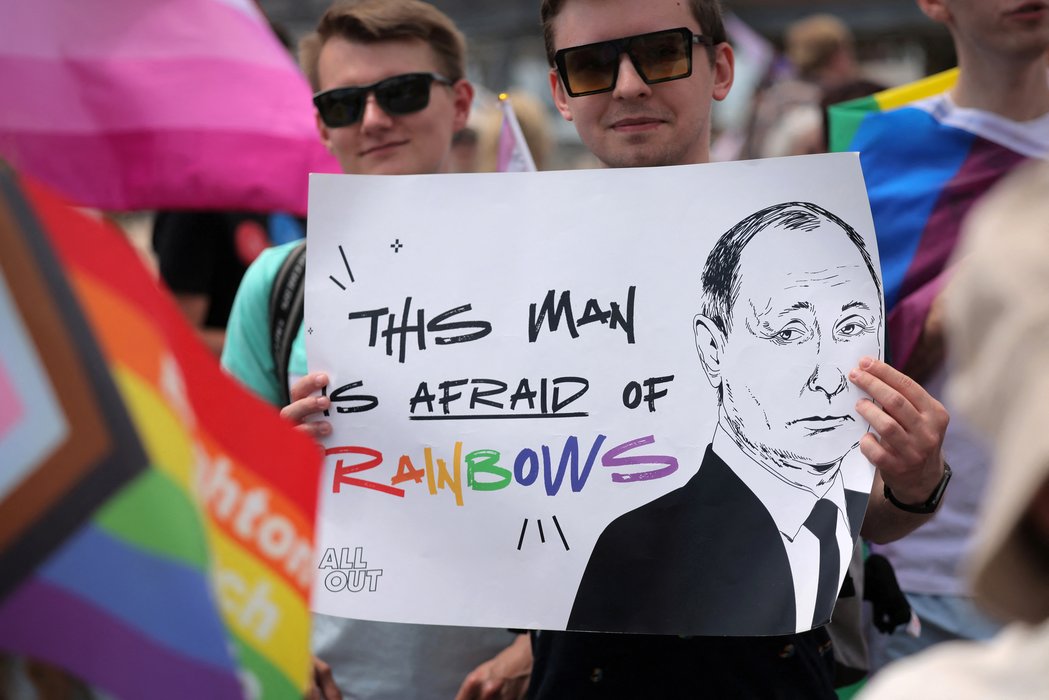
Since Russia’s Supreme Court labelled the “international public LGBT movement” as an “extremist organisation” in 2023, authorities have intensified their campaign against LGBTQI+ people and their allies. According to Human Rights Watch (HRW), by June 2025, courts had issued over 100 convictions under “extremism” laws for alleged participation in or support of the movement, including merely displaying rainbow symbols online. HRW documented both administrative and criminal prosecutions, with some defendants facing up to 12 years in prison.
HRW found that between January 2024 and June 2025 at least 20 people faced criminal charges on these grounds. In December 2024, Andrei Kotov, a man arrested for allegedly operating a travel agency for gay customers, died by suicide in pretrial detention. While merely displaying the symbols of a banned organisation is an administrative offence, repeated violations are punishable under the criminal code by up to four years in prison. One person was therefore convicted on criminal charges and sentenced to six months of compulsory labour after posting the rainbow flag on a social media page.
In May 2025, two leading Russian LGBTQI+ rights organisations, Coming Out and Sphere, reported that after the Supreme Court decision, LGBTQI+ support groups experienced a substantial increase in requests for assistance with leaving Russia, processing humanitarian visas, applying for asylum, and emergency evacuation due to persecution. They also noted that the ruling severely constrained the operational capabilities of civil society looking to support the LGBTQI+ community, leading to the closure of queer spaces and events and forcing them into operating clandestinely.
Foreign Ministry retaliates against international media following new wave of EU sanctions against Russian outlets
European sanctions imposed on Russia following its aggression against Ukraine also target the country’s information sector. In February 2025, the European Union further broadened restrictions on Russian state-controlled media and propaganda outlets promoting the war. Previously, channels such as Sputnik and RT were banned and their online content blocked within the EU. Brussels also sanctioned individuals involved in the Russian propaganda network, including moderators, editors and financiers of media platforms spreading disinformation.
The 16th sanctions package, adopted on 25th February, added eight Russian outlets to the sanctions list: EurasiaDaily, Fondsk, Lenta, NewsFront, Rubaltic, SouthFront, the Strategic Culture Foundation, and Krasnaya Zvezda. The Russian Foreign Ministry condemned the move as an attack on media pluralism and freedom of access to information.
In response, Russia announced on 30th June that it would block the online resources of about 15 foreign outlets from being accessed within its territory. “Should the restrictions against the Russian mass media and information channels be lifted, the Russia side will also revise its decision with respect to European media outlets,” the Russian Foreign Ministry said.