Introduction
Daniel Noboa wins re-election in Ecuador
On 13th April 2025, Daniel Noboa secured re-election with approximately 55.7 per cent of the vote to 44.3 per cent for Luisa González, with 95 per cent of tally sheets counted. International observers from the Organisation of American States and the European Union endorsed the integrity of the process, and the National Electoral Council (CNE) reported a transparent, real-time verification and counting system. Despite these assurances, González rejected the outcome, alleged electoral fraud and announced plans to request a recount.
Noboa was sworn in on 24th May 2025 for a full term, running until May 2029. In his inaugural speech, he pledged to confront organised crime and revitalise the economy, warning that Ecuador faces both national and transnational criminal structures. He promised to progressively reduce homicides, which remain alarmingly high: official data recorded 3,094 killings between January and April 2025, a 58 per cent rise compared with the same period in 2024, and higher than 2023, already the deadliest year on record.
Meanwhile, a report by the Association of Women for Gender Equality and Autonomy (Asociación de Mujeres por la Equidad de Género y la Autonomía, MEGA) highlighted the scale of gender-based political violence in digital spaces during the elections. It found that 53 per cent of abusive content sought to delegitimise women by portraying them as “mozas” linked to male politicians rather than engaging with their policies.
The most targeted figures included Luisa González, Verónica Abad, Diana Jácome and Ana Galarza, alongside Andrea González, Sade Fritschi, Viviana Veloz, Mónica Palacios and Mónica Palencia. Since 2020, the Electoral Contentious Tribunal has received 63 formal complaints. MEGA has urged comprehensive reform, including a national victim-care protocol and a public registry to address impunity and protect women’s democratic participation.
Ecuador’s President declares new state of emergency ahead of run-off election
On 12th April 2025, the eve of the presidential run-off, President Daniel Noboa declared a state of emergency in seven provinces, Quito and the national prison system, citing internal commotion caused by organised crime. This was the second state of emergency of 2025, following a similar measure adopted in January and extended in March 2025.
The decree suspended several constitutional rights, including inviolability of the home and correspondence, and restricted freedom of movement through curfews in 22 localities. It also suspended the right of assembly and authorised the mobilisation of armed forces with expanded competences.
In response, civil society organisations condemned the decree, calling it an abusive declaration of a state of emergency by a “president-candidate.” They warned that its timing in the middle of elections threatens democratic guarantees, undermines human rights, and ignores rulings of the Constitutional Court.
🛑Abusiva declaratoria de estado de excepción por parte del “presidente-candidato” pone en riesgo derechos humanos e incumple dictámenes de la Corte Constitucional durante #EleccionesEcuador2025
— Alianza de Organizaciones por los Derechos Humanos (@DDHH_Alianza) April 13, 2025
Pronunciamiento completo https://t.co/FkqLdO12WC pic.twitter.com/HGnVfRP5oE
Soldiers admit torture of four children before killings in Guayaquil
On 27th April 2025, during a judicial reconstruction, four of the 16 detained soldiers admitted beating the children—aged 11 to 15—subjecting them to humiliation, threats, and a simulated execution before abandoning them naked in Taura. The children’s remains were later found incinerated. The confessions confirm state responsibility and highlight systemic impunity in Ecuador.
The soldiers insist the children were alive when left. But families and human rights organisations have rejected this narrative, pointing to a pattern of enforced disappearance. Enforced disappearance carries a penalty of 22–26 years under Ecuadorian law and is non-prescriptible.
The case exemplifies Ecuador’s broader record of violations: the country accounts for 53 Inter-American Court judgments. If Ecuador fails to deliver accountability, the case could be brought before the UN Committee on Enforced Disappearances. Authorities must ensure full investigation, prosecution, and reparation for the families.
Expression
Journalists report obstruction and aggression while covering presidential run-off
On 13th April 2025, at least three journalists reported restrictions on their work during coverage of the April presidential run-off (see introduction). Photojournalist Nicole Moscoso began an interview in Quito when a soldier and a CNE official interrupted her and later told her she could not record or interview polling station members without express authorisation. After she challenged them, CNE staff confirmed her authorisation and she completed her work.
Lucía Clavijo went live for Teleamazonas when a military officer ordered a delegate to stand in front of her camera. She cited the CNE’s directive but left after finishing her segment because the soldiers kept obstructing her. Evelyn Ortiz and cameraman Bryan Guachamín entered another site to film the vote count. A coordinator and a soldier told them to leave. Soldiers shoved Guachamín and pushed Ortiz out of the room.
IMPIDEN EL INGRESO DE PRENSA EN LOS RECINTOS ELECTORALES
— Radio Sonorama OFICIAL (@radiosonoramaec) April 13, 2025
En la Unidad Educativa Liceo Policial. El militar de las Fuerzas Armadas informó que solo personal autorizado y Fuerzas Armadas pueden estar en el recinto desde las 17:00 pm. El CNE indicó no tener notificación oficial… pic.twitter.com/mvKhG0yoqw
On 20th April 2025, organised supporters of the football club Técnico Universitario threatened two journalists from Diario La Hora Tungurahua while they conducted a live broadcast outside the Indoamérica Bellavista Stadium in Ambato.
The outlet reported that the journalists—a reporter and a camerawoman, whose names remain undisclosed for security reasons — were covering fans’ reactions to Técnico Universitario’s 1–3 defeat against Cuniburo when several supporters approached them in a hostile manner. Supporters ordered them to stop, shouting: “Don’t record”, “Stop broadcasting”, and “We know your social media”.
The situation escalated after a clash between some supporters and player Christopher Angulo. As verbal aggression increased, the journalists interrupted the transmission and withdrew to protect their safety.
Journalists attacked while reporting on mayor’s corruption case
On 20th April 2025, municipal employees and supporters of Mayor John Vinueza physically and verbally attacked four journalists—Danilo Eduardo Villaruel and Darwin Altamirano (El Diario de Riobamba, RTS), Roberto Bonifaz (Radio El Sol), and Galo Bonifaz (TC Televisión)—in Riobamba. The incident took place outside the Provincial Court of Justice of Chimborazo during coverage of judicial proceedings linking the mayor to a corruption case.
The journalists reported being pushed, blocked from filming, and interrupted during live transmissions. Villaruel described how women formed a “human wall” to push reporters in a way that suggested they had initiated the violence. Two of the journalists had already received threats via WhatsApp after publishing critical videos on Riobamba’s local issues.
Police officers assault journalist covering road accident in Esmeraldas
On 26th April 2025, police officers physically and verbally assaulted Juan Alcívar, journalist from the digital outlet JAR TV, while he covered a traffic accident in La Unión parish, Quinindé canton, Esmeraldas province. The accident involved a provincial bus and a white car. Alcívar began a live broadcast on Facebook when officers approached him.
According to Fundamedios, Alcívar moved towards the accident scene—which had not been cordoned off—when the Chief of Operations of Quinindé confronted him aggressively, calling his actions “imprudent” and questioning why he wanted to film the deceased. Alcívar explained that he was carrying out his journalistic work and had not recorded any images of victims.
As he moved, another officer shoved him and told him to leave. Several officers repeated the demand, and one tried to take his phone stabiliser. Alcívar identified himself as a journalist several times, but police dismissed him and hurled insults.
Bus terminal staff harass journalists reporting accident in Ambato
On 21st May 2025, staff at the Ambato South Bus Terminal harassed journalists Hugo Sánchez, Graciela Morejón, and Freddy Chicaiza while they reported on a traffic accident. Sánchez and Morejón attempted to film outside, but staff locked the entrance and shouted at them to stop recording. One staff member tried to photograph them.
Inside the terminal, Chicaiza began a live transmission from behind the security cordon. Several staff shouted at him to leave, and a municipal employee told him that press were not allowed to record. Another official pushed him and placed a hand on his camera. Chicaiza eventually continued his coverage but from a greater distance.
Additionally, when journalists requested an official statement from the terminal’s administration, staff refused to provide information. Later that day, the Ambato South Bus Terminal administration issued a public apology to the media for what it described as the “inappropriate conduct of a staff member that impeded the free exercise of journalism.” It announced the initiation of an administrative disciplinary process against the staff member involved.
Journalist faces online harassment following television interview
On 19th May 2025, journalist María Sol Borja faced a new wave of online harassment after expressing her views during an interview with Teleamazonas journalist Milton Pérez. Borja stated: “I consider it concerning whenever there is a concentration of powers within the National Assembly.” Following this, dozens of users and troll accounts targeted Borja with insults and threats, many of them misogynistic.
Attackers cited her father’s candidacy in recent elections. Borja clarified that she has no political affiliation and that her professional independence remains intact. She also published examples of the messages on X, including: “You should be silenced, and permanently so.”
Borja explained that online harassment against her is not new, noting that she has received similar attacks even before the most recent presidential elections. On her personal X account, Borja wrote: “Once again, they attempt to scrutinise all my personal and family connections in order to delegitimise my voice, built over 17 years of journalism in various national and international media outlets.”
Trolls also criticised Teleamazonas anchor Milton Pérez for interviewing her.
Llevo más de un año recibiendo a diario hordas de trolls y fanáticos insultándome y amenazándome, convencidos de que libertad de expresión es que hablen los periodistas y analistas que les gustan, y los que no, que se callen.
— María Sol Borja (@mariasolborja) May 20, 2025
Ayer, por una entrevista en Teleamazonas, vuelve la…
Journalists targeted by abusive lawsuits in money laundering case
Three journalists are facing lawsuits filed by Bibian Hernández, a lawyer under investigation for money laundering. Between January and April 2025, Hernández filed legal actions against Sara Ortiz, Roberto Aguilar and Martín Pallares. The lawsuits include two civil cases for moral damages and one criminal complaint for defamation. Hernández is seeking USD 3.2 million in damages from Aguilar and Pallares.
The claim against Aguilar and Pallares relates to the digital programme Politizados in February 2024, in which they discussed the case involving Hernández. According to the lawsuit, the journalists allegedly issued discrediting statements suggesting “dark and secret operations”. Aguilar and Pallares rejected the claim in an article published by Expreso. They argued that their comments reflected information already contained in Prosecutor’s Office documents from two high-profile corruption cases (the Metastasis and Purga cases).
The case against Ortiz relates to her article “Ecuador, a haven for ‘lawyer-gangsters’”, published in January 2025. Hernández alleges that mentioning her name under the headline “lawyer-gangster” sought to bias public opinion against her.
The timing raises red flags. The suits arrived months before Hernández’s own criminal trial, leading the journalists to denounce them as intimidation.
Habeas data actions filed against three investigative media outlets
On 6th May 2025, Fundamedios reported that businessman Pedro Bejarano Alvarado had escalated legal pressure against three investigative outlets—Mil Hojas, Plan V, and La Fuente. He claims the three outlets published information that harmed his honour and image in a 2020 investigation titled “Drug trafficking networks interfere with State contracts” (“El narco le mete mano a los contratos del Estado”).
The claims relate to a 2020 investigation that detailed Bejarano’s alleged role in the Cartel Andino and cited judicial records confirming past drug-trafficking proceedings, including his 2016 arrest in Spain under an Interpol alert. The report drew on information already published in other regional media, such as La República in Peru.
Berajano is demanding the removal of articles, permanent apologies online, and sanctions against Plan V’s editor Juan Carlos Calderón, who says he never received proper legal notification.
The lawsuits rely on the constitutional action of habeas data. In Ecuador, Article 92 of the Constitution defines habeas data as a mechanism that protects citizens’ rights to access and correct personal data. But Ecuador’s Data Protection Law clearly states that the rule does not apply to journalism. Fundamedios called the lawsuits “an attempt at censorship”.
Authorities restrict journalists reporting on child deaths in Morona Santiago
Between 2nd and 10th May 2025, journalists faced restrictions while covering an outbreak of leptospirosis that allegedly killed at least eight children in Indigenous communities in Taisha. Iván Rodríguez, correspondent for Teleamazonas in Cuenca, reported that he followed the situation after three children were transferred to the Vicente Corral Moscoso Hospital. He noted that although the Ministry of Health initially issued general statements in early May, once leptospirosis was identified as the cause, officials stopped sharing details.
Rodríguez said that neither the hospital nor the Ministry’s office in Cuenca provided access to information on the condition or treatment of the minors. Families who had initially agreed to speak with him later declined. Wilson Cabrera, Fundamedios correspondent in Morona Santiago, confirmed similar restrictions. He said both the Ministry and the provincial governor refused to provide information. Cabrera added that community members told him they had been instructed not to talk to the press, particularly not to Teleamazonas.
The Ministry of Health subsequently released only a short written statement confirming leptospirosis and announcing that the children had been discharged.
Association
Police raid FICSH headquarters
On 28th May 2025, armed police forces carried out an arbitrary raid on the headquarters of the Interprovincial Federation of Shuar Centres (Federación Interprovincial de Centros Shuar, FICSH) in Sucúa, Morona Santiago. According to the Confederation of Indigenous Nationalities of Ecuador (CONAIE), the police entered without presenting a judicial order, in violation of due process and in disregard of constitutional rulings protecting the FICSH leadership under Domingo Ankuash.
CONAIE described the raid as violent and arbitrary, and linked it to state interests aligned with extractive activities in the Cordillera del Cóndor, particularly mining operations by the Canadian company Lowell-Solaris. The organisation argued that the raid undermined Indigenous people’s right to self-determination and collective rights guaranteed by both the Constitution and international treaties.
The Sarayaku community issued a statement of solidarity, condemning the raid and denouncing it as a breach of Indigenous rights and an attack on the integrity of Indigenous governance structures. They called on international human rights organisations and the global community to monitor and respond to the situation.
Both CONAIE and the Sarayaku community held the Ecuadorian government responsible for the operation and its consequences, warning that the action reflects a wider strategy to divide Indigenous organisations and weaken resistance to extractive projects. They reaffirmed their commitment to defending Indigenous autonomy, territory, and collective rights.
🚨 ALERT || #Ecuador
— Indigenous Peoples’ Rights International - IPRI (@IPRightsIntl) May 28, 2025
🇪🇨 Ongoing #criminalization of indigenous organizations to favor mining interests
🚔 Armed police forces illegally raided the headquarters of the Interprovincial Federation of Shuar Centers@CONAIE_Ecuador pic.twitter.com/GTRQSHCFH0
Draft law risks severe human rights violations in the name of security
On 17th May 2025, President Daniel Noboa submitted to the National Assembly the draft Organic Law to Dismantle the Criminal Economy Linked to the Internal Armed Conflict, presented as “urgent economic” legislation. The proposal contains 32 articles combining financial and security measures, including searches without judicial warrants, detentions of up to 24 hours without prosecutorial oversight, the creation of special judges for conflict-related offences, and prison terms of up to 30 years for participation in organised armed groups.
It further authorises the armed forces and police to use force proactively against alleged members of organised groups and designates assets linked to narcotics, illegal mining or arms trafficking as military targets. Officially framed as a response to rising homicide rates and the expansion of criminal economies, the initiative was renamed on 27th May 2025 by the Assembly’s Economic Development Committee as the “National Solidarity Law”.
Legal experts criticised the draft law as unconstitutional and disproportionate. They argued that the proposal, although filed as an economic measure, in reality restructures criminal law and security powers, thereby circumventing the constitutional principle of unity of subject matter. Concerns include the erosion of due process guarantees through searches without judicial authorisation, mandatory pre-trial detention, and accelerated proceedings; immunity and early pardons for state agents, fostering impunity; and excessive concentration of powers in the executive-led “Security Bloc”.
In response, more than 50 civil society organisations warned that the draft law does not dismantle criminal economies but instead entrenches militarisation, weakens accountability, risks systematic violations of fundamental freedoms, and criminalisation of human rights defenders. They argued it entrenches militarisation without addressing the root causes of crime, leaving Ecuador’s fragile rule of law at risk.
Peaceful Assembly
Police intervention threatens freedom to peaceful assembly in Las Naves
On 21st May 2025, police entered La Unión, Las Naves canton, to disperse families engaged in a peaceful assembly opposing the passage of Curimining S.A. machinery through their community. Residents had previously decided that the road in question did not form part of public infrastructure and should remain free of extractive operations.
Community members described the action as non-violent resistance to protect their territory. According to local reports, the provincial governor ordered the police deployment. Residents said the presence of armed forces created intimidation and heightened fears of criminalisation of their leaders.
#BoletíndePrensa
— Comisión Ecuménica de Derechos Humanos (@Cedhu) May 22, 2025
Habitantes del recinto La Unión del cantón Las Naves, se encuentran en #Alerta
Hoy miércoles 21 de mayo, un grupo de policías llegó al recinto La Unión para intentar desalojar a las familias que se encuentran en resistencia pacífica. Los agentes, probablemente… pic.twitter.com/byWnkK9wNF
Closure of the Troncal Amazónica in Yantzaza against illegal mining
On 30th April 2025, residents of Yantzaza in Zamora Chinchipe shut down the Troncal Amazónica highway, blocking the main road into the city. The action came in protest at the unchecked growth of illegal mining. Community members said mining has devastated the Zamora River and is threatening both their health and livelihoods.
Protesters denounced government inaction and demanded the presence of authorities with the power to enforce environmental protections. They are calling for binding commitments to stop the destruction and defend collective rights.
Government deploys military to quell Agraria University protest
On 27th May 2025, students, faculty and workers at the University of Agraria in Guayaquil mobilised in protest against recent administrative decisions. Protesters denounced the dismissal of staff and the unilateral imposition of virtual classes by Rector Tamara Borodulina, which contravened a University Council resolution to resume in-person learning.
The protest began peacefully but escalated when tyres were burned and the military entered the campus. Students reported intimidation, while families expressed fears for safety, keeping children from attending classes. The National Federation of University Students of Ecuador backed the mobilisation and demanded the rector’s removal. attending classes. The National Federation of University Students of Ecuador backed the mobilisation and demanded the rector’s removal.
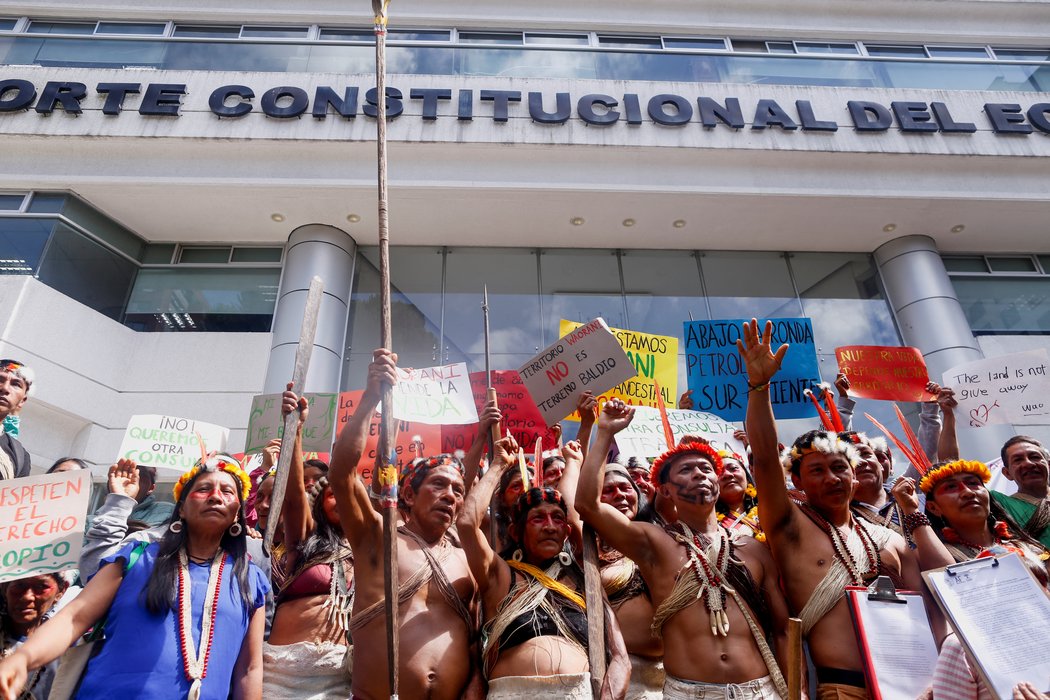
Waorani communities lead protest to Constitutional Court
On 13th May 2025, a delegation of 120 people, led by the Waorani communities of Pastaza, marched to the Constitutional Court in Quito to reject the government’s plan to launch the South-Eastern Oil Round. The initiative seeks to auction 3.5 million hectares of Indigenous territory in the Amazon without free, prior and informed consent, as required under Ecuador’s Constitution and international law.
During the march, representatives delivered a letter to the Court endorsed by Indigenous leaders, civil society organisations, activists and global allies.
📍Hoy en Quito, #Ecuador, una delegación de 120 personas — liderada por las comunidades Waorani de Pastaza — marchó hacia la Corte Constitucional para rechazar al plan del gobierno de lanzar la Ronda Petrolera Suroriente.
— AFrontlines_ES (@AFrontlines_ES) May 13, 2025
🛢Esta nueva ronda busca subastar 3.5 millones de… pic.twitter.com/ETtPqgFJuD
Families protest delays in the Dalcroze school sexual abuse case
On 21st May 2025, parents of children who had denounced sexual abuse by a teacher at the Dalcroze School staged a protest to demand justice and accountability. Gathering outside judicial offices, they expressed outrage at the repeated delays in proceedings, which they say violate children’s right to timely justice and create conditions that could allow the accused to seek release from pre-trial detention.
Protesters carried signs and chanted slogans such as “Children Do Not Lie”, calling attention to the urgent need to keep the accused in custody throughout the process. They warned that judicial inaction not only heightens the risk of flight but also prolongs the suffering of survivors and their families.
Families of the disappeared demand truth and justice
On 28th May 2025, the Association of Relatives and Friends of Disappeared Persons in Ecuador (Asfadec) gathered in front of Plaza Grande in Quito to demand answers from the State regarding cases of enforced disappearances. At the protest, families called for truth, justice and memory for their loved ones, while also urging greater visibility, awareness and public recognition of disappearances as a pressing human rights issue in the country.