Introduction
On 6th November 2025, the Georgian Prosecutor General’s Office announced criminal charges against eight leading opposition figures including sabotage, aiding foreign interests and calling for the overthrow of the government, seeking up to 15 years in prison for some.
Those targeted by the case include:
- Former president Mikheil Saakashvili, the founder and former chairman of the United National Movement party;
- Giorgi Vashadze, leader of the party Yes to Europe – Strategy Aghmashenebeli;
- Nika Gvaramia and Nika Melia, co-founders of the party Ahali;
- Zurab Girchi Japaridze, founder of the party Girchi – More Freedom;
- Elene Khoshtaria, founder of the party Droa!;
- Mamuka Khazaradze and Badri Japaridze, founders of Lelo for Georgia;
All those listed except Khazaradze and Badri Japaridze were already in detention when the charges were announced. Saakashvili has been imprisoned since 2021 and is serving a 12.5 year prison sentence on charges related to his time in office, while Khoshtaria was detained in September for vandalising one of ruling Georgian Dream party’s campaign banners. She has refused to post bail in protest and remains in pre-trial detention pending the ruling.
The remaining four have been sentenced to jail terms and two-year bans on holding public office for refusing to testify before a parliamentary commission investigating alleged crimes committed by government officials between 2003 and 2012, when the United National Movement (UNM), currently in opposition, was in power. The commission was formed exclusively from MPs aligned with Georgian Dream, as four opposition parties had refused to take up their seats or participate in parliamentary activities after disputing the fairness of the October 2024 election. CSOs have criticised the commission’s composition and mandate as incompatible with the constitution and parliamentary procedure, viewing the investigation as a pretext for Georgian Dream to punish its political opponents and dismantle political pluralism in the country.
The two Lelo leaders, Khazaradze and Badri Japaridze, were also convicted for boycotting the commission. However, they were released early after a presidential pardon, granted in recognition of the party’s willingness to participate in the October 2025 municipal elections.
In October, the commission’s findings were used to petition the Constitutional Court to outlaw the UNM and two other opposition groups the government deemed its satellites: Lelo and the Coalition for Change. The filing named three out of four opposition parties that cleared the electoral threshold in the 2024 parliamentary election. According to media reports, the fourth, the For Georgia party, led by former Prime Minister Giorgi Gakharia, avoided inclusion in the lawsuit by taking its seats in parliament shortly before the filing.
In parallel, a law was passed to ban individuals affiliated with banned parties from standing in elections or holding public office. As reported by the Georgian public broadcaster, according to the amendments, “if the Constitutional Court upholds a relevant lawsuit, it will be possible to prohibit specific individuals from establishing or joining a political party, holding leadership or political positions, financing a political party, being included on a party list, or being nominated as a candidate for an elective position”.
Freedom of association
EU institutions call attention to laws “severely limiting civic space”
The European Commission's 2025 enlargement report on Georgia, published on 4th November 2025, warned that civil society in Georgia operates in an increasingly repressive environment. Judging the country’s progress on European integration to be such that it’s now a “candidate in name only,” the report found that the previous year had seen a “serious democratic backsliding marked by a rapid erosion of the rule of law and severe restrictions on fundamental rights,” highlighting in particular “legislation severely limiting civic space, undermining freedom of expression and assembly, and violating the principle of non-discrimination.”
In particular, the report criticised a series of repressive laws adopted in 2025 that “undermine the fundamental role of civil society in upholding and strengthening democracy”, in particular the Foreign Agents Registration Act, which built on the controversial 2024 “foreign agent” law by extending registration and reporting requirements to individuals deemed to be “working under the direction of a foreign power,” as well as amendments introducing a requirement for international donors to seek pre-approval for grants from state authorities.
The mentioned legislation has severely curtailed the operating environment for civil society, imposing burdensome reporting requirements on civil society organisations (CSOs) funded from abroad, exposing them to administrative harassment and threatening their financial viability. Sanctions for non-compliance are severe, including both administrative and criminal liability, and the Anti-Corruption Bureau (ACB) has been given wide discretion in ensuring the laws’ enforcement. The EU has also warned that a state grant-making agency established in February 2025 does not stand to have a positive effect on the CSO funding landscape, warning that it would foster the development of so-called GONGOs (government-organised non-governmental organisations), thereby undermining the independence of the civic sector.
In assessing the situation of civil society in Georgia in 2025, the report concludes that increasing acts of intimidation, vandalism, threats, and physical assaults against civil society representatives, repressive actions undertaken by the ACB, and growing administrative obstacles have all negatively impacted the overall environment for CSOs.
On 17th December 2025, the European Parliament held a debate dedicated to the “deep democratic crisis” in Georgia. Commenting on the findings of the enlargement report, Michael McGrath, European Commissioner for Democracy, Justice, the Rule of Law and Consumer Protection, warned Georgia is “drifting away from democratic norms.” “Rapid erosion of the rule of law, adoption of restrictive legislation, instrumentalisation of the judiciary and a closing of civic space – all fall short of EU expectations from a candidate country,” he said, adding “I urge the Georgian authorities to see the enlargement report as an opportunity to reflect, to change their course, to rebuild trust, and to return to the EU path, for Georgia’s future ultimately rests in their hands.”
The previous day, the EU Council presidency issued a statement backed by 26 member states – which only Hungary refused to endorse – concluding that Georgia’s EU accession process had “effectively come to a standstill,” and calling on authorities to free “all arbitrarily detained politicians, journalists and activists” without delay.
Freedom of peaceful assembly
A year of continuous protests in Georgia: repression intensifies
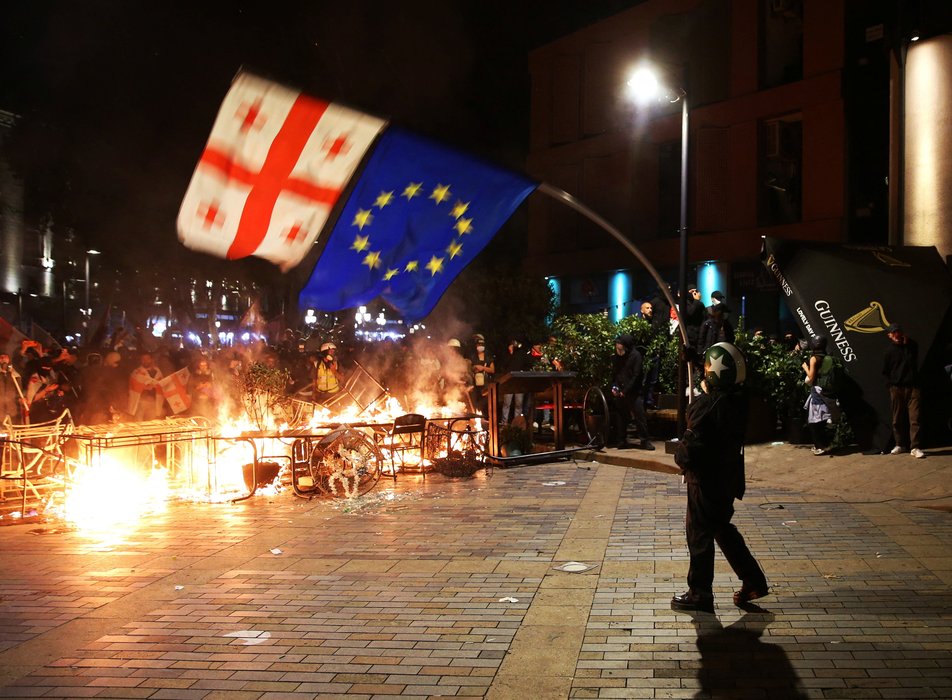
Beginning on 28th November 2024, the Georgian Dream administration’s decision to suspend EU accession negotiations until 2028 sparked mass protests across the country. These mobilisations were met with excessive force, including tear gas, water cannon, arbitrary arrests, and violence from both police and masked individuals suspected of being affiliated with the government. As protesters continue to gather daily in front of Parliament, they are being targeted by detentions and fines under increasingly restrictive laws.
One year after the protests began, civil society organisations (CSOs) reported that, by their estimates:
- Around 160 people had been subjected to criminal investigations;
- Around 300 protesters had been subjected to torture and ill-treatment;
- More than 600 people had been administratively detained;
- More than 1,000 citizens had been subjected to unjust fines;
- Around 400 cases were recorded of journalists being arrested, beaten, or harassed;
According to media reports, over 100 people remain detained, either in pre-trial detention or already serving prison sentences in connection to the protests, with the majority having been arrested in the first few weeks of the protests or in the aftermath of the unrest that surrounded the October 2025 municipal elections. Alongside protesters, several opposition leaders and journalist Mzia Amaghlobeli are among those jailed (see more under Freedom of expression).
BBC investigation alleges use of WWI-era chemical weapon against protesters
On 1st December 2025, the BBC World Service published an investigation titled “When Water Burns: The Fight for Georgia,” alleging that the Georgian government had used water cannon laced with a chemical weapon against protesters in November and December 2024. Drawing on a medical study, interviews with protesters as well as police whistleblowers, the BBC investigation found that protesters were likely targeted with “camite”, a chemical agent first used during World War One, leading to long-term health impacts.
BBC investigators were provided exclusive access to a study by Dr Konstantine Chakhunashvili, a medical doctor and participant in the protests. Based on interviews with nearly 350 protesters, the study showed that nearly half of those interviewed experienced longer-term effects (lasting more than 30 days) such as coughing, shortness of breath, and skin irritation. In some cases, changes were observed in the lungs and heart.
While admitting chemical irritants had been mixed into the water in the water cannon deployed against protesters, Georgian authorities have denied using any banned substances. Prime Minister Irakli Kobakhidze dismissed the BBC investigation as a “falsehood” and a “cheap provocation planned by foreign intelligence services.” Despite these denials, the allegations have intensified demands for accountability for the violent suppression of anti-government protests beginning in November 2024.
CoE Commissioner calls for effective investigations into alleged police violence
On 17th December, Council of Europe Commissioner for Human Rights Michael O’Flaherty raised concerns about the lack of progress in investigations into alleged excessive use of force by law enforcement and groups of unidentified masked men during protests in Georgia in November and December 2024.
In a letter addressed to the Prosecutor General of Georgia, he noted that while criminal proceedings against protesters had progressed, no police officers had been held accountable. The Commissioner also highlighted conflicting statements regarding the reported use of chemical irritants in water cannon. He recalled that, during his January 2025 visit to the country, authorities had assured him that no water cannon containing chemical irritants had been deployed against protesters – however, following the recent BBC investigation, officials stated that irritants had in fact been used, while denying using the specific banned substance identified in the investigation. Commissioner O’Flaherty underlined that such allegations require thorough investigation in line with the standards of legality, necessity and proportionality.
Recalling persistent shortcomings identified by the European Court of Human Rights in cases against Georgia, he urged authorities to ensure independent, prompt and effective investigations and provide updated information on steps taken to secure accountability for human rights violations.
Even more restrictions on protest introduced
Amidst the ongoing protests, the authorities have pushed through a series of amendments tightening restrictions on protests and increasing penalties for non-compliance.
Since 2024, successive amendments to protest legislation have made an ever-expanding list of common protest acts, such as covering one’s face, blocking traffic, or “obstructing people’s movement” in pedestrian areas punishable by immediate administrative detention. Repeating the same offence triggers criminal charges and can result in up to two years in prison. The most recent amendments were fast-tracked through Parliament on 10th December, following a previous round of amendments in October.
On 30th October, OC-Media published a list of restrictions on protest-related actions introduced since the outbreak of the protests, “to help show how the government has encroached on the constitutionally enshrined rights to protest.” These include:
- A ban on face coverings introduced in December 2024, punishable by a fine of ₾2,000 ($730). October 2025 amendments increased the penalty to a 15-day administrative detention for a first offence. Repeating the offence within one year triggers criminal liability and is punishable by up to one year in prison, and subsequent repeat offences by up to two years.
- Possession of fireworks was initially punishable by a fine of ₾1,000 ($365), with fines up to ₾15,000 ($5,500) in some circumstances. The penalties were subsequently increased, with administrative detention and incremental prison sentences introduced as for face coverings.
- A ban on the use of laser pointers at protests was introduced, punishable by a fine of up to ₾2,000 ($730).
- Fines for placing stickers, graffiti, or other protest related materials on public buildings or structures have been increased to up to ₾1,000 ($365).
- The same administrative and criminal penalties are foreseen for blocking the road during a protest, provided police deem the number of demonstrators to not be enough to “organically block the road”.
- Penalties were introduced for parents of minors who are found to have broken laws at protests, with fines of up to ₾300 ($110).
- Protests in closed spaces or buildings without the owner’s prior approval have been prohibited.
- Amendments were passed in October 2025 allowing for up to 60 days’ imprisonment for those found carrying “firearms, flammable substances, bladed or blunt weapons, or pyrotechnics” at a protest, as well as for those failing to comply with police orders to disperse.
- Further amendments introduced the possibility of preventative detention by police on the assumption that an alleged offender may commit another crime.
The most recent amendments, adopted on 10th December, broaden the scope of offences punishable by administrative detention. In addition to “blocking roads”, “blocking people’s movement” in pedestrian areas is now also prohibited, carrying the same sanctions, including administrative detention and potential criminal liability for repeat offences. It prohibits obstructing vehicle lanes or pedestrian areas “unless required by the number of participants in a gathering or manifestation”, and bans the use of vehicles, structures or objects to block movement. In case of non-compliance, participants face an immediate sanction of up to 15 days’ administrative detention, while organisers risk up to 20 days.
Furthermore, organisers of rallies affecting transport routes or pedestrian movement must now notify the Ministry of Internal Affairs, rather than municipal authorities, at least five days in advance, or “immediately within a reasonable time” for spontaneous gatherings. The ministry may propose changes on broad public interest grounds, and appealing the decision does not suspend its enforcement. Additionally, police may declare a protest unlawful if roads or pedestrian passages are not cleared within 15 minutes of a warning.
Putting the new rules into practice, the Ministry of Internal Affairs issued an order with “mandatory instructions” for anti-government protesters from 21st December, limiting the scope of the daily protests in front of Parliament.
After lawyer Kakha Tsikarishvili formally notified the ministry about daily demonstrations planned to take place from 11th December to 9th January, the authority responded with “mandatory instructions for compliance” published on its website. The order instructed protesters to gather on the stairs at the entrance to the Georgian Parliament and in the adjacent area, in such a way as to “not obstruct the movement of other citizens on the pavement or vehicles on the road,” and covered the period from 21st December to 9th January, despite Tsikarishvili also inquiring about the period prior.
In a response on Facebook, Tsikarishvili wrote that the police did not have the authority to issue mandatory instructions, as the law only enabled them to do so if they intend to change the planned time, location, or route of the demonstration, which Tsikarishvili argues was not the case.
Freedom of expression
Press freedom watchdogs report 600 attacks on the media in one year
In 2025, press freedom in Georgia came under unprecedented pressure, according to watchdogs. Data published by Reporters Without Borders (RSF) in partnership with the Center for Media, Information and Social Research (CMIS) show nearly 600 attacks on the media were documented in a single year, covering the period from October 2024 to October 2025.
These attacks include physical assaults, arbitrary fines, arrests, threats, and suspensions of press credentials, many of them in the context of anti-government protests and against reporters covering peaceful demonstrations in different cities. According to the report, authorities have often used public order laws to hinder journalists’ work, citing bans on “blocking roads” or other minor offences as pretexts to limit their work or even detain journalists. The data shows television channels are among the most violently targeted, giving the example of TV Pirveli, whose crews have been attacked more than 80 times in the reporting period.
RSF and CMIS note that repression did not stop at physical violence: restrictive legislation passed in 2025, including FARA and amendments to the Law on Grants, as well as an additional amendment prohibiting broadcasters from receiving funds from “foreign powers”, have “been directly threatening media outlets and NGOs funded by international donors, further increasing their potential criminalisation”. These regulatory changes, combined with economic pressures and the growing influence of pro-government media outlets, have resulted in what the report refers to as the “orchestrated suffocation of the media landscape”. The watchdogs also noted that the Anti‑Corruption Bureau has opened “abusive investigations” into at least six independent media outlets.
The report also notes increased targeting of foreign journalists. Speaking to RSF, Franco‑German freelance reporter Maxime Hannak claimed he had recently been harassed, followed and prevented from filming by police, which the watchdog described as “a new phenomenon that demonstrates the growing spread of intimidation tactics,” alongside increasing entry bans targeting international reporters.
Mzia Amaglobeli’s sentence upheld on appeal
On 18th November, the Kutaisi Court of Appeals upheld the Batumi City Court’s verdict sentencing journalist Mzia Amaglobeli, co-founder and director of independent media outlets Batumelebi and Netgazeti to two years’ imprisonment. Batumelebi has reported that the decision will be appealed to the Supreme Court of Georgia. Originally charged with attacking a police officer, carrying a potential sentence of four to seven years, the charge was later reduced to a lesser offence of resistance or violence against a public official. Amaglobeli had been held in pretrial detention since her arrest on 12th January 2025, despite concerns over the legality of her continued custody.
Following Batumi City Court’s first-instance verdict in August, the Committee to Protect Journalists described her sentence as “outrageous,” noting that her lawyers and rights groups have argued that her pretrial detention and criminal charge were legally unjustified and in reprisal for her work, and that authorities failed to adequately investigate allegations that Amaglobeli was unlawfully detained hours before her arrest and mistreated while in detention.
In December 2025, Amaglobeli was awarded the Sakharov Prize for Freedom of Thought by the European Parliament, alongside Belarusian journalist Andrzej Poczobut. Announcing the award, European Parliament President Roberta Metsola said “I am proud to award this year’s Sakharov Prize to journalists Andrzej Poczobut and Mzia Amaglobeli in recognition of their brave fight for freedom of expression and the democratic future of Belarus and Georgia. This House stands in solidarity with Mzia and Andrzej and calls for their immediate release from prison — because speaking truth to power must never be a crime.”