This update covers developments relating to the freedoms of expression, association and assembly in the Dominican Republic from March to July 2026.
Context
Migration controls at hospitals draw international scrutiny
On 9th March 2026, the Inter-American Commission on Human Rights (IACHR), the human rights body of the Organisation of American States, held a public hearing on the impact of Dominican migration policies on the right to health. Amnesty International, the Gender Studies Centre at the Technological Institute of Santo Domingo (INTEC), Colectivo Haitianos RD and other civil society organisations told the IACHR that Dominicans of Haitian descent, Afro-descendants and Haitian migrants faced barriers to accessing healthcare.
The organisations alleged that a protocol introduced in 2025, which linked immigration checks to access to public hospitals, exposed some patients to detention and deportation and discouraged people from seeking medical care. The Dominican state disputed this account, maintaining that authorities provided healthcare without discrimination and carried out immigration procedures only after patients had been stabilised or medically discharged.
The IACHR expressed concern about the implementation of migration procedures, particularly those resulting in expulsions, and called on the state to provide disaggregated data. The hearing added to international scrutiny of the government’s use of immigration enforcement in connection with public health services, as previously reported by the CIVICUS Monitor.
Peaceful Assembly
San Juan anti-mining protest met with tear gas and detentions
On 3rd May 2026, thousands of residents and members of environmental, community and professional organisations marched about 20 kilometres through San Juan province, an important agricultural region, against the proposed Romero gold and copper mining project being developed by Canadian company GoldQuest. Protesters said future mining could threaten water sources and agriculture in a province where farming is a major source of livelihoods. Among the most commonly heard chants were “Water yes, gold no” and “We don’t want gold, we want life”.
Police and military personnel blocked the protesters near the Sabaneta dam, a major water reservoir in San Juan province, as they sought to continue towards the Romero project area, using tear gas and water jets to disperse them. EFE reported hearing gunshots but could not identify their source. Police said instead that a group first attacked security personnel with stones, injuring three police officers and an army captain, after which officers used tear gas and water to disperse the crowd. As a result, the National Police detained at least 20 people for investigation while seeking to determine their individual involvement in the incidents.
📺 | #EnVideoDL | Lanzan bombas lacrimógenas y chorros de agua a manifestantes contra minería en San Juan
— Diario Libre (@DiarioLibre) May 3, 2026
📹 𝐕𝐢𝐝𝐞𝐨𝒔: Fuente externa#DiarioLibre #ChorrosdeAgua #PresadeSabaneta #SanJuan #Mineria #Sucesos pic.twitter.com/wEsQNBXDgN
Protest organisers and Senator Félix Bautista, who represents San Juan province, declared that the disturbance occurred after the organised mobilisation had effectively ended. One movement leader also condemned the actions of unidentified individuals whom he said had provoked the confrontation.
In late April 2026, the Ministry of Environment and Natural Resources said the project remained at the environmental assessment stage and that authorities had issued no permit for mineral extraction. Following the protest, on 4th May 2026, President Luis Abinader ordered the suspension of any activity related to GoldQuest Mining’s gold and copper project.
Thousands of protesters in the Dominican Republic fought back against a planned mining project and shut it down.
— AJ+ (@ajplus) May 13, 2026
Pres. Luis Abinader said, “If the population overwhelmingly rejects a project of this kind, it’s not viable to move it forward.” pic.twitter.com/oT6pWAVrKL
March against mining projects in Dajabón
On 24th June 2026, the Northwest Environmental Coalition (COANOR), the Dajabón Environmental Assembly (ANDA), Centro Montalvo, the Restauración Ecological Society, the Articulación Nacional Campesina por la Unidad and other environmental, farming, religious and community organisations marched in Dajabón, a province in the north-western border with Haiti, to oppose mining exploration and proposed mineral extraction in the Cordillera Central, the country’s main mountain range. The mobilisation focused particularly on the municipality of Restauración.
Organisers raised concerns about existing mining concessions and exploration permits, including those linked to Canadian company Unigold, whose Candelones project is located around 20 kilometres south of Restauración. Father Osvaldo Concepción, director of Centro Montalvo, said: “To defend these mountains is to defend life.”
Environmental coalition marches against mining and mineral exports in Barahona
On 7th June 2026, hundreds of people from several provinces marched in Barahona, a coastal city in the southwest of the country, at the call of the Coalición Enriquillo, a network bringing together dozens of community, environmental, farming, religious and professional organisations.
Protesters demanded an end to mining activities and a review of concessions in Bahoruco Oriental, a mountainous area in the region—including operations by Belfond Enterprise—, an end to bulk mineral exports through the port of Barahona—located within the urban area—, and completion of complementary works and irrigation infrastructure linked to the Monte Grande dam, a major water and agricultural infrastructure project. Protesters said mining and mineral transport threatened water sources, biodiversity, public health and the region’s agricultural and tourism potential.
Three days before the mobilisation, a special government commission met Coalition representatives and asked them to suspend the march while dialogue continued over the region’s environmental and development concerns. Coalition coordinator Leonardo Mercedes rejected cancelling the protest on the basis of government assurances, saying: “We have never refused dialogue […] but we are not going to back down because of promises.”
Shortly before the march began, police and military personnel were deployed along parts of the planned route. Mercedes said the deployment risked intimidating participants and urged residents not to be afraid, reiterating that the mobilisation would remain peaceful. Despite heavy rain, the march proceeded through Barahona under police and military presence, and ended without incident.
Police use tear gas to disperse agricultural professionals' march
On 24th June 2026, members of the National Association of Agricultural Professionals (ANPA), which represents agronomists and other agricultural specialists, marched from Parque Independencia, a central public square in Santo Domingo, towards the National Palace, the seat of the presidency. They demanded salary increases, pensions for retired professionals, the reinstatement of dismissed specialists, a review of employment categories and other improvements to working conditions. ANPA president Tito Hernández said President Luis Abinader had previously committed to responding to the organisation’s demands within three weeks following a meeting on 26th April, but that ANPA had received no substantive response.
As protesters attempted to advance towards Avenida 30 de Marzo, a main avenue leading towards the National Palace, police used tear gas to disperse the march. Several people were reportedly injured, including Hernández, who required medical attention, and another participating engineer. Journalists covering the demonstration were also reportedly affected by the tear gas. ANPA secretary general Manuel Velásquez said authorities had prevented him from seeing Hernández while he received initial medical treatment and condemned the police intervention. He said the organisation would continue pressing its demands.
According to media reports, the Ministry of Interior and Police said Hernández did not have the required “authorisation” to march to the Presidential Palace and that organisers had instead been offered the possibility of holding a static demonstration near Parque Independencia to limit disruption to traffic. Article 48 of the Dominican Republic’s Constitution does not require prior permission for a lawful and peaceful protest, subject to the conditions established by law. In practice, demonstrations that occupy or affect the use of public roads are subject to notification and traffic-coordination procedures administered by the authorities. Under international human rights law, authorities must not apply notification requirements as a system of prior authorisation or use non-compliance with such procedures, in itself, as grounds for restricting an otherwise peaceful assembly.
Police use tear gas against march supporting proposed waste facility
On 17th May 2026, dozens of residents from communities in Pedro Brand, a municipality west of Santo Domingo, peacefully marched in support of the proposed recycling and waste-recovery facility in El Aguacate, a nearby community.
As protesters attempted to continue from the entrance to La Cuaba, another community in Pedro Brand, towards El Aguacate, National Police officers blocked access roads with official vehicles and used tear gas against protesters. Protesters then moved towards the Duarte motorway, one of the country’s main highways linking Santo Domingo with the northern region, where they remained for several minutes.
According to media reports, organisers showed documents that they said proved they had notified authorities of the planned route, including the Ministry of Interior and Police, the National Institute of Transit and Land Transportation (INTRANT), the state body responsible for road traffic and transport, and the Pedro Brand municipal authorities.
On the same day, a separate demonstration involving hundreds of residents opposed to the project took place in La Cuaba and proceeded peacefully. Media reports indicated that police dispersed the pro-project mobilisation amid concerns that the two groups could confront one another, although the National Police had not publicly provided its own explanation for the use of tear gas at the time.
Cibao communities suspend strike but warn of broader protests
On 6th July 2026, the Frente de Lucha Unidad y Progreso (FLUP), a grassroots social movement in Cibao, the northern region of the country, alongside other grassroots groups, launched a 48-hour strike in Licey al Medio, Canca La Reina, the lower area of Moca and surrounding communities. The stoppage significantly reduced commercial activity, public transport and classes. Protesters demanded the completion of the municipal hospital in Licey al Medio, road construction and repairs, reliable drinking-water services, improvements to schools and sports facilities and action on other longstanding community needs, some of which they said had remained unresolved for 15 to 20 years.
The following day, FLUP ended the strike early after business groups, traders and local media called for dialogue. The organisation said it was giving the government a 30-day period to agree concrete timetables, written commitments and responsible authorities for carrying out the demanded works, while warning that broader and longer protests could resume if substantive progress was not made.
Human rights protest prompts ultranationalist counter-mobilisation
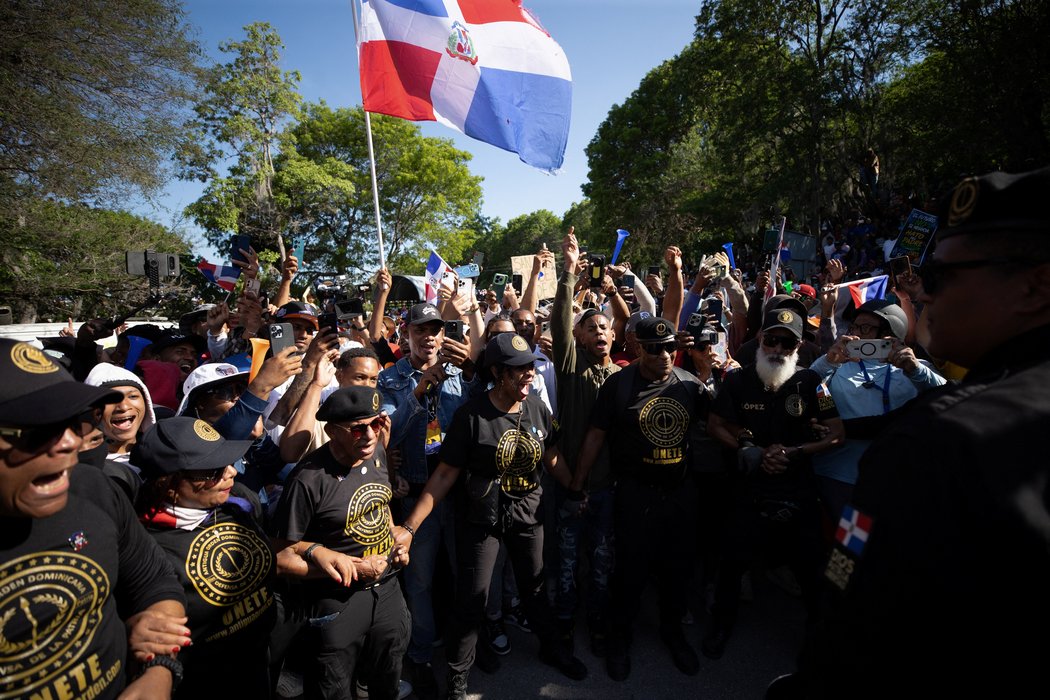
On 22nd May 2026, members of Reconoci.do, a civil society organisation defending the rights of people of Haitian descent, demonstrated outside the Presidential Palace in Santo Domingo under the slogan “We are not invisible: let us end statelessness” (“No somos invisibles: pongámosle fin a la apatridia”).
The organisation called on the government to fully implement Law 169-14, adopted in 2014 to address the nationality and documentation situation of people affected by previous restrictions on Dominican citizenship, restore or issue identity documents, reopen offices responsible for monitoring implementation and establish dialogue with affected communities. Reconoci.do also called for an end to arbitrary detention, racial profiling and expulsions of Dominicans of Haitian descent. The movement said it had documented more than 100 cases of Dominican-born people of Haitian descent who had been detained or expelled to Haiti.
Later that day, Ángelo Vázquez, a member of the Antigua Orden Dominicana (AOD), an ultranationalist group known for anti-Haitian mobilisation, announced a counter-mobilisation and broadly characterised the Reconoci.do demonstrators as Haitians, while arguing that migrants in an irregular situation should not participate in demonstrations. AOD subsequently demonstrated on 30th May 2026, reiterating its opposition to the earlier protest and calling for stricter migration policies.
Expression
New Penal Code retains risks for fundamental freedoms
On 27th July 2026, President Luis Abinader promulgated Law 44-26, amending 27 articles of the new Penal Code after sustained criticism from civil society over provisions affecting fundamental rights. The amendments came shortly before Law 74-25 was due to enter into force at the end of its one-year vacatio legis, the period between promulgation and entry into force. President Abinader had promulgated it on 3rd August 2025.
Civil society intensified calls to revise the Code during its one-year vacatio legis. Legal and press freedom organisations raised concerns about criminal defamation and other restrictions on expression, and submitted proposals addressing vaguely defined offences, sentencing, the criminal liability of legal persons and compatibility with constitutional and international human rights standards. Women’s rights organisations challenged provisions affecting reproductive rights, while LGBTI organisations challenged provisions relating to discrimination. By July 2026, civil society had filed at least 11 direct constitutional challenges against Law 74-25, several of which awaited judgment when Congress began considering amendments.
In early July 2026, the Chamber of Deputies, the lower house of the Congress, opened a process for receiving proposal amendments. On 8th July 2026, it referred three legislative initiatives to a bicameral commission. The proposals included extending the vacatio legis by six months and amending provisions on defamation, insult and other offences. On 10th July, President Abinader submitted his own package of amendments, which he said followed about five weeks of consultations with civil society representatives.
Congress then conducted a rapid parliamentary review. The bicameral commission formally began work on 14th July and completed its substantive review four days later, on 17th July 2026. The Chamber approved the resulting amendments in two readings on 18th and 20th July, and the Senate gave final approval on 22nd July. Although Congress received extensive written proposals, it held no formal public hearings and completed the parliamentary process in roughly two weeks. The compressed timetable provided limited opportunities for sustained public scrutiny of legislation that establishes criminal penalties and affects fundamental rights.
The amendments addressed some concerns relating to freedom of expression but left significant human rights concerns unresolved. For example, Articles 208 and 210 continue to criminalise defamation and insult and allow imprisonment as a penalty. Notably, article 208 provides for one to two years’ imprisonment, alongside a fine and possible complementary measures. The principal problem is the continuing use of imprisonment. The UN Human Rights Committee establishes in its General Comment No. 34 on Article 19: Freedoms of opinion and expression: states should consider decriminalising defamation, reserve criminal law for the most serious cases and never impose imprisonment as a penalty for defamation.
Article 275 introduces an important accountability safeguard by prohibiting police and military officers from preventing people from recording law enforcement operations, but it also restricts the subsequent publication of such recordings. It makes it an offence for a police or military officer to prevent a person from recording or filming an arrest, search or raid involving themselves or a third party, punishable by 15 days to one year’s imprisonment and a fine. The prohibition does not apply where the recording interferes with the officer’s work or endangers the officer.
However, Paragraph II permits publication only with the consent of the person subjected to the intervention. The provision does not distinguish between publication that unjustifiably interferes with an individual’s privacy and public interest publication, including material documenting excessive use of force, unlawful searches, deaths or serious injuries during arrest, or other alleged official misconduct. A categorical consent requirement could therefore restrict public interest reporting and the dissemination of evidence needed to document human rights violations and hold public officials accountable. In 2019, the IACHR stressed that freedom of expression protects the recording of police operations and the dissemination of incidents involving security forces in public contexts, highlighting their importance for gathering information and holding public authorities accountable.
The Code also raises concerns about freedom of peaceful assembly. Article 313 creates an aggravated form of “rebellion” when violent resistance to a public official occurs in the context of a meeting or demonstration. Under Article 312, “rebellion” consists of “violent resistance” against a public official who, in exercising their functions, is carrying out legal powers inherent to their office. The basic offence carries one to two years’ imprisonment and a fine. Article 313 provides that where the same offence occurs in connection with a meeting or demonstration or with the use of weapons, the penalty rises to five to ten years’ imprisonment, alongside a higher fine.
The provision therefore treats the context of a meeting or demonstration as an aggravating circumstance alongside the use of weapons, sharply increasing both the minimum and maximum prison sentence. Article 313 does not distinguish between different degrees of violent resistance or require additional harm resulting from the fact that the conduct occurred during an assembly. This raises concerns about the proportionality of the penalty and may have a chilling effect on participation in peaceful protests—including non-violent civil disobedience demonstrations—if authorities interpret or apply the concept of “violent resistance” broadly.
The provision does not criminalise peaceful assembly as such, nor does it expressly impose liability on organisers or other protesters for violence committed by somebody else. The concern is about individualisation and proportionality, particularly if the aggravating provision is interpreted broadly. The UN Human Rights Committee’s General Comment No. 37 draws a particularly important distinction between violence by an individual and the character of an assembly as a whole. This means that any application of Articles 312 and 313 should require evidence of the individual defendant’s own violent resistance, rather than relying merely on their presence at a protest or association with others who committed violence.
The new Penal Code also strengthens protection against some abuses of public authority by criminalising unlawful interference by public officials with the exercise of freedom of expression, association and assembly. It also expands provisions on femicide under Articles 93-96 and criminalises several forms of gender-based violence under Subsection III. However, one of the Code’s most serious human rights concerns is its near-total criminalisation of abortion under Section III.
On 5th August 2026, Law 44-26 entered into force, except for the provisions on criminal liability of legal persons, whose application was deferred for three months, until 5th November 2026.
Journalists assaulted by police and relatives during news coverage in Santo Domingo Este
On 6th March 2026, three women journalists reported attacks while covering the detention of a teacher accused of child abuse at the Mi Segundo Hogar education centre in Alma Rosa, a neighbourhood of Santo Domingo Este, the municipality immediately east of the capital. The journalists were Yesica Hernández of Red Nacional de Noticias (RNN), Ana Laura López of digital news outlet Último Minuto, and Yulisa Tavárez of AN7, all Dominican media outlets.
According to the Dominican College of Journalists (CDP), the country’s main professional association for journalists, and the Marcelino Vega movement, a journalists’ professional group, police officers used tear gas against the journalists, injured one of them and threatened them while carrying firearms. The organisations also alleged that relatives of the accused teacher assaulted members of the press and said police should have protected the journalists from the violence.
Press freedom organisations condemned the violence and called on the authorities to investigate the conduct of the officers involved and ensure journalists could work safely.
Journalist assaulted while covering court proceedings in Puerto Plata
On 28th July 2026, an unidentified man assaulted journalist and lawyer Gregorio Del Rosario and took his mobile phone while he covered a murder hearing at the Palace of Justice, the main courthouse complex in Puerto Plata, a city on the northern coast. According to media reports, video footage showed the man striking Del Rosario and taking the phone he was using to document the scene. The attack occurred amid tensions after relatives of the murder victim reportedly attempted to confront the defendants as authorities brought them to court.
The Puerto Plata branches of the National Union of Press Workers (SNTP), a journalists’ trade union, and the CDP condemned the attack. They called on prosecutors and police to identify and prosecute those responsible, recover Del Rosario’s phone and strengthen security for journalists covering court proceedings.
Association
Migrant rights defender in exile
On 13th June 2026, Roudy Joseph, an activist with HaitianosRD, a migrant rights organisation working with Haitian communities in the Dominican Republic, declared that migrant rights defenders faced threats, hate speech, public stigmatisation and criminalisation. By April 2026, Amnesty International reported that Joseph was living in Spain under a protection programme for human rights defenders after experiencing threats, harassment and stigmatisation by Dominican ultranationalist groups because of his work. In December 2024, four UN Special Procedures had previously raised concerns over alleged intimidation and attacks affecting organisations and defenders working with Haitian migrants and Dominicans of Haitian descent.