General
Amnesty International warns of severe human rights regression under President Javier Milei’s first year in office
In early December 2024, on the first anniversary of President Javier Milei’s administration, Amnesty International released a report titled “12 months of government, 12 rights lost”, documenting a sharp deterioration in human rights in Argentina throughout 2024. The report identified serious setbacks across twelve key areas, driven by austerity measures and structural reforms that have deepened inequality and curtailed fundamental freedoms.
According to Amnesty International, poverty increased from 41.7 per cent to 52.9 per cent, leaving over 15 million people below the poverty line and more than a million children without access to a daily meal. Older people were particularly affected, as minimum pensions no longer cover basic needs, a situation worsened by the presidential veto of the pension adjustment law. The organisation further highlighted an increasingly hostile environment for journalists, marked by intimidation, disinformation, and gendered online violence against women reporters.
The report further warned that the right to peaceful assembly is under serious threat due to the enforcement of the National Security Protocol on Public Order and repeated instances of excessive use of force, including rubber bullets and tear gas. Amnesty documented arbitrary detentions, criminalisation of protesters, and assaults on accredited journalists. Additional concerns include the creation of an Artificial Intelligence Unit within the Ministry of Security, raising fears of mass surveillance and discriminatory profiling.
Amnesty International also highlighted regressions in gender equality, reproductive rights, and protections for women and LGBTQI+ persons, alongside inadequate climate and territorial policies that have left Indigenous communities increasingly vulnerable.
Civil society condemns Argentina’s withdrawal from COP29 as a major setback for environmental policy
On 20th November 2024, over 70 civil society organisations denounced the Argentine government’s decision to withdraw its official delegation from the 29th United Nations Climate Change Conference (COP29), held in Baku, Azerbaijan, in November 2024. The organisations warned that abandoning international climate negotiations represents a serious regression in Argentina’s environmental and climate policy, undermining decades of participation since the country joined the UN Framework Convention on Climate Change in 1992.
The organisations urged the government to reverse the measure and reaffirm its commitment to multilateral climate action, warning that disengagement from global climate governance threatens both Argentina’s credibility and its capacity to implement effective domestic adaptation and mitigation policies.
Association
Crackdown on Mapuche communities, and volunteer firefighter arbitrarily detained
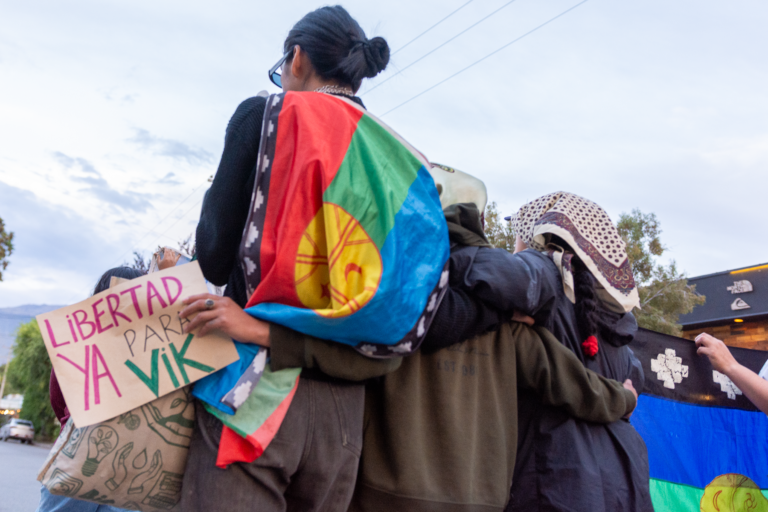
On 11th February 2025, police forces conducted coordinated raids across Mapuche Indigenous territories in Chubut Province, targeting Lof Pillan Mawiza, Lof Cañio, Lof Catriman Colihueque, Lof Nahuelpan, and the Petü Mogeleiñ Community Radio in El Maitén. The operations took place as wildfires ravaged Patagonia, destroying over 35,000 hectares across three provinces.
The raids, authorised by a local judge and prosecutor, led to the arbitrary detention of Mapuche activist Victoria Núñez Fernández, later placed under house arrest after her defence presented evidence proving she was far from the alleged arson site. Communities reported violent police incursions, confiscation of communication equipment, and isolation from external contact. At the time of writing, Núñez remains in custody.
According to the independent media outlet Agencia Presentes, the actions followed a press conference in Esquel where Governor Ignacio Torres, alongside provincial and local officials, accused Mapuche-Tehuelche community members of being “criminals” and “frauds” allegedly responsible for the wildfires. On 13th February 2025, the Ministry of Security issued Resolution 210/2025, declaring the Resistencia Ancestral Mapuche (RAM) a terrorist organisation and listing it in the Public Registry of Persons and Entities Linked to Acts of Terrorism and their Financing (RePET). The Ministry claimed the group, allegedly linked to Chile’s Coordinadora Arauco-Malleco (CAM), posed a “serious threat to national security” due to its alleged involvement in arson and violent acts in southern Argentina.
Mapuche leaders, including Moira Millán of Lof Pillan Mawiza, rejected any link to the RAM and announced legal action against Governor Torres for defamation and racist remarks. The Network for the Accompaniment of Indigenous Peoples (RAPI) and other organisations condemned the government’s narrative, warning that it fuels hate speech and legitimises disproportionate police operations. Mapuche representatives stated that the government’s campaign aims to erode Indigenous solidarity and suppress community resistance to environmental degradation and land dispossession. Cultural Survival further denounced that state authorities were using the wildfires to criminalise Indigenous movements, portraying them as “terrorists of fire.”
In a separate incident, on 5th February 2025, volunteer firefighter Nicolás Heredia was arbitrarily detained while assisting efforts to contain wildfires in Mallín Ahogado, Río Negro Province. Although others arrested with him were released within hours, Heredia was charged with “attempted arson” and placed in preventive detention for 30 days by a judge. Six days later, another judge upheld the decision on appeal, despite the lack of objective justification.
The Centre for Legal and Social Studies (CELS) described this decision as arbitrary and disproportionate, noting the absence of direct evidence. It also denounced that Heredia’s detention forms part of a wider pattern of criminalisation affecting Indigenous communities and environmental defenders in Patagonia: “Amid an erratic and insufficient state response to wildfires, residents and volunteers have taken the lead in firefighting and recovery efforts”. CELS warned that the criminalisation of volunteers discourages civic engagement, fosters mistrust in institutions, and hampers collective action against the fires.
We demand an immediate end to the raids and the criminalization and persecution of the Mapuche People in Argentina, as well as the release of, and charges dropped against, Victoria Fernández Núñez, who was unjustly detained.@MaryLawlorhrds https://t.co/zgG0nWSi5B
— Cultural Survival (@CSORG) February 12, 2025
Security Minister vilifies Amnesty International
On 14th January 2025, Minister of Security Patricia Bullrich publicly vilified Amnesty International following the organisation’s report condemning the excessive use of force during protests under the government’s new security protocol. Bullrich accused Amnesty of “defending criminals” and “lecturing from London” while “ignoring human rights violations in Venezuela”. In posts on social media, she asserted that Argentina is a “liberal democracy” threatened by “mafia-style protests”, claiming that her security protocol had “returned the streets to decent Argentinians”.
Amnistía Internacional no tiene vergüenza, y mientras se violan sistemáticamente los derechos humanos en Venezuela, decide criticar a una democracia liberal como lo es la Argentina.
— Patricia Bullrich (@PatoBullrich) January 13, 2025
Desde sus sillones cómodos en Londres, vienen a darnos lecciones mientras acá bancamos 25 años de… pic.twitter.com/wtybyww2Kg
IACHR warns of setbacks in protection of Indigenous people’s land and self-determination rights
On 4th December 2024, the Inter-American Commission on Human Rights (IACHR) expressed concern over recent administrative decisions by the Argentine government that could undermine Indigenous people’s rights to land, territory, natural resources, and self-determination.
The warning followed the decision by the National Institute of Indigenous Affairs (INAI) to suspend applications for legal personality of Indigenous communities pending in the National Registry of Indigenous Communities (RENACI) and to encourage local governments to create their own registries. The measure, adopted without consultation in September 2024, could affect at least 250 of Argentina’s 1,881 officially recognised Indigenous communities, nearly half of which have not yet completed the territorial mapping process required for land titling.
The IACHR noted that this suspension takes place amid broader setbacks in the recognition of Indigenous territorial rights and reports of forced evictions in provinces such as Jujuy, Río Negro and Chubut, despite the ongoing validity of the Territorial Emergency Law, which prohibits evictions until November 2025. These operations have reportedly been accompanied by institutional violence and the stigmatisation of Indigenous leaders, including the killing of Mapuche community member Juan Carlos Villa by a security officer in Río Negro on 11th August 2024. The state reported that the officer involved has been dismissed and is under judicial investigation.
The Commission also condemned public statements by national authorities that insult Indigenous cultural and spiritual rights. It recalled that, under inter-American standards, Indigenous peoples have the right to self-determination, collective legal recognition, and the protection of their ancestral lands and resources. The IACHR urged Argentina to adopt effective administrative mechanisms to safeguard these rights.
Lesbian activist acquitted after two-year criminalisation for graffiti demanding justice for missing trans man
On 31st October 2024, lesbian activist Pierina Nochetti reached an agreement with the Municipality of Necochea that led to her full acquittal and the closure of the criminal case against her. The municipality also agreed to reinstate her employment and salary. Nochetti, a well-known LGBTQI+ rights defender and organiser of Necochea’s Pride Parade, had faced prosecution since February 2022 on charges of “aggravated damage” for allegedly painting a graffiti reading “Where is Tehuel?” on a municipal amphitheatre. The slogan referred to Tehuel de la Torre, a young transgender man who disappeared in March 2021 while on his way to a job interview, a case that remains unsolved and emblematic of the violence faced by trans people in Argentina.
Civil society organisations, including CELS, the Network of LGBTI Litigants of the Americas, filed amicus curiae briefs arguing that Pierina’s prosecution represented an act of criminalisation of peaceful protest and LGBTQI+ activism. They stressed that her case violated the rights to freedom of expression, peaceful assembly, and the defence of human rights. The trial, repeatedly postponed by the judiciary, had disrupted Pierina’s personal and professional life for nearly two years.
Peaceful Assembly
Indigenous communities in Jujuy protest environmental damage by mining company amid threats of eviction
On 22nd November 2024, a dozen members from Indigenous communities in Susques, Jujuy, held a protest against the Marcilese mining company, accusing it of contaminating local rivers and violating environmental impact procedures at the Loma Blanca borate site. Community members from Río Grande de Coranzulí demanded accountability and free, prior and informed consent, warning that their health, livestock and environment were at risk.
Provincial authorities deployed police units near the protest site and reportedly threatened eviction, prompting fears of repression similar to the 2023 Purmamarca crackdown. Despite isolation and communication blockages, dozens of protesters vowed to continue their peaceful action, denouncing intimidation and extractivist policies that disregard Indigenous rights and environmental protections.
Las comunidades aseguraban que realizan la medida por temor a más contaminación, leer:https://t.co/GmMneWdcfY pic.twitter.com/N9CgTC9EzA
— ANRed #30Años (@Red__Accion) November 22, 2024
Mass Anti-fascist and Anti-racist Pride March condemns Milei’s LGBTQIphobic remarks at Davos
On 1st February 2025, thousands of people took to the streets in more than 60 cities across Argentina to protest against President Javier Milei’s statements at the World Economic Forum in Davos in January 2025. Protesters called attention to ongoing attacks against women and LGBTQI+ communities, after Milei criticised gender policies and drew an offensive link between same-sex marriage and paedophilia.
The march aimed to defend and promote human rights, demanding equality and an end to discrimination. “Today we march to say enough, to say that this is as far as it goes. Words matter, and hate speech has real consequences. We are never going back into the closet. We refuse to let gender identity or sexual orientation be pathologised again”, said Andy Panziera, psychologist with the Women, Gender and Diversity Secretariat of Santa Fe Province, and trans activist.
Mass protests in Patagonia over government response to devastating wildfires
On 13th February 2025, thousands of residents across Patagonia demonstrated in the provinces of Río Negro, Chubut and Neuquén, demanding government action to combat the region’s worst wildfires in three decades. Marches took place simultaneously in several cities to denounce inadequate fire management at both provincial and national levels. Protesters criticised Security Minister Patricia Bullrich for prioritising the criminal investigation of suspects over protecting affected communities and ecosystems.
The demonstrations occurred amid tensions following the raids and arbitrary detention of Mapuche activist Victoria Núñez Fernández (see association). Civil society expressed concern that the authorities’ focus on criminalisation risks diverting attention from systemic environmental failures and the broader climate emergency affecting southern Argentina.
According to Greenpeace, more than 37,000 hectares of Andean-Patagonian forest and residential areas have been destroyed, including parts of the Lanín and Nahuel Huapi National Parks. The organisation described the situation as an “ecocide”, warning that forest recovery could take centuries and urging authorities to strengthen prevention, firefighting infrastructure and rapid response capacity.
Social movements march in Buenos Aires demanding wage increases and food assistance
On 22nd November 2024, hundreds of protesters from labour rights and grassroots social movements, including the Polo Obrero and the Unidad Piquetera coalition, marched through central Buenos Aires demanding higher wages and greater food support for community kitchens. The demonstration began outside the Ministry of Social Development and moved along de Julio Avenue to the Ministry of Labour, where the National Wage Council was meeting to discuss adjustments to the minimum wage. The mobilisation caused major traffic disruptions across the capital.
Protesters demanded that the minimum wage be raised to match the poverty line, which unions estimate at 140,000 pesos, and denounced the government’s austerity measures amid record inflation and rising food insecurity. Movement leaders called on national trade unions to stage a general strike, arguing that wage stagnation and budget cuts were worsening living conditions for low-income and informal workers. The demonstrations reflect growing frustration with the government’s fiscal adjustment policies under President Javier Milei.
Nationwide blackout protest denounces Milei’s “tarifazo” as households rally against soaring utility prices
On 31st October 2024, households, businesses and institutions across Argentina participated in a ten-minute “National Blackout against the Tarifazo” to protest steep increases in electricity, gas and water tariffs under President Javier Milei’s administration. The coordinated action, organised by the Multisectoral Forum against Tariff Hikes, with support from the Buenos Aires provincial government, trade unions, small business associations and social organisations, called on citizens to turn off their lights between 21:00 and 21:10 hours in a symbolic protest against the government’s austerity programme led by Economy Minister Luis Caputo.
Participants shared images of darkened homes across provinces, including Buenos Aires, Mendoza and Chubut, while the hashtag #ApagónNacional trended nationally on social media. The organisers warned that tariff increases had far outpaced inflation, disproportionately affecting low- and middle-income households. According to media reports, electricity prices in Greater Buenos Aires rose by up to 758 per cent between November 2023 and October 2024, while average wages grew by less than 154 per cent. Gas tariffs increased between 164 and 225 per cent, hitting lower-income groups hardest.
Provincial Infrastructure Minister Gabriel Katopodis defended the initiative as a response to “an endless adjustment that is crushing workers, pensioners, and small businesses”.
Hoy, de 21 a 21:10hs, #ApagónNacional.
— Gabriel Katopodis (@gkatopodis) October 31, 2024
Apoyemos esta iniciativa del Foro Multisectorial contra los Tarifazos. El ajuste infinito de Milei y Caputo está golpeando a la clase media, a los jubilados, las pequeñas y medianas empresas, a los comercios y a los clubes de barrio.
El… pic.twitter.com/1qzC9ibp5g
Federal judge acquits 11 protesters detained against the Law for Bases protests
On 8th November 2024, a federal judge acquitted 11 of the 33 people detained during the 12th June 2024 protests against the government’s Law for Bases reform package, ruling that video evidence clearly showed no criminal conduct. The judge noted that the footage, available since the day of the protest, confirmed that many detainees were peacefully demonstrating or simply working nearby when they were arbitrarily detained, beaten and interrogated about their political views. 17 people remain awaiting a similar ruling, and five face minor charges pending oral trial.
The prosecution had requested pre-trial detention for all 33, accusing them of “inciting collective violence” and threatening constitutional order, but presented no credible evidence beyond media links and government statements describing demonstrators as “terrorists”.
As previously reported by the CIVICUS Monitor, the protests had been violently repressed by police using tear gas, rubber bullets and water cannon, followed by mass detentions.
Expression
Police raids target Mapuche communities and community radio
On 11th February 2025, multiple police raids were carried out across Mapuche communities in Chubut Province, including the Petü Mogeleiñ Community Radio in El Maitén, as authorities sought to link Indigenous organisations to the wildfires that had been burning for days across Patagonia (see association).
Community leader Mauro Millán, a Mapuche activist and member of the raided radio station, denounced the raids as an attempt to deflect attention from the state’s failure to control the fires, calling the accusations “a strategy to stigmatise and criminalise Indigenous peoples”. He reported that several homes, Mapuche community centres, including Lof Catrimán, Lof Cañio, and Lof Nahuelpan, and the radio station were raided simultaneously, with police seizing computers and documents.
Another broadcaster, Federico, said police broke locks and searched the premises while no one was present, allegedly looking for “Molotov cocktails and grenades” in connection with arson cases in Esquel.
Media collectives such as Red Enfoques and the Argentine Forum of Community Radios (Foro Argentino de Radios Comunitarias, FARCO) condemned the raids as arbitrary and politically motivated, warning that the operations aim to intimidate journalists and Mapuche-Tehuelche communities and to construct a criminal narrative blaming them for the fires.
Journalist injured by police projectile while covering protest
On 31st January 2025, journalist Rodrigo Solórzano, owner of the digital outlet Semanario Actualidad in Moreno and General Rodríguez, was struck in the face by a stone thrown by a member of the Buenos Aires provincial police while covering a demonstration in Moreno.
According to eyewitness accounts and video footage, police officers from the Buenos Aires provincial force responded to projectiles thrown by some protesters by hurling stones back into the crowd. One of the stones struck journalist Solórzano on the nose, causing bleeding and swelling. Despite the injury, Solórzano continued reporting from the scene and later interviewed the provincial security minister, who made no mention of the incident during the exchange. The journalist filed a formal complaint with the Moreno Public Prosecutor’s Office.
Journalist and his wife assaulted outside their home in Misiones
On 15th January 2025, journalist Enrique Ortiz, a correspondent for Crónica TV, was physically assaulted outside his home in Misiones by lawyer Gustavo Maldonado, who is reportedly implicated in several cases involving forged property titles and land disputes in the province. The attacker punched, kicked, and insulted Ortiz and threatened his wife, who recorded the incident on video.
The journalist linked the assault to previous threats and to local land disputes involving the Chipul family and the killing of Rufino Blanco, a case in which individuals allegedly connected to lawyer Maldonado were implicated. Ortiz stated that Maldonado had previously threatened him.
Photographer and journalist attacked by football players and fans during match in Trelew
On 24th November 2024, photographer Sergio Esparza and journalist Leo Lugo, both working for Diario Jornada in Trelew, were attacked by players and supporters of Club La Ribera while covering a Liga del Valle football match. Several members of the press were threatened, and equipment was damaged during the assault.
According to reports, Esparza was attacked while photographing a confrontation between players and police. Despite being threatened to stop taking pictures, he continued working and was dragged and injured on his left hand. His camera was damaged, but he managed to recover the images, which were later submitted as evidence in a criminal complaint. Meanwhile, Lugo was pelted with stones and threatened by both players and fans while filming the altercation, forcing him to stop recording.
President Milei publicly vilifies journalists
On 22nd January 2025, President Javier Milei publicly insulted Luisa Corradini, La Nación’s Europe correspondent, calling her a “serial liar” and a “political operative” via social media, in reaction to her reporting on Argentina’s participation in the World Economic Forum in Davos. The next day, he amplified a post from Santiago Oría, presidential publicist and Director of Audiovisual Productions at the Office of the President, who had called the journalist a “lying piece of trash”, adding his own comment repeating the insults.
In a separate incident, on 26th January 2025, Oría insulted financial journalist Mariano Gorodisch (El Cronista) on X, calling him a “liar” and a “pathetic political operative” after the journalist shared a post showing low tourism levels in Pinamar in late December. Shortly after, President Milei amplified the message, reposting Oría’s message and referring to Gorodisch as a “cheap operative” and “disgraceful slob”. The President’s remarks appeared to be a reaction to Gorodisch’s 28th December 2024 tweet, which included a video showing empty beaches and suggested a slow start to the summer season.
Journalist in Entre Ríos intimidated after reporting on poor living conditions
On 12th December 2024, a journalist from Entre Ríos Province was subjected to intimidation by local government officials after publishing a story exposing poor living conditions in her municipality. Shortly after the article’s release, she received a phone call informing her that her outlet’s state advertising would be suspended and that all official contracts were “under review”.
When she inquired further, another official told her that the decision was due to her article “not being innocent”. After the journalist warned she would make the situation public, the official asked her not to do so. The following day, a senior official contacted her again to confirm that the advertising funds would be restored.
Journalist receives death threat during live radio broadcast
On 13th November 2024, journalist Alexis Miranda received an anonymous threat via Instagram, warning of physical harm in retaliation for his journalistic work. The message was sent while Miranda was broadcasting his programme on FM Cadena Infinito.
Miranda filed a complaint with the Public Prosecutor’s Office, and an investigation is under way to determine the source of the threat. He stated that he could not link the message to any specific topic he had reported on, but it explicitly warned of an attack if he was seen in public.
Legislator in Córdoba accuses journalists of being “media hitmen”
On 27th November 2024, during a legislative session in Córdoba, legislator Gregorio Hernández Maqueda of the Mejor Futuro bloc accused local journalists of maintaining ties with the government of Governor Martín Llaryora, referring to them as “media hitmen” and labelling one reporter directly as a “sicario” (hitman).
The incident adds to growing concerns about the normalisation of verbal attacks and discrediting of journalists by public officials in Argentina.
Journalist faces judicial harassment
On 8th November 2024, journalist Alejandro Alfie of the newspaper Clarín reported that he is facing a civil defamation lawsuit filed by libertarian figure Esteban Glavinich, who is seeking 20 million Argentine pesos in damages for alleged harm to his reputation. Glavinich is known as one of the main figures behind a sustained online harassment campaign targeting Alfie over his reporting.
According to the Argentine Journalism Forum (FOPEA), over the past three months, President Javier Milei has amplified ten of Glavinich’s attacks against the journalist on social media, five of which originated directly from Glavinich’s account.
Journalists harassed after reporting on alleged corruption in Tucumán
On 6th November 2024, journalists Roque Galeano and Martín Faciano from El Avispero (Canal 10), along with columnist Mauricio Formoso, director of Enterate Noticias, reported that they had been subjected to digital harassment in recent weeks following their reporting on alleged corruption within the Tucumán Court of Accounts.
According to their statements, the Tucumán Court of Accounts initiated administrative proceedings against Faciano and Formoso, citing their status as public employees in unrelated positions, an action the journalists consider retaliation for their investigative reporting and opinions expressed on air. They also reported that personal information was disseminated online and that they were photographed outside their studio, allegedly by individuals including a relative of the Court’s president.
Journalist dismissed and harassed over critical reporting in Santa Cruz Province
On 3rd November 2024, journalist Mariano Tagliotti, owner of Primicias Santa Cruz and host of FM Federal, was dismissed from his non-journalistic job at the state-owned company Distrigas after expressing critical opinions in his reporting. According to Tagliotti, the company’s president, Marcelo de la Torre, informed him that he was being dismissed for his “ideological positions”.
According to FOPEA, the dismissal followed a campaign of online harassment, including insults posted by Vice-Governor Fabián Leguizamón and later amplified by the official account of the Santa Cruz provincial legislature.
Report finds growing barriers to public information following Decree 780/2024
On 27th February 2025, the civil society organisation Poder Ciudadano released the first report of the Public Access to Information Laboratory, analysing the state of the right to access public information in Argentina following the enactment of Decree 780/2024.
The study, based on 63 information requests submitted to ministries and state-owned companies between September 2024 and February 2025, revealed systemic delays, formal obstacles and arbitrary denials. Only 40 per cent of the requests were answered within the legal deadlines, while 81 per cent were subject to extensions, often without justification. In half of the cases, agencies failed to redirect misfiled requests to the competent authority, and 21 requests received no response.
Authorities imposed additional formalities in 14 per cent of the requests, contravening the principle of informalism established under Law 27.275/2016. Of six cases in which exemptions were invoked, only one complied with legal requirements, and none included the mandatory harm or public-interest tests.
The findings reveal a growing gap between legal obligations and administrative practice, suggesting that Decree 780/2024 has had a restrictive effect on transparency and accountability. The report calls on the government to revise the decree, regulate the use of extensions, strengthen the Agency for Access to Public Information, and align national practices with international human rights standards recognising access to information as a fundamental right.
Press freedom faces sharp decline in first year of Milei administration
In the first year of President Javier Milei’s administration, Argentine journalism faced 173 attacks, according to FOPEA. The most frequent forms of aggression were harassment and digital violence, averaging one attack every two days. FOPEA reported that 81 per cent of incidents involved state officials or people linked to government structures, with Milei himself responsible for 56 cases of public stigmatisation and verbal attacks.
Nearly half of the incidents involved public vilification (44 per cent), while a quarter were physical assaults. FOPEA warned that Milei’s rhetoric has been increasingly hostile toward journalists, fostering a climate of intimidation and self-censorship. The organisation also noted restrictions on access to information, including amendments to transparency laws, limits on press access, and the absence of regular press conferences.
On 10th December 2024, Reporters Without Borders (RSF) echoed these concerns, documenting 12 physical assaults, some by security forces, after the introduction of a protest-control protocol by Security Minister Patricia Bullrich. RSF warned that Argentina has seen a severe deterioration in media freedom, marked by the rollback of legal safeguards and increasing media concentration following the lifting of broadcasting limits.
RSF and FOPEA both cautioned that the combination of hostile rhetoric, legal intimidation and state interference represents a systemic assault on press freedom, undermining democratic accountability and public access to information.
RSF is on high alert over the growing threats to journalism in Argentina since President Javier Milei took office. In addition to an extremely aggressive and unacceptable rhetoric, the head of state and public authorities have encouraged media concentration and curtailed pluralism and diversity, disproportionately affecting the most vulnerable outlets. This combination of hostile discourse, physical violence, and judicial and online harassment demonstrates a serious deterioration in press freedom. It is imperative that this offensive comes to an end and that the Argentine government respect and guarantee the exercise of journalism in the country
- Artur Romeu, RSF’s Latin America Director