This update covers developments relating to the freedoms of expression, association and assembly in the United States of America from 1st October to 31st December 2025.
General
In December 2025, the CIVICUS Monitor downgraded the United States from “narrowed” to “obstructed” in its civic space rating, reflecting a sharp deterioration of fundamental freedoms in the country, and the complex landscape for civil society actors in the wake of President Donald Trump’s first year of his second term.
Voting rights threatened and the fight for representation
In an important legal win on 31st October 2025, a federal court blocked the implementation of an element from Trump’s Executive Order on “Preserving and Protecting the Integrity of American Elections” requiring that the Election Assistance Commission necessitate that voters show their passport or other documents proving their citizenship when registering to vote. This move would disenfranchise American voters, predominantly women and people of colour. The court found that the president does not have the authority to single-handedly change election processes and procedures.
In November 2025, local and state elections took place with high voter turnout and Democratic wins in New Jersey, Virginia, and New York City. The mayoral race in NYC garnered significant attention as the mayor-elect, Zohran Mamdani, ran on a progressive platform with a focus on accessibility and economic sustainability, mobilising Democratic voters across the boroughs. The New Jersey and Virginia gubernatorial races ended in victory for Democrats Mikie Sherrill and Abigail Spanberger, respectively, with Sherrill serving as the first woman in this position.
In early December 2025, the Supreme Court ordered Texas to utilize a voting map in the upcoming 2026 midterm elections that a lower court had deemed as gerrymandered. The use of the redrawn state’s congressional map will mean Black and Latino communities will have their electoral power stripped. There have been redistricting efforts targeting communities of colour in multiple states, including North Dakota and Louisiana, though Indigenous and Black voters have pushed back through legal means to ensure that Section 2 of the Voting Rights Act, which prohibits discrimination on the basis of race in voting procedures, is protected. The high court is reviewing these cases, including Spirit Lake Tribe et al. v. Jaeger and Louisiana v. Callais.
Defiance of International Law intensifies
Since September 2025, the Trump administration has targeted cartels by way of Foreign Terrorist Organisation (FTO) designations and strikes on Venezuelan vessels allegedly carrying designated organised crime groups and drug shipments. This conflation of counter-terrorism and counter-narcotics frameworks has created challenging operating spaces for civil society organisations in the immigration and human rights space. It has also been the basis for human rights violations in international waters, with the US carrying out strikes on 26 vessels and targeted killing of civilians in the Caribbean in 2025. UN experts and human rights organisations have stated that these actions amount to “extrajudicial executions” and have called for investigations into the use of force by the US. The administration has continued to make statements suggesting unwarranted military operations in Latin America and the Caribbean due to the threat of “narcoterrorism.”
Association
Terrorism designations expand further
On 13th November 2025, the Department of State announced the designations of four Antifa-related organisations based in Germany, Italy, and Greece. This is the latest in the administration’s targeted attacks on Antifa as an ideology and amorphous organisation and follows the designation of Antifa as a “domestic terrorist organisation” in September 2025, which has no legal authority. This designation was documented by the CIVICUS Monitor in the previous update.
The implications for organisations working domestically with any ties to the mission or priorities of the designated groups may be significant. These FTO designations prevent organisations from accessing resources needed for operations and pave the way for material support allegations to be made against domestic groups, linking foreign entities to domestic ones. This allows the government to utilise legal frameworks traditionally targeting foreign adversaries on US citizens, threatening their civil liberties.
On 24th November 2025, President Trump issued an executive order that began the process of designating the Muslim Brotherhood as a Foreign Terrorist Organisation (FTO) and Specially Designated Global Terrorist (SDGT). US persons are prohibited from engaging in any financial transaction with listed organisations or providing them with material support. There have been Executive and Congressional efforts to make this designation in previous years and nonprofit organisations have expressed concerns around this, including through a letter signed by over 80 groups in 2017, noting the reputational, economic, and operational implications for Muslim and Arab charities, activists, and nonprofits.
This is the latest in an unconventionally long list of FTO designations that includes international cartels and unstructured ideological organisations.
C&SN is concerned by the State Department's decision to designate Europe-based orgs. alleged to be "Antifa" as Foreign Terrorist Organizations (FTO) -- a move which continues the proliferation of FTO designations by the Trump administration. 👇 bit.ly/4o0DNjc
— Charity & Security Network (@charitysecurity.bsky.social) Nov 18, 2025 at 1:19 AM
[image or embed]
Civil society organisations under attack
The 119th US Congress initiated at least 88 investigations into nonprofit organisations as of the end of 2025 by way of letters, reports, and subpoenas, with a few notable examples below:
- On 7th October 2025, the US House Committee on Ways and Means sent a letter to the Internal Revenue Service (IRS), calling for the agency to examine and revoke the 501(c)(3) tax-exempt status of multiple US-based nonprofit organisations. The Committee claimed that the organisations are suspected of supporting terrorist activity. This was the second iteration of letters sent, the first in 2024, citing efforts to link protests for Palestine to terrorist organisations. This expands on the government’s attempt to draw connections between activists and terror groups on the basis of First Amendment-protected activities, such as protests for Palestine, and to criminalise individuals and organisations.
- On 6th November 2025, House Judiciary Committee Chairman and Subcommittee on the Constitution and Limited Government Chairman sent letters to Open Society Foundations (OSF) and Alliance for Global Justice (AFGJ), two major philanthropic entities, requesting internal documents pertaining to their alleged “financial support for organisations connected to Antifa.” The letters named environmental and anti-fascist organisations funded by the prominent donors, associating their work with terrorism and violence. Prior to these latest targeted investigations, Congress sent letters to over 200 organisations, working primarily on immigration issues, probing their use of federal funds and services to immigrant communities.
- On 20th November 2025, Congressional members sent Attorney General (AG) Pam Bondi a letter raising concerns about claims that the People’s Republic of China (CPP) was influencing US environmental policy through its support of nonprofit organisations carrying out climate advocacy. Two weeks later, on 12th December, lawmakers also called for a look into potential interference by the CPP into New York state, noting alleged violations of the Foreign Agents Registration Act (FARA).
- On 25th November 2025, the House Judiciary Committee sent a letter to the AG calling for an investigation into the Biden Administration’s alleged “weaponisation of federal law-enforcement” and the Department of Justice’s collaboration with the Southern Poverty Law Centre (SPLC), a leading civil rights organisation.
We are standing firm in the face of any challenges.
— Open Society Foundations (@OpenSociety) November 19, 2025
Our work in the United States is dedicated to strengthening democracy and upholding constitutional freedoms. We stand by the work we do to improve lives in the United States and across the world. Our activities are peaceful… pic.twitter.com/gpiuEowFiZ
Roadmap to suppression of dissent revealed as civil society responds
In early October 2025, following the issuance of National Security Presidential Memo-7 (NSPM-7) that established the administration’s priority of addressing domestic terrorism and organised political violence allegedly carried out by progressive organisations, included in the previous update from the CIVICUS Monitor, over 3,700 organisations signed onto a letter condemning the administration and its string of attacks on nonprofit organisations over the course of the year. US civil society demonstrated a coordinated response to the latest threat.
On 8th December 2025, independent investigative journalist Ken Klippenstein leaked a memo from AG Pam Bondi sent on 4th December 2025. The subject of the memo was “Implementing National Security Presidential Memorandum-7: Countering Domestic Terrorism and Organised Political Violence” and outlined the approach, priorities, and timeline for how the administration would execute NSPM-7. It clarifies that opponents of the administration are broad in scope and that those with progressive views on immigration and gender, or who hold “anti-American, anti-capitalist or anti-Christian” perspectives, may be targeted if named on a domestic terrorist list set to come out on 4th January 2026, creating a chilling effect on nonprofit organisations, activists, advocates, and individuals.
Nonprofit killer bill resurfaces in Congress
On 17th December 2025, the latest version of the legislation commonly known as the “nonprofit killer bill” was reintroduced in both the House (H.R.6800) and Senate (S.3554). These bills would give broad discretion to the Secretary of Treasury to label a nonprofit as a “terrorist-supporting organisation” and in turn revoke their tax-exempt status without meaningful due process.
The first iteration was introduced by the 118th Congress in November 2023 and passed in the House in April 2024 before stalling in the Senate. H.R.9495 was then introduced in the House that September with harmful language from the previous bill, leading a coalition of 354 civil society organisations to mobilise and write a letter to the House of Representatives opposing it.
The same language has emerged throughout 2025, including in the “One Big Beautiful Bill,” but nonprofits have worked to have it removed and continue to oppose it and urge legislators to consider the ways such legislation can be abused by the Executive Branch. This continued advocacy has prevented momentum, however, it will be important to monitor the bill’s movement through both Chambers
Immigration as a tool to punish dissent
On 23rd December 2025, the US Department of State imposed visa bans on five Europeans leading campaigns to combat misinformation and hate online. Those affected are Thierry Breton, former EU Commissioner; Imran Ahmed, chief executive of the Centre for Countering Digital Hate; Clare Melford, head of the UK-based Global Disinformation Index; and Anna-Lena von Hodenberg and Josephine Ballon, leaders of the German civil society organisation HateAid.
US Secretary of State Marco Rubio announced the measure under a visa policy adopted in May 2025, which authorises entry restrictions on foreign nationals accused of “censoring Americans”. In a public statement, Rubio described the individuals and organisations concerned as “radical” and alleged that they operated as “weaponised” non-governmental organisations. He asserted that their work advanced foreign government censorship campaigns targeting Americans and US-based companies, which he said posed “potentially serious adverse foreign policy consequences” for the US.
The decision triggered strong reactions in Europe. French President Emmanuel Macron condemned the visa bans as acts of intimidation that undermine European sovereignty and emphasised that the Digital Services Act (DSA), developed during Breton’s tenure as EU Commissioner, was adopted through a democratic legislative process. France’s foreign minister similarly rejected any claim that the DSA or related initiatives exert extraterritorial control over speech outside the European Union.
Separately, on 12th December 2025, new rules issued by the Department of Homeland Security require foreign nationals from countries participating in the Visa Waiver Program, which allows short-term travel to the US without a visa, to submit five years of social media activity and additional personal information for screening prior to entry. US Customs and Border Protection (CBP) stated that the mandatory disclosure aims “to protect its citizens from aliens who intend to commit terrorist attacks, threaten our national security, espouse hateful ideology, or otherwise exploit the immigration laws for malevolent purposes.” Authorities have not defined what types of online activity would constitute a security threat, and experts have noted the absence of clear criteria or safeguards governing the assessment process.
Building on President Trump’s June 4th Proclamation, on 16th December 2025, the White House issued a Fact Sheet entitled “President Donald J. Trump Further Restricts and Limits the Entry of Foreign Nationals to Protect the Security of the United States,” noting changes from the outputs from the summer. This includes placing “full restrictions and entry limitations” on Burkina Faso, Mali, Niger, South Sudan, and Syria, and adding the same to “individuals holding Palestinian-Authority-issued travel documents.” Such curtailments prevent the engagement of individuals from these regions in advocacy and civic space.
US sharply cuts UN humanitarian funding amid wider rollback of foreign aid
On 29th December 2025, the US government announced that it would provide US$2 billion in humanitarian assistance to the United Nations, marking a sharp reduction from the US$8-10 billion in voluntary contributions it had provided annually in recent years as the UN’s largest donor. The decision forms part of the Donald Trump administration’s broader rollback of foreign aid and restructuring of humanitarian engagement.
US officials stated that the funding would be channelled through a pooled mechanism targeting 17 countries, including Bangladesh, the Democratic Republic of the Congo, Haiti, Syria and Ukraine. Authorities excluded Afghanistan and Palestine, with officials indicating that assistance related to Palestine would fall under a separate and still incomplete Gaza plan. At the same time, the administration has effectively dismantled the United States Agency for International Development (USAID) and urged UN agencies to “adapt, shrink or die”, while conditioning funding on institutional reforms.
The reduction comes amid escalating global humanitarian needs. The United Nations launched a US$23 billion appeal for 2026, warning of the deepest funding shortfall ever recorded for the humanitarian sector. UN agencies and humanitarian organisations have reported severe operational impacts, including reduced access to food, healthcare and education for refugees and other crisis-affected communities.
Win for labour rights
On 11th December 2025, the House passed H.R.2550, Protect America's Workforce Act, which intends to repeal two executive orders issued by President Trump earlier this year that took away collective bargaining rights from federal employees and required agencies to cancel contracts with unions. While this was an important win for labour rights organisations, it is difficult to know how the bill will fare in the Senate.
Peaceful Assembly
Protesters and law enforcement clash
Protests against the deployment of the National Guard and attacks on immigrant communities have continued in Chicago and Portland. On 4th October 2025, additional members of the Illinois and Texas National Guard were sent to Chicago to protect ICE centres and staff, according to the government.
In response, Chicago and Illinois filed a lawsuit against the Trump administration over the deployment of troops in Illinois v. Trump. A judge blocked the administration from sending troops to the state for 14 days. On 23rd December 2025, the Supreme Court decided that the temporary restraining order would remain in place and that there was no reason for the National Guard to remain in the state. The Trump administration announced at the end of the year that the military reserve organisation would be leaving Chicago, Los Angeles, and Portland, in response to the courts’ decisions, at least for the time being.
Federal, state, and local law enforcement continued to ramp up violence against peaceful protesters at the U.S. Immigration and Customs Enforcement (ICE) processing centre in Broadview, Illinois. According to the National Lawyers Guild in Chicago, these officials have used force against protesters and community members with weapons, injuring legal observers, seniors, and disabled people, and have threatened the use of chemical agents. Protesters have also been arrested and detained in droves, with the NLG reporting that between 19th September and 14th October, at least 78 protesters had been detained for varying lengths of time. Six, including Kat Abughazaleh, Illinois congressional candidate, and other high-profile individuals have been charged with conspiracy to impede or injure an officer.
The use of force by federal agents during “Operation Midway Blitz” outside the Broadview facility has come under judicial scrutiny. Courts declined to indict defendants in several cases, and prosecutors dismissed charges where video evidence or other material contradicted agents’ accounts. On 11th November 2025, a federal judge issued an injunction restricting certain enforcement tactics, noting discrepancies between officers’ reports and body-camera footage and describing the use of force against citizens as conduct that “shocks the conscience”. An appeals court later stayed the injunction on grounds that it was overly broad, after which plaintiffs voluntarily dismissed the case.
According to media reports, detainees interviewed alleged excessive use of force, fabricated grounds for arrest, delayed or denied access to legal counsel and disorganised detention practices, including release without charges and abandonment at a petrol station. The text also reported claims that agents compelled access to mobile phones, searched devices and used intrusive identification measures without clear explanation.
On 6th October 2025, media organisations, journalists, and protesters filed a class action lawsuit in the Northern District of Illinois against President Trump and officials from various agencies, including ICE, CBP, DOJ, and DHS, claiming violations of their First Amendment rights. In the complaint, the plaintiffs cited “use of excessive force, suppression of free speech and religious expression, and unlawful arrests.” Days later, a US court issued a temporary restraining order (TRO) restricting policing activities in the region, which may have been violated shortly thereafter.
According to ACLED, demonstrations spanned 10 days in November in North Carolina in the midst of Operation Charlotte’s Web, a Department of Homeland Security effort to target migrants in the major city. Protesters put their bodies on the line in attempts to prevent federal law enforcement from making arrests. On 16th December 2025, protesters including faith-based organisations and leaders, as well as immigrant rights groups and teachers, gathered outside an ICE facility in San Francisco to block entry into the building. 44 of those individuals were arrested for obstruction.
There has also been growing concern over the use of surveillance technology and artificial intelligence by federal agencies, including ICE, to identify and target protesters as well as individuals they seek to detain and deport. Through advanced software, the agency is able to hack cell phones, scour social media platforms, and collect large amounts of data on individuals. Palantir, a company that collects and combines data from across many sources, is a key partner of federal law enforcement agencies, allowing for a comprehensive assessment of data points to inform their targeting and operations.
First prosecution on terrorism charges
On 16th October 2025, charges were filed against two protesters involved in a demonstration outside an ICE Prairieland Detention Centre in Alvarado, Texas, where a police officer was non-fatally shot. The case was the first with terrorism charges against individuals allegedly connected with Antifa.
It follows the release of NSPM-7 and designation of Antifa as a “domestic terrorism organisation,” demonstrating expanding legal action against protesters and targeting of left-leaning ideologies and individuals. In sum, 15 persons were charged with material support to terrorism, as well as other charges such as rioting and attempted murder, and six have pleaded guilty.
Starbucks workers launch nationwide strike over pay and labour practices
On 13th November 2025, members of Starbucks Workers United, a trade union representing more than 14,000 baristas across the US, voted by 92 per cent to begin strike action. Workers cited demands for higher pay, improved staffing levels and the resolution of outstanding unfair labour practice charges. Organisers branded the action the “Red Cup Rebellion”, referencing Starbucks’ annual Red Cup Day promotion, a major sales event for the company.
Within a week, the strike expanded to 95 stores in 65 cities, with hundreds of workers joining the action at 30 additional locations across 25 new cities. Workers and supporters organised pickets and demonstrations, contributing to one of the highest monthly levels of union-related protest recorded by ACLED in 2025. Protest activity concentrated in New York, where the first unionised Starbucks store opened, and in Pennsylvania, where protesters blocked access to the company’s largest distribution centre.
On 4th December, around 500 people rallied outside a prominent corporate office building, carrying oversized red cups reading “Baristas on Strike” and signs criticising Starbucks’ chief executive. Twelve workers and supporters sat down to block the building’s office entrance after requesting a meeting with company executives. Police warned the group that they faced arrest if they did not disperse and subsequently arrested all twelve. Protesters chanted slogans as media documented the arrests.
On 15th December 2025, a Starbucks Workers United protest at a Starbucks Roasting Plant in Minden ended after law enforcement issued trespassing citations. According to the Douglas County Sheriff’s Office, protesters arrived at the facility early in the morning and blocked the main truck entrance. Deputies reported that approximately 75 people were present, with around 30 actively obstructing the gate. After repeated orders to leave the property, authorities issued 32 citations in lieu of immediate arrest and later arrested those who remained. Union representatives stated that the protest was peaceful and that delivery trucks were turned away during the action.
A central demand of the Red Cup Rebellion is the conclusion of a first collective bargaining agreement for unionised Starbucks workers, which remains unresolved. Starbucks stated that 99 per cent of its stores remained open during the strike and reported strong sales on Red Cup Day.
Two bills targeting protests since October 2025 have been documented by ICNL. On 8th October, Rep. Rouzer (R-NC-7) introduced H.R.5721, or Protect Our Judiciary Act of 2025, a bill at the federal level that would “prohibit picketing or parading” near federal buildings and the residences of federal judges, jurors, or court staff. In Pennsylvania, HB.1831 would create new penalties for protesters wearing masks on public property, in alignment with federal restrictions.
On 5th November, the Department of Homeland Security also issued new rules restricting certain activities, not only on federal property but also beyond it. In these rules, DHS also placed limitations on the wearing of masks while protesting near a federal facility, raising First Amendment concerns.
Mass mobilisation against administration continues
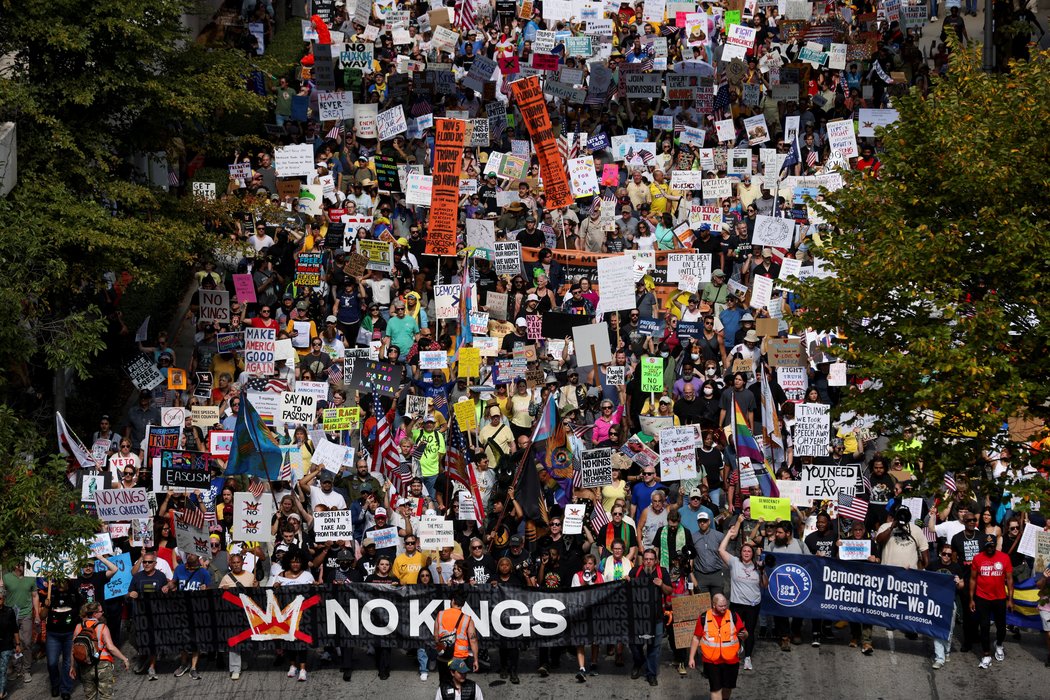
According to ACLED, 2025 saw an amazing rise in protest action from 2024 in response to the return to office of President Donald Trump, with the “Hands Off” protests in April and “No Kings” protests garnering massive participation.
“No Kings” National Day of Action on 18th October marked one of the largest protests the US has seen, with approximately seven million people showing up across all 50 states to protest the administration’s erosion of democratic institutions and ideals, including the First Amendment. The first batch of “No Kings” protests took place on 14th June and have largely been peaceful events spanning the country.
Peaceful protests oppose congressional redistricting plan in Indiana
On 8th December 2025, dozens of people peacefully gathered inside the Indiana Statehouse, the seat of the state legislature, in Indianapolis, as lawmakers debated proposed changes to congressional district maps. Protesters opposed plans advanced by Republican legislators, arguing that the redraw would entrench partisan advantage and remove two congressional seats currently held by Democrats.
The proposal had passed the Indiana House of Representatives the previous week and followed public pressure from Donald Trump, who urged state lawmakers to proceed. Republican leaders in the state Senate acknowledged uncertainty over securing enough votes to approve the maps, intensifying internal party pressure and public criticism of dissenting members.
The demonstrations coincided with the final day of public testimony before the Indiana Senate Committee on Elections, the legislative body reviewing the proposal. Protesters filled the Statehouse, chanting slogans and displaying signs opposing the changes.
People already starting to chant now.
— Cate Charron (@catecharron) December 8, 2025
Last week, anti- redistricting organizers held a rally earlier in the day and saw numbers dwindle once lawmakers gaveled in. Not the case this week. Protesters organized around when lawmakers are scheduled to meet today. pic.twitter.com/tVaGLSx3Yt
Nationwide campus protests challenge federal higher-education policy and academic freedom
On 7th November 2025, coordinated protests took place at more than 100 university campuses across the US, as students, academics and education workers mobilised against federal policies affecting higher education. The demonstrations were organised by Students Rise Up, in coordination with the American Association of University Professors (AAUP) and Higher Education Labour United, alongside multiple civil society and youth-led groups.
Protests focused on opposition to the Trump administration’s higher-education agenda, particularly the proposed Compact for Academic Excellence in Higher Education. Under the proposal, universities would gain priority access to federal funding in exchange for adopting specified policy commitments. Critics characterised these requirements as a form of political conditionality akin to a “loyalty oath”. Several universities reportedly declined to participate, citing risks to academic freedom and institutional autonomy.
Organisers described the demonstrations as the first phase of a broader mobilisation, with further protests and potential student and worker actions planned through May Day 2026. During the actions, participants called on university leadership to reject the compact, protect freedom of expression on campus, and address long-standing concerns over affordability, access to education and student safety.
Government officials defended the proposal, stating that it aims to enforce federal civil rights obligations and reform university governance. Academic unions and student groups, however, warned that funding conditionality, heightened political pressure on universities and increased scrutiny of campus activism risk undermining academic freedom.
Expression
Journalists under attack for coverage of protest and immigration proceedings
On 3rd October 2025, authorities deported journalist Mario Guevara to El Salvador after he had spent more than 100 days in detention following his arrest at the “No Kings” protest in Atlanta, Georgia, in June 2025. Police arrested Guevara while he was recording law enforcement activity during the demonstration. Authorities alleged that his actions posed a threat to national security.
Further incidents affecting journalists occurred in the context of immigration-related protests. On 11th October 2025, police hit photojournalist John Rudoff with a stinger grenade while he covered protests in Portland, Oregon. On 22nd November 2025, authorities arbitrarily detained photojournalist Dave Decker at an immigration protest outside an ICE facility in Miami, Florida, and charged him with rioting, obstruction and trespassing. In response, 23 media and civil liberties organisations sent a joint letter to the Miami-Dade County State Attorney, calling for the charges to be dropped and raising concerns about attacks on press freedom. Prosecutors dropped the case on 16th December 2025.
According to a report by the Freedom of Press Foundation, authorities had detained or charged at least 32 journalists in the United States as of 15th December 2025. The report stated that 90 per cent of these arrests and detentions occurred during protests. Additional cases have been documented by the US Press Freedom Tracker.
Restrictions on journalistic access also extended beyond protest settings. On 5th December 2025, officials prevented photojournalist Jonathan Chang from bringing a camera into a federal building in California to document immigration court proceedings. Chang had previously photographed activity in public hallways rather than courtrooms. However, under a new policy issued by the Department of Homeland Security, authorities required prior permission to bring recording equipment into the building, effectively denying him access. Journalists in Maryland reported similar restrictions while attempting to document immigration proceedings.
Political pressure on broadcasters
On 15th November 2025, in the latest attack against late-night TV hosts, President Trump called on the National Broadcasting Company (NBC) to fire Seth Meyers for his criticism of the President on his show Late Night with Seth Meyers, in a post on Truth Social. The Chair of the Federal Communications Commission (FCC), Brendan Carr, reposted Trump’s remarks, raising concern over the federal agency’s influence on content and voices.
This has become a pattern, as Jimmy Kimmel and Stephen Colbert came under fire for their remarks about the President and his allies, resulting in temporary and permanent cancellation of their shows, respectively. Threats against networks and vocal critics of the administration continued with Trump’s call for the revocation of ABC’s broadcast licence after a reporter asked about the Epstein files.
New Pentagon and White House rules restrict journalistic access
The administration enacted new rules regarding journalists’ access to the Pentagon and the White House. On 15th September 2025, the Department of Defence (DoD) put out a new press policy requiring that reporters and media outlets sign a pledge by 15th October 2025, agreeing not to cover unauthorised information, or they would not be granted access to the Pentagon. Defence Secretary Pete Hegseth claimed that this was a matter of national security.
Similarly, as of 31st October 2025, White House reporters are required to schedule an appointment if they seek to speak with an official in the West Wing. This is a shift away from the free access they previously had to the West Wing office space.
In response, The New York Times filed a lawsuit on 4th December 2025 against the Trump Administration over the new Pentagon policy, alleging that it is a violation of the First Amendment, preventing journalists from carrying out their jobs. Many outlets chose not to sign the pledge, leaving primarily far-right reporters with access to updates from the DoD.
Puerto Rico amends access to information law, raising press freedom concerns
On 14th December 2025, Jenniffer González Colón, Governor of Puerto Rico, signed Senate Bill 63 (SB 63) into law, introducing substantial changes to rules on access to public information. The law amends the 2019 Transparency and Expedited Procedure for Access to Public Information Act, Puerto Rico’s functional equivalent of the US Freedom of Information Act (FOIA).
SB 63 extends deadlines for responding to public records requests, increasing them from 10 to 20 business days or from 15 to 30 business days, depending on the public body involved. It also adds new formal requirements for submitting requests, including the mandatory provision of both a postal address and an email address, as well as submission to multiple designated officials. Authorities may declare requests that do not meet these criteria “defective”, which can halt processing.
The law requires public bodies to justify refusals in writing and allows requesters to appeal denials before the Court of First Instance of San Juan, Puerto Rico’s main trial-level court. At the same time, it permits agencies to release information in the lowest-cost format available, removing the requester’s ability to seek data in searchable or analysable formats, such as spreadsheets or statistical tables. The law would also require agency heads to be notified of every records request.
Puerto Rico’s existing transparency framework has already faced documented implementation challenges. In recent years, civil society organisations have pursued litigation to obtain public records that authorities did not proactively disclose. Most recently, the American Civil Liberties Union of Puerto Rico filed a lawsuit seeking information on the Puerto Rico Department of Transportation and Public Works’ sharing of drivers’ licence data with US federal immigration authorities, raising concerns about potential violations of privacy protections.
Ahead of the law’s adoption, civil society organisations, including Reporters Without Borders, warned that SB 63 could restrict access to information and undermine press freedom. They argued that the amendments create additional opportunities for delay, reduce protections for the confidentiality of requesters, and impose restrictive conditions on in-person consultation of documents, limiting effective public scrutiny.
The legislative process itself also drew criticism. The Freedom of the Press Foundation reported that the Puerto Rico Senate approved SB 63 without a public hearing, while the House of Representatives allowed only one day of testimony, during which several organisations were unable to participate. Observers linked these procedural limitations to the substance of the bill, noting the reduced opportunities for public oversight.
Puerto Rico’s constitutional protections for access to information are an example for the rest of the country, but SB 63 would turn them into a cautionary tale. At a time when press freedom is declining nationwide, it is inconceivable that Puerto Rico’s leaders would go out of their way to harm their constituents’ access to information and degrade the quality of press freedom on the island.
- Clayton Weimers, Executive Director, RSF North America.
Questions raised over editorial independence following broadcast withdrawal
On 21st December 2025, CBS News Editor-in-Chief Bari Weiss pulled a “60 Minutes” segment on Centro de Confinamiento del Terrorismo (CECOT), the infamous detention centre in El Salvador, where the administration illegally sent Venezuelan migrants in early 2025. She claimed to do so because the story was not ready for broadcasting as officials from the administration had not gone on the record to offer comments. This decision has been criticised for being political rather than editorial. Weiss was also involved in the editing of a “60 Minutes” interview with President Trump, removing comments on corruption and cryptocurrency.
There has been a trend towards media consolidation, particularly in the last year, with film producer David Ellison taking over Columbia Broadcasting System’s (CBS) parent company, Paramount, to form Paramount Skydance in the summer, and current efforts to buy Warner Brothers, the parent company of Cable News Network (CNN).
In August 2025, Reporters Without Borders (RSF) sent a letter on “how consolidating media ownership threatens independent journalism” in response to FCC’s call for public comments regarding the size of broadcast media conglomerates.
US President sues public broadcaster BBC
On 15th December 2025, President Donald Trump filed a lawsuit against the British Broadcasting Corporation (BBC), alleging defamation and violations of the Trade Practices Act. The claim relates to an edited segment of a BBC documentary that included footage of Trump’s 6th January 2021 speech. Trump alleged that the edit misrepresented his remarks, portraying them as an incitement to violence and amounting to interference in the 2024 US presidential election.
Trump stated that the BBC had “intentionally, maliciously and deceptively” altered the footage. The broadcaster had previously issued an apology for the editing error but rejected claims that the incident constituted defamation. The legal action followed public threats by Trump against the BBC and the leak of an internal memorandum criticising the editorial decision. Shortly afterwards, the BBC’s Director General, Tim Davie, and Head of News, Deborah Turness, resigned.
Legal analysts described the case as highly unusual, noting that it involves a sitting US president bringing a defamation claim against a foreign public broadcaster. They also highlighted that defamation claims by public officials face a high legal threshold under US constitutional law, which provides strong protection for freedom of expression and the media, even where journalistic errors occur.
The lawsuit raises concerns about the use of litigation by senior political figures to exert pressure on independent media. Although courts are expected to apply established free-expression standards, the case risks reinforcing a chilling effect on investigative journalism.
Online censorship and the decline of press freedom
In the aftermath of the imposition of US sanctions on the three leading Palestinian human rights organisations, as previously documented by the CIVICUS Monitor, in early October 2025, YouTube took to removing videos that documented human rights violations committed by Israel against Palestinians from the accounts of each organisation.
In a separate incident, in mid-December 2025, YouTube, alongside social media platform TikTok, also took down clips from the aforementioned “60 Minutes” episode on CECOT to abide by copyright regulations, seemingly capitulating to the far-reaching restrictions enacted by CBS (see above).
British journalist released from US immigration detention amid free expression concerns
On 12th November 2025, Sami Hamdi, a British journalist and political commentator, was released from US immigration detention and departed the country voluntarily after more than two weeks in custody. His release followed negotiations between his legal team and US authorities and took place during federal court proceedings challenging the lawfulness of his detention. Authorities did not file criminal charges, and no formal removal order was issued.
US immigration authorities detained Hamdi on 26th October 2025 at San Francisco International Airport, citing an alleged visa overstay, just a day after he spoke at the annual gala of the Council on American-Islamic Relations’ Sacramento chapter. Hamdi and his lawyers contested this justification and argued that the detention amounted to retaliation linked to his public commentary about Palestinian human rights and the Israeli genocide in Gaza.
In response, over 250 civil society organisations sent a joint letter to members of Congress and US Secretary of State Marco Rubio calling on them to demand the immediate release of Hamdi.
While in custody, Hamdi reported inhuman conditions, including overcrowding, inadequate food, delayed medical attention despite severe pain, repeated transfers without notice and prolonged use of restraints. On 1st November 2025, a federal court ordered ICE not to transfer Hamdi out of California while the case proceeded. The court found that the legal challenge raised serious questions as to whether the detention may have constituted retaliation for protected speech under the First Amendment, and indicated that further protective measures could become necessary if detention continued.
I am profoundly grateful to my family, my legal team and every individual in the global community who prayed, protested and refused to be silent. Let the record show: I broke no law and posed no threat. My only ‘offence’ was speaking the unvarnished truth about the genocide in Gaza. I am departing now, voluntarily, to reunite with my loved ones, not because the U.S. government ever established a credible case against me. This detention was a stark demonstration that a Muslim journalist can be held captive because extremists, amplified on social media, seek to weaponise state policy against inconvenient speech. This is not merely an injustice against me, but a searing indictment of any nation that claims to uphold free speech, a free press and the right to due process.
- Sami Hamdi.
University of Alabama permanently suspends student magazines, citing federal anti-DEI guidance
On 1st December 2025, the University of Alabama permanently suspended two student magazines at its Tuscaloosa campus: Nineteen Fifty-Six, which focused on Black student life, and Alice, a publication covering women’s fashion and wellness. The decision followed a July 2025 memorandum issued by the US Department of Justice, signed by AG Pam Bondi, which cautioned federally funded institutions against what it described as “unlawful proxy discrimination”.
The memorandum asserted that programmes using formally neutral criteria but serving specific demographic groups could violate federal anti-discrimination law. According to reporting by The Crimson White, the university’s Vice President for Student Life informed staff that the magazines fell within this category because Nineteen Fifty-Six focuses on specific groups. A university spokesperson said the suspensions aimed to ensure equal access to student media projects funded by the Office of Student Media.
Editors disputed the university’s justification, as neither publication restricted participation on the basis of race or gender. Gabrielle Gunter, editor-in-chief of Alice, argued that the suspension interferes with First Amendment protections for student press, while Kendal Wright, editor-in-chief of Nineteen Fifty-Six, said the decision removes an essential platform for documenting Black student experiences on campus.
The permanent suspensions prompted mobilisation by students and alumni. A fundraising campaign raised more than USD 25,000 to support independent publication of future issues. On 16th December, US Representatives Terri Sewell and Shomari Figures urged University President Peter Mohler to reinstate the magazines, warning that the decision undermines freedom of expression and academic freedom.
Kansas county agrees to multi-million-dollar settlement after 2023 newsroom raid
On 10th November 2025, more than two years after police raided the newsroom and the owners’ home of the Marion County Record in Marion County, Kansas, county authorities agreed to a settlement exceeding USD 3 million.
As previously reported, the August 2023 raid, led by then police chief Gideon Cody, involved the seizure of journalistic equipment and personal mobile phones from newsroom staff and owners. In response, press freedom condemned the operation, and Cody resigned later that year. In April 2024, Eric Meyer filed a federal lawsuit alleging violations of constitutional protections for the press. Additional federal civil actions brought by Meyer, Gruver and Zorn against city and county officials remain pending.
Other developments
Colorado River granted legal personhood by Indigenous Tribe, and student advocacy leads to recognition of river rights in Durango
On 6th November 2025, the Tribal Council of the Colorado River Indian Tribes (CRIT) unanimously adopted a resolution recognising the Colorado River as a living being and granting it legal personhood under tribal law. The decision applies to the approximately 100 miles of the river that flow through CRIT’s reservation and instructs the Tribe’s Attorney General and legal staff to draft amendments to the tribal water code to reflect the river’s new legal status.
CRIT is one of 30 federally recognised Indigenous tribes within the Colorado River Basin and one of the few whose lands include the river itself. The tribe also holds the largest volume of senior water rights in Arizona, giving it a central role in regional water governance. In adopting the resolution, the Tribal Council framed the measure as an exercise of Indigenous sovereignty and environmental stewardship, grounded in the tribe’s spiritual, cultural and historical relationship with the river. Before finalising the resolution, tribal authorities conducted consultations and public hearings with the tribe’s approximately 4,200 members, including those living off-reservation.
As reported by the Eco Jurisprudence Monitor, while the river’s legal personhood applies only within CRIT jurisdiction, the resolution carries broader implications. Under tribal law, the river now holds rights to protection, enabling the tribe to incorporate the river’s interests into water-related decisions and to pursue legal responses to environmental harm, including impacts linked to climate change. The move comes amid ongoing disputes over Colorado River management, as seven US states failed to reach a federally mandated agreement on water conservation while the river faces prolonged drought and chronic over-allocation.
In a related development in November 2025, the Durango City Council adopted a resolution acknowledging the inherent rights of the Animas River, following advocacy by students at Fort Lewis College:
“The timing aligned with the tenth anniversary of the 2015 Gold King Mine spill, a catastrophic event that thrust the Animas River into international focus and underscored the need for new approaches to watershed justice. The resolution recognises the Animas River’s fundamental rights, including the right to flow, flourish, and maintain its natural ecological systems, and requires the City of Durango to consider these rights in all future planning and decision-making processes. It also acknowledges the river’s deep social, cultural, and spiritual significance, particularly to neighbouring Indigenous Tribal Nations, the Southern Ute and Ute Mountain Ute tribes, whose traditional ecological knowledge was used as inspiration for the proposal.”