Freedom of association
New legislative amendments to further simplify designating NGOs as extremist
At the beginning of February 2025, the Russian government submitted a new legislative proposal to the State Duma with potentially severe consequences for non-governmental organisations (NGOs). Under the proposal, if a member of an organisation or community is convicted of extremism, the entire organisation could be designated as extremist.
Currently, such a designation requires a preliminary court ruling banning or liquidating the organisation. If adopted, the amendments would make an individual conviction sufficient grounds for this classification. Experts cited by Kommersant warned that, while the measure would simplify the process of adding entities to the list of banned organisations, it also poses a serious risk that legitimate associations could be wrongly branded as extremist. The draft law also proposes harsher penalties under Article 282 of the Russian Criminal Code for inciting hatred or enmity, particularly in cases where the act is accompanied by the justification or promotion of such violence or when committed by a group.
First criminal conviction for repeated violations of the “foreign agent” law
On 30th January, a Russian court sentenced Sergei Piskunov, a member of the election-monitoring NGO Golos, to four years in prison. He was found guilty of repeated violations of the country’s “foreign agent” law, as well as “indecent acts”. This is reportedly the first conviction under the provisions establishing criminal liability for repeated violations of the “foreign agent” law.
According to prosecutors, Piskunov posted content on VKontakte, a Russian social media platform, while failing to indicate his designation as a “foreign agent”. He was also accused of corresponding with an underage girl and allegedly offering money in exchange for nude photographs.
Piskunov was arrested near the Kazakh border in February 2024. Shortly before his arrest, he had submitted an application to hold a solo demonstration to protest the upcoming presidential election scheduled for the following month. He was reportedly initially arrested on charges of “participating in an extremist group”, but then held in pre-trial detention on charges of “sexual abuse”.
Founded in 2000, Golos is a Russian non-governmental organisation dedicated to protecting citizens’ electoral rights and promoting civil society. It was the first NGO in Russia to be suspended under the repressive “foreign agents” legislation. The charges against the organisation stemmed from its receipt of 10,000 USD in prize money after being presented with the Andrei Sakharov Freedom Award by the Norwegian Helsinki Committee, despite having instructed its bank to return the full amount. The Ministry of Justice claimed that the group’s advocacy for the adoption of a unified Electoral Code constituted “political activity” as it sought to influence public opinion and the work of government bodies.
Navalny’s lawyers sentenced to prison on “extremism” charges
On 17th January 2025, a Russian court sentenced three lawyers who defended late opposition leader Alexei Navalny to prison terms of up to five and a half years on charges of participating in an “extremist organisation”. Vadim Kobzev received five and a half years, Alexei Liptser five years, and Igor Sergunin three and a half years after a closed trial.
Several months after Navalny was detained in 2021, Navalny’s Anti-Corruption Foundation and its regional offices were classified as “extremist”. This was followed by a conviction against Navalny, who was already jailed on other charges, for founding and funding an extremist organisation as well.
The lawyers were accused of “using their status” to relay messages between Navalny and his team. Amnesty International condemned the verdict, describing it as an attempt by Russian authorities to dismantle “what remains of the right to legal defence” in the country.
Donors to Navalny’s Anti-Corruption Foundation could be prosecuted, report warns
Donors to Alexei Navalny’s Anti-Corruption Foundation (FBK), designated “extremist” in June 2021, remain at risk of prosecution, according to Mediazona. Individuals who contributed between August 2021 and February 2022 could face criminal charges.
After the “extremist” designation, FBK briefly halted donations but later resumed fundraising through the US payment processor Stripe, believing it provided a secure channel for Russian card payments. However, Mediazona reported in February 2025 that Russian authorities could still identify donors, as FBK’s merchant account number remained visible to domestic banks. As of February 2022, this is no longer the case, as Russian banks have largely halted international transfers since the invasion of Ukraine.
This loophole enabled multiple prosecutions, and all donors from that period still face potential legal action.
On 16th December 2024, investigators in Kurgan Oblast opened a criminal case against Nadezhda Mikhailova, a former resident now living in exile, for donating 2,100 roubles (around 26 USD) to FBK between 5th August 2021 and 5th February 2022. Charged under Article 282.3, Part 1 of the Criminal Code for “financing extremist activity”, Mikhailova’s home was searched in November 2024, and police seized her electronic devices. She later left Russia and has not been placed in pretrial detention.
Freedom of peaceful assembly
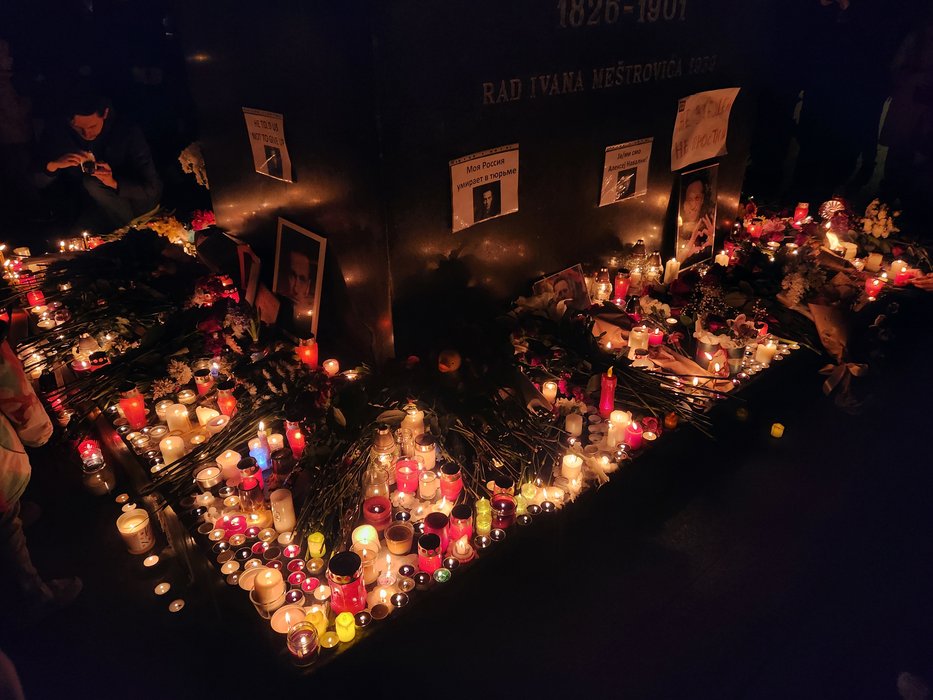
One year after Navalny’s death: arrests in Russia as global commemorations held
A year after opposition leader Alexei Navalny’s death in prison on 16th February 2024, memorial gatherings were held in numerous cities outside Russia, reflecting the enduring international resonance of Navalny’s legacy. The largest took place on 1st March 2025 in Berlin, where supporters also marked the three year anniversary of the full-scale invasion of Ukraine and ten years since the assassination of another Russian opposition figure, Boris Nemtsov, who was killed in late February 2015 while preparing an anti-war protest scheduled for 1st March that year.
In Russia, however, commemorations were largely suppressed. According to watchdog group OVD-Info, at least 42 people in 18 cities were detained when attempting to honour Navalny’s memory. The group cited the example of a young couple from Voronezh, identified as Yevgenia and Alexander, who were detained after laying flowers at the memorial to Osip Mandelstam, a Russian dissident poet who died in a Gulag. Yevgenia held up a placard reading, “Do not be afraid. This is our country and we have no other,” while Alexander filmed her. They were immediately confronted by plain-clothes security agents, who detained them both. While in detention, agents attempted to force Alexander to unlock his phone, beat him and threatened him with a taser. He was released soon after.
Freedom of expression
Russia bans so-called “child-free propaganda” to safeguard “traditional family values”
In November 2024, Russia’s State Duma passed a bill banning what it terms “child-free propaganda”: content that promotes a “childless lifestyle” in media, films, and online platforms. The measure forms part of the government’s campaign to promote “traditional family values” and boost Russia’s declining birth rate, which has worsened since the war against Ukraine.
In the same session, lawmakers also approved legislation restricting international adoptions, citing the need to protect adopted Russian children from alleged “dangers” in countries that allow gender reassignment. The new rules ban citizens of at least 15 countries — mostly in Europe, but also including Australia, Argentina and Canada — from adopting Russian children. U.S. citizens were already blacklisted.
Civil society groups have condemned the measures as a further attack on freedom of expression and women’s rights, arguing they fail to address the economic insecurity that drives many women to remain childless.
Under the new law, individuals found guilty of promoting a “child-free lifestyle” face fines of between 50,000 and 400,000 roubles (approximately 950–3,800 USD), rising to 800,000 roubles (7,700 USD) for public officials. Organisations could be fined up to five million roubles (48,200 USD) or suspended for up to 90 days, while foreign nationals and stateless persons risk deportation.
Russia expands “foreign agents” list to include two RFE/RL journalists, opens criminal case against another
On 31st January 2025, the Russian Ministry of Justice added seven more individuals — including two journalists from Radio Free Europe/Radio Liberty (RFE/RL) — to its growing list of so-called “foreign agents”. The ministry claimed the designations were linked to participation in foreign media platforms and, in some cases, to the alleged dissemination of “false information” about Russia’s electoral system. However, all seven share one common trait: opposition to Russia’s war in Ukraine, which Moscow continues to describe as a “special military operation” against the “Kyiv regime”.
RFE/RL President Stephen Capus denounced the move as part of Russia’s “brutal assault on independent media”. Those newly designated include Dmitry Sukharev, a journalist with Systema, RFE/RL’s Russian investigative unit, and Andrei Novashov, a contributor to its Russian and North Caucasus services. Both currently reside outside Russia.
Separately, the Moscow Prosecutor’s Office has initiated a criminal case against TV Rain journalist Yulia Taratuta for repeated violations of the law on foreign agents. Declared a “foreign agent” in December 2022, Taratuta has twice faced administrative penalties for breaching the terms of this designation. Many of her colleagues at TV Rain are already listed as “foreign agents”.