Introduction
On 19th October 2025, Tufan Erhürman, leader of the Republican Turkish Party (CTP), won the presidential election in the Turkish Republic of Northern Cyprus (TRNC) with 62.8% of the vote, defeating incumbent Ersin Tatar, who received 35.8%, according to preliminary results. The 55-year-old lawyer secured a landslide victory over Tatar, widely regarded as Turkey’s preferred candidate. Erhürman supports a bi-zonal, bi-communal federal solution to the island’s partition, in contrast to Tatar’s two-state model aligned with Ankara. Cyprus has been divided since Turkey’s 1974 invasion following a coup backed by Greece. The island remains split between an unrecognised Turkish Cypriot state in the north and the internationally recognised Republic of Cyprus in the south. Formal reunification talks have stalled since 2017, but Erhürman’s victory is viewed as a potential opportunity to revive dialogue between the two sides.
The election followed a period of heightened tension regarding Turkey's influence and human rights concerns in the north. The introduction of a law permitting the wearing of headscarves in schools, seen as Turkey’s attempt to impose political Islam in the north, sparked a series of strikes and protests across northern Cyprus, culminating in the law being struck down by the TRNC’s Supreme Court in September. On 11th September 2025, the European Parliament adopted a resolution condemning the detention of five Greek Cypriots by TRNC’s de facto authorities. The group — Antonis Louka, Andreas Kyprianou, Annie Kyprianou, Niki Gregoriou and Gregoris Gregoriou — had been arrested on 19th July while visiting a property owned by one of them in the Turkish-occupied north and accused of espionage. MEPs described the detentions as an intimidation tactic to deter Greek Cypriots from reclaiming property in the occupied areas. Two of those detained were released on bail on 10th September, with the remaining three released two days later. All five were subjected to a ban on leaving Northern Cyprus until the conclusion of proceedings against them.
Freedom of association
Human rights defender Doros Polykarpou continues to face charges of misdemeanour acts of “trespassing”, “disturbance of peace”, “insult”, and assaulting two security guards at a reception centre in March 2022. If convicted, he could face up to three years in prison.
Polykarpou is a prominent human rights defender and founding member of KISA – Action for Equality, Support and Anti-Racism, a leading Cypriot NGO focusing on migration, asylum, discrimination, racism, and trafficking.
According to Polykarpou and an eyewitness account, during his visit to the reception centre one guard slapped him on the back, asked if he remembered him, and then physically and verbally attacked him. The guard in question was previously the subject of a KISA complaint after two women asylum seekers accused him of using excessive force. Following the altercation, during which Polykarpou was reportedly pushed, he was taken to a police post near the centre’s exit and requested to file a report. Police allegedly refused to record it immediately, directing him instead to a local station after making him wait. Polykarpou believes this delay allowed the guards to file their own complaint first and avoid accountability.
In January, ten international human rights organisations – including Amnesty International, the International Partnership for Human Rights (IPHR), Front Line Defenders, and the European Network Against Racism (ENAR) – issued a joint statement urging that the charges be dropped, describing them as unfounded and linked to his human rights work.
On 11th February 2025, the hearing of Polykarpou’s case was postponed to 15th September 2025 due to the prosecution’s failure to provide the defence with key evidence. This marks the fourth postponement in the case since he was notified of the indictment in August 2022.
As previously reported by the CIVICUS Monitor, KISA has faced sustained harassment and administrative pressure in recent years. In December 2020, following an amendment to the law on associations, the organisation was removed from the Registry of Associations and proceedings for its dissolution began. KISA’s appeal before the Appeal Court remains pending. Although re-registered as a non-profit company, the organisation continues to face significant obstacles.
In September 2023, KISA reported a renewed smear campaign seeking to link it to terrorism and money laundering. The organisation stated that this campaign led to staff facing verbal abuse, insults, and death threats.
On 5th January 2024, KISA’s offices were targeted with an improvised explosive device that caused severe damage to windows, computers, and office equipment. KISA and its members have also received repeated threats from anti-migrant and nationalist groups. Despite multiple complaints, investigations into these threats have so far yielded no known results.
🚨 Front Line Defenders is deeply concerned about the continuous postponement of the trial of HRD Doros Polykarpou since 2022.
— Front Line Defenders (@FrontLineHRD) February 12, 2025
The failure of the court to proceed with this in a timely manner risks violating Article 6 of the European Convention on Human Rights, which protects… pic.twitter.com/tjfLtPNqcU
Freedom of peaceful assembly
Four arrested at protest against police killing in UN-controlled buffer zone
On 19th January 2025, a protest took place in Nicosia over the police killing of 24-year-old migrant Shoaib Khan, who was shot by police in the UN-controlled buffer zone on 6th January. Police intervened with force after the demonstration ended, arresting four participants and later charging two more with public disorder offences, bringing the total number of those facing charges to six. Among those arrested was a man who filmed the police officers’ conduct, who was detained for allegedly violating data privacy laws.
Video footage reportedly showed an officer making an offensive gesture towards protesters during the detainees’ transfer, while another recording captured police raising a baton at a demonstrator who was attempting to assist a 65-year-old protester allegedly pushed to the ground by officers. Monitoring group Far Right Watch Cyprus criticised the police response, stating: “Video evidence shows these individuals not only didn’t resist arrest or display aggressive behaviour, but were themselves subjected to unprovoked police action at the march’s conclusion.”
Progressive Party of Working People (AKEL) MPs Alexandra Attalides and George Koukoumas called for a parliamentary inquiry into police conduct, citing potential violations of the constitutional right to peaceful assembly, the UN Human Rights Charter, and the EU Charter of Fundamental Rights.
Parliamentary hearing on the right to protest
On 24th February 2025, the House Human Rights Committee of the Cypriot parliament held a heated hearing on allegations of police brutality and restrictions on the right to peaceful assembly in Cyprus. The session, initiated by MPs George Koukoumas and Alexandra Attalidou, examined reports of arrests carried out weeks after protests, excessive surveillance and disproportionate police responses to peaceful acts such as hunger strikes or displaying banners.
According to the Independent Authority for the Investigation of Allegations and Complaints Against the Police (AADIPA), two criminal and three disciplinary cases remain pending in connection with police conduct during the 2021 “Os Dame” (Ως Δάμε, No Further) anti-corruption protests. MPs also cited recent examples, including the January 2025 arrests following demonstrations over the police killing of Shoaib Khan, and the violent arrest of journalist George Tattis and activist Oz Karahan in October 2024.
Tattis and Karahan were arrested on 1st October 2024 after displaying a banner reading “Republic of Cyprus: the only solution” and “Apartheid is not a solution” in Greek and Turkish at a parade marking the anniversary of Cyprus’s independence from British rule. Police attempted to prevent them from holding up the banner, claiming “political” content was not allowed during the parade. Both were violently arrested after resisting the removal of the banner. Proceedings against them are ongoing, with a hearing scheduled for 22nd October.
Protests against Turkish influence in Northern Cyprus
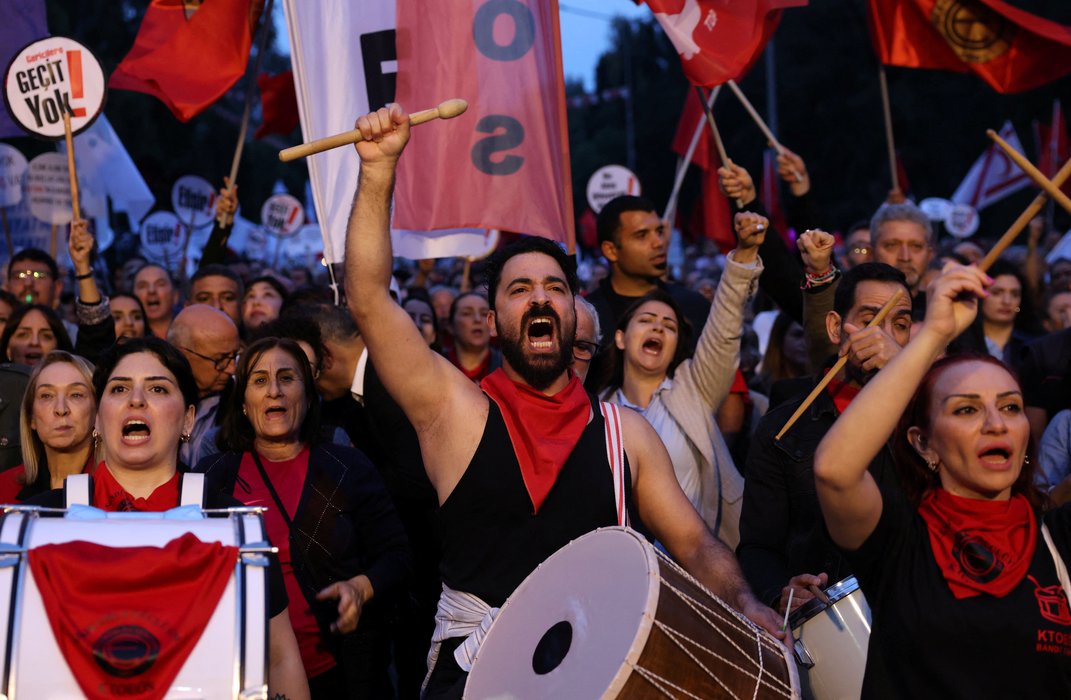
On 2nd May 2025, several thousand Turkish Cypriots protested in northern Nicosia against what they described as Turkey’s attempt to impose political Islam on their secular society. Organised by teachers’ unions and leftist groups, the demonstrators opposed the lifting of the headscarf ban in high schools—while other religious symbols remain prohibited—calling the move a form of “social engineering” and a step towards the Islamisation of education. The protest coincided with a visit by Turkish President Recep Tayyip Erdoğan to inaugurate new government buildings.
The following day, on 3rd May, five protesters were arrested near the new official residence of Turkish Cypriot leader Ersin Tatar during a small anti-Erdoğan demonstration. Police intervened after the group refused to leave a roundabout, detaining conscientious objector Halil Karapasaoglu and four others. All were later released without charge.
During his visit to northern Cyprus, President Erdoğan responded to the protests, warning that efforts “to sow the seeds of hatred [...] will not be successful”, asserting that opposition to his measures would ultimately fail.
On 25th September 2025, the north’s Supreme Court annulled the law allowing headscarves in public schools, restoring the ban on all religious symbols. The ruling followed months of protests by teachers’ unions and secular groups, hailed by Cyprus Turkish Secondary Education Teachers’ Union (KTOEÖS) leader Selma Eylem as a victory for secular education and constitutional order.
Restrictive new protest law introduced despite criticism
On 10th July 2025, the Cypriot Parliament passed a contentious law restricting the right to protest by 28 votes to 17. The legislation introduces a mandatory seven-day notification period for demonstrations and requires organisers to disclose extensive information including the protest’s purpose, location, timing, and potential impact on traffic and public services. Police are granted broad powers to impose restrictions both before and during demonstrations, and to disperse gatherings deemed non-peaceful. The law also creates offences for inciting violence and for protesters concealing their identities without “reasonable cause.” It took immediate effect.
The legislation faced strong opposition from civil society organisations, trade unions, and human rights groups, as well as AKEL MPs and independent parties, who warned that it undermines constitutionally guaranteed rights, fails to protect spontaneous demonstrations, and risks increasing police repression.
The organisations opposing the law – including initiatives such as Far Right Watch, Save Akamas, and Queer Collective – held a protest outside Parliament on 3rd July, when the vote on the bill was initially scheduled. In response, the government postponed the vote until 10th July to allow further review by the parliamentary committee on legal affairs.
Peaceful protests on environmental, labour and LGBTQI+ rights
On 30th August 2025, environmental and political organisations held a protest in Agios Georgios Peyias, denouncing alleged violations in the protected areas of Peyia and Akamas. Demonstrators from the Greens Movement, Friends of the Earth, and other groups carried banners reading “Save Akamas” and “Concrete is not development”, demanding stricter environmental protection and accountability. Speakers criticised the authorities for failing to prevent illegal construction and backfilling near the sea caves, warning that impunity had become “the norm.” The peaceful protest, monitored by police, concluded with a clean-up campaign organised by participating environmental groups at Lara Beach.
On 10th September 2025, workers across Cyprus staged a three-hour general strike from 11:00 to 14:00 over the Cost of Living Allowance (CoLA) automatic wage adjustment, demanding its full restoration to 100 per cent. The industrial action, organised by the trade unions SEK, PEO, PASYDY, and DEOK, affected schools, hospitals, airports, transport services, and citizen service centres. Schools closed early, hospitals suspended non-emergency services, and more than 50 flights at Larnaca and Paphos airports faced delays or cancellations. Simultaneous demonstrations were held in all five districts, causing traffic disruptions. Unions said the strike was necessary after negotiations with employers and the Labour Ministry failed to resolve the CoLA dispute.
On 27th September 2025, LGBTQI+ communities from both sides of the divided island marched in parallel processions that converged at the UN-administered Ledra Palace buffer zone for the fourth annual United by Pride event. Participants from across Cyprus gathered under the slogan “We are still here, and we are still marching for peace, reunification, queer liberation, and collective justice.” The event featured live performances, DJ sets, and speeches promoting equality and coexistence. Organisers described United by Pride as a space of “politics, joy, and struggle”, symbolising hope for peace and transformation amid the island’s ongoing division.
Excessive force at pro-Palestine protests prompts calls for review of controversial assembly law
Throughout 2025, numerous demonstrations in solidarity with the people of Palestine were held in Cyprus in response to the genocide in Gaza.
On 24th February 2025, protesters gathered in Nicosia’s Eleftheria Square, demanding a permanent ceasefire in Gaza, unrestricted humanitarian aid, and that Cyprus sever military, political, and economic ties with Israel. Organised by United for Palestine, participants carried banners calling for the release of Palestinian aid workers and an end to settlement expansion.
In May 2025, activist Louis Allan staged a five-day hunger strike from an olive tree at the Ayiou Prokopiou roundabout in Engomi, Nicosia, in solidarity with Palestinians in Gaza. Consuming nothing but two litres of water daily, he sought to symbolise the humanitarian blockade and raise public awareness of the crisis.
On 6th June 2025, pro-Palestinian activists disrupted a Limassol Municipal Council meeting, demanding that the city condemn the Gaza genocide and halt cooperation with Israeli investors. Wearing red-painted hand symbols and carrying Palestinian flags, the group delivered a letter urging the council to take practical solidarity measures, terminate partnerships with Israeli investors involved in controversial developments, and renounce the twin city relationship with Haifa. The session was briefly suspended as authorities managed the protest.
On 15th June 2025, hundreds marched peacefully for Gaza in Limassol, organised by the Cyprus Peace Council. Demonstrators at the Molos amphitheatre called for an end to the blockade and Israeli attacks, displaying banners and chanting slogans in support of Palestine while criticising the Cypriot government’s stance on the conflict.
On 28th September 2025, pro-Palestine protesters marched through Nicosia, calling for an end to the Gaza conflict and the dismantling of British military bases in Cyprus. The rally, titled “Global Rally Against this Supply Chain of Death”, began outside Nicosia District Court and proceeded to the British High Commission. Demonstrators carried flags and placards with slogans such as “Freedom for Palestine. Stop the genocide” and “Bases of destruction and death, out of our land”, highlighting opposition to the UK’s Sovereign Base Areas and their perceived role in supporting Israel’s military operations.
Hundreds gathered outside Cyprus’s Ministry of Foreign Affairs in Nicosia on 2nd October to protest Israel’s interception of the Global Sumud Flotilla bound for Gaza. The demonstration, initially peaceful, became tense when anti-riot police intervened, using pepper spray to disperse protesters. Videos show officers pushing protesters, and witnesses alleged excessive force. A woman journalist was reportedly assaulted by police (see under Freedom of expression). Also among those allegedly subjected to excessive force was Neoklis Sylikiotis, a former minister, member of parliament, MEP, and AKEL party official. Organisers condemned the response, urging the Cypriot government to denounce Israel’s actions and respect international law. The protest coincided with global demonstrations demanding the flotilla crew’s release and an end to the Gaza blockade.
Police stated that officers intervened using “proportionate force and individual spray” after demonstrators refused to comply with instructions, adding that officers “faced pushing and resistance” while attempting to move participants. However, Massimiliano Sfregola, a freelance journalist reporting on the demonstration for the Italian daily Il Manifesto, told in-cyprus that authorities attacked people without warning. Positioned on the pavement near a park to film the police action, Sfregola was hit by pepper spray despite being on the sidelines. “The spray was used 360 degrees. It was not targeting one person. It was pretty random. The purpose was to create damage to everybody that was there”, he said.
On 6th October, the Independent Authority for the Investigation of Complaints Against the Police (AADIPA) announced an inquiry into alleged police misconduct during the protest. The investigation follows multiple citizen complaints and will include both criminal and disciplinary investigations, pending authorisation from the Attorney General.
The same day, House Human Rights Committee chairwoman Irene Charalambides announced plans to invite the OSCE to Cyprus to review the controversial protest law adopted in July. Charalambides emphasised that the law does not prohibit spontaneous, unannounced demonstrations concerning urgent events, such as Israel’s interception of the humanitarian flotilla. Reportedly, police officers had cited the new protest law and its notification requirements as justification for their intervention.
Freedom of expression
Freedom of the press in Cyprus is constitutionally guaranteed but increasingly constrained by political, economic, and institutional pressures, according to Reporters Without Borders (RSF). Media ownership is highly concentrated, with two of the four major newspapers linked to political parties, and editorial interference is widespread. While journalists are generally safe from physical harm, they face verbal attacks from politicians, online harassment, and growing self-censorship, particularly regarding the sensitive issue of Cyprus’ partition. Economic dependence on state and private funding further undermines editorial independence.
In this fragile environment for media freedom, new legislative initiatives have raised additional alarm among journalists and watchdog groups.
On 9th April 2025, the Cypriot government introduced a draft bill enabling surveillance of journalists and potential lifting of source protection, prompting widespread criticism. Presented by the Ministry of Interior as aligning with the European Media Freedom Act (EMFA), the legislation would allow authorities to seek court orders permitting the search of journalists’ homes, offices, and electronic devices. The draft also opens the door to the use of spyware, as well as extending potential surveillance to colleagues, friends, and other contacts. In line with the proposal, the head of the secret service, the police chief, or “any other investigator or authorised official” could request the attorney general to obtain a court order forcing journalists to reveal their sources. Media and legal experts warned that the draft omits key EMFA safeguards, such as the requirement of an “overriding reason of public interest”, risking misuse and weakening press freedom. Following backlash, the ministry pledged to revise the draft.
The previous year, Cyprus faced controversy over a proposed amendment to its criminal code that would criminalise the dissemination of “fake news”, introducing prison sentences of up to one year. The draft law, discussed by parliament’s Legal Committee in July 2024, aimed to curb disinformation but drew criticism from journalists and international media freedom groups, who warned it could be used to silence dissent and restrict press freedom. The Media Freedom Rapid Response (MFRR) consortium and other press freedom watchdogs condemned the proposal as incompatible with European standards. Following widespread criticism, the government withdrew the bill in late 2024.
On 15th September 2025, Cyprus’s House Human Rights Committee launched a parliamentary inquiry into rising threats against journalists and citizens aimed at silencing public criticism and curbing free expression. The investigation, initiated by MP Irene Charalambidou, followed a complaint from a citizen allegedly threatened by a member of the Cypriot Intelligence Service (CIS) on social media. Lawmakers and media representatives reported increasing intimidation through fake social media accounts and trolling campaigns targeting journalists. The Union of Cyprus Journalists (UCJ) warned that insecurity and threats are undermining press freedom, while MPs called for stronger safeguards and accountability for officials who misuse their authority to intimidate critics.
On 2nd October 2025, journalist Bisan Ibrahim of the Dialogos media group was assaulted by police while covering a peaceful protest outside the Ministry of Foreign Affairs in Nicosia against the interception of the Gaza-bound Global Sumud solidarity flotilla. According to Ibrahim and the UCJ, officers pushed her to the ground twice and pepper-sprayed her, despite her showing her press card. The union condemned the incident as “unacceptable and deplorable” and urged Police Chief Themistos Arnaouti to investigate and hold those responsible accountable.
On 2nd May 2025, journalist Ayşemden Akın of the Turkish Cypriot outlet Bugün Kıbrıs received serious death threats following her investigation into an alleged money laundering network involving senior Turkish officials. Her key source, Cemil Önal, was shot dead in the Netherlands a day earlier. Akın said she received a 27-minute call warning her she would be killed if she continued publishing the story. Police initially stationed guards outside her home but later reduced protection, reinstating it after public pressure. The Union of Cyprus Journalists and opposition figures have voiced serious concern for her safety.
On 3rd December 2024, a leaked directive from Agriculture Minister Maria Panayiotou revealed that ministry employees were forbidden from speaking to the media without prior approval and guidance from the minister’s office. The instructions required all responses to be issued in writing and vetted by the ministry’s press office. The UCJ condemned the order as an attempt to restrict press freedom. Later that day, Panayiotou acknowledged on X that the wording of her instructions had been “formulated incorrectly” and reaffirmed her respect for the media.