Introduction
In 2025, France experienced a deep political crisis and significant civic mobilisation. Since President Emmanuel Macron called snap elections in 2024 (see previous CIVICUS Monitor update), several Prime Ministers have resigned due to political deadlocks. In 2024, Prime Minister Michel Barnier resigned less than three months after a no-confidence vote. On 8th September 2025, the National Assembly rejected the government’s confidence motion, leading to François Bayrou’s resignation. Finally, after 27 days in office and shortly after he announced his new government, Sébastien Lecornu resigned in early October 2025.
Several other important political developments took place in the reporting period. In April 2025, the National Assembly approved the new Narcotics Law, aimed at combating the surge in drug trafficking and drug-related crimes in France. Rights groups criticised the proposal, arguing that it enables the use of mass surveillance technologies and raises legitimate privacy concerns. According to European Digital Rights (EDRi) and a coalition of digital rights organisations, the obligation for providers to implement a “back door” for law enforcement and intelligence services, as well as the authorisation of secret, remote activation of cameras and microphones, risks violating the European Convention on Human Rights (ECHR). In a positive development, before the law’s final approval, the provisions on encryption that would have impacted digital rights were voted down.
In April 2025, after a nine-week-long trial, the leader of the far-right National Rally (Rassemblement national, RN) party, Marie Le Pen, was found guilty of embezzlement of EU funds. During her mandate as a member of the European Parliament, Le Pen organised a scheme that used funds allocated for the salaries of her parliamentary assistants in Strasbourg and Brussels to finance RN staff at home in France. Le Pen, along with more than 20 others, was convicted for involvement in the scheme. She received a four-year prison sentence, with two years suspended, two years to be served outside prison with an electronic bracelet, and a fine of €100,000. Importantly, the court banned Le Pen from running for public office for five years, thereby impacting her future political career in France. The verdict was followed by severe online harassment of the judges, including the chief judge, who was placed under police protection.
Freedom of association
On 17th June 2025, France’s national human rights institution, the National Consultative Commission on Human Rights (CNCDH) adopted an opinion warning that civic space in France is currently under threat and calling on state authorities to take action to foster an enabling environment for civil society. The CNCDH found that civic space has been restricted through various means, including public policy, harassment of human rights defenders, impairment of academic freedoms, discrimination against trade unions, and legal or other harassment of journalists, civil society organisations, and unionists. French authorities have failed to take measures to protect civil society and have instead diminished funding, failed to take legal action against those who harass activists, imposed mass surveillance and used excessive force against peaceful protesters.
Furthermore, a quantitative national enquiry by the Observatory of Associative Freedoms analysed the relation between civil society organisations (CSOs) and State powers. It found that nine per cent of CSOs involved in the study have faced institutional sanctions after expressing critical opinions, 27 per cent practised self-censoring to avoid facing consequences such as revoked public subsidies, and 41 per cent of the respondents viewed the “contract on republican engagement” (CER) as a threat to civic space. Additionally, more than half of the organisations included in the study reported that they have limited time for fundraising and struggled with securing long-term funding.
Court victory for anti-corruption watchdog
In April 2025, the Paris Administrative Court ruled that the government’s decision to withdraw the accreditation of the anti-corruption watchdog Anticor to intervene in legal proceedings was unlawful. The accreditation mechanism had allowed Anticor to become a civil party in corruption cases, enabling it to petition an independent investigating judge even if the public prosecutor’s office had dismissed the complaint. Since its creation in 2002, the association has been involved in more than 160 cases, including several targeting ministers or staff members of President Emmanuel Macron. In 2021, the renewal of Anticor’s accreditation was annulled by court order following a challenge by former employees, sparking a years-long legal battle to re-establish this status and continue its anti-corruption work.
On 5th August 2025, the Paris Administrative Court ruled in favour of Anticor's appeal after it sought compensation for damages from the state related to the wrongful withdrawal of its accreditation. The judge hearing the summary proceedings recognised that the State was liable to the association and ordered the public authorities to pay Anticor a provisional sum of €10,800.
Dissolution of CSOs
Various civil society organisations (CSOs) and groups in France have been dissolved or threatened with dissolution in recent years. On 12th June 2025, the Council of Ministers announced the initiation of a procedure to dissolve three groups: la Jeune Garde, an antifascist movement; Lyon Populaire, a far-right group; and Urgence Palestine, a group in solidarity with Palestine.
According to a communication by the Interior Minister, the groups are accused of allegedly inciting violence, violating Article L. 212-1 of the Internal Security Code. The Ministry accused Urgence Palestine of “promoting a terrorist organisation like Hamas”, calling for an “intifada” (the Arabic term for uprising, often used in other languages to refer to significant historical Palestinian uprisings against Israeli occupation in the West Bank and Gaza Strip) on national territory and “provoking hatred, violence or discrimination against Jews.”
In a statement, the human rights organisation La Ligue des Droits de l’Homme (LDH) raised concerns over the decision to dissolve la Jeune Garde and Urgence Palestine, describing it as the executive using “exorbitant powers” to restrict freedom of association and expression.
Currently, Urgence Palestine is challenging this decision in court with the support of the European Legal Support Centre, and has launched a petition to oppose its dissolution. As of the time of writing, the dissolution of the group has not been finalised and remains under examination of the Conseil d’Etat.
Negative narratives against CSOs
A report commissioned by President Emmanuel Macron and presented to the French Council of Defence at the end of May 2025 has raised serious concerns among CSOs, particularly minority rights groups, who warn it may introduce new restrictions on Muslim communities and civil society in France. The report labels several Muslim CSOs, including organisations like the Collective for Countering Islamophobia in Europe (CCIE), Forum of European Muslim Youth and Student Organisations (FEMYSO) and Etudiants musulmans de France (EMF), all members of the EU-wide network European Network Against Racism (ENAR), as part of the Islamist Muslim Brotherhood group. It outlines potential new measures targeting Muslim communities and organisations, with Macron announcing that actions based on the report will be implemented shortly.
Given the already hostile political climate towards Muslim and minority rights CSOs in France, the report has raised concerns about further dissolutions, funding cuts, and restrictions on freedom of association and expression. CSOs are concerned that narratives and labels expressed in the report could legitimise further discrimination and institutional violence against Muslims and those perceived as such, both in France and at the EU level.
Related to this, in early September, leaders of the CCIE, along with members of a French partner organisation, were arrested, questioned, and placed under judicial supervision with restrictions on their activities. French authorities claimed they were attempting to reconstitute the Collective Against Islamophobia in France, which was dissolved in 2020. However, the CCIE is a legally independent Belgian organisation operating across Europe. The arrests follow a broader pattern of dissolutions, raids, and funding restrictions against Muslim organisations under the Separatism Law.
Legal harassment of CSOs
In 2024, the French government initiated three lawsuits against Utopia 56, an organisation advocating for migrant rights and organising search and rescue missions. It claimed that the CSO intentionally alerted emergency services to false cases of distress and danger at sea, which “would have mobilised them or would have been likely to mobilise them in an unjustified manner.” The group denies these allegations and confirmed it would cooperate with the authorities during the proceedings.
In 2025, Utopia 56, together with around 40 other CSOs, launched legal proceedings against the French State for failure to provide adequate social assistance and shelters to people on the move. In addition, LDH, Le Mouvement contre le Racisme et pour l'Amitié entre les Peuples (MRAP) and Utopia 56 sued Frontières magazine and other media outlets for defamation after they published claims that the organisations were promoting illegal immigration in France.
Related to the attacks on migrant rights organisations, in March 2025, a member of the French Senate proposed a law that aims to deprive CSOs of their role in informing and supporting migrants in detention centres on the grounds of alleged bias, raising fears of authorities’ efforts to silence human rights and watchdog organisations and prevent them from accessing the centres. The law would instead entrust these responsibilities to the immigration office.
The criminalisation of climate activism
According to a report by Amnesty International France published in July 2025, CSOs devoted to climate activism are particularly targeted by the French government. The French government has promoted a narrative which delegitimises climate activists, defining them as “ecoterrorists”, “eco-jihadists”, or “green totalitarians”, with the effect of stigmatising the cause and legitimising police violence used against climate actions. As previously reported by the CIVICUS Monitor, in 2023, the French government initiated a procedure to dissolve the well-known environmental group Les Soulevements de la Terre on counts including sabotage. The group has been targeted after it organised direct actions and mass mobilisations across the country. Upon review of the case, the Council of State suspended the dissolution decision, which is pending to this day.
Instrumentalising the “contract of republican engagement”
According to Le Mouvement Associatif, the targeting of CSOs by the government has taken place through the instrumentalisation of the law “on the respect of the republican principles” (Law No. 2021-1109 of 24 August 2021), dubbed the “Separatism bill”. The law makes it easier for authorities to dissolve an association and includes a “contract of republican engagement” (CER), a requirement for civil society in order to access funding or obtain accreditations. The “contract” requires associations to commit to respect the principles of liberty, equality, fraternity and human dignity, the secular nature of the state, and to refrain from any action which undermines public order. According to VoxPublic, the most targeted associations are those advocating for Palestinian solidarity, climate justice, migrant rights, and feminism, with attacks coming from both the State and far-right groups.
Related to the CER, the Bordeaux Administrative Tribunal examined the appeal of the Arlette Moreau theatre company, which was denied public funding in 2023 due to alleged “militant commitments” that do not comply with the CER. The decision, expected in the coming months, will be a test of how far authorities can invoke the CER to constrain the activities and expression of cultural and civil society organisations.
Separately, a proposed law on “simplification” sought to dissolve around 20 consultative Regional Economic, Social and Environmental Councils (CESERs), including those in the health and environmental sectors, threatening the representation of civil society and public participation in decision-making. However, public pressure led to a reversal of the planned abolition, for now.
Harassment of activists and obstruction of their events
Organisations supporting migrants’ rights have repeatedly faced legal harassment, threats, criminalisation, and stigmatisation. On 16th February 2025, a group of approximately 20 far-right extremists violently assaulted attendees of a film screening organised by the group Young Struggle and the Turkish Migrant Workers Cultural Association (ACTIT) in Paris. The far-right group used broken bottles to attack the participants of the event, causing serious injuries to one of them.
In another case, Marie Coquille-Chambel, an anti-fascist activist and well-known figure in the #MeToo movement, received death threats, rape threats and was harassed by far-right movements, especially the far-right “identitarian feminist” group Némésis. Most of the harassment took place online.
Vox Public reports that the willingness of authorities to open investigations into cases of harassment against CSOs varies. When a group of far-right militants attacked the attendees of the ACTIT screening in February 2025, a member of the CGT (Confederation Nationale du Travail) was wounded. On this occasion, six of the attackers were taken into custody, and the police opened an investigation into attempted murder. However, there seems to be little or no official investigation or intervention regarding the ongoing daily online harassment experienced by human rights defenders and groups.
In Corsica, the association Corse C3S (Corse Stratégie Santé Sexuelle) was banned from conducting a sexual education workshop in a high school after the regional education authority cancelled the event, citing a risk of “public disorder”. The decision followed pressure from the far-right movement Mossa Palatina, which accused the association of hosting “drag-nun shows” and promoting “gender and trans theories.” This incident highlights growing intimidation by far-right actors and the authorities’ increasing tendency to yield to such pressure, undermining rights groups’ ability to carry out legitimate educational activities.
Freedom of peaceful assembly
Numerous protests took place across France in 2025, including solidarity protests for Palestine, protests against the construction of the A69 highway, labour rights, and protests related to the so-called Zucman tax. According to LDH, national and international monitors are generally allowed to access and monitor protests, but struggle with systemic issues such as the lack of funding.
Protests against the construction of the A69 highway
The construction of the A69 highway continued to spark mobilisations and be met with police violence. In 2024, protesters established an “area to protect” —zone à défendre or ZAD–along the planned route of the highway, seeking to halt the project.
Citing police claims, media reported that, during the “Turboteuf” protest in July 2025, some protesters threw stones, fireworks and Molotov cocktails at the police, prompting police to intervene. However, independent field observations contradicted the government's claims. The Observatoire Toulousain des Pratiques Policières (OPP) found that the authorities responded to the protests by deploying over-militarised law enforcement, including armoured vehicles and by using agents to infiltrate the movement.
Undercover police agents disguised themselves as “zadists” (people who take part in protests and activist occupations aimed at preserving ZADs) and took part in the demonstrations, intending to produce evidence for future criminalisation of the movement. According to the Observatoire Toulousain des Pratiques Policières (OPP), these methods were used by the police to portray the mobilisation against the A69 highway as a violent movement, claiming that the violence was started by the protesters.
Police also used excessive force to disperse the protests, including tear gas and extensive use of grenades against protesters. The OPP’s protest observers also had their protective equipment seized.
Palestine solidarity protests
Since 2023, demonstrations in solidarity with Palestine have taken place in France regularly. In June 2025, up to 50,000 people gathered in Paris in support of the Global Freedom Flotilla, a humanitarian mission attempting to peacefully break the naval blockade imposed on Gaza by Israel. Rima Hassan, a French Member of the European Parliament from the leftist political party La France Insoumise, who is French-Palestinian, and other activists such as Greta Thunberg, were detained in Israel after taking part in the flotilla. Police met the peaceful protests with excessive force. According to footage posted on social media and eyewitness testimony, police brutally charged protesters who had staged a sit-in at Place de la République, beating them with batons and dragging them away in an attempt to disperse the demonstration. Multiple clearly-identified journalists were also reportedly subjected to violence during the intervention.
On 9th June, the same day as the above demonstration, a solidarity camp was established at Place de la République in Paris. On 11th June, the camp was evicted by the police, who ordered the protesters to disperse and remove the tents and installations they had set up.
On 27th July 2025, two people were arrested for displaying a Palestinian flag while attending the Tour de France. They were kept in police custody for 22 hours and were charged with “violence against a police officer without incapacity” and “rebellion”.
At the beginning of October, following mass mobilisations in support of another Gaza-bound humanitarian flotilla intercepted by Israel, protests were again met with violence and disruption. In Paris police assaulted a person observing a protest for the respect of human rights, violently kettled demonstrators, and obstructed medical aid for a woman who fainted, while several clearly-identified journalists were beaten and denied passage. In Toulouse, a banned Gaza solidarity protest was violently dispersed with stun grenades, leaving several injured and hospitalised, while police assaulted independent observers monitoring the event. Meanwhile, in Rennes, police obstructed the work of the independent protest observers, pushing observers and threatening identity checks, continuing a pattern of intimidation and harassment.
“Block Everything” mobilisations
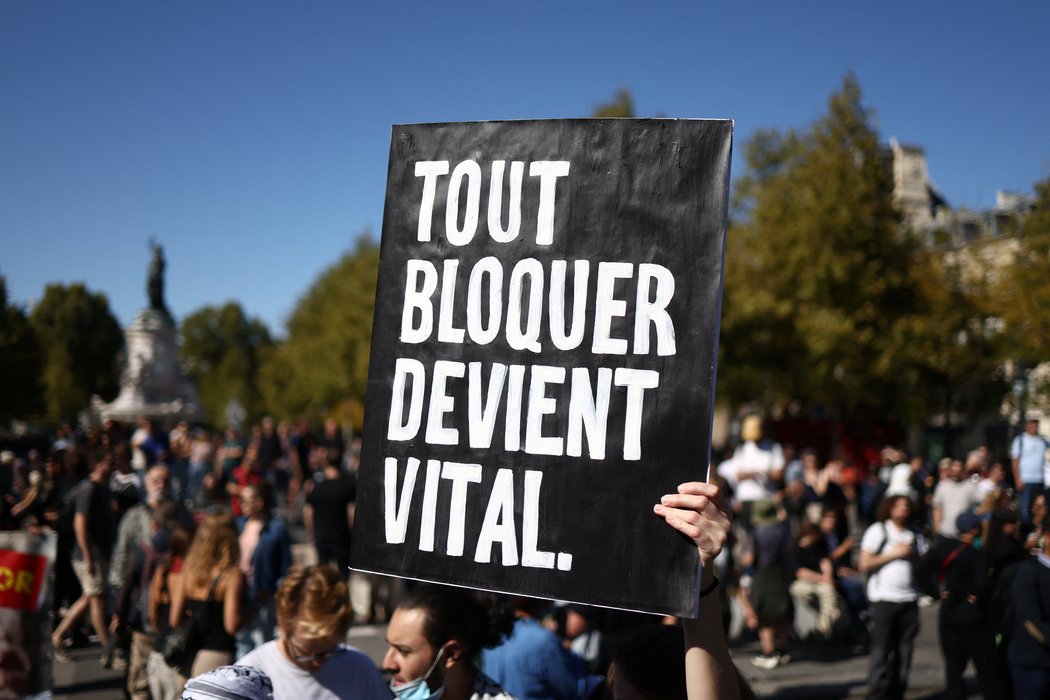
In September, a huge social justice movement came together to oppose budget cuts proposed by the government for 2026, and the refusal of the proposed “Zucman tax”, a legislative proposal which would tax households worth over €100 million in assets with 2 per cent of their net worth on an annual basis.
Economist Gabriel Zucman, who initiated the proposal, argues that because the effective tax rate for French billionaires is lower than that for most other taxpayers, action is needed to ensure the wealthiest pay their fair share. However, Prime Ministers Francois Bayrou and Sébastien Lecornu, as well as President Emmanuel Macron’s centrist, pro-business party oppose the tax, instead proposing an austerity budget as a response to the country’s mounting deficit and debt.
These fiscal policies prompted mass mobilisations in the country, under the so-called “Block Everything” movement. On 10th September, the Block Everything movement gathered almost 200,000 people to protest the funding cuts to public services discussed for the 2026 national budget plan. The protest was spontaneously organised, using social media as the main coordination tool.
Across the country, highways were blocked and barricades were mounted, with more than 500 protesters arrested. VoxPublic reports that the “Block Everything” movement has received wide support from trade unions and left-wing political parties. The Ministry of Interior recorded 812 actions across the country, including 550 gatherings and 262 blockades. The Confédération Générale du Travail (CGT) confirmed the participation of nearly 250,000 people at a protest on 10th September. It is reported that more than 50 prefectures had authorised the use of drones to monitor the 10th September demonstrations, with some decrees challenged in court and subsequently suspended.
On 18th September 2025, hundreds of thousands of people marched again to support Zucman’s tax initiative, after it was blocked by the right-wing majority in the Senate, marking one of the largest strikes of the decade in France. Public service providers, such as employees in the education and transportation systems, took part in the mobilisation. Police responded with the use of tear gas, beatings, targeting of journalists and the arrest of more than 300 protesters.
Despite the mass mobilisations, in October, Prime Minister Lecornu confirmed that the Zucman tax will not be included in the 2026 budget plan.
Bans and other repressions of protests
There have been several concerning bans and repressions of protests, including Palestine solidarity protests (see below).
- On 3rd March 2025, the mayor of Mennecy prohibited a protest from taking place in front of the Marie Laurencin high school on the grounds of public safety, citing incidents that had taken place at the location in previous years. The organisers, the Force Ouvrière union of high schools and colleges of Essonne, the Sud Education Essonne union, and the association of teachers of economic and social sciences, had provided prior notice of the protest as legally required. LDH intervened in this case by asking the Administrative Tribunal of Versailles to suspend the protest ban, a request that was granted.
- No prior approval is required to protest in France, as authorities only need to be notified in advance if a protest is planned. However, authorities then have discretion to issue bans and may use the pretext of public security to crack down on specific protests. For instance, in March, an ultra-right protest took place without intervention, while a feminist and Palestine solidarity march was prohibited from taking place by the police due to an alleged risk of public disturbances.
- Since December 2024, more than 400 migrants have been occupying La Gaîté Lyrique cultural centre. Many of them, who were under age or unaccompanied migrants, occupied the building because they lacked housing. In March 2025, the police evicted them from the premises. During the raid, protesters who held a picket outside and attempted to prevent the eviction were met with police violence and more than 40 protesters were arrested.
- On 1st May, many marches took place around the country on the occasion of International Workers’ Day, with several incidents of police violence recorded. At the demonstration in Paris, at least three journalists were physically assaulted by police. In addition, five independent Spanish journalists had their protective equipment arbitrarily seized by police and were threatened with detention when they asked for it back.
- It has been reported that far-right groups have infiltrated left-wing demonstrations to incite violent clashes with the police. Members of the far-right Eros group requested to take part in the Paris Pride parade in June 2025. Their participation was not formally welcomed by the organisers of the Pride, and they claimed that if they were not allowed to join, it would mean that the Pride was being monopolised by left-wing ideologists. Finally, the group took part in the march by walking beside it.
In Martinique, people continued to mobilise against the rising cost of living, illustrating the persistence of deep social grievances in France’s overseas territories. Previous protests in 2024 were met with severe restrictions from French authorities, as reported by the CIVICUS Monitor. In September 2025, protests were again met with violence as the French government sent in reinforcements, including mobile gendarmes and nautical brigades.
Freedom of expression
Harassment of journalists
According to the European Centre for Press and Media Freedom’s Mapping Media Freedom project, 60 cases of journalists being sued, harassed or prevented from doing their job have been recorded in France in 2025 alone.
In January 2025, investigative journalist Ariane Lavrilleux was arrested, had her home raided and was detained for almost 40 hours. The journalist was charged with disclosing information in violation of national defence secrecy. The charges relate to her published investigation which alleged that French intelligence services had worked with Egyptian intelligence services in operations aimed at targeting migrant smugglers at the Libyan border, during which civilians were killed by French intelligence agents. On 17th January 2025, charges against Ariane Lavrilleux were dropped, and she was released.
During an anti-racism protest in Paris on 22nd March 2025, independent journalist Clément Lanot was physically assaulted by police while covering the event. Video footage showed Lanot, clearly identifiable as press, being tripped by an officer and then struck on the head with a baton while on the ground. No formal investigation or accountability measures had been publicly confirmed by mid-2025. This event exemplifies the risks faced by journalists covering demonstrations, particularly when reporting on police actions, and adds to growing concerns over police violence and the deterioration of press freedom in France.
On 8th June 2025, Yanis Mhamdi of the independent media outlet Blast, and Omar Faiad, a reporter for Al Jazeera, were arrested by Israeli authorities while on the Madleen ship, as part of the Global Freedom Flotilla humanitarian mission. Faiad was released on 10 June, while Mhamdi remained in detention for eight days. During his detention, CSOs such as Reporters Sans Frontières and the Committee to Protect Journalists urged the French government to pressure the state of Israel into ending the arbitrary detention of Mhamdi. On 14th June, Le Monde reported that the French government had not yet commented on the legality of the arrest of French citizen Mhamdi. Yanis Mhamdi was finally released on 16 June.
Proposal to reform the public broadcaster and threats against journalists
In 2023, Rachida Dati, the French Minister of Culture, presented a legislative proposal to create a holding company to oversee public broadcasters France Télévisions, Radio France and the Institut national de l’audiovisuel (INA).The reform proposal has been criticised by left-wing opposition parties and trade unions, who warn the merger will result in editorial interference and budget cuts. While this proposal is currently waiting to be re-examined by the Senate, many workers in the sector have protested and held strikes against it in 2025, claiming that the proposal risks diminishing diversity of opinions and freedom of expression by monopolising the media landscape.
Furthermore, in June 2025, Dati publicly threatened journalist Patrick Cohen with legal action. During a live TV broadcast on France 5, the journalist had raised questions about money laundering to the minister. In response, Minister Dati threatened to initiate legal action against Cohen regarding past allegations of workplace harassment during his previous role as host on France Inter.
Harsh sanctions for Palestine-related speech
In June 2025, a French court sentenced Palestine solidarity activist and founder of the organisation “From Nice to Gaza” Amira Zaiter to six months in prison and a €6,000 fine, following an appeal that reduced her original sentence of three years’ imprisonment and a €10,000 fine.
Zaiter, a nursing student and mother of a young daughter, from Nice, was initially arrested and charged with “glorification of terrorism”, “glorification of crimes against humanity” and hate speech in November 2024 for her posts on X (formerly Twitter).
In one example cited by the court, she is accused of posting the words “Hitler made a big mistake. He should have put you in all the gas chambers” on her X account, despite her post being intended to criticise the statement, which is said in a video by a woman attacking an Orthodox Jewish protester holding a Palestinian flag, with Zaiter’s post quoting the video in question. In a worrying conflation of criticism of Israel with antisemitism, the court also cited a post referring to the Israeli flag as a “flag of shame” as justification for the verdict.
Her case drew the attention of organisations such as Crif (Conseil représentatif des institutions juives de France, the Representative Council of French Jewish Institutions), Licra (Ligue internationale contre le racisme et l'antisémitisme, the International League Against Racism and Anti-Semitism), and the European Jewish Organisation, groups known for using legal avenues to suppress Palestine solidarity and anti-genocide speech and activism, who have intervened in the case as civil parties. Alongside those organisations, Ilan Choucroun, a French-Israeli soldier engaged in Gaza, also participated as a civil party. Zaiter had exposed his participation in the genocide in Gaza on social media, referring to him as a “genocidal Zionist”. Alongside her prison sentence, Zaitar has been ordered to pay out the €6,000 to these civil parties, as well as to publish her conviction in local newspapers at her own expense.
As her case gained visibility, Zaiter was expelled from her nursing school, compounding the impact on her personal and professional life. She was held in pre-trial detention for 46 days, and reported being denied visits and contact with her daughter.
Her case is the first prison sentence given in France to a Palestine solidarity activist for social media content. Previously, in March 2025, Pro-Palestinian activist Elias d’Imzalene was given a five-month suspended prison sentence for using the term “intifada” at a protest in September 2024. D’Imzalene stated that he was initially threatened with even more serious legal charges, including a possible 15-year prison sentence for allegedly undermining France’s fundamental interests, which was later reduced to a potential five-year term for “inciting violence.”