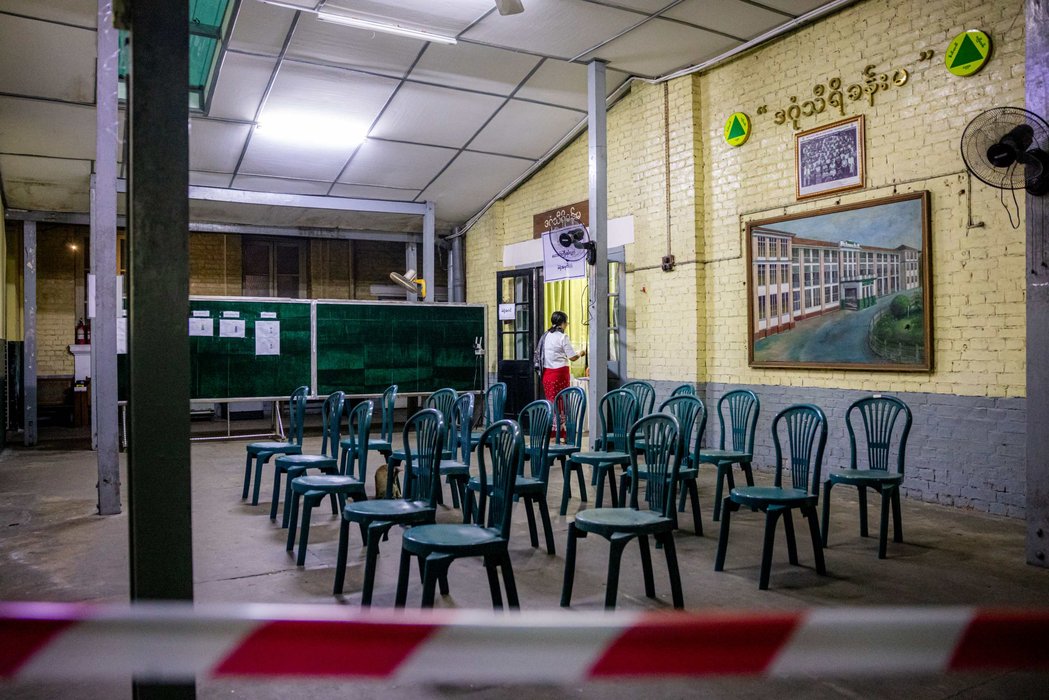
Myanmar’s civic space is rated ‘closed’ by the CIVICUS Monitor. Since the 2021 coup, thousands of activists and protesters have been detained on fabricated charges including terrorism, incitement and sedition. Many have been convicted by secret military tribunals in unfair trials and given harsh sentences, including the death penalty. Some have been tortured or killed. There has also been an unrelenting crackdown on the media. Many independent civil society groups have had to shut down, operate underground or outside the country.
In September 2025, a report published by the UN Human Rights Office pointed to increased killings, torture, razing of villages, and mass forced displacement. Between the 2021 military coup and 20th August 2025, credible sources have verified the killing of some 7,100 people by the military, of whom about a third were women and children. At least 29,560 people have been arrested on political grounds and over 22,000 remain in detention without respect for fair trial and judicial guarantees in military-controlled courts. Since the escalation of hostilities in Rakhine, hundreds of thousands more people have been displaced.
In October 2025, the Special Rapporteur on the situation of human rights in Myanmar issued a report that found that junta forces have continued airstrikes on civilian targets, including schools, clinics, monasteries and displacement camps. Over 100,000 civilian homes have been destroyed in arson attacks. 3.6 million people are displaced, and nearly 22 million require humanitarian assistance. Having driven Myanmar into a devastating humanitarian and human rights crisis and failed to consolidate control over the country, the junta is making a desperate bid to manufacture a façade of legitimacy by holding sham elections.
On 12th January 2026, hearings began at the International Court of Justice (ICJ) on the Myanmar genocide case against the ethnic Rohingya. In August 2017, Myanmar security forces began a sweeping campaign of massacres, rape, and arson against the Rohingya in northern Rakhine State that forced more than 700,000 people to flee to neighboring Bangladesh. In November 2019, Gambia filed a case before the ICJ alleging that Myanmar’s atrocities against the Rohingya constitute genocide and violate the Convention on the Prevention and Punishment of the Crime of Genocide.
Five years since the 1st February 2021 coup, human rights groups say that the junta has committed widespread repression and abuse in every facet of life in the country including war crimes and crimes against humanity. The junta held elections in three phases since December 2025 which civil society groups have called a sham and an effort by the military to ensure victory for the junta’s proxy party, the Union Solidarity and Development Party (USDP). Major opposition parties have been barred from participating, democratic leaders are jailed and an ongoing civil war has kept many from voting. Autocratic countries like Russia, Belarus, and China have expressed support for the junta’s election as well as ASEAN members Cambodia, Vietnam, and Laos.
On 31st January 2026, it was reported that Myanmar's military-backed party - The USDP - had won the elections, winning an overwhelming majority in Myanmar's two legislative chambers. The 11-member Association of Southeast Asian Nations (ASEAN) has yet to recognise the election outcome at the time of writing.
In recent months, the junta deployed the new ‘Election Protection Law’ to criminalise more than 300 individuals, including activists, for their criticism or protests against the sham elections. Organisations and media outlets were also targeted by the law. Rallies were also banned by the junta-appointed election commission while journalists inside and outside Myanmar reported severe restrictions on press freedom and a climate of fear.
There were also reports of restriction on civil society around the March 2025 earthquake and transnational repression of an activist and family from Malaysia. A Chinese network and Myanmar telecoms companies enabled the junta’s digital terror campaign.
Association
Repressive tactics intensified around junta-imposed elections
After the coup, the junta replaced the civilian Union Election Commission with a military-appointed body. The junta has sought to crush all political opposition, derail any possible establishment of democratic civilian rule, and obtain legitimacy for a military-controlled state. The winner of the previous elections in 2015 and in 2020, the National League for Democracy, has been dissolved and its leaders Aung San Suu Kyi, Win Myint and others remain detained, and opposition parties have all been either deregistered or dissolved.
As previously documented, in July 2025 the junta passed the Law on the Protection of Multiparty Democratic General Elections (Election Protection Law) which criminalises speaking out or inciting violence against the election or election workers. Jail sentences under the law range from three years to a maximum of life imprisonment or even the death penalty.
In the weeks leading up to the first round of voting on 28th December 2025, the junta weaponised it to intensify repressive tactics, homing in on criticism of any kind, even social media reactions, messages and posts. Others have been criminalised for distributing stickers and leaflets or delivering speeches.
The regime has arrested two more film directors, Zambu Htun Thet Lwin and Aung Chan Luu, over a propaganda film promoting its planned election—this time because they reacted with “love” emojis to Facebook posts deriding the actors who took part in it.#WhatsHappeningInMyanmar pic.twitter.com/Uiib7TrRhb
— The Irrawaddy (Eng) (@IrrawaddyNews) November 1, 2025
On 9th September 2025, Ko Nay Thway, a man in Myanmar’s Shan State, was sentenced to seven years with hard labour for criticising the election on social media. On 14th September 2025, five individuals from Loikaw, including three minors aged 14, 16, and 17, were arrested under the same law. Subsequently, on 16th September, four men from Yangon were arrested for shouting a popular resistance slogan while riding motorcycles, while on 19th September the junta targeted two young men for allegedly posting anti-regime stickers.
On 29th October 2025, the filmmakers Zambu Htun Thet Lwin and Aung Chan Lu were arrested for “liking” a Facebook post that criticised an election propaganda film. In November 2025, in Hlaing Tharyar Township, three youths were sentenced to up to 49 years in prison. They were charged for posting anti-election posters that depicted a bullet on a black ballot box. In early December 2025, a man was arrested near Yangon for a Facebook message condemning the vote, while another was arrested for damaging an election billboard.
ALTSEAN-Burma reported on 21st January 2026 that 335 individuals have been charged under the law for criticising or disrupting the sham polls.
According to the Myanmar Internet Project (MIP), four organisations and three news information sharing pages, including media, were charged under the law, including the People’s Defence Force (PDF). Hlaing Info Telegram Channel, the Telegram channel of Khit Thit News Media, and AAMIJ News were also charged under this law.
There are also reports of people in camps for Internally Displaced Persons being pressured to vote under threat of losing aid. Out of a total of 330 townships nationwide, there are an estimated 56 under martial law throughout the country where no voting took place, according to the UN human rights office.
In January 2026, Tom Andrews, Special Rapporteur on the situation of human rights in Myanmar called on the international community to unequivocally reject as illegitimate the election results in Myanmar and any power arrangement that follows. Civil society groups have called the elections a sham and an effort by the military to ensure victory for the junta’s proxy party, the Union Solidarity and Development Party.
Restrictions on civil society around the earthquake response
In September 2025, ICNL published a report about restrictions to civil society following the devastating earthquake that struck Myanmar in March 2025.
According to ICNL, the military used the Organisation Registration Law (2022), which criminalised unregistered associations, to create a hostile legal environment for civil society. In the aftermath of the earthquake, it instituted an arbitrary permission regime for all emergency aid on top of existing restrictions, imposing a system of direct control that systematically obstructed and co-opted independent relief efforts.
Civil society access to affected populations was systematically blocked through a web of intimidating checkpoints, restrictive travel permits and curfews, preventing timely search and rescue operations and channelling humanitarian assistance to military allies.
The military effected an information blackout by trying to control digital communications, banning independent media, repressing journalists, and simultaneously attempting to control the narrative via its own campaigns.
Civil society workers and volunteers were subjected to violence, arbitrary arrest, and politically motivated charges under restrictive laws, creating a climate of fear that undermined independent relief efforts.
Despite the severe repression, informal, local, and unregistered civil society organised together, operating clandestinely to deliver life-saving aid, demonstrating profound resilience.
Transnational repression of activist by junta
🇲🇾Myanmar pro-democracy activist and refugee Thuzar Maung and her family, forcibly abducted from their home in Kuala Lumpur in 2023, have been confirmed to be in the custody of the Myanmar’s junta two years after their disappearance.
— Fortify Rights (@FortifyRights) October 24, 2025
Malaysian authorities and international… pic.twitter.com/seFtpscARp
On 17th October 2025, the junta announced that they had detained Thuzar Maung, a Myanmar pro-democracy activist, along with her husband and three children. The junta said that Thuzar Maung and her family members were arrested for “illegally reentering” Myanmar and that an arrest warrant had been issued for her under Myanmar’s counterterrorism law in January 2023.
Thuzar Maung is a longtime advocate for democracy in Myanmar and for refugee and migrant rights in Malaysia. She fled Myanmar for Malaysia in 2015 to escape growing violence against Muslims. The United Nations refugee agency, UNHCR, recognised her and her family as refugees.
In July 2023, unidentified men abducted Thuzar Maung with her husband, Saw Than Tin Win, and her daughter and two sons from their home in Ampang Jaya, Kuala Lumpur in Malaysia. A friend on the phone with Thuzar Maung at the time heard her yell that unknown men were entering the house, before being disconnected. CCTV footage captured a car with fake licence plates entering their gated community before the call and exiting three hours later, at which point all of the family’s phones had been turned off.
Peaceful Assembly
Junta banned election campaign rallies
On 21st October 2025, the junta-appointed Union Election Commission (UEC) banned campaign rallies and street processions ahead of the December 2025 polls, citing security concerns. Instead, parties will be restricted to delivering speeches at designated venues approved by the authorities.
The UEC announced the restrictions during a meeting with political parties, stating that security at speech venues would be handled by the Ministry of Home Affairs. Parties must submit requests in advance, specifying the date, location, and speakers for each event.
UEC chairman Than Soe warned that parties and independent candidates must avoid undermining the “dignity of the military” during speeches and must comply with provisions in the Election Protection Law. Violations, he said, would be met with legal action.
Protest leader arrested and ill-treated under draconian election protection law
The Yadanabon University Students’ Union shared on social media that its former chairperson Htet Myat Aung, 24, was arrested by regime police in Mandalay Region sometime after they lost contact with him on Dec. 14.#WhatsHappeningInMyanmar
— DVB English News (@DVB_English) December 19, 2025
Read more: https://t.co/WLU2lY2rxK pic.twitter.com/gtCMuNhxcm
Protest leader Htet Myat Aung from Mandalay was arrested on 14th December 2025. He is being held incommunicado by the military regime, raising serious concerns for his life and physical safety. He was among prominent activists including Dr. Tayzar San, Nan Lin and Khant Wai Phyo who led a protest in Mandalay city calling for the release of political prisoners, an election boycott, and an end to forcible conscription into the military.
A former president of the Yadanabon University Students’ Union, Htet Myat Aung had been subject to an arrest warrant with a bounty on his head for his anti-junta activities. The General Strike Coordination Body (GSCB), a network of non-violent anti-regime forces, said the junta inflicted “severe physical violence” on Htet Myat Aung during the arrest.
The junta charged him and nine others the same day under Section 24(b) of the draconian new Election Protection Law. Htet Myat Aung had long been a thorn in the junta’s side by leading non-violent protests since the 2021 coup.
Charles Santiago, APHR Co-Chairperson, Former Member of Parliament, Malaysia said: “Any harm that comes to Ko Htet Myat Aung in detention will lie squarely with the military authorities who continue to torture with impunity. His case is emblematic of the thousands of political prisoners across Myanmar who must be immediately and unconditionally released.”
Expression
Journalists and media outlets targeted around elections
According to ALTSEAN-Burma, journalists inside and outside Burma reported severe restrictions on press freedom and a climate of fear during the sham election. Reporters stated that the junta granted access primarily to pro-regime outlets and forced independent domestic journalists to self-censor their work.
In November 2025, Reporters Without Borders (RSF) highlighted the use of the “electoral interference” law to prosecute the Assistance Association for Myanmar-based Independent Journalists (AAMIJ) for its journalistic work.
According to RSF, On 10th November 2025, the military authorities charged AAMIJ — both a media outlet and an association publishing independent reporting on the situation in Myanmar from exile — under Article 24(a) of this law, which punishes “any threat or harm caused to a candidate” with sentences of up to seven years in prison. AAMIJ’s “offence”: having revealed evidence linking an electoral candidate to drug trafficking.
In December 2025, according to ATHAN, freelance journalist Hsuat Rain Pan (aka Swan) was sentenced to an additional 10 years in prison by the Yangon Western District Court on December 2nd under Section 50(j) of the Counter-Terrorism Law. Hsuat Rain Pan had previously been sentenced to three years in prison on May 16, 2025, under Section 505(a) of the Penal Code.
#Myanmar: CPJ strongly condemns the alleged physical abuse of imprisoned journalist Myat Thu Kyaw at Yangon’s Insein Prison and calls on authorities to immediately release him on humanitarian grounds.https://t.co/6n5SltCN0G#PressFreedom
— CPJ Asia (@CPJAsia) January 28, 2026
In January 2026, the Committee to Protect Journalists (CPJ) reported that imprisoned Myanmar journalist Myat Thu Kyaw had been physically abused at Yangon’s Insein Prison. Prison authorities orchestrated an assault on Myat Thu Kyaw and three other political prisoners using members of an incarcerated Taiwanese drug syndicate, acting on the direct orders of prison officials. Myat Thu Kyaw sustained serious injuries to his eyes, face and arms and was temporarily admitted to a prison hospital for treatment, Nay Myo said.
Myat Thu Kyaw, a veteran freelance photojournalist who has contributed to foreign and domestic outlets, was arrested in January 2023, while covering a protest in Yangon. In July 2023, a military court in Insein Prison sentenced him to three years under Section 505(a) of the Penal Code for publishing reports favourable to the opposition National Unity Government and anti-junta armed forces known as People’s Defence Forces. In January 2025, he was handed an additional five-and-a-half-year sentence under the Counter Terrorism Law, bringing his total sentence to eight and a half years in prison.
#Myanmar 🇲🇲: Journalist Mu Dra was abducted from her home in Myanmar’s Rakhine state by the rebel Arakan Army on September 20. We join our affiliate ,the Myanmar Journalists Network (MJN), in calling for her immediate release https://t.co/VOE7UePaTc
— IFJ (@IFJGlobal) September 26, 2025
Journalists were also targeted by armed groups. In September 2025, the Arakan Army detained journalist Mu Dra for more than a week after she reported on abuses committed by this armed group opposed to the military junta. Mu Dra, a journalist reporting for the independent press agency Border News Agency, was abducted from her home in front of her parents by the intelligence services of the Arakan Army (AA), an ethnic armed organisation, controlling much of Rakhine State in western Myanmar. Three days later, an AA spokesperson denied that she had been arrested, claiming instead that she was merely being questioned as part of an investigation into activities 'beyond the rules to be followed during the fighting period', without providing any concrete evidence.
Chinese network and Myanmar telecoms companies enabling the junta’s digital terror campaign
A report published in September 2025 exposed the significant collaboration between the military junta and Geedge Networks in implementing a commercial version of China’s “Great Firewall”, giving the junta unprecedented capabilities to track down, arrest, torture and kill civilians.
Geedge Networks is a Chinese company with links to the Chinese government.
Justice For Myanmar’s report, Silk Road of Surveillance: The role of China’s Geedge Networks and Myanmar telecommunications operators in the junta’s digital terror campaign also exposes 13 telecommunications companies in Myanmar that are integral to the continued functioning of Geedge’s sophisticated surveillance and censorship technology on behalf of the junta.
Geedge’s transfer of a commercialised version of China’s “Great Firewall” gives the junta unrestricted access to the online activities of 33.4 million internet users in Myanmar. Notably, Geedge systems enable the tracking of network traffic at the individual level and can identify the geographic location of mobile subscribers in real time by linking their activity to specific cell identifiers.
Justice For Myanmar said that by providing hardware, software, training and support to the illegal military junta, Geedge may be aiding and abetting in the commission of crimes against humanity, including the acts of torture and killing, carried out by the junta.
Activists to sue Norway’s Telenor for handing data to military
In October 2025, a group of civil society organisations in Myanmar said it had plans to take legal action against Norwegian telecoms firm Telenor, accusing it of passing customer data to the country’s military government for use in repression.
The activists sent Telenor a notice of intent to sue, according to a statement from the Netherlands-based nonprofit Centre for Research on Multinational Corporations (SOMO), which is backing the case. The case states that the data shared by the telecoms giant was used by the military following its 2021 coup to trace and target civilians.
The claimants allege that Telenor, majority-owned by the Norwegian government, disclosed data from millions of customers to the military authorities, which, after toppling the country’s elected government, embarked on a campaign of violence and repression. They say the information helped the military target anti-coup activists, several of whom were tortured in detention and one of whom was executed.
In December 2025, The Norwegian National Contact Point (NCP) for the OECD Guidelines for Multinational Enterprises on Responsible Business Conduct found that Telenor breached international standards on human rights and responsible business conduct. The decision confirms the complainants’ claim that Telenor failed to respect human rights and failed to conduct human rights due diligence concerning its operations in Myanmar and its disengagement from Myanmar following the military coup in 2021.