GENERAL
At the end of March and beginning of April 2026, Israeli authorities adopted a new law introducing the death penalty for Palestinians convicted of certain “terrorism-related” offences, primarily in military court cases. As previously documented, the legislation, approved by the Knesset on 30th March 2026, mandates capital punishment in specific cases and has been widely criticised by human rights organisations and UN experts for being discriminatory in its application and effectively targeting Palestinians only. In early April 2026, the law continued to generate strong international reaction, with UN officials and multiple states warning that it could violate international human rights law, particularly the principles of non-discrimination and the right to life. Human rights organisations also raised concerns that the law could entrench unequal legal treatment and increase the risk of arbitrary deprivation of life.
These concerns deepened further in May 2026, when the Knesset approved additional legislation establishing a special military tribunal to prosecute Palestinians accused of involvement in the 7th October 2023 attacks.
This legislative development must also be understood within a wider context of shrinking civic space in Palestine, as underlined in recent research by the Arab NGO Network for Development (ANND) published on 27th April 2026, which highlights the structural pressures and systematic targeting faced by civil society organisations.
Similar concerns were raised by the Palestinian NGOs Network (PNGO) in a study published in May 2026 on civil society interventions in the Gaza Strip. The study documented the severe operational challenges facing Palestinian NGOs, including restrictions on access and movement, destruction of infrastructure, displacement of staff, funding uncertainties, and heightened security risks for humanitarian and civil society workers. PNGO further noted that these conditions have significantly constrained the ability of organisations to deliver services, monitor human rights violations, and engage in advocacy activities, contributing to an increasingly restrictive environment for civil society action in Palestine.
Peaceful Assembly
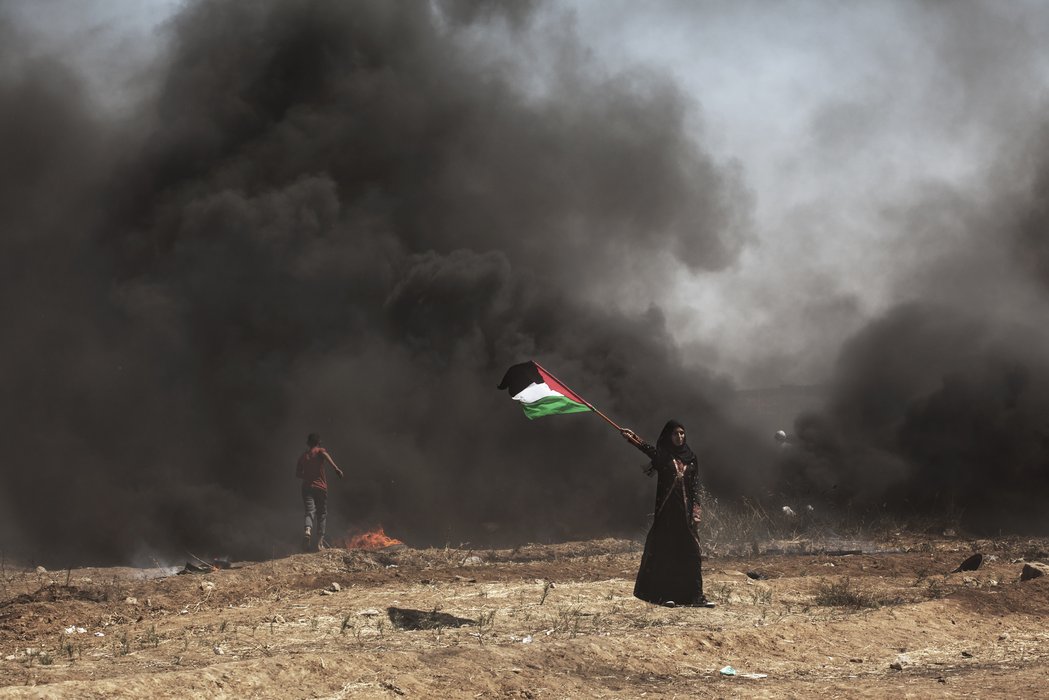
Widespread public mobilisation and general strikes in the occupied West Bank have continued to reflect strong opposition to legislative measures perceived as discriminatory and escalatory in the context of the ongoing bombardement by Israel. On 1st April 2026, widespread demonstrations and a general strike took place across the occupied West Bank in response to the Israeli parliament’s adoption of a law introducing the death penalty for Palestinians convicted of certain attacks (see above in the general update section). The mobilisations were supported by political factions, including Fatah, and led to the closure of shops, schools, and public institutions in several cities such as Ramallah, Nablus, and Hebron. Protesters marched in large numbers, denouncing the law as discriminatory and calling for international intervention.
Association
On 6th April 2026, a World Health Organisation–contracted humanitarian worker was killed in Gaza during a security incident, prompting the WHO to suspend all medical evacuations from the territory via the Rafah crossing due to serious safety concerns for staff and patients.
The pattern of violence against humanitarian and civilian service providers continued on 18th April 2026, when UNICEF reported that two contracted water truck drivers were killed in northern Gaza while delivering clean drinking water at a distribution point in Gaza City, leading the organisation to suspend operations at the site and call for the protection of humanitarian personnel and infrastructure. This trend persisted two days later, on 20th April 2026, when an Israeli airstrike reportedly struck NGO personnel working at a water well in Gaza City, killing one person and injuring four others, while also causing severe damage to the water infrastructure.
Expression
Freedom of expression in Palestine remains severely impacted by the ongoing conflict, particularly through repeated lethal risks faced by journalists and humanitarian personnel operating in Gaza.
On 16th April 2025, UNESCO’s Director-General strongly condemned the killing of Palestinian journalist Fatima Hassouna in Gaza, stressing that journalists are civilians protected under international humanitarian law and must not be targeted.
Similarly on 8th April 2026, Palestinian journalist Mohammed Washah, working for Al Jazeera Mubasher, was killed in an Israeli drone strike that hit the vehicle he was travelling in near Gaza City while he was carrying out reporting activities.
Restrictions on press freedom continued to intensify in the occupied West Bank. On 25th May 2026, the Palestinian Centre for Development and Media Freedoms (MADA) reported the arrest of freelance journalist Anas Mujeir Hawari following a pre-dawn raid by Israeli forces on his home in the town of Sebastia, northwest of Nablus. According to testimonies collected by MADA, the forces conducted a violent search of the house, confiscated personal equipment including a mobile phone and laptop, and subjected the journalist to on-site interrogation focused on his professional activity before transferring him to an undisclosed location.