GENERAL
TEMPI TRAIN CRASH INVESTIGATION COMPLETED AND TRIAL SET FOR MARCH 2026
More than two years after the disastrous railway accident near Tempi on 28th February 2023, which killed 57 people, many of them university students, the main investigation was declared complete at the end of August 2025. The Tempi train crash has remained a major political issue ever since, with past and ongoing public protests, rallies, and demands from victims’ families for accountability (see previous CIVICUS Monitor updates). Public criticism focused on railway safety failures, regulatory oversight, and government accountability and inaction, keeping the tragedy at the center of national debate.
As reported in a previous CIVICUS Monitor update, the conclusion of the investigation sparked nationwide protests on 6th September 2025, with victims’ families raising serious concerns over gaps in the case and requesting the exhumation of victims’ bodies for further forensic examination, arguing that additional tests were necessary to clarify the circumstances of the victims’ deaths. Following public pressure and a hunger strike by the father of one of the victims, on 26th September 2025, the Larissa First Instance Prosecutor ordered the exhumation of Routsis’ son strictly for DNA identification, without toxicological testing. On 6th October 2025, in a significant procedural shift, the Larissa Appeals Prosecutor’s Office approved toxicological and biochemical testing of victims’ remains, allowing a separate investigation if new findings emerge, marking the first formal approval of laboratory testing beyond identification.
On 14th October 2025, media reported that the Larissa Appeals Prosecutor had set 23rd March 2026 as the date for the start of the trial.
OPEKEPE SCANDAL: POLICE ARRESTS, COURT VERDICTS, AND PARLIAMENTARY INQUIRY CONCLUDE
In October 2025, the investigation into the so-called “OPEKEPE scandal” continued to unfold through both parliamentary and judicial proceedings. The scandal, which first publicly emerged in May 2025, involves the Greek state agency Organisation for Payments and Control of Community Aid Guidance and Guarantees (OPEKEPE), responsible for distributing European Union agricultural subsidies to farmers. It centres on the massive alleged misappropriation of EU agricultural funds totalling more than 20 million euros (and even possibly exceeding one billion euros), dating back at least to 2017. As reported in a previous CIVICUS Monitor update, the case also escalated into a political crisis following the submission of a 3,000-page European Public Prosecutor’s Office (EPPO) dossier to the Greek Parliament on 19th June 2025, which allegedly links government officials to the manipulation of these subsidies.
During a press conference on 2nd October 2025, European Chief Prosecutor Laura Codruța Kövesi stated that “OPEKEPE has become the acronym for corruption, nepotism and clientelism,” and stressed the need to amend Article 86 of the Greek Constitution, which she argued hampers the investigation process. Article 86 grants the Greek Parliament exclusive authority to prosecute government officials for criminal offences.
On 22nd October 2025, Greek police arrested 37 individuals in Thessaloniki, Pella, Ioannina, Attica and Crete for allegedly fraudulently receiving 5-10 million euros in EU farm subsidies between 2018 and 2025. The suspects, who were not farmers, reportedly used false land registrations and collaborated with OPEKEPE staff and accountants to divert funds, often spending them on luxury goods. Another operation on 12th December 2025 in Crete led to 15 more arrests, with more than 1.7 million euros in subsidies allegedly fraudulently claimed.
On 26th November 2025, the Athens Single-Member Misdemeanor Court found 14 defendants, mostly from Crete, guilty of illegally obtaining 5,000-40,000 euros in subsidies, imposing 10 to 18 month prison sentences, all suspended for three years.
The parliamentary inquiry into the “OPEKEPE scandal” formally concluded on 27th February 2026, with its findings submitted to the Speaker of the Greek Parliament, Nikitas Kaklamanis. Established on 29th July 2025, the investigative committee met from 15th September 2025 over five and a half months, holding 49 sessions, hearing 76 witnesses, and producing about 19,000 pages of minutes. Using its parliamentary majority, the ruling New Democracy (ND) party approved the final report, which concluded that OPEKEPE’s problems were long-standing and systemic, but found no evidence of criminal liability on the part of former ND ministers Makis Voridis and Lefteris Avgenakis. Opposition parties criticised the inquiry for failing to fully examine the case and called for the committee’s work to continue.
FREEDOM OF EXPRESSION
JOURNALIST PHYSICALLY ATTACKED WHILE COVERING STRIKE DEMONSTRATIONS IN PATRAS
On 14th October 2025, “Peloponnisos” newspaper journalist Panagiotis Rigopoulos was verbally and physically attacked while covering strike demonstrations in the city of Patras. The attack was carried out by a group of around 40 people, reportedly led by the former president of the Patras Builders’ Union and former general secretary of the Patras Labour Centre, Dimitris Angelopoulos. According to media reports, the group surrounded the journalist and demanded that he delete a video showing officials from the Patras Labour Cenre entering the construction site of the Roman Conservatory and urging workers to leave their jobs to join the strike. Rigopoulos was punched and kicked, and his clothes were torn in an attempt to seize his mobile phone and delete the photos and videos he had taken. He was later hospitalised, and police launched an investigation.
Government Spokesperson Pavlos Marinakis condemned the attack, describing it as “a brutal attack on the freedom of the press.” In a response letter from the Permanent Representation of Greece to the Council of Europe dated 22nd January 2026, it was stated that the case file had been submitted to the Public Prosecutor at the Court of First Instance of Achaia on 27th October 2025 and that the investigation remains ongoing.
JOURNALISTS THREATENED AFTER PUBLISHING INVESTIGATION
On 8th November 2025, the investigative journalism group Reporters United received threats a day after publishing an investigation linking the Latsis family, a prominent Greek shipping and business dynasty, to a planned ammunition shipment from Greece to Israel. According to Reporters United, the intimidation came through several channels. An anonymous Instagram account sent threatening messages to Reporters United and three journalists involved in the investigation, while an unknown caller also contacted the newsroom demanding that the report be withdrawn. When one of the journalists called back the number, he received a text message stating that he was “in very bad trouble.”
REPORTERS EXPOSED TO TEAR GAS WHILE COVERING FARMERS’ PROTESTS
The Union of Journalists of the Peloponnese, Epirus and the Islands (ESIEPIN) reported that four journalists were exposed to tear gas fired by police on 9th December 2025 while covering farmers’ protests at the Charilaos Trikoupis Bridge (Rio-Antirrio Bridge). According to ESIEPIN, the journalists were positioned in a visible area, in front of the main group of protesters, documenting the events as part of their professional duties. The union called for an immediate and thorough investigation into the incident and for accountability where responsibility is established.
GOVERNMENT SPOKESPERSON THREATENS JOURNALIST AFTER QUESTION ON DEADLY CHIOS INCIDENT
During a press briefing on 9th February 2026, Government Spokesperson Pavlos Marinakis threatened journalist Christos Avramidis with legal action following a question about the collision between a boat carrying migrants and a Greek Coast Guard vessel near Chios on 3rd February, which resulted in 15 deaths. Avramidis asked whether the Coast Guard operation had been a rescue operation or an act of deterrence, referring to an earlier statement by the mayor of Chios and noting that deterrence practices violate international law. Marinakis responded that the Coast Guard’s role was “to prevent, in accordance with the provisions of the law and without endangering human lives, the illegal entry into our country of people who do not have the relevant right”. Rather than directly addressing whether the Chios incident constituted an act of deterrence, he accused Avramidis of “distorting” his words. Marinakis warned that such conduct was “criminal” and could have “legal consequences”, arguing that “when someone attributes to another something he did not say, that is illegal”. He also demanded that Avramidis retract his statement and called the journalist a “coward”.
On 10th February 2026, during a media appearance on the television channel ANT1 TV, Marinakis publicly singled out the newspaper Efimerida ton Syntakton (“Ef.Syn.”), accusing it of either ignorance or a “fraudulent distortion of reality” in its reporting on his confrontation with Avramidis. He further alleged that certain media outlets form a “circuit” seeking to destabilise the country.
During a press briefing on 12th February 2026, Marinakis rejected criticism that his remarks toward Avramidis amounted to the threat of a strategic lawsuit against public participation (SLAPP). He argued that he had merely pointed out the legal remedies available when statements are falsely attributed to him. He maintained that referring to possible legal action does not constitute intimidation but rather reflects a legitimate right to defend oneself against what he described as defamatory or misleading claims.
GREEK COURT CONVICTS FOUR INDIVIDUALS IN “PREDATORGATE” SPYWARE SCANDAL
As previously reported by the CIVICUS Monitor, the Supreme Court Prosecution Office of Greece concluded its investigation into the so-called “Predatorgate” case in July 2024, clearing state ministries and agencies, including the intelligence services, as well as government officials, of involvement in the use of Predator or other spyware. Prosecutors instead initiated proceedings against four business figures linked to two companies involved in supplying and purchasing the Predator spyware.
The trial of the four defendants — Tal Dilian, founder of Intellexa, whose company allegedly sold Predator spyware in Greece; his business partner Sara Aleksandra Fayssal Hamou, who provided managerial services to Intellexa; Felix Bitzios, a shareholder in Intellexa; and Giannis Lavranos, whose company Krikel purchased Predator — began on 10th April 2025. It concluded on 26th February 2026, when the Athens Single-Member Misdemeanor Court found all four defendants guilty. According to the court’s decision, they were convicted of wiretapping the phones of journalist Thanasis Koukakis, former Facebook security executive Artemis Seaford and three other individuals in cases where surveillance was deemed to have been completed, as well as 82 attempted surveillance cases. The court imposed a combined sentence of 126 years and eight months. However, under Greek law, the defendants will serve a maximum of eight years in prison, and their sentences are suspended pending an appeal.
Amnesty International described the ruling as an example of “rare accountability in abuse of surveillance technology”, while stressing that the role of the Greek government in the wider surveillance scandal remains unresolved.
FREEDOM OF ASSEMBLY
PRO-PALESTINE PROTEST IN ATHENS
On 20th September 2025, a solidarity rally in support of the Palestinian people was held in Athens. The demonstrations were organised by a wide range of civil society groups, including the March to Gaza Greece, the Palestinian Community of Greece, the Union of Palestinian Workers, the Stop the War Alliance, BDS Greece, and the Solidarity Initiative with the Palestinian People. Demonstrators voiced their support with displaced Palestinian civilians and called for an end to the war and the cessation of Israel’s military operations in Gaza.
MASS PROTESTS ACROSS GREECE OVER 13-HOUR WORKDAY LAW
Protests against a new labour law, which began on 8th September 2025 after the government opened the legislation for public consultation in late August, continued across Greece throughout autumn. The proposed law included a provision allowing working days to be extended to 13 hours (see previous CIVICUS Monitor update).
On 1st October 2025, thousands of private- and public-sector workers took part in a 24-hour general strike in Athens and Thessaloniki, causing major disruptions to transport, education, healthcare and other public services, according to media reports. Protesters argued that the proposed extension of the working day would undermine work-life balance and highlighted Greece’s relatively low wages, with the minimum monthly salary then standing at around EUR 880. They also pointed to Greece’s already long working hours: according to Eurostat, Greek workers averaged 39.8 hours per week, compared with an EU average of 35.8 hours.
The proposed labour law, titled “Fair Work for All: Simplification of Legislation – Support for the Employee – Protection in Practice”, was submitted to Parliament on 4th October for further debate. As the parliamentary vote approached, thousands of private- and public-sector workers staged another nationwide strike on 14th October, disrupting shipping, public transport and other services. Trade unions denounced the proposed legislation as “legalised exploitation”.
Despite the protests, Parliament approved the bill on 16th October by 158 votes to 109. The government said the legislation was intended to increase labour-market flexibility and efficiency, while Labour Minister Niki Kerameus emphasised that the provision allowing 13-hour working days would apply only in “exceptional circumstances”. The law came into force on 16th February 2026.
HUNGER STRIKE IN ATHENS LEADS AUTHORITIES TO APPROVE EXHUMATIONS IN TEMPI CASE
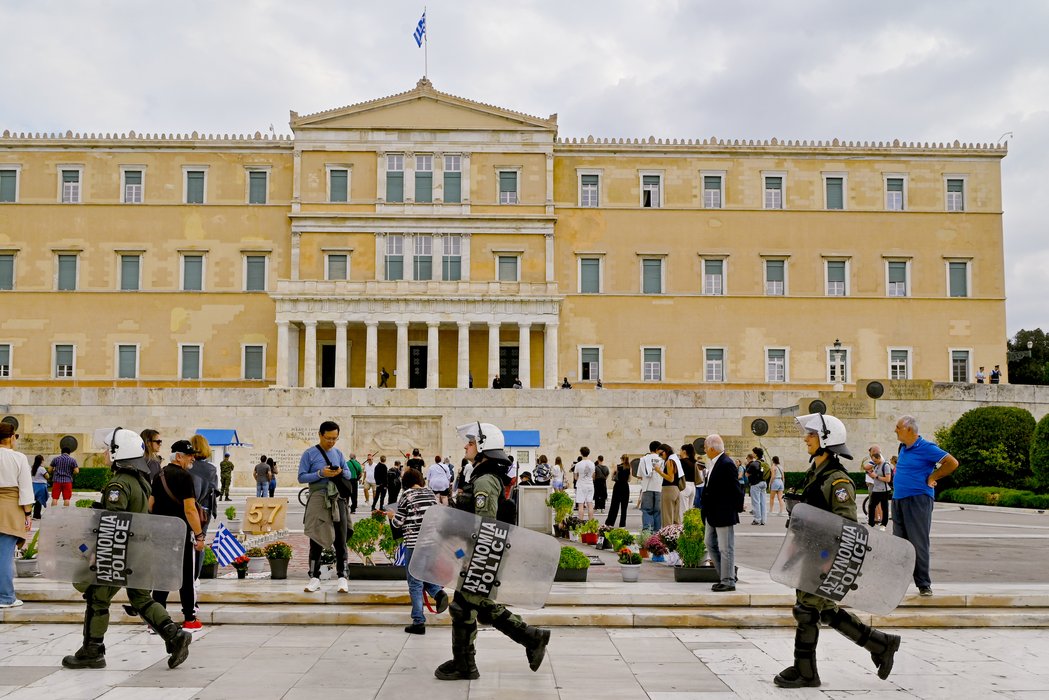
On 15th September 2025, Panos Routsis, whose son was among the 57 victims of the Tempi train crash on 28th February 2023, began a hunger strike in Syntagma Square in Athens, outside the Greek Parliament and the Tomb of the Unknown Soldier. He demanded the exhumation of his son’s body so that toxicological tests could be conducted to clarify the circumstances of his death. Routsis and other victims’ relatives had been seeking justice for more than two years, and he began the hunger strike after the Larissa Appellate Investigator refused to authorise the exhumation, which Routsis argued was necessary to establish potential criminal responsibility in the case.
Routsis’ action quickly drew widespread public support. On 18th and 22nd September, two people who were not relatives of the victims joined his hunger strike in solidarity. Others gathered at solidarity rallies throughout the strike, while professional unions, including train drivers and taxi drivers, also expressed their support.
After 23 days, Routsis ended his hunger strike on 8th October 2025, following the Prosecutor’s Office’s decision to accept relatives’ requests for the exhumation of victims’ remains and toxicological testing.
BAN ON PROTESTS NEXT TO THE TOMB OF THE UNKNOWN SOLDIER
On 20th October 2025, a controversial amendment banning protests next to the Tomb of the Unknown Soldier, one of the nation’s most symbolic landmarks, was submitted to the Greek Parliament. Besides being a popular tourist site, the tomb is also a focal point for public demonstrations, most notably by families of the victims of the Tempi train crash.
The amendment followed Prime Minister Kyriakos Mitsotakis’ Facebook post on 12th October 2025, in which he questioned the use of the tomb for protest and demonstration purposes and announced the government’s intention to introduce legislation to address the issue.
Despite objections from opposition parties in Parliament, which argued that the amendment was unconstitutional and curtailed the right to assembly, the amendment, which was included in the draft law on the Ministry of Transport, passed on 22nd October 2025 with 159 votes in favour and 134 against. According to the adopted amendment, the use or occupation of the area in front of the Monument to the Unknown Soldier for any purpose other than visiting the monument is prohibited, as are public gatherings and any alterations to the site. Sanctions include a fine or up to one year of imprisonment. The amendment entered into force on 24th October 2025.
The ban on protests next to the Tomb of the Unknown Soldier was implemented for the first time on 15th November 2025, when 23 members of the anarchist group Rouvikonas (Rubicon) were sentenced to nine months’ imprisonment, suspended for three years, for unfurling a banner in front of the monument that read: “The Unknown Soldiers were not guarding traitors of the people.”
NATIONWIDE PROTESTS OF FARMERS, LIVESTOCK BREEDERS, AND BEEKEEPERS: “A FIGHT FOR SURVIVAL”
The so-called “OPEKEPE scandal” (see above and the previous CIVICUS Monitor update) had consequences not only for government officials scrutinised by the parliamentary inquiry and individuals prosecuted in connection with fraudulent schemes, but also for the intended beneficiaries of agricultural subsidies distributed through OPEKEPE – Greek farmers, livestock breeders and beekeepers. Significant delays in the payment of subsidies and compensation by OPEKEPE, which distributes around €2.5 billion in EU agricultural aid annually, coupled with a lack of government support during an outbreak of sheep pox, prompted large numbers of farmers, livestock breeders and beekeepers to protest in Athens and Thessaloniki on 11th November 2025. On the eve of the protest, Dimitris Kampouris, former vice president of the Panhellenic Livestock Association of Chalkida, said “this is not just a protest, it is a fight for survival,” urging the government to take action.
From 30th November 2025, farmers began a nationwide mobilisation, bringing tractors onto the roads and establishing blockades at major highways and key junctions in Thessaly and other regions. Clashes with police broke out as protesters attempted to breach barricades, prompting police to use tear gas. Media reports indicated that at least one farmer was detained.
The demonstrations intensified in the following days, with protesters blocking border crossings with Bulgaria and North Macedonia on 3rd December. On 5th December, police used tear gas against farmers who attempted to block the main access road to Thessaloniki International Airport. Similar tensions erupted in Crete on 8th December, when protesters attempted to block access to Heraklion International Airport. Police responded with tear gas, sound grenades and smoke devices, while protesters threw stones. The clashes resulted in the airport being shut down. At Chania International Airport, police also used tear gas, while protesters responded by throwing stones and wooden sticks. On 10th December, farmers attempted to block the Rio-Antirrio Bridge, a key link between the Peloponnese and mainland Greece. Clashes with police followed, with stun grenades used to disperse the crowd.
The government made its first attempt to open a dialogue with farmers on 11th December 2025, when it met representatives from Crete. The meeting ended without a resolution. On 13th December, farmers declined an invitation to meet Prime Minister Kyriakos Mitsotakis, instead submitting a document outlining their demands and emphasising that responses to these demands would be a key condition for further dialogue. With no resolution reached, nationwide protests escalated further, reaching a critical phase by early January 2026.
On 7th January 2026, the government announced support measures, but farmers rejected them, arguing that they failed to address key concerns in the agricultural sector, including livestock vaccination. A four-hour meeting between the Prime Minister and farmers on 19th January also failed to resolve the dispute, and protests continued.
After farmers lifted the blockades on 23rd January, they shifted the form and tactics of their mobilisation. On 13th February 2026, they held a rally in Athens, bringing dozens of tractors into the capital.
THIRD ANNIVERSARY OF TEMPI TRAIN CRASH MARKED WITH NATIONWIDE PROTESTS
On 28th February 2026, tens of thousands of people rallied in Athens, Thessaloniki and other cities across the country on the occasion of the third anniversary of the Tempi train crash, the biggest railway accident in Greek history, as a result of which 57 people, mostly students, lost their lives. The disaster became a symbol of state failings, systemic underinvestment and corruption, highlighting what many described as a broader crisis of democracy and rule of law.
The protesters' demands remained the same as in previous years (see previous CIVICUS Monitor update). They called for justice for the victims and expressed anger over the government’s failure to conduct a thorough investigation into the accident. Trains and ferries were halted, while urban transport was disrupted as workers left their workplaces to join the demonstrations. The main slogan of the protests was “we do not forget, we do not forgive.”
According to media reports, minor incidents broke out in Athens in Syntagma Square after the rally had concluded, when a small group of demonstrators clashed with police. In front of the Tomb of the Unknown Soldier, officers deployed stun grenades after protesters threw bottles and other objects. Authorities reported at least 200 detentions, 19 of which resulted in arrests.
Similar incidents were reported in Thessaloniki. After the peaceful rally ended, tensions escalated near the Ministry of Macedonia and Thrac, a regional sub-ministry of the Ministry of Interior. Police reportedly used tear gas and stun grenades against protesters, while protesters allegedly threw Molotov cocktails. Clashes continued in the surrounding streets, resulting in detentions and arrests. According to media reports, authorities detained at least 21 individuals and made five arrests.
FREEDOM OF ASSOCIATION
HUMANITARIAN WORKERS ACQUITTED AFTER SEVEN YEARS OF LEGAL PROCEEDINGS
On 15th January 2026, the Mytilene Court of Appeals acquitted 24 humanitarian workers of all charges related to assisting migrants between 2016 and 2018, which had originally been brought seven years earlier.
As previously reported by CIVICUS Monitor, the prosecution of the humanitarian volunteers and activists began with the arrest of humanitarian workers Seán Binder, Sarah Mardini and Athanasios (Nassos) Karakitsos in August 2018 for their work with the Emergency Response Center International (ERCI), where they assisted migrants arriving on the Greek island of Lesbos between 2016 and 2018. The arrests took place against the backdrop of large-scale arrivals to the island, with almost 500,000 migrants reaching Lesbos between January and December 2015.
In total, 24 humanitarian workers associated with ERCI faced charges in two separate cases. The first involved membership of a criminal organisation, facilitating the entry of third-country nationals into Greece, and money laundering, with potential sentences of up to 20 years in prison. The second concerned forgery, espionage, possession of an unlicensed radio and infringement of state secrets, carrying potential sentences of up to eight years. On 13th January 2023, the Mytilene Appeals Court in Lesvos annulled the latter set of charges against the 24 human rights defenders.
Reacting to the verdict on 15th January 2026, Sarah Mardini said:
Saving human lives is not a crime. We never did anything illegal because if helping people is a crime, then we are all criminals.
- Sarah Mardini
Amnesty International and Human Rights Watch welcomed the acquittal, while noting that “these charges should never have been brought to trial in the first place,” and called on Greece to fulfil its obligations under international refugee law.
NEW LAW ADOPTED NARROWING SPACE FOR NGOs ASSISTING MIGRANTS
Against the backdrop of tightening operating conditions for NGOs supporting migrants (see previous CIVICUS Monitor update), the Ministry of Migration and Asylum introduced a draft law titled “Promotion of Legal Immigration Policies” for public consultation from 30th December 2025 to 14th January 2026. The bill was submitted to Parliament on 23rd January 2026 and, despite widespread criticism and specific concerns raised by Greece's Ombudsman, was adopted on 5th February 2026.
The resulting Law 5275/2026 amends the Migration Code and introduces stricter registration requirements for NGOs working on migration, along with additional administrative and financial constraints. Under existing legislation, NGOs must be registered with the Ministry of Migration and Asylum to access reception centres and to receive EU or state funding. The new law reduces the permitted share of regular state subsidies from 50 to 30 per cent of an organisation’s budget (excluding staff costs) and expands the range of criminal proceedings and convictions that can bar registration. It also allows the government to introduce further registration requirements through secondary legislation.
The law further imposes aggravated penalties on employees of registered NGOs convicted of certain immigration-related offences, including significantly longer prison sentences. Facilitating the entry or exit of a third-country national, for instance, is normally punishable by at least five years’ imprisonment and a fine of at least €20,000; when committed by an NGO member, however, it carries a minimum sentence of ten years and a fine of at least €50,000. Similarly, facilitating the illegal stay of a third-country national or refusing to hand their travel documents over to the authorities – normally misdemeanours carrying sentences of one to two years – can become felonies punishable by up to ten years' imprisonment and fines of up to €50,000 when committed by members of registered NGOs. In addition, organisations can be removed from the official registry if a staff member is charged with an offence, and can only seek re-registration once that person has been irrevocably acquitted. These provisions expand state oversight and legal risks for NGOs working with migrants, refugees and asylum seekers, restricting their ability to operate.
UN experts, including the Special Rapporteur on Human Rights Defenders, and Human Rights Watch have criticised Law 5275/2026, arguing that it unfairly targets NGOs and human rights defenders assisting migrants, refugees and asylum seekers.
GREECE TARGETS NGO FOUNDER WITH EUROPEAN ARREST WARRANT OVER WORK WITH MIGRANTS
As reported by the non-governmental organisation Aegean Boat Report, the Norwegian police informed the organisation’s founder, Tommy Olsen, on 11th February 2026 of a European Arrest Warrant issued against him by Greece. This development represents a further escalation following the issuance of a Greek national arrest warrant in June 2024 against Olsen for “forming a criminal organisation” with the aim of “facilitating the entry and stay of third-country nationals into Greek territory,” charges that stem from his work documenting pushbacks of migrants and asylum seekers in Greece (see previous CIVICUS Monitor update).
Amnesty International and Front Line Defenders have raised concerns about the case, with Front Line Defenders stating that the European Arrest Warrant against Tommy Olsen is part of broader efforts by the Greek authorities to silence and intimidate organisations and human rights defenders working to protect the rights of migrants.