This update covers developments relating to the freedom of expression and the right to peaceful assembly in Malta from 30th August 2026 to 26th October 2026.
GENERAL
Council of Europe Commissioner for Human Rights recommends revisions to Bill on Independent Human Rights Commission
A previous update exposed the developments related to the creation of an independent human rights commission. In June 2026, Equality and Civil Rights Minister Rosianne Cutajar introduced Bill No.3 on the establishment of a National Commission for Human Rights and Equality to the Parliament. Civil society organisations had lamented the lack of opportunity to review and comment on the Bill despite years of involvement in shaping earlier versions of the reform. The vote on the bill did not take place as the opposition walked out of Parliament, blocking the two-thirds parliamentary majority needed to change the Constitution.
On 25th September 2026, the Commissioner for Human Rights of the Council of Europe wrote to the Minister for Equality and Civil Rights about the content of the bill. He welcomes the proposal but indicated several aspects that need to be amended to ensure full independence and effectiveness. First, the proposed selection process for the Commissioner and members of the Commission may not provide sufficient guarantees of an independent, transparent and participatory process. Second, that the definition of human rights encompassed in the Commission’s competence might be too narrow. And third, that the exclusion of certain national security matters from the Commission’s competence should be narrowly and precisely defined. A week later, the Minister replied to these different points and expressed that certain aspects of the bill will be reconsidered.
FREEDOM OF EXPRESSION
Acquittal verdict in murdered journalist’s case seen as setback for press freedom and accountability, prosecution appeals
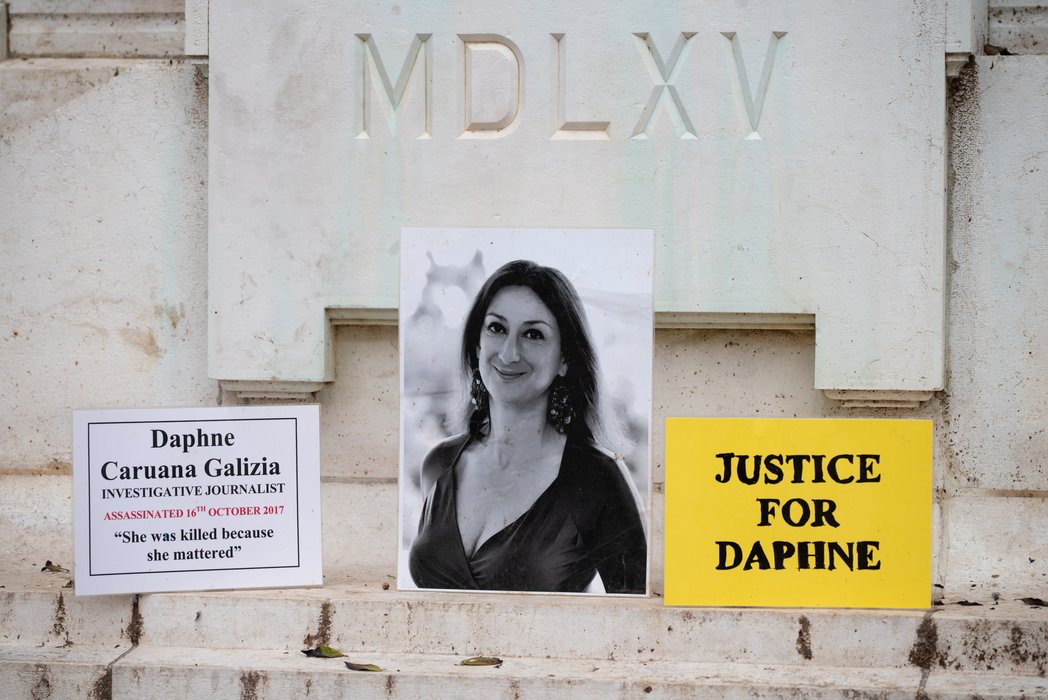
On 16th October 2017, investigative journalist Daphne Caruana Galizia was assassinated in Malta. 2026 marked the long-awaited trial of Maltese business magnate Yorgen Fenech, the key figure accused of orchestrating her murder following a blogpost she published incriminating the magnate of high-level corruption.
Fenech was arrested on his yacht in 2019 while trying to leave Malta through its Portomaso Marina. Since then, five men were charged and handed several sentences: in February 2021, hitman Vince Muscat was sentenced to 15 years as part of a plea deal to reveal details of the murder plot that would eventually lead to the conviction of Robert Agius and Jamie Vella, who were found guilty in June 2025 and sentenced to life in prison for acquiring the military grade explosives that were used by Muscat to execute the murder. Brothers Alfred and George Degiorgio were charged in 2022 with installing and detonating the bomb and were each sentenced to 40 years behind bars. On 21st January 2026, the Court of Appeal dismissed Agius and Vella’s appeal, which claimed that alleged juror misconduct and prejudicial pre-trial publicity led to an unfair trial. Despite these convictions, the alleged mastermind of the murder had yet to be convicted.
After years of delays, the trial of Yorgen Fenech started in Valletta on 1st July 2026. He was accused of complicity in the wilful homicide of Caruana Galizia and of associating himself with one or more persons for the purpose of committing the murder. He pleaded not guilty.
On 2nd September 2026, eight out of the nine jurors found Yorgen Fenech not guilty on both complicity in the voluntary homicide of Daphne Caruana Galizia and association with the intention of committing a crime, and the judge ordered Fenech’s release from custody. A press release by the Daphne Caruana Galizia Foundation released on the day of the verdict affirmed that the “institutional failures that enabled (Daphne’s) murder remain unaddressed and unreformed”.
This court ruling amounts, quite simply, to denying justice not only to Daphne’s family, but also to the hundreds of thousands of journalists around the world who suffer as a result of the widespread impunity for crimes committed against their colleagues.
- European Federation of Journalists President Maja Sever
Several media watchdogs including Reporters Without Borders (RSF) responded to the verdict with ‘outrage’, seeing it as proof that for almost nine years Maltese officials had “failed to identify and convict the mastermind” behind the journalist’s murder. They called on the government to serve “full justice” and implement the “long overdue measures protecting journalists and media freedom”, the absence of which had led to a culture of impunity which facilitated the journalist’s murder, as had been concluded in a 2021 independent public inquiry.
“Daphne’s case is not just about Malta - it’s about Europe. It’s about our defence against impunity, our defence of journalists.” CPJ’s @at_tgibson spoke at a solidarity and remembrance event for Maltese investigative journalist #DaphneCaruanaGalizia in Brussels, Belgium today. Nine years after she was murdered in a car bomb on October 16, 2017, the fight for justice continues. @efjeurope @peteragius_eu
— CPJ Europe and Central Asia (@CPJ_Eurasia) October 15, 2026
On 17th September 2026, three jurors, comprising the nine-person jury that acquitted Yorgen Fenech of murder charges, as well as the husband of one of them, were arrested and interrogated in the Financial Crimes Investigation Department, according to local media outlets. Police confirmed in a statement later that day that the investigation concerned social media posts made by jurors regarding the case years prior to their implication in the jury, as well as the alleged switching on of a juror’s phone during the trial. The three jurors were released on police bail but a day later, on 18th September, another reserve juror was arrested, becoming the fifth person arrested in connection to the police’s ongoing probe against potential perjuries and suspicious juror behaviour.
On 22nd September 2026, the Maltese Public Prosecutor’s Office filed an appeal to challenge the jury’s verdict on grounds of ‘grave irregularities’ during the court procedures. In Malta, appeals submitted in the Court of Criminal Appeal can only be requested on limited grounds and, even then, the court reserves the right to dismiss the appeal if it concludes no miscarriage of justice had occurred. According to Article 500(2) of the Criminal Code, while an Attorney General has the right to appeal an acquittal, the state’s capacity to challenge a verdict is more restricted than that of a convicted individual. The 80-page appeal will now be reviewed by a three-judge panel at the Court of Criminal Appeal.
Media reform bill soon to be unveiled
On 29th September 2026, Justice Minister Clifton Grima announced plans to introduce its ‘long-awaited’ media reform bill in the coming weeks. During a press conference on investment and reforms in the justice sector, Grima underscored the bill’s priority on Parliament’s agenda, and that “final touches” were being applied after previous rounds of discussion. In 2025, the government published a consultative public document on the media reform bill following concertation with local and international civil society organisations, notably to include safeguards to protect journalists from unfounded lawsuits and defamation procedures in the 2026 bill. Following the announcement of the media reform bill’s imminent introduction into the legislature, the Committee to Protect Journalists (CPJ), alongside other press freedom organisations, urged Maltese PM Robert Abela to allow “sufficient time” for an “open, transparent and consultative review of the draft” and for “legal analysis by national and international stakeholders” to be taken into consideration.
FREEDOM OF ASSEMBLY
Protests demand justice following acquittal in Daphne Caruana Galizia’s murder case
On 2nd September 2026, hours after the jury acquitted businessman Yorgen Fenech of the Daphne Caruana Galizia’s murder, the Nationalist Party staged a ‘silent demonstration’ outside PM Robert Abela’s office. In a public address to the crowd, Nationalist party leader Alex Borg asserted that, while the Nationalist Party respected the jury’s verdict and the rule of law, Abela’s government had “failed” to deliver justice in the nine-year long case, namely through its rejection of a Nationalist Party motion to implement recommendations from the 2021 public inquiry.
On 16th September 2026, thousands of protesters marched through the streets of Valletta, holding portraits of Daphne Caruana Galizia’s face and calling for accountability in her assassination. Civil society organisations Repubblika and Occupy Justice organised the protest, which began in front of parliament and went past the law courts on Republic Street. The protest was attended by several MPS and politicians including Nationalist Party leader Alex Borg and European Parliament President Roberta Metsola. The assassinated journalist’s relatives equally gave speeches at the Great Siege Monument, which had been the site of a monthly makeshift vigil to the journalist.
Protest against Planning Authority CEO
On 24th September 2026, activists and members of Moviment Graffitti and Friends of the Earth interrupted a public conference in Valletta to protest against corruption. The CEO of the Planning Authority, Johann Buttigieg, was scheduled to participate in the conference titled “The Citizen, the Environment and Development”. The activists accuse him of a lack of integrity following the revelation of past communications with businessman Fenech and denounced the choice of the venue and the absence of citizens’ groups or environmental organisations.
LGBTQI+
Prides
On 5th September 2026, the annual Gozo Pride took place in Victoria under the theme “Pride Without Permission”. The Minister for Gozo, Clint Camilleri, and Minister for Equality and Civil Rights Rosianne Cutajar attended the event.
progress is not measured only by the laws we pass or the policies we draw up. It is also measured by the everyday experience of each person, by how safe they feel at home, at work, at school, on the street and in their community
- Minister for Gozo Clint Camilleri
The larger Malta Pride festival took place from 4th to 13th September 2026, in Valletta.