Freedom of association
On 14th May 2025, as part of Ukraine’s process of accession to the European Union, the Cabinet of Ministers adopted and approved three strategic documents under Cluster 1: Fundamentals of the Accession Process. These documents serve as roadmaps for legislative and policy reforms in the areas of the rule of law, public administration, and the functioning of democratic institutions.
The CSO Meter, a project monitoring the enabling environment for civil society in the Eastern Partnership region, noted that the roadmap on the functioning of democratic institutions specifically outlines the key actions needed to strengthen democratic governance and support civil society. It defines the core legal, regulatory, and policy framework for civil society organisations (CSOs) and addresses essential aspects of democratic governance, including free and fair elections, political party and campaign financing, media engagement during elections, parliamentary transparency, accountability and integrity, and the overall environment for civil society. CSO Meter experts emphasised that this roadmap presents a rare opportunity to institutionalise guarantees for civic freedoms, enhance transparency in CSO–state relations, and increase the accountability of state bodies to civic actors. They also highlighted that the roadmaps were developed through a participatory process, with active input from civil society organisations.
The next step is the approval of these roadmaps by the European Commission and EU member states, followed by their practical implementation. CSO Meter urged Ukrainian civil society to take an active role in monitoring progress, to ensure that commitments move beyond paper and result in tangible improvements.
Freedom of peaceful assembly
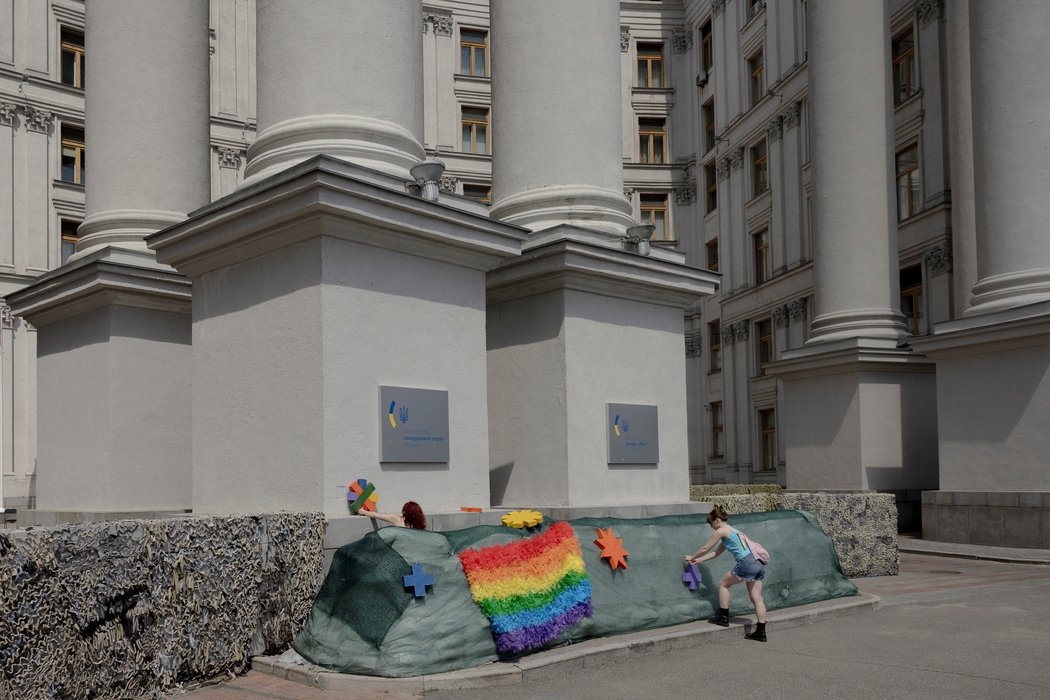
On 7th June, a charity event for Kyiv Pride took place outside the Foreign Ministry building and was met with a nearby counter-protest. The event raised funds for FPV drones for Ukraine's Armed Forces. Counter-protesters, reportedly from the “Right Youth” movement, chanted anti-LGBTQI+ slogans and clashed with police, with several detained.
As previously reported, in April, an LGBTQI+ film festival had faced similar opposition from “Right Youth” activists, who objected to the festival opening on Good Friday. Police dispersed that protest and detained all participants for identity checks.
Kyiv Pride’s previously planned event was cancelled due to police pressure on the National Expo Center of Ukraine (VDNG). In a 6th June Facebook post, organisers said: “This year, the police did everything they could to cancel our event. They even intimidated the management of VDNG […] Unfortunately, under such pressure, VDNG decided to cancel our event.”
On 14th June, the LGBTQI+ community held its first large-scale Pride march since the beginning of Russia’s full-scale invasion, despite a highly challenging security context. According to the Kyiv Independent and organisers, over 1,500 people participated, including international activists, diplomats, and representatives from other Ukrainian Prides, such as Kharkiv Pride and Ukraine Pride. Kyiv’s student community was represented by groups including the Student Parliament of Taras Shevchenko National University of Kyiv and Ukraine Global Scholars. The march was also joined by the LGBT+ Military NGO. Participants emphasised that the fight for equal rights and protection from discrimination must continue even during war.
The event was met with counter-protests from far-right groups. On the same day, far-right nationalists held their own “March of Tradition”, organised by the “patriotic military organisation” Carpathian Sich. Chanting “God. Family. Ukraine,” members marched through central Kyiv to protest what they called the “march of colour perversion.” Images of participants appearing to give Nazi salutes drew widespread condemnation. Taras Deyak, a Ukrainian Armed Forces soldier and leader of Carpathian Sich, claimed in the media that the gesture symbolised “dedication in the struggle for the Ukrainian state.”
Kyiv Pride organisers condemned the counter-protests, stating: “With regret, we must note that those who incite violence still have broader access to public space and freely walk through central streets, while participants of Kyiv Pride March are surrounded by police and restricted in their route. We continue to witness the spread of hate speech.”
In 2024, Kyiv Pride held a march for the first time since Russia’s invasion in February 2022. However, police dispersed the crowd after only ten minutes and redirected participants to the subway due to threats from anti-LGBTQI+ groups.
Freedom of expression
According to an analysis published by the Institute of Mass Information (IMI) at the end of June, Russia has committed more than 800 crimes against Ukrainian journalists and media outlets, as well as foreign reporters documenting Russian aggression on the front line, in over three years of full-scale invasion. These include assassinations, kidnappings, torture, intimidation, and the destruction of equipment or newsrooms. The IMI report highlights that Ukraine remains one of the most dangerous countries in the world for journalists, with dozens of independent reporters forced to relocate or work anonymously. Some journalists, particularly those with relatives in occupied areas, cannot reveal their identities.
Alongside physical attacks, journalists are increasingly targeted by hacking, cyberattacks, and smear campaigns amid broader Russian efforts to spread misinformation through fake media networks and propaganda channels. In April 2025, Radio Svoboda, the Ukrainian bureau of Radio Free Europe/Radio Liberty (RFE/RL), exposed one such coordinated network operating more than 150 sites in 49 languages, which republished content from Russian state media and pro-government Telegram channels. Researchers said the operation aimed to flood Google search results and influence AI models rather than readers directly. In this context, Ukrainian officials have discussed the possibility of blocking or limiting platforms such as TikTok and Telegram, though no concrete steps have yet been taken.
In May, Ukrainian journalists continued to come under Russian fire while performing their professional duties. On 23rd May 2025, journalist Vyacheslav Lakomkin came under Russian attack while travelling with Ukrainian soldiers in Pokrovsk, Donetsk region. Their car, equipped with drone detection systems, was struck by a drone that exploded nearby, causing minor damage and two flat tyres. The crew evacuated safely and no one was injured. Two days later, on 25th May, Suspilne Donbas journalists Andriy Kramchenkov and Vladyslav Ukolov came under Russian fire while reporting in Rodynske, also in Donetsk region. A Russian drone reportedly changed course towards the visibly marked journalists before exploding between two buildings. Both escaped unharmed after taking cover. Kramchenkov, editor-in-chief of Suspilne Donbas, told the IMI that several more drones and gunfire followed before they evacuated.
Journalists also faced physical assaults and threats. On 25th May 2025, an unidentified man attacked an Espreso TV camera operator in Markhalivka, near Kyiv. The operator was filming a site recently hit by a Russian missile when the man pushed him off a fence, damaging his camera. Other journalists restrained the attacker and called police. It was not reported whether the operator was injured or if the suspect faced prosecution. On 26th May 2025, a man armed with a gun threatened MykVisti journalists Kateryna Sereda and a colleague while they were reporting in central Mykolaiv. Shouting from a nearby building, he ordered them to stop taking photos and pointed what appeared to be a gun at them. Police intervened and recorded the incident. The suspect claimed he feared journalists’ presence could attract Russian strikes. The reporters chose not to press charges.
Threats also came from public officials. On 5th May 2025, Vilne Radio journalist Yevhen Vakulenko reported receiving insulting and threatening Facebook messages from Kyiv city military administration spokesperson Yevhen Yevlev, who allegedly threatened to “break his face” and called him an “enemy of the Ukrainian people.” The messages followed a Vilne Radio investigation alleging possible corruption involving Yevlev’s father. Yevlev later defended his actions online, while the outlet said it would not file a police complaint unless the threats continued.
On 29th May 2025, investigative outlet Syla Pravdy reported that Lutsk official Viktor Humeniuk had attempted to register “Syla Pravdy” as a trademark, potentially restricting the outlet’s use of its name. The request, filed in July 2024, followed previous reporting linking Humeniuk to corruption. Syla Pravdy said it contacted him for comment, but he refused to respond, and asked the Ukrainian state patent institute not to approve the registration.
On 4th June 2025, Ukrainian MP Oleksiy Honcharenko sent an official letter to investigative outlet Bihus.Info demanding details of its financing, later posting the letter on Telegram. The move followed a critical Bihus.Info video scrutinising Honcharenko’s political conduct. Outlet head Denys Bihus called the request an attempt to pressure independent media, noting that MPs cannot use official channels to seek such information. Honcharenko later mocked Bihus online and renewed his demand for financial disclosure.
Amid threats from various actors, smear campaigns and attempts to discredit journalists also continued. On 8th May 2025, Hromadske Radio journalist Mariana Chorniyevych received an anonymous email threatening to fabricate and publish pornographic videos featuring her. The threat followed her programme citing a survey showing declining support for the Soviet-era Victory Day. Chorniyevych and Hromadske Radio filed police complaints. Authorities quickly identified the sender, but he reportedly resides in Russian-occupied territory, making prosecution unlikely.
On 29th May 2025, journalist Serhiy Horbatenko reported receiving threats and insults from anonymous Telegram users after publishing a video about Bakhmut’s history on RFE/RL’s Donbas.Realii. A pro-Russian Telegram channel from Donetsk ridiculed his work, prompting a wave of hostile comments questioning his origins and ties to Bakhmut. Horbatenko shared screenshots of the threats but said he did not intend to file a police complaint.
On 16th May 2025, Rivnenski Novyny published an article attacking investigative outlet Chetverta Vlada, continuing a pattern of similar reports. The article quoted a Ukrainian soldier, Yuri Kovalyuk, insulting Chetverta Vlada without clarifying the source. Kovalyuk had previously been dismissed from a local military recruitment commission after giving an interview to the outlet.
On 23rd May 2025, Telegram channel Trukha launched a smear campaign against data journalism outlet Texty.org.ua after it published an analysis accusing Trukha of exploiting Russian strikes to boost its audience and promote gambling sites. Trukha responded with three discrediting posts, labelling Texty and Detector Media “grant eaters”, recalling past U.S. criticism of Texty, and publishing photos of editor-in-chief Roman Kulchynskiy and his wife, urging followers to message them directly.
On 9th June 2025, journalist Olena Mudra reported being targeted in a smear campaign accusing her of receiving Russian funding and supporting Gazprom and Rosneft. The smear followed her criticism of a wind farm project in Zakarpattya, which she said was planned in a protected area. Mudra denied the allegations and suggested the company behind the project could be responsible for the false claims and related complaints filed against her.
Journalists also faced obstruction in their work. On 16th June 2025, RFE/RL’s Ukrainian service reported that Ukraine’s State Border Service (DPSU) refused to disclose information on when assassinated politician Andriy Portnov last crossed the Ukrainian border. RFE/RL said it sought the data after Portnov was killed in Madrid on 21st May, reportedly having left Ukraine in June 2022. The outlet aimed to verify claims he had recently travelled to Ukraine. DPSU said details of Portnov’s border crossings related to his “private life” and could only be released “upon his agreement or in other situations foreseen by law.”
Violations of press freedom in the online sphere also persisted, including cyberattacks, hacking, and the spread of fabricated content. On 2nd May 2025, investigative outlet Slidstvo.Info reported that Facebook deleted one of its posts about Russia’s ongoing attacks on Ukraine and temporarily restricted access to its page. The post quoted a Ukrainian soldier saying Russians have “no honour or dignity” amid the occupation. Facebook cited “hate speech” as the reason, calling it an “attack on people based on their identity.” While the page was later restored, the post remained unavailable as of 16th June.
On 9th May 2025, Ukrainska Pravda reported that an unknown source hacked an email address used for subscriber communications, sending pro-Russian messages. The emails, in Russian, referred to “our common victory” over Nazi Germany and called Ukraine’s authorities “an illegitimate regime.” The outlet said it did not send the messages and later regained control of the email account. How the hacker accessed the address remained unknown.
On 12th May 2025, Ukrainian outlet Liga.net reported being targeted in a Distributed Denial of Service (DDoS) attack lasting over five hours. The attack appeared to focus on a recent blog post by journalist Nadiya Pototska analysing a celebrity scandal involving a singer refusing to perform in Ukrainian. Liga.net defended Pototska’s right to express her opinions but did not speculate on the attacker’s identity. The impact on readers’ access to the site was unclear.
On 19th June 2025, YouTube channel ISLND TV published an interview with Ukrainian comedian Dmytro Rozoviy using a fake screenshot allegedly showing defamatory claims by Focus.ua. The interview criticised media coverage of Rozoviy’s recent divorce, with the interviewer insulting Focus.ua. The outlet’s deputy editor, Andriy Sukhrakov, posted an authentic screenshot proving no defamation occurred and told Ukraine’s Institute of Mass Information (IMI) that ISLND TV had not responded to requests for explanation. IMI also received no comment from the channel.
On 25th June 2025, at least two Telegram channels published an AI-generated video falsely showing Ukraine’s Minister for European Integration, Olha Stefanishyna, announcing the government was planning a ban on women aged 18–27 leaving the country. The video used the logo of state-owned TV channel Freedom. Inomovlennya, which operates Freedom, stated the video was fake and not produced by the channel. The Telegram channels, with over 100,000 followers each, presented the false claims as true, citing unspecified “media reports.”