Introduction
On 8th May 2025, President William Ruto signed into law the Persons with Disabilities Act 2025, marking a significant milestone in the protection and promotion of the rights of persons with disabilities in Kenya. The legislation establishes a comprehensive legal framework to guarantee access to education, employment, healthcare, political participation, and public spaces for persons with disabilities (PWDs). It addresses long-standing issues of exclusion, stigma, and systemic neglect by embedding disability rights within Kenya’s constitutional and international obligations, notably Articles 2(6), 27, 54, and 260 of the Constitution, as well as the UN Convention on the Rights of Persons with Disabilities (UNCRPD). The Act reinforces the principle that disability rights are central to human dignity and social justice, signalling a shift towards an inclusive, rights-based approach to governance and development.
In early May 2025, during a joint press conference with Finnish President Alexander Stubb, President William Ruto addressed recent reports of abductions, stating that the government had taken firm steps to prevent such incidents from recurring. Ruto claimed that all previously missing individuals had been reunited with their families but offered no information about who was responsible for the abductions, raising ongoing concerns about transparency and accountability. His claims were made despite recent statistics from the Kenya National Commission on Human Rights showing that as of 26th December 2024, 82 cases of enforced or involuntary disappearances had been documented since the June 2024 protests.
As previously documented (on the Tanzania page), on 18th May 2025, former Kenyan Justice Minister and opposition leader Martha Karua, along with Law Society of Kenya (LSK) Council member Gloria Kimani and member of the Pan-African Progressive Leaders Solidarity Network Lynn Ngugi, were detained upon arrival at Tanzania’s Julius Nyerere International Airport and deported to Nairobi without explanation. A day later, former Kenyan Chief Justice Willy Mutunga, and human rights defenders (HRDs) Hanifa Adan and Hussein Khalid faced a similar fate. The group had travelled to Dar es Salaam to attend a court hearing in a treason case against Tanzanian opposition politician Tundu Lissu. Their deportation, confirmed via public statements on X, raises serious concerns about regional commitments to freedom of movement and solidarity among East African civil society actors. The incident drew criticism from rights groups, who view it as part of a broader trend of shrinking civic space and intolerance toward transnational political engagement in the region.
On the same day, Kenyan activist Boniface Mwangi and Ugandan journalist Agather Atuhaire arrived in Tanzania as part of a delegation to observe the trial of opposition politician Tundu Lissu. The following day, Tanzanian police and immigration officers arrested the two at the Serena Hotel in Dar es Salaam. They were held incommunicado at an undisclosed location, where they were allegedly tortured, stripped naked, and sexually assaulted by individuals believed to be from the Tanzanian military. Their disappearance, particularly Mwangi’s, triggered diplomatic tensions and widespread outrage across Kenya, with civil society, family members, and HRDs demanding their release. On 21st May 2025, Kenya’s government formally protested the detention, citing violations of the Vienna Convention on Consular Relations after repeated requests for consular access were denied. Mwangi was deported the following morning by road and dumped in Ukunda, Kenya. He was rushed to a hospital for a medical review after preliminary observation indicated he looked injured and frail. Tanzanian President Samia Suluhu accused foreign activists of interfering in domestic affairs, while Kenya’s Foreign Minister Musalia Mudavadi partially echoed her concerns, suggesting Kenyan activists sometimes provoke foreign governments. Despite this, the Police Reforms Working Group-Kenya (a CSO umbrella body), and LSK, condemned the alleged abuse, calling for regional and international accountability for the torture and sexual violence perpetrated against Mwangi and Atuhaire, in violation of international human rights law.
Peaceful Assembly
University students protest school closure
On 25th February 2025, students from the Technical University of Kenya (TUK) held a peaceful demonstration in Nairobi to demand the reopening of their institution, which was shut down on 3rd February 2025 due to a lecturers’ strike. The protest began on campus and proceeded towards the Ministry of Education headquarters in the Central Business District. Upon arrival, students were denied entry to the premises and continued their protest peacefully at the ministry gates. Rather than engaging with the students or facilitating dialogue, police responded with force, deploying tear gas to disperse the demonstrators.
Residents protest police killing
On 5th March 2025, protests broke out in the Majengo and Pumwani areas of Nairobi following the fatal shooting of a 17-year-old student during a police operation involving undercover officers. The demonstrations quickly escalated into violent unrest, with groups of youths setting bonfires, burning two police vehicles, and torching the Shauri Moyo Police Station. According to Amnesty International, four people were killed and 37 were injured during the crackdown. Rights groups, including the KHRC and Kamkunji Human Rights Defenders, condemned the police’s reliance on lethal force and called for independent investigations by the IPOA.
Residents from Kajiado protest carbon offset lease agreement
On 30th April 2025, a community meeting to finalise a 40-year carbon offset lease agreement between Oldonyonyokie Group Ranch in Kajiado County and Soils for the Future Africa Limited was disrupted by protests from area residents opposing the deal. The residents’ group expressed fears that the proposed agreement, which would lease 168,000 acres of ancestral land, could lead to displacement and weaken indigenous land rights. While the group ranch leadership claimed that 600 of the 1,157 registered members had consented, critics questioned the legitimacy of the process, citing the inclusion of deceased members in the registry and alleging that consent was obtained through misinformation and false promises. They also accused the leadership of using the promise of long-delayed land titles as leverage to push the deal. The incident has intensified national scrutiny of carbon credit schemes, with civil society calling for greater transparency and safeguards to protect indigenous communities from exploitative conservation models.
Mass protests erupt over killing of blogger in police custody
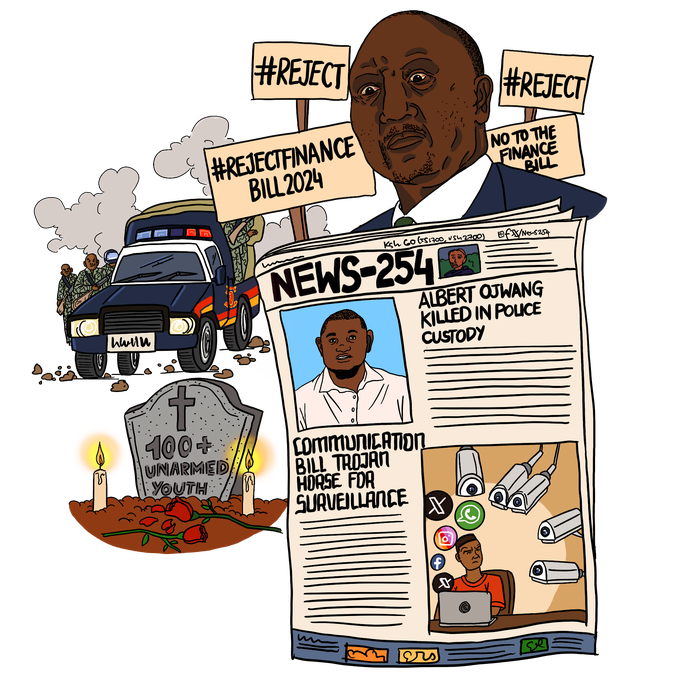
On 17th June 2025, widespread protests erupted in Nairobi, Mombasa, Kilifi, and Kwale Counties following the death of blogger Albert Ojwang in police custody, after he was arrested and detained over a social media post (see expression section). The demonstrators demanded the immediate resignation of Deputy Inspector General (DIG) Eliud Lagat, after reports emerged that Lagat had issued instructions to police officers to "discipline" the blogger, after he published a social media post allegedly implicating the DIG in corruption.
Police responded with excessive force, including tear gas and live ammunition. At least one unarmed bystander was shot, and 25 others hospitalised, five with gunshot wounds. In one tragic incident, a hawker, Boniface Kariuki who was reportedly selling masks, was shot at close range by a uniformed police officer and later died from his injuries. In Nairobi, credible reports and protest observation revealed that masked goons armed with tyre whips, batons, and knives were mobilised, transported, and deployed to disrupt protests and assault critics. Disturbingly, security forces appeared to collaborate with these groups, with police observed coordinating with them at key locations such as Moi Avenue, Railways Club, and Kenyatta Avenue in Nairobi’s central business district. Videos circulated of these violent actors publicly thanking Nairobi’s Governor, Johnson Sakaja. Reports emerged that government officials deployed armed thugs to violently attack, injure and intimidate protesters, and loot shops.
Despite the violence instigated by these groups, police failed to intervene and instead arrested peaceful protesters, including four HRDs in Mombasa, who had followed legal procedures to notify authorities.
These events reflect a troubling pattern of state-enabled suppression of dissent, which is morphing to include additional layers of state-sanctioned terror on unarmed protesters that compounds the brutality already inflicted by law enforcement. Through a growing trend in which the state increasingly outsources acts of repression to armed groups, the Kenyan government effectively extends its campaign of terror through covert but coordinated violence.
Mass protests continue into July, to mark 1 year anniversary since 2024 protests & democracy struggle
On 25th June 2025, thousands of Kenyans demonstrated nationwide to mark the one year anniversary of youth-led protests against tax hikes and to demand accountability for police brutality and systemic corruption, as previously documented. While the protests were largely peaceful, they were met with excessive police responses, including roadblocks, barricades around key government buildings, and widespread deployment of security forces. They used rubber bullets, live ammunition and water cannon to disperse the crowds. The KNCHR documented 19 deaths, 531 injuries, 15 enforced disappearances, 179 arrests, and cases of sexual violence, including rape and attempted gang rape. Authorities cited infiltration by criminal elements and property destruction, with credible reports indicating the use of “hired goons” to disrupt demonstrations in Eldoret, Mombasa, Nairobi, Nakuru, Nyeri, Kajiado, and Kisumu. These groups engaged in looting and violence, raising serious concerns about State sanctioned sabotage of lawful protest.
On 7th July 2025, during the annual Saba Saba demonstrations, a historic day symbolising Kenya’s pro-democracy struggle, state actions resulted in grave violations of the right to peaceful assembly and the freedom of movement. In anticipation of protests, the government set up extensive roadblocks across Nairobi and several counties, paralysing transport, restricting access to workplaces, hospitals, and schools, and stranding hundreds. While justified as public safety measures, these blockades appeared designed to obstruct mobilisation and deter participation. The KNCHR documented a deeply troubling toll of 38 deaths (including two children), 130 injuries, two abductions, and approximately 532 arrests across 17 counties. Most fatalities resulted from gunshot wounds. Authorities escalated repression by invoking the Prevention of Terrorism Act against protestors and activists, charging 37 individuals, including opposition leaders and an MP, with terrorism-related offences. Some were re-arrested immediately after securing bail and slapped with harsher charges, raising serious concerns over the misuse of anti-terror laws to suppress political dissent. Such charges enable prolonged pre-trial detention, deny access to fair trial guarantees, and erode due process rights.
Despite a court order requiring officers managing protests to remain identifiable and in uniform, authorities blatantly disregarded the order, with numerous hooded officers operating from unmarked vehicles. Disturbingly, criminal gangs armed with crude weapons were seen patrolling alongside police in Nairobi, Kiambu, Kajiado, and Eldoret. The government’s heavy-handed response to Saba Saba demonstrates a calculated campaign to criminalise protest, intimidate civic actors, and shrink democratic space.
Between 25th June 2025 and 11th July 2025, at least 65 protesters were killed, at least 600 hundred injured, with cases of rape, including gang rape by suspected sponsored goons, being reported. At least 1500 people were arrested and charged with various crimes including murder, rape, and terrorism for alleged destruction of public and private property. Adding to the 60 people who were killed during the youth led protests in 2024, no less than 125 people have been killed during mass protests held between June 2024 and July 2025.
Government resorts to unlawful directives and proposed laws to thwart protests
On 26th June 2025, following the Gen Z commemoration protests in Kenya, the government escalated its crackdown on the right to peaceful assembly through inflammatory rhetoric, unlawful directives, and excessive use of force. Interior Cabinet Secretary Kipchumba Murkomen dismissed credible reports of police brutality despite confirmed deaths and injuries, framing the protests as “terrorism disguised as dissent” and an “attempted coup,” without providing substantiating evidence. In an alarming move, Murkomen publicly authorised police to shoot on sight anyone approaching police stations with perceived criminal intent, an extrajudicial directive that the LSK condemned as unconstitutional and illegal. Following widespread backlash, Murkomen attempted to downplay the directive, stating that security agencies are well trained and aware of their responsibility not to misuse authority. Similarly, on 9th July 2025, President William Ruto reinforced this hardline stance, urging police to shoot protesters in the legs to “incapacitate” them, normalising state violence against civilians and undermining the rule of law. These statements legitimise the use of live ammunition against unarmed protesters and mark a dangerous shift towards a counter-insurgency approach to civic dissent.
In the same vein, on 2nd July 2025, the Kenyan Parliament introduced the Public Order Amendment Bill, 2025, which poses a serious threat to the constitutionally protected right to peaceful assembly under Article 37. The Bill proposes to impose disproportionate restrictions by prohibiting demonstrations within 100 metres of key state institutions, including Parliament, State House, and court premises, which are central to political expression and accountability. The Bill also makes it a crime to violate the new rules, with penalties of up to KSh 100,000 (USD 770) or a jail term of up to three months. It further grants the Cabinet Secretary for Interior sweeping powers to designate protest zones in consultation with county governments. These measures risk suppressing dissent, enable arbitrary state control, and fail the tests of legality, necessity, and proportionality under both domestic and international human rights standards. Justifications based on prior protest-related violence do not warrant such sweeping restrictions, especially when law enforcement already holds the mandate to address disorder without infringing on fundamental freedoms. Following massive public outrage, Nairobi Woman County Representative, Esther Passaris, who had sponsored the Bill, later announced on 2nd July that she would shelve the Bill to allow for public participation.
Expression
Institutions of transparency face vilification by government officials
On 6th March 2025, following a series of damning reports by Auditor General Nancy Gathungu and Controller of Budget Margaret Nyakang’o exposing financial irregularities in national and county government expenditures, Members of Parliament attacked both independent offices. Instead of addressing the substance of the reports, MPs, led by Majority Leader Kimani Ichung’wah, accused the Controller of Budget of corruption and inefficiency, claiming county governors must pay bribes to secure expenditure approvals. Ichung’wah further criticised the media for alleged misreporting and spreading “propaganda.” Targeting oversight bodies and the media for performing their constitutional duties undermines transparency, accountability, and the public’s right of access to information.
Government extends censorship to protest-themed creative arts
On 10th April 2025, authorities violently disrupted the staging of Echoes of War, a student play that criticised political leadership. Despite a High Court order affirming the play’s inclusion in the national drama festival, police detained its author, Cleophas Malala, also a former Senator for Kakamega, without charge, blocked him from attending final rehearsals, and later stormed the venue with tear gas and batons. They forcibly dispersed the students, barred members of the public from accessing the performance, and assaulted journalists who were clearly marked as press. Reporters from Citizen TV, KTN, Inooro TV, and the Standard Group were physically attacked, with some sustaining injuries and equipment damage. Senior government officials criticised Malala’s involvement, framing it as political interference, further exposing efforts to silence dissent under the pretext of protecting education from politics.
On 27th April 2025, the BBC published an investigation identifying members of Kenya’s security forces involved in the fatal shooting of anti-tax protesters outside parliament on 25th June 2024. Using video and photo evidence from protesters and journalists, verified through metadata, livestreams, and visible public clocks, BBC Africa Eye mapped three killings to a 3D reconstruction of the scene. This analysis traced the fatal shots to weapons carried by a police officer and a soldier. Despite a directive from a parliamentary committee for IPOA to investigate and publicly release findings, no report has been issued, and no one has been held accountable. The following day, the BBC cancelled a private screening of the documentary in Nairobi, citing pressure from authorities. On 29th April, government Spokesperson Isaac Mwaura dismissed the investigation as biased, arguing it failed to offer the government a right of reply. MP Peter Kaluma went further, calling for the BBC’s licence to be revoked, labelling the documentary “reckless” and “inciteful.” His remarks sparked widespread backlash on social media, prompting him to delete the tweet amid criticism for undermining media freedom.
On 2nd May 2025, police officers arrested four Kenyan filmmakers, including Nicholas Wambugu, Brian Adagala, Mark Denver Karubiu, and Christopher Wamae, reportedly in connection with the BBC’s Blood Parliament documentary. The Kenya Film and Television Professionals Association (KFPTA) confirmed that police confiscated their equipment and data storage devices during the raid. The four spent the night in separate police cells before being released on free bond. However, the BBC clarified that the individuals were not involved in the production of the documentary. Civil society organisations, including the Civic Freedoms Forum, condemned the arrests as politically motivated and reflective of a broader trend of using law enforcement to intimidate independent media practitioners.
New Communications Bill threatens mass surveillance
On 3rd June 2025, it was reported that a new bill had been tabled in parliament, the Kenya Information and Communications (Amendment) Bill, 2025. It proposes a metered billing system for internet users, assigning each subscriber a unique, trackable meter number to monitor real-time usage and generate detailed logs. While the bill cites consumer protection under article 46 of the constitution as its primary objective, experts warn it could create a surveillance infrastructure that enables the state to monitor, map and potentially control people’s internet use. It would potentially grant the government expansive tracking powers without adequate safeguards or accountability.
Web developer detained, charged for developing public participation tool
On 3rd June 2025, software developer and civic activist Rose Njeri was arraigned at the Milimani Law Courts in Nairobi after spending over 90 hours in police custody. Njeri faced charges of unauthorised interference with a computer system, contrary to the Computer Misuse and Cybercrimes Act, after she created a platform to allow people to input their views on the 2025 Finance Bill through a web interface, which then autogenerates an email to a designated parliamentary address. Njeri’s arrest demonstrates the government’s growing intolerance of citizen action.
Noting that Kenya’s cybercrime law is intended to target cyber terrorists, fraudsters and malicious hackers, and that the constitution requires parliament to facilitate public participation in law-making, Njeri’s lawyers pointed out that the charges against her were political and accused the office of the prosecutor of being used politically by the executive.
The case sparked national outrage and attracted some of Kenya’s most prominent lawyers, including Senior Counsel John Khaminwa, who is Kenya’s oldest practising lawyer, Senator Dan Maanzo, former Chief Justice David Maraga, Senior Counsel Kalonzo Musyoka and former Law Society of Kenya president Eric Theuri, who have all represented Njeri in court. During the court session, activists and protesters gathered outside the building demanding her release. Njeri was released on a bond of KES 100,000 (approx. US$680), pending a hearing of the case later in June 2025. In response, on 4th June 2025, the Commissioner Rapporteur on the human rights situation in Kenya at the African Commission on Human and People’s Rights issued a letter of urgent appeal to President William Ruto, raising concern over the arbitrary arrest and due process violations in Njeri’s case. On 20th June 2025, the court dismissed all charges against Rose Njeri, ruling that they did not disclose any offence. Magistrate Geoffrey Onsarigo found the charges vague and untenable. He ordered the immediate return of Njeri’s confiscated electronic devices, rejecting the prosecution’s claim that they were still under review.
Blogger tortured, killed over X post
On 7th June 2025, Kenyan blogger and teacher Albert Ojwang was arrested at his parents’ home in Homa Bay County for allegedly spreading false information about Deputy Inspector General Eliud Lagat. He was transferred from Mawego Police Station to Nairobi’s Central Police Station, where he died in custody the next day under suspicious circumstances. While police initially claimed he may have committed suicide, an IPOA investigation and autopsy ruled out this possibility. CCTV footage revealed that officers brought Ojwang to Mbagathi Hospital at 1:35 a.m. on 8th June in a lifeless state and failed to seek immediate medical attention. The footage shows a 24-minute delay before he was wheeled into the casualty ward, where medics confirmed he had been dead on arrival, with visible injuries consistent with prior trauma. These revelations raised serious concerns about the officers’ conduct and prompted public outrage. In response, the Inspector General of Police retracted earlier statements, blaming junior officers, while IPOA arrested three individuals, including the Nairobi Central police chief, and opened a broader investigation. President William Ruto condemned the killing, affirmed that Ojwang died in police custody, and directed full cooperation with IPOA. On 16th June, Deputy Inspector General Eliud Lagat announced he had temporarily stepped down from his position as investigations proceed. On 23rd June 2025, three police officers were charged with murder along with three civilians. Ojwang's murder sparked protests in several cities (see Peaceful Assembly section), with demonstrators demanding justice and the immediate resignation of Deputy Inspector General Lagat. Their calls were fueled by claims from the police officer now considered a key suspect, who alleged that Lagat had issued instructions to "discipline" the blogger. The incident renewed calls for structural reforms and accountability in Kenya’s policing system. The incident also raised questions as to how Ojwang was traced to his family's home, over 350 kilometres from Nairobi, raising concerns about the use of surveillance by authorities to track activists.
Parliament proposes increased budget for monitoring social media activity
Just two days after the brutal killing of social media user Albert Ojwang by police officers because of a post on X (see above incident), on 10th June 2025, the National Assembly's Budget Committee in June proposed to amend the budget estimates of the National Treasury, reallocating KES. 150 million (approx. US$1,153,000) to the Directorate of Criminal Investigations (DCI) to procure and service a system with the potential to track social media users in the country. The proposed allocation would see the DCI purchase and run an Optimus 3.0 system and run a forensic lab. Experts have raised serious concerns regarding state surveillance and privacy, warning that the system may allow authorities to track social media users, identify their posts and locations, and track the devices they use.
Concerns over the role of ICT companies in aiding protest and digital rights violations
Safaricom, Kenya’s largest internet and telecommunications provider, has come under fire following an exposé on its alleged involvement in mass surveillance. On 29th October 2024, the Nation Media Group published an investigative report revealing that Safaricom, in collaboration with Neural Technologies Limited, had developed software that gave Kenyan security agencies access to private consumer data. The system reportedly enabled authorities to track and capture suspects, raising concerns about the possible use of consumers’ mobile phone records to assist abductions amid the 2024 protests.
Safaricom responded to these allegations by threatening the Nation Media Group with legal action, in what was broadly seen as a strategic lawsuit against public participation (SLAPP), and withdrawing advertising from the media house. Safaricom also sent a legal warning to CSOs, including the Kenya National Commission on Human Rights, which issued a statement calling for transparency. The CSOs noted that although Safaricom issued a statement in response to the exposé, it failed to respond to the key findings of the investigative report.
In June 2025, questions also arose as to how blogger and activist Albert Ojwang (see incident above) was traced by police officers to his home in Homabay County, raising concerns about state surveillance of government critics. Opposition leaders accused Safaricom of aiding and facilitating the tracing and abduction of Kenyans, including Albert Ojwang.
Standard Media Group threatened and targeted over protest related coverage
On 25th June 2024, Kenya Television Network (KTN), operated by the Standard Media Group, reported it had received threats from authorities to shut it down because of its detailed live coverage of the protests and police violence.
On 9th April 2025, the Communications Authority of Kenya (CA) announced it was revoking the Standard Media Group's broadcast licences, citing unpaid licence fees and Universal Service Fund levies, despite the media house following a KES 48 million (approx. US$369,000) repayment plan. The CA had issued revocation notices in September 2024, which expired in March 2025, and rejected the existing payment arrangement. Meanwhile, the government owes the Standard Media Group KES 1.2 billion (approx. US$9.2 million) in unpaid advertising fees. The group’s Chief Executive Editor, Chacha Mwita, described the CA’s action as a politically motivated move to silence the media following its critical coverage of the government. However, on 16th April 2025, the Communications Appeals Tribunal temporarily stopped revocation of the group’s licence, pending a hearing on the matter.
Earlier in March 2025, the government had cancelled the Standard Media Group’s contract with the Ministry of Irrigation due to its critical coverage. Alongside other media outlets, the group had been selected earlier that month to run a campaign for the launch of the National Irrigation Sector Investment Plan.
Separately, on 31st May 2025, two Standard Media Group journalists were denied entry to State House in Nairobi to cover a joint press briefing by Ruto and visiting Slovenian President Nataša Pirc Musar, in what is believed to be a response to the outlet’s critical coverage.
Government shuts down live coverage of protests
On 25th June 2025, the Communications Authority of Kenya (CAK) issued a directive ordering all television and radio stations to halt live coverage of ongoing demonstrations, citing alleged violations of constitutional provisions on freedom of expression and media. The authority claimed that broadcasting the protests contravened Articles 33(2) and 34(1) of the Constitution, as well as Section 46I of the Kenya Information and Communications Act, and warned of unspecified regulatory sanctions for non-compliance. Several privately owned stations, including NTV, K24, and KTN, were subsequently taken off-air, though they continued sharing protest footage online. This move drew immediate backlash from civil society, with the Kenya Editors’ Guild highlighting a prior High Court ruling that the CAK lacks constitutional authority to regulate media content. Later that day, the Law Society of Kenya successfully obtained a High Court order compelling the restoration of broadcast signals. Furthermore, NetBlocks, a global internet observatory, confirmed that access to the messaging platform Telegram had been restricted in Kenya. The shutdown reflects increasing state interference in media freedom and raises serious concerns over access to information during public demonstrations.
On the same day, two journalists were injured while covering the protests. NTV reporter Ruth Sarmwei sustained a leg injury from an unidentified projectile while interviewing demonstrators in Nakuru, while Standard Media Group photojournalist David Gichuru was struck by a stone thrown by a protestor in Nairobi.
Journalists attacked, injured while on duty
On 6th July 2025, journalists who were covering a press conference at the offices of the Kenya human Rights Commission (KHRC) were attacked by hired goons allegedly linked to the State violently stormed the KHRC offices to disrupt the planned event (see more in association section below)
During the coverage of the 5th March 2025 protests in Nairobi’s Pumwani area (see above in Peaceful assembly section), General Service Unit (GSU) officers detained Justine Ondieki, a photojournalist with Eastleigh Voice, for several hours in a vehicle near Gikomba, rough-handled him, and damaged his equipment. Police officers also blocked NTV journalists Fridah Okachi, Dennis Onsongo, and Leah Wambui Kurema from accessing the protest site. They assaulted the team’s cameraperson and forcibly deleted footage from the camera. These journalists were documenting demonstrations triggered by the fatal police shooting of a 17-year-old boy. The National Police Service promised investigations and accountability.
MP faces targeting & harassment over government criticism
On 16th February 2025, Juja Member of Parliament George Koimburi was arrested and now faces two charges under Kenya’s Computer and Cybercrimes Act, following public remarks criticising the alleged misuse of public funds in support of Raila Odinga’s African Union Commission bid. Authorities claim his comments, made at a church event in Juja, were knowingly false and intended to incite unrest, thus constituting incitement against the government under Section 22 of the Act. The charge sheet frames his criticism of public expenditure as a threat to public order, raising serious concerns about the misuse of cybercrime legislation to criminalise political expression. Koimburi’s arrest by the Directorate of Criminal Investigations and subsequent denial of bail reflect an increasingly punitive approach towards dissenting voices, particularly those of elected leaders.
On 18th February 2025, Koimburi was re-arrested and charged with six counts related to alleged forgery of academic certificates dating as far back as 1994. While the charges, including forging Kenya National Examination Council (KNEC) and Jomo Kenyatta University of Agriculture and Technology (JKUAT) credentials appear serious, the timing and pattern of his arrests raise credible concerns over the misuse of legal processes to suppress dissent. Koimburi, a vocal government critic, had recently accused the State of spending KSh 13 billion on Raila Odinga’s failed African Union Commission bid, remarks that sparked significant public debate. His sudden re-arrest shortly after making these comments suggests a deliberate attempt to intimidate political opponents and stifle freedom of expression. Following his arraignment, the MP was released on a Ksh 200,000 cash bail.
Association
CSO office raided, activist assaulted
In a post on X (formerly Twitter), activist Boniface Mwangi recounted that on 2nd April 2025, three police officers entered the Sema Ukweli (Swahili for ‘Say The Truth’) office in Nairobi, reportedly over a noise complaint. Mwangi claimed that one officer, allegedly intoxicated, physically assaulted him and attempted to draw his firearm. The officers then handcuffed, beat, and dragged him from the premises, causing injuries to his wrists, knees, and ribs. At Kilimani Police Station, Mwangi alleged further assault until colleagues intervened. The Kilimani OCS later authorised his transfer to Nairobi Hospital, where he received treatment and was discharged. He subsequently filed a complaint with the Independent Policing Oversight Authority (IPOA). Despite police assurances of an investigation, Mwangi was later charged with offensive conduct and assault. The charges were filed in his absence on 7th April at Kibera Law Courts while he was abroad, and an arrest warrant was issued after he failed to appear.
HRDs arrested and charged over fresh 2025 protests
On 27th June 2025, police arrested three HRDs, namely, John Mulingwa Nzau (alias Garang), Mark Amiani (Generali), and Francis Mwangi (Chebukati), accusing them of inciting violence, theft, and destruction of property during the 25th June protests (see more in peaceful assembly section). Despite these serious allegations, the Police Reforms Working Group, a coalition of 22 organisations advocating for accountable policing, strongly refuted the claims, emphasising that the activists played no role in the demonstrations. They cautioned the State against exploiting the unrest as a pretext to criminalise peaceful protest, silence dissent, and undermine constitutionally protected civic space. On 30th June, the three defenders were arraigned in court and charged with incitement and related offences. The prosecution, however, failed to provide credible evidence linking them to the violence, yet sought to detain them for an additional 21 days to continue investigations. They were released on bail on 2nd July, with a court date set for 23rd July 2025.
KHRC activist deported
HRDs and CSOs now face surveillance and targeting. On 5th July 2025, the Kenyan government unlawfully deported Martin Mavenjina, a senior legal advisor on transitional justice at the Kenya Human Rights Commission (KHRC), in a move widely seen as politically motivated. Mavenjina had returned from an official visit to South Africa the previous night, yet was abruptly deported despite holding valid work documentation permitting his stay and employment in Kenya. The KHRC condemned the action as part of a broader crackdown on civil society and HRDs, noting that the State has systematically targeted activists since 25th June. The government’s silence on the matter reinforces concerns of a coordinated campaign to suppress dissenting voices and restrict civic space. This deportation, lacking any legal justification, represents a clear violation of the right to peaceful assembly and association and signals increasing authoritarianism under the current regime. The KHRC has pledged to pursue all legal and diplomatic measures to ensure Mavenjina’s return and to hold the State accountable for its ongoing repression.
KHRC office raided by state sponsored goons
On the day of Mavenjina’s deportation, armed groups believed to be state-sponsored violently disrupted a press conference at the KHRC offices which had been organised to demand an end to extrajudicial killings, enforced disappearances, and arbitrary arrests of protesters ahead of nationwide protests the next day. The attack was explicitly aimed at intimidating the KHRC from participating in the Saba Saba rallies scheduled for 7th July (see peaceful assembly section). Saba Saba, a historic day of resistance and civic courage in Kenya, continues to serve as a rallying point for demands for accountability and justice.
This incident at the KHRC office highlighted once again the growing trend in which the state increasingly outsources acts of repression to militia groups, effectively extending its campaign of terror through covert but coordinated violence (see more in peaceful assembly section).
Activist arrested day after filing human rights petition
On 19th July 2025, Kenyan activist Boniface Mwangi was arrested at his home, a day after he and Ugandan lawyer-journalist Agather Atuhaire filed a petition at the East African Court of Justice (EACJ) accusing the governments of Kenya, Uganda, and Tanzania, alongside the EAC Secretary General, of gross human rights violations (see more on the introduction section above). Initially, authorities claimed Mwangi was linked to terrorism-related activities, alleging his logistical and financial involvement in the 25th June protests. However, upon appearing before the Kahawa Magistrates Court, the Directorate of Criminal Investigations (DCI) dropped the terror-related charges. Instead, Mwangi was charged with alleged possession of three tear gas canisters and one round of blank ammunition without lawful authority under the Firearms Act. His legal counsel refuted these allegations, describing them as fabricated attempts to justify his arrest. The case raises serious concerns about the misuse of legal instruments to intimidate activists engaged in lawful civic and regional accountability efforts. Mwangi was released on bail.