This update covers the period November 2025 – March 2026
GENERAL UPDATE
War and Humanitarian Devastation
In December 2025 and again in February 2026, the United Nations intensified its appeals for an immediate ceasefire in Sudan, urging both parties to halt hostilities and engage in meaningful negotiations toward a civilian-led political process. The UN stressed the urgent need to protect civilians, ensure unhindered humanitarian access, and prevent further deterioration of the already catastrophic humanitarian situation, reiterating its readiness to support inclusive dialogue efforts. The UN High Commissioner for Human Rights expressed renewed concern in March 2026 over a surge in deadly drone attacks in Kordofan and White Nile states, which reportedly killed more than 200 civilians, highlighting the escalating risks to non-combatants in conflict-affected areas.
Sudan’s political situation has remained highly unstable, with Sudan’s Sovereignty Council Chairman and Army Commander Abdel Fattah al‑Burhan rejecting any peace settlement that would include the Rapid Support Forces (RSF) as a political actor. This stance has entrenched divisions, leaving the country split between RSF-controlled areas in most of Darfur and SAF-held territories in the capital, as well as the eastern and northern regions, with ongoing fighting, territorial fragmentation, and lack of inclusive political engagement perpetuating an unresolved conflict that places civilians at severe risk.
On 9th February 2026, the UN reported deadly drone attacks on civilians in Kordofan, including strikes on a mosque that killed children. From November 2025 through February 2026, fighting has been concentrated in North and South Kordofan and Darfur, with frequent drone and artillery strikes, urban shelling, and ground offensives. Neither the SAF nor the RSF have achieved territorial dominance, while civilians continue to suffer high casualties, forced displacement, destruction of homes, and attacks on hospitals, schools, and markets. Thousands remain trapped in conflict zones, facing acute insecurity and limited access to food, water, and medical care.
As of February 2026, OHCHR in Sudan reported mass killings in El Fasher, including approximately 6,000 deaths over three days, alongside “sexual violence as a weapon of war, abductions for ransom, thousands detained & disappeared”.
The humanitarian emergency in Sudan has therefore worsened dramatically, especially since the capture of Al Fasher on 26th October 2025 by the RSF. The takeover triggered renewed fighting across North Darfur and the three Kordofan states, generating instability and large-scale displacement.
Between 26th October and the end of November 2025, more than 106,000 people fled Al Fasher and nearby villages, spreading across 37 localities in 11 states. Tawila has absorbed the largest share of displaced families, while over 6,000 individuals undertook a dangerous journey of more than 800 kilometres to reach Ad Dabbah in Northern State.
Reports also indicate gender-based violence, abductions, and killings. Families stranded on transit routes are exposed to hunger, ransom-related detentions, and ongoing violence.
Famine has been confirmed in Al Fasher and Kadugli, with severe child malnutrition reported across affected areas, while cholera and measles outbreaks are spreading amid collapsing health services, unsafe water, and overcrowded displacement sites as Kadugli and Dilling have been under siege-like conditions, with thousands trapped and humanitarian access severely restricted.
Humanitarian operations are heavily restricted due to insecurity and movement limitations, significantly hampering the delivery of essential assistance.
Protection risks are extremely high. In North Darfur alone, 701 separated children and 244 unaccompanied children have been identified.
Education systems have largely collapsed, leaving children without access to safe learning environments.
The situation in Sudanese prisons is also deteriorating. Shala Prison alone holds over 9,000 civilian detainees, many wounded by indiscriminate shelling and lacking medical care. As of February 2026, daily deaths from untreated injuries, disease, and cholera are reported.
International diplomatic efforts to end the conflict in Sudan continued but struggled to produce breakthrough. Various regional and global actors, including the United States, Saudi Arabia, Egypt, Türkiye, and Qatar, have repeatedly called for ceasefires and negotiated settlements. However, no comprehensive or sustained political process has materialised, and international mediation has yet to succeed in significantly curbing the fighting or achieving a lasting ceasefire.
Association
Human rights defenders and humanitarian workers are being increasingly targeted in the context of Sudan’s civil war. The first two weeks of February 2026 were marked by repeated drone attacks on civilian areas, placing humanitarian workers at grave risk.
On 19th February 2026, a drone strike hit an aid convoy carrying humanitarian supplies in the Kartala area of South Kordofan, killing three aid workers and wounding four others as they were travelling to deliver assistance to Kadugli and Dilling. The attack was attributed to drones reportedly operated by the Rapid Support Forces (RSF) amid heavy fighting between the RSF and the Sudanese army.
Separately, in late February 2026, Sudanese authorities took steps that significantly undermined the operational space for civil society organisations.
On 26th February, the Humanitarian Aid Commission, the Council of Ministers, and the Registrar General of NGOs issued a directive that revoked the legal registration of four local non‑governmental organisations; the Darfur Victims Support Organisation, Kayan Organisation for Women’s Empowerment and Peace Building, Enjaz Organisation for Gender, Humanitarian Aid and Development, and the Union of Darfuri Scholars and Experts. The cancellation of their registration effectively halted their ability to function, as government bodies were instructed to cease engagement with them, but no official reasons were provided for the decision.
On the evening of 16th February 2026, Federal Police forces affiliated with the Rapid Support Forces (RSF) raided the home of former Nyala Radio journalist, Manal Mustafa, and took her to the Nyala Police Station. Manal Mustafa runs a training centre called “Al-Manhal,” based in her home, and her arrest was reportedly related to a training session she held with female journalists at her home. This activity was part of a discussion session organised by the “Women Journalists for Peace” initiative two weeks prior.
Peaceful Assembly
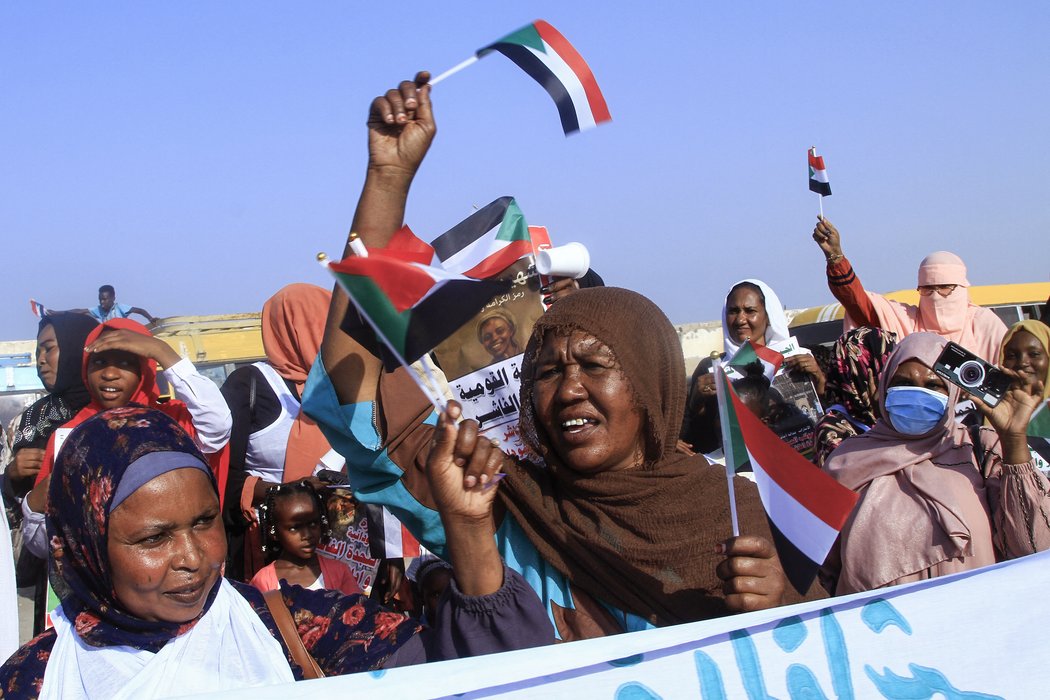
Sudanese diaspora communities organised several significant peaceful protests in response to the ongoing conflict and human rights violations in Sudan. On 2nd November 2025, hundreds of Sudanese in Paris and Berlin held marches calling for an end to the violence. On 8th November 2025, thousands marched in London, with simultaneous demonstrations reported in cities including Paris, Berlin, Washington D.C., Toronto, and Sydney, demanding justice for Darfur, an end to alleged genocide, and accountability for the Rapid Support Forces (RSF) and their supporters. On 20th December 2025, Sudanese residents in London held a peaceful protest outside the UK Prime Minister’s Office, urging an end to the war.
Observers documented widespread human rights violations in Khartoum State, particularly in the Greater Omdurman localities of Karrari, Ombada, and Abu Saad, between 10th and 13th December 2025. During this period, police and other security forces forcibly dispersed peaceful demonstrations, including on 19th December 2025 during marches commemorating the December Revolution (the 2018 popular uprising in Sudan that led to the ousting of long-time dictator Omar al-Bashir), and carried out mass arrests of dozens of participants, many of whom were detained without clear legal procedures. In addition, observers reported night raids on homes, arbitrary arrests, and enforced disappearances, occurring alongside widespread looting by irregular armed groups.
Between 22nd and 23rd January 2026, in Al-Qarqaf area, Kassala State, eastern Sudan, tensions escalated following clashes between residents and anti-smuggling security forces that led to widespread arrests and alleged abuses. On 22nd January, more than 20 young men were arrested during confrontations in the village, prompting protests in which residents blocked the Kassala–Port Sudan highway. On 23rd January, protests intensified, and residents reportedly set fire to an anti-smuggling camp in response to what they described as arbitrary arrests and mistreatment.
Residents and local activists in Wadi Halfa protested on 8th March 2026 against a newly announced housing development plan that they said threatened ancestral land rights and the region’s cultural identity. Dozens gathered outside local government offices, submitting a formal memorandum demanding the plan’s cancellation and calling for meaningful consultation with affected communities, while authorities indicated the proposal would be reviewed at the state level.
Expression
Attacks, Detention, and Enforced Disappearances on Journalists
Press freedom in Sudan has come under increasing strain as journalists face arbitrary detention and disappearances amid the ongoing conflict. In January 2026, The Committee for Justice (CFJ) reported serious violations against journalists and media workers in Sudan over the past year. According to the Sudanese Journalists Syndicate (SJS) report, 67 violations against journalists and media outlets were documented, 14 journalists and media professionals were killed, 6 individuals were subjected to enforced disappearance, 4 faced long-term detention, 9 experienced arbitrary or temporary arrests, and 4 judicial prosecutions were documented, reflecting the ongoing threats to press freedom and the extreme risks faced by media personnel in the country.
Similarly, the ability of journalists and ordinary citizens to report and access information has been severely disrupted by the near-total collapse of communications infrastructure, including widespread internet shutdowns and telecommunications outages.
On 5th March 2026, authorities in Nyala, South Darfur apprehended three female journalists during security operations; in the same incident, several women activists were also detained following their participation in a workshop on women’s rights, prompting criticism from human rights groups who demanded their immediate release and highlighted the broader repression of civic actors. By 8th March 2026, the Syndicate reported that numerous media workers remained either missing or in custody, underscoring the heightened risks faced by those reporting on or engaging in civil society activities in conflict-affected areas.
On 7th February 2026, the Sudanese Journalists Syndicate called for the immediate release of reporter Muammar Ibrahim, who had been held by the Rapid Support Forces (RSF) for over 100 days without formal charges or access to legal counsel. Ibrahim was arrested by the Rapid Support Forces (RSF) on 26th October 2025 in El-Fasher, North Darfur, while attempting to leave the city after it fell under RSF control. Shortly after his arrest, a video circulated showing him in RSF custody, and he was later reportedly transferred to Nyala, South Darfur. Since then, his exact whereabouts, legal status, and health condition have remained unknown, and he has been held without access to his family or legal counsel. In January 2026, international human rights organisations publicly called on the RSF to immediately release him, ensure his safety, and respect the protections afforded to journalists under international law.
Women journalists in Sudan have been systematically targeted during the ongoing conflict, often forced into exile and lacking adequate safety support. As of December 2025, around 40 % of female journalists experienced physical abuse, sexual assault, digital harassment, and threats; two were killed, nearly half were displaced or fled abroad, and over half reported job losses or income reduction, with most lacking safety training.
Enforced disappearances and detention of journalists were also reported on 5th November 2025, when the Sudanese Journalists Syndicate stated that around twenty journalists had been present in the camps of El Fasher and Abu Shouk before fighting erupted. Twelve managed to reach safety in Tawila, two were arrested and detained, contact was lost with seven others, including two women journalists, and the forced detention of four additional journalists had been documented prior to the assault on the city.
In early December 2025, Osman Mirghani, editor-in-chief of the newspaper Al-Tayyar, was subjected to an organised campaign of harassment, receiving explicit death threats and direct calls for violence due to his political views. He reported being targeted with hundreds of threatening phone calls and messages, highlighting the growing risks faced by journalists expressing independent or critical opinions in Sudan.
Targeting of Independent Media
Restrictions on media operations were imposed on 10th November 2025, when Sudan’s Ministry of Culture and Information banned Sky News Arabia from operating in the country, arguing that the channel lacked official authorisation to conduct media activities and that its staff were operating without the required licence, in violation of national law.
Similarly, in December 2025, Droobb, a Sudanese independent news website covering civic affairs and human rights issues (droobb.com), was blocked in the country. Although the site remained technically operational and continued publishing updates, it could only be accessed via VPNs, limiting the public’s ability to obtain independent reporting on human rights violations amid the ongoing conflict.
Restricted Access to Information
The situation has remained largely unchanged since late 2025, with internet shutdowns and deliberate disruptions continuing across Sudan, leaving large parts of the population without reliable access to news and independent reporting, further impeding documentation of human rights violations and leaving the media landscape vulnerable to disinformation. In El‑Fasher, for example, the combination of restricted communications, internet outages, and the absence of independent reporting created an environment in which false and manipulated content spread rapidly. Videos claiming to show atrocities, such as a mother hiding with her children from soldiers or a young girl trapped in a metal barrel, were later proven to be either unrelated to the conflict or reused from other sources, while dozens of AI-generated clips depicting destruction, displacement, and human suffering circulated widely on social media.