Hong Kong’s civic space is rated as ‘closed’ by the CIVICUS Monitor. The draconian 2020 National Security Law (NSL) has been used to prosecute activists, journalists and critics with heavy penalties, while sedition charges have been brought against activists and critics to silence dissent. A 2024 security law - Safeguarding National Security Ordinance (Article 23) or SNSO - added another layer of repression in the territory. Warrants have also been issued against exiled pro-democracy activists. Peaceful protesters have been convicted and some remain behind bars. The right to freedom of association has also been undermined by the introduction of the NSL, with civil society groups, unions and opposition parties ceasing to operate.
Hong Kong held elections for its Legislative Council (LegCo) on 7th December 2025, without a single pro-democracy candidate. According to Human Rights Watch (HRW), Beijing has seized full control of the LegCo and revised laws to ensure that only Chinese Communist Party loyalists can run. It has disqualified elected pro-democracy lawmakers, and imprisoned dozens of leaders of the city’s pro-democracy movement.
In February 2026, HRW reported that throughout 2025, the Hong Kong government frequently invoked draconian national security laws to criminalise peaceful expression and activities. Pro-democracy activists face police surveillance and severe restrictions, and censorship is rampant. Academic freedom has also declined and the government’s transnational repression continued.
In recent months, media owner Jimmy Lai was sentenced to jail together with other media executives from Apple Daily. The government silenced criticism and expression following the deadly Wang Fuk Court fire. Dissenters have been targeted while films have been restricted or banned, an LGBTQI+ play was blocked and student unions ceased operations. The father of activist Anna Kwok was convicted under a national security law and the opposition Democratic Party and Hong Kong Federation of Students disbanded. The national security trial of the Tiananmen vigil group began.
Expression
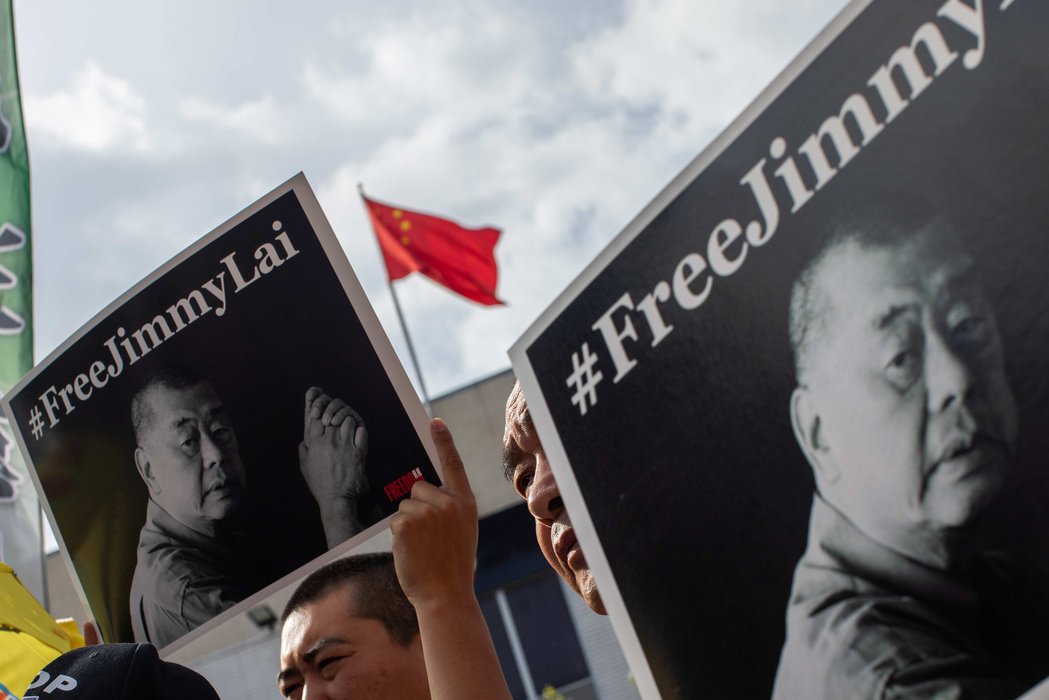
Media owner Jimmy Lai sentenced under draconian national security law
#HongKong: The Committee to Protect Journalists condemns the 20-year prison sentence handed down to publisher Jimmy Lai, the founder of now-defunct pro-democracy newspaper Apple Daily, in Hong Kong’s biggest media trial.#FreeJimmyLai @SupportJimmyLai https://t.co/TSGbcNdXOW
— CPJ Asia (@CPJAsia) February 9, 2026
On 9th February 2026, Hong Kong pro-democracy media owner Jimmy Lai was sentenced to 20 years in jail following his conviction on two counts of ‘conspiracy to commit collusion with foreign forces’ under the Beijing-imposed National Security Law (NSL), and one count of ‘conspiracy to commit sedition’ under the Crimes Ordinance.
Authorities said the collusion charges related to the publication of articles in Apple Daily, a newspaper owned by Lai, that called on foreign countries to impose sanctions. Authorities also cited Lai’s meetings with US politicians and interviews with overseas media, his Twitter (now X) posts and his list of followers on the platform which included prominent foreign politicians and NGOs supportive of the pro-democracy movement in Hong Kong.
For the sedition charge, prosecutors claimed that 161 Apple Daily articles, including 33 by Lai, constituted seditious publications because they allegedly fuelled public distrust and hatred toward the authorities.
According to human rights groups, Lai’s prosecution was marred by multiple serious violations of fair trial rights, including being tried by judges hand-picked by the Hong Kong government, denied a jury trial, subjected to prolonged pretrial detention, and barred from having counsel of his choice.
Jimmy Lai founded the outspoken Apple Daily in 1995. Shortly after the National Security Law was introduced on 30th June 2020, nearly 200 police raided the newspaper’s headquarters. Apple Daily closed in June 2021 following another police raid and the freezing of its assets.
Apply Daily journalists and activists sentenced
Lai received his sentence alongside eight others, including six former Apple Daily executives who had previously pleaded guilty to similar charges in the same case, and two activists.
Publisher Cheung Kim-hung received six years and nine months behind bars, associate publisher Chan Pui-man got seven years, and editorial writer Yeung Ching-kee was sentenced to seven years and three months.
Cheung, Chan and Yeung had testified against Lai in exchange for shorter sentences.
Meanwhile, editor-in-chief Ryan Law, executive editor-in-chief Lam Man-chung, and editorial writer Fung Wai-kong all received 10-year jail terms.
Two former activists linked to the international lobby group Stand with Hong Kong who also testified against Lai, were also jailed. Wayland Chan got six years and three months behind bars, whilst Andy Li received seven years and three months.
Government silences criticism and expression following deadly fire
Hong Kong authorities must transparently investigate the causes of the devastating fire in Tai Po, rather than silencing those who ask legitimate questionshttps://t.co/M9zlcU9vPG
— Amnesty International USA (@amnestyusa) December 1, 2025
On 26th November 2025, a fire broke out at Wang Fuk Court, a housing complex under maintenance that killed at least 151 people and injured 79. The government’s preliminary investigations found that some of the construction netting covering the eight buildings did not meet fire safety standards and arrested 13 people linked to the maintenance company for manslaughter.
According to Human Rights Watch, following the fire, there were growing demands for government accountability. In response, authorities have suppressed peaceful criticism and grassroots initiatives. On 28th November 2025, hundreds gathered near Wang Fuk Court to donate and distribute supplies to victims. But as the initiative gained popularity, the government sent in the police, demanded that the volunteers leave, and had government workers take over the site.
On 29th November 2025, police detained Miles Kwan Ching-fung, a university student who started an online petition calling for an independent investigation. The petition website drew more than 10,000 signatures before it was shut down. Kwan was reportedly arrested on suspicion of ‘seditious intention’, a national security crime, and released on bail on 1st December 2025. In February 2026, he was expelled from the Chinese University of Hong Kong (CUHK), after a disciplinary review due to ‘multiple acts of misconduct’, according to a letter from the university.
On 1st December 2025 local media reported that national security police took away two people for sedition - a volunteer who assisted victims, and the former district councillor Kenneth Cheung Kam-hung - on suspicion of ‘inciting hatred against the government.’
Bruce Liu Sing-lee, chair of the Hong Kong Association for Democracy and People’s Livelihood, was taken in for questioning by the police force’s national security department. He was initially set to speak at a cancelled civil society-led press conference. Wong On-yin, a 71-year-old commentator, was the first person charged under national security-related offences in relation to commentary on the fire and plans to hold a press conference demanding accountability. During court proceedings, Wong was denied bail and remanded in custody.
Journalists warned around reporting on fire
On 28th November 2025, The Hong Kong Security Bureau chief, Chris Tang Ping-Keung, accused people of spreading misinformation and characterised such acts as “destabilising Hong Kong.” The Chinese government’s Office for Safeguarding National Security in Hong Kong warned that any “anti-China and anti-Hong Kong” actors who attempted to use the disaster to incite hatred toward the government would be punished under the city’s draconian national security laws.
In a rare move, Beijing’s national security arm in Hong Kong, the Office for Safeguarding National Security, summoned international journalists on 6th December 2025 to warn them against spreading false information and “crossing red lines,” following critical coverage of the apartment complex fire that killed at least 159 people.
According to the Committee to Protect Journalists, foreign media including Agence France-Presse, the Financial Times, The New York Times, the Associated Press, Bloomberg, and The Wall Street Journal were told there would be no tolerance for “trouble making.” The officials did not give specific examples of the supposedly problematic coverage or take questions, the reports said.
Ongoing efforts to silence dissent
Hong Kong Watch has continued to document the use of lawfare to suppress dissent.
According to the group, on 1st October 2025, China's National Day, an 89-year-old man was arrested in Causeway Bay MTR station for sedition under Article 23, allegedly for displaying written signs. He was granted police bail.
On 31st October 2025, a 16-year-old boy pleaded guilty to conspiring to commit secession for his involvement with the Taiwan-based Hong Kong Democratic Independence Union, including attending online meetings and sharing social media posts about the "Hong Kong Parliament" between November 2024 and July 2025.
On the same day, a 19-year-old woman pleaded guilty to sedition under Article 23 for producing and promoting videos for the "Hong Kong Parliament" and encouraging participation in its unofficial polls via social media between March and May 2025.
In November 2025, authorities arrested at least 29 people for alleged attempts to ‘sabotage’ the Legislative Council election held in December 2025.. They were accused of offences ranging from damaging election posters to reposting online messages that encouraged voters to boycott or cast blank ballots.
Film restrictions by authorities
In October 2025, it was reported that a total of 50 films had been required to be edited, and 13 titles had not been approved for screening on national security grounds since Hong Kong amended the Film Censorship Ordinance in 2021
The Office for Film, Newspaper and Article Administration (OFNAA) told HKFP of the number of films that had to change their content or were barred from being screened between November 2021 and July 2025.
On 12th December 2025, OFNAA refused approval for director Kiwi Chow Kwun-wai’s latest film “Deadline” to be released, citing national security concerns. The decision came after over four months of review since its 4 August 2025 submission
The Film Censorship Ordinance was amended in late October 2021 to include national security clauses, more than a year after the Beijing-imposed national security law came into effect. All films must now be approved by OFNAA before they are screened publicly in Hong Kong. Any that are deemed contrary to national security can be barred from screening, or the authority can request changes such as the removal of certain scenes.
The law also gave the city’s chief secretary, a member of the Committee on National Security, sweeping powers to instruct the Film Censorship Authority to revoke approvals granted – at any time – if they believe the presentation of a film would harm national security.
LGBTQI+ play cancelled by local authorities
West Kowloon Cultural District axes LGBTQ play after complaints it ‘defames Hong Kong’. In full: https://t.co/aupWlFxHsB
— Hong Kong Free Press HKFP (@hkfp) October 19, 2025
In October 2025, the managing body of the West Kowloon Cultural District cancelled an LGBTQ-themed play, hours before tickets went on sale, after complaints alleging the drama “defames Hong Kong.”
The production team of the play 'We Are Gay', written by award-winning playwright Candace Chong, said in a statement that the West Kowloon Cultural District Authority (WKCDA) notified them of the cancellation at around 9am that day, roughly two hours before tickets were to go on sale.
According to the production team, the WKCDA’s notification did not mention the reason behind the cancellation. 'We Are Gay', which tells the story of a love triangle between three men, was set to run at the Xiqu Centre.
Student unions cease operations
Between 21st December 2025 and 18th January 2026, six Chinese University of Hong Kong (CUHK) college student unions ceased operations after the university refused recognition without police registration under the Societies Ordinance.
Shaw College Student Union was suspended on 21st December 2025, Wu Yee Sun College on 23th December 2025, New Asia College on 28th December 2025, United College dissolved 9th January 2026 after the 5th January 2026 notification of non-recognition, Lee Woo Sing College was suspended on 16th January 2026 (including council, assembly, day scholars and hall associations), and Chung Chi College was suspended on 17 January 2025: the same day as the college’s 75th anniversary celebration.
All unions cited the university requirement for police registration as creating “unprecedented risks” and an inability to maintain autonomous operations after colleges refused recognition
Association
Father of activist Anna Kwok convicted under national security law
#HongKong: CIVICUS condemns the conviction of activist @AnnaKwokFY’s father under the national security law. This is a clear reprisal against her activism in exile & blatant intimidation. It also creates a chilling effect for other activists abroadhttps://t.co/qLpI3hQHLb pic.twitter.com/bfx5ZcBFRv
— CIVICUS (@CIVICUSalliance) February 12, 2026
On 11th February 2026, a Hong Kong court found the father of a wanted activist guilty of a national security violation, after he tried to end her insurance policy and withdraw the funds.
Kwok Yin-sang, 68, is the first person to be charged under Hong Kong’s Safeguarding National Security Ordinance, often referred to as the ‘Article 23’ law, for “attempting to deal with, directly or indirectly, any funds or other financial assets or economic resources” belonging to an absconder.
He was charged for withdrawing an education savings insurance policy he bought for her when she was almost two years old. He had pleaded not guilty and did not testify at the trial. He was sentenced to 8 months jail on 26th February 2026.
His daughter, Anna Kwok, helps lead the Washington-based advocacy group Hong Kong Democracy Council (HKDC), and is one of 34 overseas activists wanted by Hong Kong national security police. She is accused of colluding with foreign forces, and police have offered a bounty of 1m Hong Kong dollars (USD 128,000) for her arrest. In late 2024, Hong Kong’s Secretary for Security Chris Tang invoked his powers under Article 23 to cancel Kwok’s Hong Kong passport.
Amnesty International Hong Kong’s Overseas spokesperson Joey Siu said: “This conviction is the first time a family member of a ‘wanted’ pro-democracy activist living abroad has been convicted under Hong Kong’s national security laws. It marks a disturbing escalation in the Hong Kong government’s repressive use of ‘Article 23’.
Opposition Democratic Party commits to disband
In December 2025, Hong Kong’s opposition Democratic Party officially passed a resolution to disband and enter liquidation after operating in the city for more than three decades.
The vote, held at the party’s headquarters in Prince Edward, finalised a decision that was first proposed in February 2025. Democratic Party Chair Lo Kin-hei said a total of 121 members took part in the vote. 117 voted for the disbandment, no one voted against, and four blank votes were received.
It was once the largest opposition party in the city’s Legislative Council (LegCo), commanding as many as 13 seats in the then 60-strong legislature in 1998.
Former party chair Yeung Sum said: “The disbandment of the Democratic Party in Hong Kong has indicated the regression of Hong Kong – from being a free and liberal society into an authoritarian society.”
Since Beijing imposed a national security law in Hong Kong in 2020, dozens of political and civil society groups have dissolved. The pro-democracy Civic Party, then the city’s second-largest opposition party in the Legislative Council (LegCo), officially folded in March 2024.
Hong Kong Federation of Students disbands
On 5th February 2026, the Hong Kong Federation of Students (HKFS), established in 1958, announced dissolution after 68 years citing “increasingly severe pressure” on members and supporters. Isaac Lai, chief representative, confirmed the standing committee voted to initiate dissolution.
For over 68 years, HKFS played key role uniting students, engaging social issues, advocating reform: witnessing and participating in critical moments including supporting democratic movements in mainland China since 1980s, promoting Hong Kong democratic development, anti-national education movement, 2014 class boycott and the Umbrella Movement.
Court upholds the convictions of about a dozen activists in national security case
On 23rd February 2025, a Hong Kong court dismissed the appeals of 12 defendants arising from the city’s biggest case brought under a Beijing-imposed national security law.
Of the 12 activists who lodged appeals, former journalist Gwyneth Ho sought only to overturn her conviction, while 10 others, including ex-lawmaker Leung Kwok-hung and activist Owen Chow, appealed against both their convictions and sentences.
As previously documented, the pro-democracy advocates were among 47 activists charged in 2021 with conspiracy to commit subversion for their involvement in an unofficial primary election for the 2020 Legislative Council elections that were ultimately postponed by authorities on COVID-19 grounds before a new electoral system was brought in that strictly vetted who could stand for office.
Of the 47 charged, 31 pleaded guilty to the charge while 16 pleaded not guilty, two of whom were acquitted. 45 of the defendants were sentenced to between four years and 10 years in 2024, with their punishments drawing criticism from foreign governments and rights groups.
Peaceful Assembly
National security trial of Tiananmen vigil group begins
The trial of three activists who organised annual vigils to commemorate the 1989 Tiananmen Square crackdown, began in January 2026. They are facing charges under the National Security Law.
Lawyer Chow Hang-tung, trade unionist Lee Cheuk-yan and former lawmaker Albert Ho are accused of ‘inciting subversion of state power’ under the China-introduced law. Ho has entered a guilty plea while the other two pleaded not guilty.
The trio are part of the now-disbanded Hong Kong Alliance (HKA) that was founded in May 1989 to support students holding pro-democracy rallies. The three face up to 10 years in jail if convicted. They have been held in pre-trial detention since 2021, having been repeatedly denied bail.