GENERAL
BALLOON SMUGGLING CRISIS BETWEEN BELARUS AND LITHUANIA
Since October 2025, Lithuania has faced repeated airspace incursions by high-altitude balloons launched from neighbouring Belarus to smuggle cigarettes, disrupting operations at Vilnius Airport due to safety concerns. On 9th December 2025, the Lithuanian government declared a state of emergency over the impact on civil aviation and wider security risks, describing the activity as a “hybrid attack” and accusing Belarus of enabling, or failing to prevent, launches that interfere with air traffic and force temporary flight restrictions. The crisis led to the interception of 635 balloon-borne contraband shipments in 2025 and continued into 2026, with incidents recorded in January, February, March, and April. By April 2026, Lithuanian authorities had opened around 30 pretrial investigations into cigarette smuggling by balloon from Belarus, identifying roughly 90 suspects, more than 30 of whom have been convicted.
A further consequence of the crisis was the detention of Lithuanian trucks in Belarus. This move was seen as retaliation by the Belarusian government after Lithuania closed two border crossings for a month, from October to November 2025, in response to the balloon incidents. Although Belarus agreed to release the trucks in March 2026, the requirement to pay storage fees has complicated their return due to EU sanctions.
CORRUPTION INVESTIGATION INTO THE STATE PLANT SERVICE AND POLITICAL LINKS
At the end of 2025, Lithuanian law enforcement launched a large-scale investigation into systemic corruption within the State Plant Service, where employees are suspected of accepting bribes in exchange for issuing phytosanitary certificates. On 9th February 2026, the investigation expanded to the political level, with searches carried out in the offices and homes of members of Parliament, including former prime minister Saulius Skvernelis, leader of the Democratic Union “For Lithuania”, and former agriculture minister Kazys Starkevičius, an MP for the party Homeland Union-Lithuanian Christian Democrats.
The case continued to have political repercussions. On 6th March 2026, Starkevičius resigned from Parliament following links to the investigation. On 9th April 2026, prosecutors requested the lifting of Saulius Skvernelis' parliamentary immunity, after which he suspended his party membership. The following day, 10th April 2026, Skvernelis was formally accused of accepting €51,000 in cash bribes. On 16th April 2026, Parliament lifted his immunity at his own request. As of April 2026, Skvernelis continues to deny all allegations, while the investigation remains ongoing as authorities gather further evidence and assess the scope of the alleged corruption network.
LITHUANIAN COURT RULES “GREEN BORDER” PUSHBACKS UNLAWFUL
On 30th December 2025, Lithuania's Supreme Administrative Court issued a landmark ruling in a case brought by the Human Rights Monitoring Institute together with the law firm ReLex. The court found that border guards acted unlawfully by pushing back a Sri Lankan national to Belarus on 23rd October 2023 without allowing him to apply for asylum. According to the Human Rights Monitoring Institute, the judgment sets an important precedent, as it is the first time the court has ruled that pushbacks at the so-called "green border"—stretches of the state border outside official crossing points, often in remote or forested areas—violate the right to seek international protection. The ruling confirms that the right to apply for asylum applies regardless of how a person enters the country.
INVESTIGATION INTO HUMAN TRAFFICKING LINKED TO EPSTEIN FILES
At the beginning of February 2026, Lithuanian prosecutors opened a formal pre-trial investigation into potential human trafficking offences after Lithuania was mentioned more than 1,000 times in published documents related to the activities of American financier and convicted child sex offender Jeffrey Epstein. The documents also refer to Lithuanian figures, including prominent businessman and event organiser Valdas Petreikis, as well as Lithuanian models. As of the beginning of April 2026, the investigation is ongoing. Prosecutors have questioned 20 individuals and continue to gather further information.
ETHICS VIOLATION FOUND IN MP’S CONDUCT TOWARD LRT AND ITS JOURNALISTS
On 17th December 2025 and 14th January 2026, the Lithuanian Parliament’s Ethics and Procedures Commission issued two decisions finding MP Remigijus Žemaitaitis, leader of the Nemunas Dawn (Nemuno aušra) party, in violation of parliamentary ethics rules over his public statements and actions concerning the national broadcaster Lithuanian National Radio and Television (LRT) and its journalists.
The first decision concerned an incident in which Žemaitaitis was found to have pressured journalist Žygintas Abromaitis by requesting that a specific political remark be included in a news report and suggesting that future interviews with LRT could depend on whether his request was met. The second decision concerned Facebook posts in which Žemaitaitis used insulting and derogatory language towards LRT and its journalists. He also portrayed LRT as being influenced by communist ideology and described it as a so-called “fifth column” posing a threat to the state. The Commission concluded that his conduct and rhetoric violated basic standards of respect for individuals and state institutions, as well as the general rules of ethical conduct expected from elected officials.
CONTROVERSIAL REFORMS OF LRT FUNDING AND GOVERNANCE
At the end of 2025, several controversial amendments affecting the governance and funding of the Lithuanian public broadcaster LRT were introduced.
On 27th November 2025, Parliament adopted the first legislative change, revising LRT's funding model by freezing state funding at the 2025 level for 2026-2028 and reducing the share of personal income tax and excise duty revenues allocated to the broadcaster. Shortly afterwards, on 6th January 2026, it was reported that a group of opposition MPs had challenged the law before the Constitutional Court, where it remains under review.
In parallel, two draft laws on LRT governance (No. XVP-1052 and No. XVP-1119) were introduced in November and December 2025. They proposed lowering the voting threshold in the LRT Council from a two-thirds majority to a simple majority, introducing secret ballots, and changing the procedures for appointing and dismissing the Director General. After the opposition blocked consideration of one of the drafts in mid-December 2025, Parliament abandoned the urgent procedure in favour of a broader review.
On 30th December 2025, a working group was established to reassess LRT governance and address concerns about transparency and risks to media independence. However, its composition and mandate were criticised, with some journalists’ organisations declining to participate. Their request to include representatives of organisations recommended by the Media Council, a cross-sectoral advisory body of the Ministry of Culture, in the working group was not honoured, despite support from opposition parties. Two opposition parties later also withdrew their representatives from the working group. It completed its work with a new draft law at the end of February 2026. As of mid-April 2026, the draft legislation on LRT governance remains under consideration in Parliament.
From the outset, the proposed reforms to LRT's funding and governance prompted significant domestic debate, including mass protests, as well as international criticism. In November 2025, the Council of Europe raised concerns about the risks that the amendments could pose to the broadcaster’s independence. In December 2025, the European Broadcasting Union criticised the fast-track procedure, warning that the amendments could undermine media freedom and potentially conflict with EU law. In January 2026, the European Parliament adopted a resolution criticising the proposals and urging the Lithuanian Parliament to reject them. In March 2026, the Venice Commission issued an opinion warning that the proposed amendments “may create conditions that increase vulnerability to political pressure and self-censorship.”
POLITICAL LINKS TO MEDIA OWNERSHIP
According to findings published by Transparency International Lithuania on 15th January 2026, 54 politicians and their spouses owned 109 of Lithuania's 806 media outlets in 2025. The analysis, based on publicly available data, found that these ownership links existed across a wide variety of media outlets, with a particularly strong presence at the regional and local level. Compared with 2021, the number of politicians, public officials and their spouses owning media outlets fell from 68 to 54, while the number of outlets they owned declined from 129 to 109. During the same period, the total number of media outlets in Lithuania also decreased, from 1,064 to 806, reflecting an overall contraction of the media market.
PROPOSAL FOR ENTRY BAN ON PERFORMERS CONTINUING ACTIVITIES IN RUSSIA AND BELARUS
Following the 10-year entry ban imposed on Russian rapper Morgenshtern on 13th November 2025, which was later overturned by the Supreme Administrative Court of Lithuania on 15th April 2026, and the 5-year entry ban imposed on Russian rapper Gio Pika on 20th February 2026, conservative parliamentarian Vytautas Kernagis registered amendments to the law “On the Legal Status of Aliens” on 18th March 2026.
The initiative followed a proposal made in February 2026 by Vilnius Mayor Valdas Benkunskas, who suggested introducing legal restrictions to prevent performers from entering Lithuania who had continued their activities in Russia or Belarus after the start of the war in Ukraine.
The proposed amendments would introduce a five-year entry ban for such performers and other entertainment figures. According to the explanatory memorandum, the changes aim to establish a legal mechanism to “protect the information and cultural space of the Republic of Lithuania from individuals who are supportive of the Kremlin regime.”
HIGHER FINES INTRODUCED FOR OFFICIALS REFUSING INFORMATION TO JOURNALISTS
On 9th April 2026, Parliament adopted amendments to Article 547 of the Code of Administrative Offences, increasing fines for officials who refuse to provide information to journalists or obstruct them in carrying out their professional duties. The revised penalties range from €60 to €300 for a first offence (previously €20 to €140) and from €300 to €600 for repeat offences (previously €50 to €300). The amendments are intended to strengthen enforcement of obligations relating to access to public information and transparency in public institutions.
FREEDOM OF ASSEMBLY
MASS PROTESTS AGAINST CONTROVERSIAL LRT REFORMS
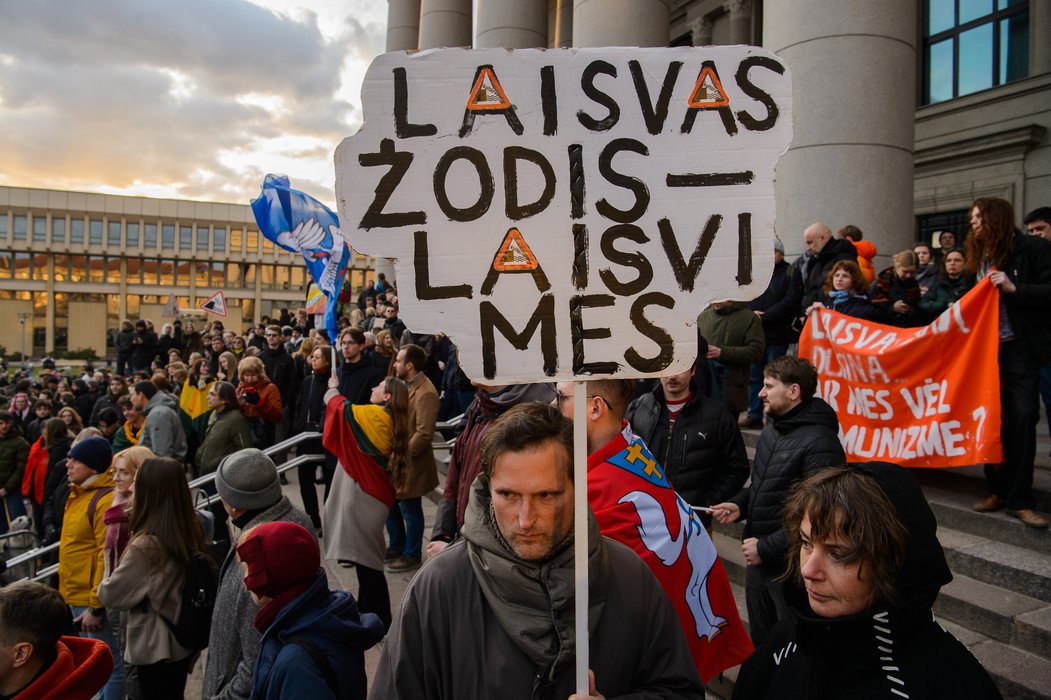
On 9th December 2025, around 10,000 people gathered in front of the Lithuanian Parliament in Vilnius for a rally titled “Hands Off Free Speech,” protesting proposed changes to the governance and funding of the public broadcaster LRT. Protesters, including journalists and members of the public, argued that the fast-tracked reforms would make it easier to dismiss the LRT Director General and give the governing majority greater control over the broadcaster’s leadership, increasing political influence over public media and weakening media independence. The protests continued daily from 16th to 18th December 2025, with around 10,000 people again gathering on the first day.
At the end of December 2025, the fast-tracked process for adopting the proposed amendments was dropped, and a parliamentary working group was set up to review LRT’s governance. The group presented a new draft law at the end of February 2026. However, the revised proposal continued to raise concerns and draw criticism, both in Lithuania and internationally. In response, another rally was held on 8th April 2026, with around 10,000 people protesting what they saw as the risk of increased political influence over the public broadcaster.
PROTESTS OVER KAPČIAMIESTIS MILITARY TRAINING GROUND
On 24th January 2026, between 1,500 and 2,000 people took part in a protest titled “Kapčiamiestis for Life – Not for a Training Ground!” in the Lazdijai district, near the town of Kapčiamiestis. Participants gathered along the Kapčiamiestis-Sopotskin road, forming a continuous line stretching for around eight kilometres toward the Belarusian border.
The protest was held in response to government plans to establish a military training ground in the area. The proposed site would be divided into two sections, with around two-thirds used for manoeuvres, tactical exercises and administrative buildings, and the remainder designated as live-fire training ranges, where civilian activities would be prohibited. The project would affect approximately 90 homesteads in the area. Of these, 13 near the Polish border fall within the planned live-fire zone and are expected to be purchased by the state.
On 16th February 2026, another rally took place in Kapčiamiestis, with around 200 people gathering in the square after an 8-kilometre march.
On 18th March 2026, Lazdijai District Mayor Ausma Miškinienė stated that the concerns of the majority of local residents regarding the training ground had been addressed. Despite this, further protests were held in Vilnius on 28th March and 14th April 2026, organised by the “For Lithuanian Forests” movement. These demonstrations opposed both the establishment of the Kapčiamiestis training ground and related deforestation, with around 300 people gathering on 14th April 2026. On the same day, parliament approved the draft law on the establishment of the Kapčiamiestis training ground in its second reading.
COMMEMORATIVE AND SOLIDARITY MARCHES
In February and March 2026, a series of commemorative and solidarity marches took place in Vilnius, marking key national dates and expressing civic and social concerns.
On 16th February 2026, participants held a torchlight procession to mark the Day of the Restoration of the State, celebrating the proclamation of Lithuania as an independent state following the First World War, while on 24th February 2026, a civic march was organised to commemorate the anniversary of Russia’s full-scale invasion of Ukraine and express solidarity with Ukraine. Further marches took place in March 2026, including a Women’s Day demonstration on 8th March 2026, where participants highlighted gender equality and social issues through slogans and placards, and a march along Gediminas Avenue on 11th March 2026 to mark the Day of the Restoration of Independence, celebrating Lithuania’s independence from the Soviet Union.
SERIES OF PROTESTS AGAINST US AND ISRAELI FOREIGN POLICY
On 28th March 2026, protests took place in Vilnius and Kaunas against United States and Israeli actions in the Middle East, drawing around 100 participants in the capital. In Vilnius, demonstrators gathered at Vinco Kudirkos Square and marched to Town Hall Square, carrying Iranian, Palestinian and Ukrainian flags and anti-war placards. According to organisers, the protest called on the Lithuanian government to withdraw political, economic and military support for the United States and Israel and to adopt a more consistent foreign policy position.
Earlier in 2026, smaller protests were held in front of the US embassy in Vilnius on 7th January 2026 against US actions in Venezuela, on 30th January 2026 against US plans towards Greenland, and on 4th March 2026 near the Ministry of Foreign Affairs against Lithuania’s position on the war in the Middle East following the US and Israel’s attack on Iran.