INTRODUCTION
This update covers civic space developments in Guinea from February to July 2026, and includes the following:
- Journalist forced to flee Guinea following death threats.
- Media regulator suspends a TV show, two news websites, five journalists and permanently shuts down Kaback TV.
- Social media face restrictions in April and July 2026.
- Military authorities dissolve 40 political parties.
- Family members of exiled human rights defender abducted.
Human rights organisations raise concern about enforced disappearances and abductions in Guinea
On 9th July 2026, Amnesty International, the Coordination of Human Rights Organisations (CODDH) of Guinea and the West African Human Rights Defenders Network (WAHRDN) issued a joint statement on the numerous enforced disappearances and abductions of journalists, civil society activists and opposition members.
The statement was issued two years after Oumar Sylla, also known as Foniké Mengué, and Mamadou Billo Bah were forcibly disappeared. The two Front for the Defence of the Constitution (FNDC) activists were arrested on 9th July 2024 at Sylla’s home in Conakry and allegedly taken by special forces to the Loos archipelago for interrogation and torture. Despite the announcement of an investigation into their disappearances, there is no evidence that steps have been taken by authorities to locate the two HRDs.
Other cases of abductions and enforced disappearances highlighted by the human rights organisations include five family members of exiled human rights defender Elie Kamano who were abducted by armed men on 16th November 2025, including four minors; the youngest was later released, but the fate of the remaining four remains unknown. Mohamed Traoré, former President of the Guinean Bar Association, was abducted from his home on the night of 20th-21st June 2025 by armed men and subjected to abuse before being released a few hours later. Abdoul Sacko, National Coordinator of the Forum of Social Forces of Guinea, was abducted on 19th February 2025 and found the same day in “a critical state, tortured and abandoned.” Habib Marouane Camara, journalist and director of Le Révélateur 224 online media, was abducted by men in uniform on 3rd December 2024; no contact has been made with his family and friends since.
Additionally, the human rights organisations expressed concern about the broadening pattern of abductions and enforced disappearances in Guinea, including that of journalist Habib Marouane Camara, director of Le Révélateur 224 online media, who was abducted by men in uniform on 3rd December 2024.
EXPRESSION
Journalist forced to flee Guinea following death threats over investigative report
Ibrahima Sory Barry, the publishing director of the online news site Vérité 224, was forced into exile in June 2026 after receiving death threats against him and his family. According to the Media Foundation for West Africa (MFWA), these threats were linked to his work as a fixer and cameraman for Canadian journalist Isabelle Hachey of the Quebec newspaper La Presse, in investigating the 2007 death of Rachelle Wrathmall, former wife of Guinean opposition politician Rafiou Sow, in Canada. In June 2026, Hachey travelled to Guinea as part of her investigation, which involved an interview with Rafiou Sow.
After the publication of the investigative report, which reportedly went viral on social media, Barry began to receive anonymous text messages and calls containing explicit death threats, including one that said: “You are the journalist who set up Mr. Rafiou with the Canadian journalist. Remember that you are a dead man. We will find you wherever you hide and make you regret what you did.” Threats also targeted his family, with anonymous texts saying: “It’s over for you and your family…sooner or later we will get you, we will get a member of your family, we will finish you and there will be no consequences.” Furthermore, the journalist told MFWA that two unidentified men came to his house looking for him and questioned his wife about his whereabouts.
On 18th June 2026, the Network of Online Media in Guinea (REMEGUI) released a statement expressing concern and urging the Guinean Police to ensure Barry’s safety and that of his family.
Media regulator suspends a TV show, two news websites, five journalists and permanently shuts down Kaback TV
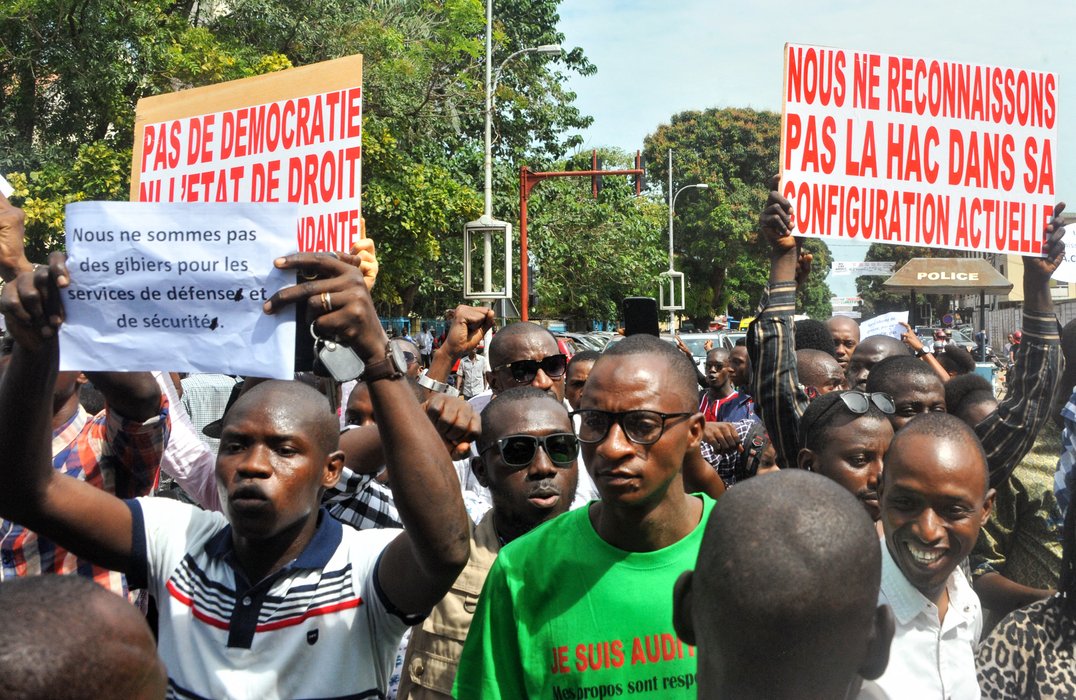
On 23rd April 2026, Guinea’s media regulator, the High Authority for Communication (HAC), suspended the TV show ‘Guinea Today’ on Télé 24 media outlet and its presenters, Aboubacar Diallo and Bah Sékou, for a period of three months. HAC accused the programme and its presenters of breaching electoral communication regulations prior to the 31st May 2026 legislative and municipal elections. The suspension followed a broadcast on the Guinea Today show discussing unverified theft and misappropriation allegations made against Baldé Ibrahima Sory, candidate for Kollé municipality.
The HAC also referred to an earlier broadcast on the show on 21st April 2026, which it considered election propaganda for another candidate. According to the HAC, the show breached pre-electoral communication regulations and did not meet professional standards. Despite apologies from Télé 24, the HAC considered this a repeated offence.
On 18th April 2026, the HAC suspended journalist André Gaston Morel for six months, also for alleged electoral propaganda ahead of the legislative and municipal elections. On 17th April 2026, Morel had aired an interview with a presumed candidate in the Kaloum constituency during the ‘Belle Canailles’ programme on Étoile TV. The HAC concluded that the interview contained promotional statements and electoral promises favouring the candidate, thereby breaching the principles governing pre-electoral communication regulations. As a result, the HAC prohibited Morel from practising journalism anywhere in Guinea for six months, including hosting, producing or directing audiovisual programmes and contributing to print or digital media platforms.
On 25th March 2026, the HAC permanently closed the private television station Kaback TV and its digital platforms. The HAC cited a conflict of interest of the station’s owner, Mamadou Camara, who also serves as the Inspector General of police, and broadcasting of content HAC considers likely to disturb public order. Second, the HAC mentioned the airing of content that could disturb public order and morality. The latter referred to an interview with a school principal in Conakry conducted after a protest by parents of students, in which he accused a parent representative of being a security officer, allegedly linked to military leader Mamadi Doumbouya.
While Kaback TV’s editors, who spoke with MFWA, chose not to air the interview, the journalist posted the footage on his personal social media account without permission, with the station’s logo still visible on the microphone used, leading HAC to hold Kaback TV responsible for the content.
Kaback TV was previously suspended for a period of three months on 10th December 2025, for airing content HAC deemed indecent and defamatory during the ‘Telero’ programme, a decision lifted two days later.
In a positive development, on 30th April 2026, the HAC lifted the suspension of Télé 24 and its presenters, Diallo and Sékou, and Morel. On the same day, HAC also allowed Kaback TV to resume operations.
On 12th March 2026, the HAC suspended two news websites, Africaturemedia.com and Guineesource.com, for three months following their coverage of violent confrontations on 11th March 2026 between Guinean and Liberian youths in Kiéssènèye, a border town in southern Guinea, amid wider tensions between Guinea and Liberia over a disputed strip of land.
According to the HAC, Africaturemedia.com and Guineesource.com had disseminated images and commentary, including live footage of the clashes, which it considers as potentially inciting further violence across the border. The HAC further stated that the suspension aimed to prevent further escalation of the tense situation. Furthermore, the HAC suspended two journalists, Saa Edouard Tinguiano from Africaturemedia.com and Foromo Lamah from Guineesource.com, for a period of six months, held responsible by HAC for the dissemination of the content, on accusations of not possessing valid press credentials. The HAC lifted the suspension against Africaturemedia.com and Guineesource.com on 16th April 2026.
Social media platforms restricted in April and July 2026
Between April and July 2026, the government of Guinea implemented two major restrictions on social media access. On 15th April, access to Facebook, Messenger, TikTok and YouTube was blocked, forcing users to rely on VPNs. Civil society organisations, particularly the Guinean Bloggers Association (Ablogui), immediately called for restoration on 16th April, citing fundamental rights to information and freedom of expression and noting the platforms’ importance for economic activities. A government statement cited the need to prevent insulting language, hate speech and division. Following a brief reprieve, on 28th July, access to Facebook, TikTok, YouTube and WhatsApp was again restricted. The Guinean Bloggers Association and the Union for the Defence of Consumers of Guinea renewed calls for immediate restoration, with the Union's president, M’Bany Sidibé, highlighting significant losses incurred by small and medium-sized enterprises engaged in online commerce. Both organisations demanded explanations from the authorities, but the government and the Postal and Telecommunications Regulatory Authority (ARPT) did not respond. This July restriction marked the sixth instance of social media restrictions since 2023, signalling an escalating pattern of platform disruptions.
ASSOCIATION
Military authorities dissolve 40 political parties
Guinea has dissolved 40 political parties, including its three main opposition groups, via a late-night decree, fewer than two months after former junta leader Mamady Doumbouya was sworn in as president. https://t.co/tN84GDsep0
— AFP News Agency (@AFP) March 7, 2026
On 6th March 2026, Guinea’s Ministry of Territorial Administration and Decentralisation (MTAD) issued an order dissolving 40 political parties, including the Union of Democratic Forces of Guinea (UFDG), the Rally of the Guinean People (RPG), and the Union of Republican Forces (UFR), citing their “failures to comply with their legal obligations.” However, MTAD did not specify which obligations were unmet by these parties.
This order revoked the parties’ legal recognition, froze their assets, prohibited the use of their names, logos, and symbols, and assigned a state curator to manage the transfer of their assets.
Alfred Nkuru Bulakali, Regional Director of ARTICLE 19 Senegal and West Africa, stated:
Dissolving 40 political parties including the main opposition party with the stroke of a ministerial order, and without any judicial process, is a clear violation of freedom of expression, freedom of association, and the right to participate in public affairs.
- Alfred Nkuru Bulakali, Regional Director of ARTICLE 19 Senegal and West Africa
Civil society actors condemned the decision as an “autocratic power grab” intended to establish single-party rule.
Family members of exiled human rights defender abducted
The UN High Commissioner for Human Rights (OHCHR) and the UN Working Group on Enforced Disappearances expressed concern regarding the alleged enforced disappearance of Kamano’s relatives in May 2026, calling for information on their fate and their immediate release. The OHCHR issued a statement on 20th November 2025 expressing deep alarm over the apparent enforced disappearances. Kamano has been in exile for over a year, leaving his family in Guinea. Kamano accused the military authorities of being responsible for his family’s abduction.