GENERAL
APPOINTMENT OF ANDREJ BABIŠ AS PRIME MINISTER AND FORMATION OF NEW GOVERNMENT
Andrej Babiš was appointed Prime Minister of the Czech Republic on 9th December 2025, despite ongoing conflict-of-interest concerns, following the victory of his right-wing populist party, ANO, in the parliamentary elections held on 3rd and 4th October 2025 (see previous CIVICUS Monitor update). ANO won 34.5% of the vote and secured 80 of the 200 seats in Parliament.
On 15th December 2025, President Petr Pavel appointed a new coalition government, formed after weeks of consultations and negotiations. The coalition, comprising right-wing parties including ANO, Freedom and Direct Democracy (SPD), and Motorists for Themselves, held 108 of Parliament's 200 seats (54%). On 15th January 2026, the government won the mandatory confidence vote in the Chamber of Deputies by 108 votes to 91.
MINISTERIAL APPOINTMENT DISPUTE SPARKS TENSIONS AND BLACKMAIL ALLEGATIONS BETWEEN PRESIDENT AND MOTORISTS PARTY
The composition of the new coalition government, particularly the allocation of ministerial posts, became a source of public controversy in late 2025 and early 2026.
As previously reported by the CIVICUS Monitor, President Petr Pavel blocked the appointment of Motorists MP and former MEP Filip Turek as Minister of Environment due to controversial racist, homophobic and sexist statements he had allegedly made on social media. In addition to these controversies, critics pointed out the danger in entrusting this ministry to a representative of a fiercely anti-environmentalist and pro-fossil fuel party such as the Motorists.
On 27th January 2026, President Pavel accused Petr Macinka, the newly appointed Minister of Foreign Affairs and leader of the Motorists Party, of blackmail after the President's adviser received text messages from Macinka threatening negative consequences if Pavel continued to reject Turek’s nomination. The President’s Office subsequently filed a formal complaint, asking the authorities to assess whether the messages constituted coercion or blackmail.
Macinka rejected the allegations, arguing instead that the President had exceeded his constitutional authority by refusing to appoint Turek. Under the Czech Constitution, ministers are appointed by the President on the Prime Minister’s proposal, but legal opinion differs on whether the President has the discretion to reject ministerial nominees.
The dispute between the Motorists Party and President Pavel escalated, prompting the opposition to call for a vote of no confidence in the government on 4th February 2026. The government survived, with only 84 MPs voting in favour of the motion, well short of the 101 votes required to bring down Andrej Babiš's third cabinet.
Approximately two months after the government was formed, the Motorists Party, Prime Minister Babiš and President Pavel agreed to appoint Igor Červený as Minister of Environment. He was formally appointed on 23rd February 2026. Filip Turek was instead appointed Government Commissioner for Climate Policy and the Green Deal, a newly created position that attracted criticism.
FREEDOM OF EXPRESSION
DENÍK N JOURNALISTS DENIED ACCESS TO FOREIGN MINISTER’S PRESS BRIEFING
On 27th January 2026, the news outlet Deník N reported that its journalist Zdislava Pokorná, along with other Deník N reporters, had been barred from attending a public briefing by Minister of Foreign Affairs Petr Macinka, leader of the Motorists Party. In addition, Deník N photojournalist Gabriel Kuchta was refused entry to the Ministry building.
Macinka justified the decision by referring to a criminal complaint filed against Deník N editorial staff and journalists Zdislava Pokorná and Michael Švec. The complaint had been submitted by the Motorists party in October 2025 following the publication of a Deník N article based on archived Facebook posts containing racist, sexist and homophobic comments attributed to their MP Filip Turek (see the previous CIVICUS Monitor update). A party spokesperson stated at the time that they were pressing charges due to “serious suspicions of committing criminal offences of defamation, false accusation, unauthorised access to a computer system and information carrier, as well as damage to the rights of others.”
Later the same day, the editors-in-chief of ten media outlets issued a joint appeal urging Macinka to end the arbitrary exclusion of journalists from his public press conferences. The following day, he responded by promising that no media outlets would be excluded from future press briefings.
MP JINDŘICH RAJCHL REPEATEDLY TARGETS JOURNALISTS AND MEDIA OUTLETS
Jindřich Rajchl, leader of the right-wing populist Law, Respect, Expertise (PRO) party who was elected as an MP on the SPD list, repeatedly targeted journalists and media outlets with verbal attacks and intimidation on social media during the first months of 2026.
On 7th January 2026, Rajchl attacked Deník N journalist Jiří Labanc on Facebook, labelling him an “indoctrinated pseudo-intellectual” and “woke activist.” The post, which also included the journalist's photograph, was shared by the official PRO party account. The attack followed Labanc’s critical commentary on U.S. Secretary of Health Robert F. Kennedy. Deník N described the incident as inappropriate, stressing that politicians should “defend their work in front of the media, not intimidate them”.
On 17th February 2026, Rajchl also threatened journalist Václav Moravec and public broadcaster Czech Television after a decision not to allow him on their political discussion programme “Questions from Václav Moravec” (Otázky Václava Moravce - OVK). The show’s editorial team had invited the SPD Minister of Defence or his deputy to participate in a televised debate on security issues. However, the party did not allow them to participate and instead proposed Rajchl as a replacement, which the programme did not accept. In response, Rajchl accused Moravec of personal bias and encouraged viewers to submit complaints to the Czech Television Council, arguing that the broadcaster was obligated to accept whoever political parties nominate as a guest.
After the editor-in-chief of Czech Television rejected the accusations and reasserted the broadcaster’s editorial independence, Rajchl posted a video response on social media stating that Czech Television needs to be “tamed” and threatening to do “everything he can” to ensure Moravec leaves the programme, referencing the January 2026 dismissal of OVK’s editor Hana Andělová, reportedly for not agreeing to feature SPD Leader and Speaker of the Chamber of Deputies Tomio Okamura on the programme.
On 8th March 2026, Moravec announced his resignation, stating that he could no longer guarantee editorial independence or critical journalism at Czech Television after Andělová’s replacement invited Okamura to the programme despite Moravec's objections.
On 31st March 2026, Rajchl again made derogatory remarks about media outlets and journalists on Facebook, referring to outlets including DVTV, Forum 24, Reflex, and Respekt as “paid activists” and “feces” in response to them contacting him with interview requests.
GOVERNMENT PLANS TO ABOLISH PUBLIC MEDIA LICENCE FEES
On 23rd March 2026, the ruling coalition announced plans to abolish public television and radio licence fees for people over 75, those under 26, people with disabilities and companies from mid-2026, although, as of April 2026, the necessary legislation had not yet been drafted.
On 26th March 2026, international media and journalists’ organisations warned that the proposal, which would exempt nearly a quarter of households from paying licence fees, could significantly undermine the financial stability and independence of Czech Radio and Czech Television. Pavol Szalai, Director of the Reporters Without Borders (RSF) Prague Bureau, emphasised that licence fees “remain the best guarantee of editorial independence and transparent funding for public media” in the Czech Republic.
The proposal followed the government’s programme statement of 5th January 2026, which outlined plans to abolish public media licence fees entirely, despite their currently being the principal source of funding for Czech public broadcasters.
On 14th April 2026, the government presented a draft law to abolish licence fees for Czech Television and Czech Radio and replace them with direct state funding, expected to be around 20% lower than the current budget. The proposal would also allow voluntary contributions, which would have to be publicly disclosed. The draft law is intended to enter into force on 1st January 2027.
On 20th April 2026, Czech Television and Czech Radio criticised the proposal, pointing to ten fundamental legal shortcomings, including insufficient safeguards for public media independence. The following day, Deputy Prime Minister Karel Havlíček promised a substantive expert debate on the draft law. On 22nd April 2026, a protest was held in Prague, while trade unions representing employees of Czech Radio and Czech Television declared an indefinite strike against the proposed abolition of licence fees.
FREEDOM OF ASSEMBLY
PROTESTS OVER MOTORISTS PARTY ROLE IN THE MINISTRY OF ENVIRONMENT
On 9th December 2025, students gathered in Prague, Brno and other cities across the Czech Republic to protest the appointment of a Motorists Party representative as Minister of Environment during the formation of the new coalition government. The protests were organised by the Universities for Climate initiative.
Demonstrators criticised the Motorists Party’s sceptical stance on climate change, referring in particular to statements by its leader Petr Macinka, who had previously said that “the idea that humans are the sole cause of climate change is funny”. They also pointed to his support for rolling back protections for the Soutok Protected Landscape Area and his reported ties to coal oligarch Pavel Tykač.
The protests were repeated across the country on 15th December 2025 following the appointment of Motorists Party leader Petr Macinka as interim Minister of Environment. In Prague, Greenpeace activists climbed the headquarters of the Ministry of Environment and hung a banner reading “Let’s protect nature” from the building. Police were deployed to the scene and later stated on social media that the activists had descended voluntarily. They also announced that they had identified the activists and would refer them to the relevant authorities for misdemeanour proceedings.
Following a wave of layoffs at the Ministry of Environment in early April 2026, as well as plans to create a special department for Climate Policy and the Green Deal under Government Commissioner Filip Turek, a demonstration titled “We won’t let nature be erased!” was held in Prague on 19th April 2026. Organised by Greenpeace and Hnutí Duha (Rainbow Movement), the protest also raised concerns about reduced funding for national parks and harmful proposals blocking the construction of wind farms, with demonstrators calling for the removal of Motorists Party representatives from the ministry’s leadership.
THOUSANDS RALLY IN SUPPORT OF PRESIDENT PAVEL AMID DISPUTE OVER GOVERNMENT APPOINTMENTS
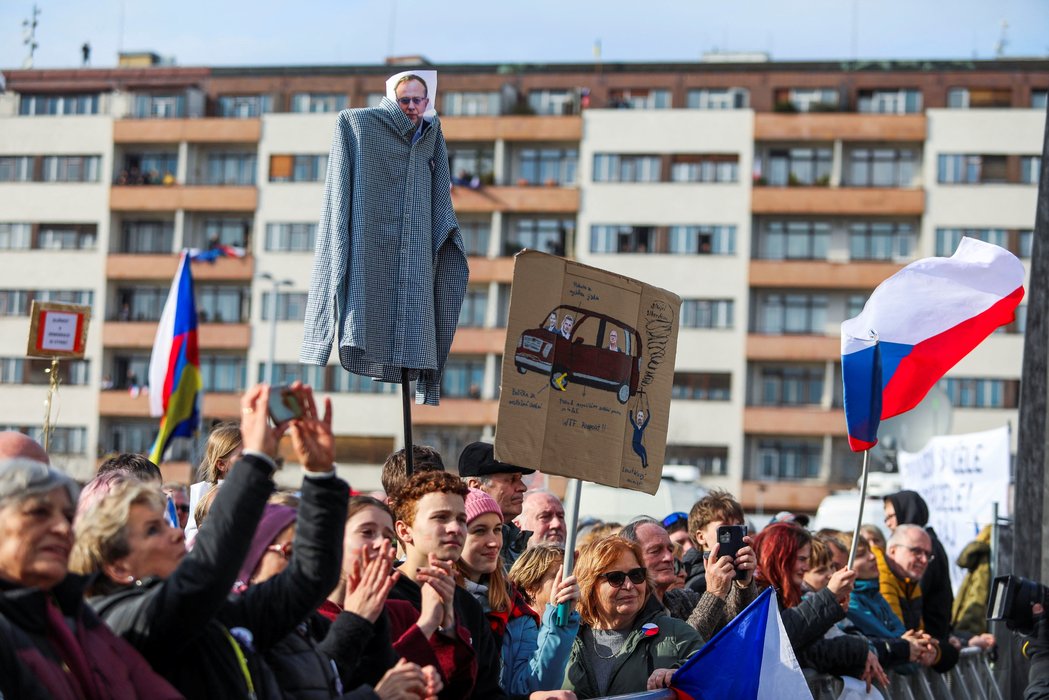
On 1st February 2026, tens of thousands of people took to the streets of Prague in support of President Petr Pavel amid a growing political dispute over his decision to reject the nomination of Filip Turek as Minister of Environment. In the days leading up to the protest, Pavel stated that he had faced threats and blackmail from Foreign Minister Petr Macinka, leader of the Motorists Party, in connection with the nomination process. The President described Turek as an unsuitable candidate, citing publicly reported statements and actions, including expressions of support for the Nazi regime as well as sexist and homophobic remarks.
Protests continued across more than 400 municipalities in the Czech Republic on 15th February 2026, according to organisers from the non-governmental organisation (NGO) Million Moments for Democracy. Demonstrators held up banners reading “We want decent politics” and displaying slogans criticising Foreign Minister Macinka. The day before, Macinka had stated that pressure from the opposition would not alter the direction of the government.
The dispute between President Petr Pavel and Petr Macinka led the ruling coalition to withdraw Filip Turek’s nomination and propose Igor Červený, also from the Motorists Party, as Minister of Environment. He was later approved by President Pavel on 23rd February 2026.
ONE OF THE LARGEST PROTESTS SINCE 2019 HELD IN PRAGUE AGAINST BABIŠ GOVERNMENT
On 21st March 2026, around 250,000 people gathered at Letná Plain in Prague for one of the largest anti-government rallies since 2019.
Protesters voiced concerns about democratic backsliding, particularly a proposed Russian-style “foreign agents” law that would require individuals and organisations with foreign ties to register in a special registry. They also criticised the government’s plans to reform public service media funding. The demonstration ended peacefully, with no major incidents reported.
Andrej Babiš previously served as Prime Minister from 2017 to 2021 and returned to office in 2025. The scale of the demonstrations against his current administration was comparable to protests in June and November 2019, when between 200,000 and 250,000 people took to the streets calling for Babiš’s resignation over allegations of fraud involving EU subsidies and concerns about conflicts of interest linked to his business empire.
PRO- AND ANTI-ABORTION DEMONSTRATIONS IN PRAGUE
Prague saw two competing demonstrations on 11th April 2026: the 23rd annual March for Life, organised by the anti-abortion Movement for Life, and a counter-protest organised by activists supporting women's bodily autonomy.
The March for Life ran from Prague Castle to Wenceslas Square, where Prague Archbishop Jan Graubner addressed the crowd. Meanwhile, demonstrators on Republic Square carried signs and chanted slogans defending reproductive rights, before many moved to try to block the marchers’ route. While verbal altercations between the two groups were recorded, there were no reports of serious incidents or clashes. A heavy police presence was reported, forming a protective presence around the anti-abortion activists who had split their march into smaller groups, and preventing counter-protesters and journalists from approaching them. According to a police spokesperson, five counter-protesters were detained for ignoring police orders, including one woman accused of striking an officer with a banner.
STRIKE AND PROTESTS ERUPT AFTER GOVERNMENT MOVE TO END PUBLIC MEDIA LICENCE FEES
On 22nd April 2026, trade unions at Czech Television and Czech Radio declared an indefinite strike in response to the government’s draft law to abolish licence fees and replace them with direct state funding, arguing that the move would threaten the independence and financial stability of public media.
On the same day, students in Prague and other cities joined protests, carrying banners reading “Hands off the media” and “We want independent media”, supporting Czech Television and Czech Radio and calling for the withdrawal of the draft law.
In response, Minister of Culture Oto Klempíř, responsible for the proposal, stated that the government did not intend to withdraw the draft law and that work on it was ongoing.
FREEDOM OF ASSOCIATION
LEAKED DRAFT “FOREIGN AGENTS” LAW SPARKS BACKLASH AND MIXED SIGNALS FROM GOVERNMENT
On 10th March 2026, the media outlet Seznam Zprávy published the text of a draft law aimed at increasing transparency around foreign influence, which drew criticism for its similarity to Russia’s infamous “foreign agents” law. As previously reported by the CIVICUS Monitor, preparations for the proposal had already begun in October 2025.
According to the draft law, individuals and organisations receiving foreign funding or with international ties would be required to register in a special public database. The register would include personal details such as name, address, citizenship and date of birth, as well as information on activities, staff roles, and any links to foreign entities, including financial transactions. Failure to comply could result in fines of up to 15 million crowns (approximately €616,000) or 10% of annual revenue, a ban on maintaining foreign connections for up to five years, or even dissolution.
The draft has faced significant criticism for its similarity to Russia’s “foreign agent” legislation, as well as for its vague and ambiguous wording, which critics warn could extend to universities involved in international research projects or youth organisations participating in EU-funded programmes such as Erasmus+. The proposal was also among the issues raised during a large anti-government demonstration held in Prague on 21st March 2026.
The government’s response to the leaked draft has been inconsistent. On 12th March 2026, Prime Minister Andrej Babiš rejected criticism of the proposal, stating that its aim is to improve transparency in non-profit funding and that the leaked version is not final and will be revised. On 16th March 2026, Speaker of the lower house of Parliament Tomio Okamura said the Ministry of Justice would further work on the draft before its introduction to Parliament.
A week later, on 23rd March 2026, Minister of Justice Jeroným Tejc denied that the Ministry or government were preparing such a draft law, stating that only a decree by the Ministry of Finance on subsidies for non-profit organisations from public funds was currently on the agenda. However, the following day, 24th March 2026, Prime Minister Babiš stated on social media that plans to introduce a law establishing a register of non-governmental organisations and their foreign funding had not been abandoned.
MP FILIP TUREK THREATENS NGO’S FUNDING ON SOCIAL MEDIA
MP and Government Commissioner for Climate Policy Filip Turek sparked controversy in early April 2026 after threatening environmental organisation Hnutí Duha (Rainbow Movement) in a Facebook comment on one of its video posts, suggesting he could influence its application for state funding. The reaction followed the organisation’s criticism of the Motorists Party (of which Turek and Minister of Environment Igor Červený are members), accusing it of pursuing policies harmful to nature. Turek responded by implying that Rainbow Movement would “not receive a single crown” and that he would ensure its funding was restricted.
A Ministry of Environment spokesperson denied any political interference, stating that Rainbow Movement had successfully secured funding for a project monitoring large carnivores, as well as other initiatives.