Introduction
Investigation reveals Russia paying influencers to spread pro-Kremlin narratives
An investigation published by the Organised Crime and Corruption Reporting Network (OCCRP) in March 2025 and conducted by iStories has revealed a coordinated effort to promote pro-Russian narratives online. The report found that Russia Today (RT), the state-owned media outlet, has been covertly paying social media influencers who present themselves as independent commentators to spread Kremlin-aligned messages about the war in Ukraine and to promote Russia as a defender of “traditional values”.
According to the investigators, these influencers conceal the true source of their funding, creating the illusion of genuine grassroots support for pro-Kremlin positions.
David Salvo, Managing Director at the Alliance for Securing Democracy, said the strategy reflects a broader pattern of Russian information manipulation. The campaign relies on three tactics: financing seemingly independent influencers, building their credibility through non-political content, and later inserting political messages favourable to the Kremlin. Increasingly, the messaging portrays Russia as a moral refuge from the West — a tactic aimed at attracting and radicalising foreign audiences, with potentially significant long-term effects.
Freedom of association
Plans to impose even more restrictions on “foreign agents”
On 13th March, State Duma Speaker Vyacheslav Volodin announced three new legislative initiatives to further expand Russia’s “foreign agents” law. The proposals would classify as “foreign agents” any Russian cooperating with international organisations of which Russia is not a member—such as the International Criminal Court—or anyone assisting foreign governments in activities deemed hostile to Russia’s security. The amendments would also permit the trial in absentia of “foreign agents” accused of inciting terrorism, spreading “false” information about the military, or “rehabilitating Nazism”.
Those calling for sanctions on Russia or “discrediting” the army for “mercenary motives or payment” could face up to five years in prison and property confiscation. Assisting international organisations to which Russia does not belong for payment would carry a penalty of up to seven years’ imprisonment and confiscation of property. Volodin said the measures aim to ensure that “anyone who betrays our country should not be able to escape justice and liability, even beyond its borders.”
State Duma votes to ban “foreign agents” from engaging in educational activities
In April 2025, the Russian State Duma approved in the second and first readings a bill imposing new restrictions on individuals and organisations labelled as “foreign agents”. The legislation would ban those listed from participating in educational and outreach activities across Russia. According to Current Time, it deprives “foreign agents” of access not only to work in schools and universities, but also prohibits them from holding seminars, masterclasses, round tables, and giving private lectures. The ban will take effect on 1st September 2025.
Under the new law, NGOs designated as “foreign agents” will also be barred from inclusion in the official register of socially oriented non-profit organisations, which allows recognised groups to receive donations eligible for tax deductions.
As the bill was being debated in the first reading, Deputy Chair of the Duma Committee on Civil Society Development, Olga Zanko, further proposed extending the ban to organisations led by individuals accused of “anti-Russian activities”. She argued that the inclusion of “foreign agents” in the register “undermines trust” and enables the funding of projects that “do not serve the interests of the state”.
“Foreign agents” list expanded to include more activists and journalists
Meanwhile, Russia continued to broaden its campaign against dissenting voices, with the Ministry of Justice steadily adding new names to its “foreign agents” register throughout March and April 2025.
On 7th March, journalists Vasily Gatov and Inal Khashig, writer Sergei Zhirnov, former Leningrad Oblast deputy Anton Klimov, and Telegram author Nikolai Levshits were designated as “foreign agents”. They were followed on 14th March by writer Alla Bossart, activist German Obukhov, and podcaster Andrei Aksyonov.
The 21st March update included journalists Nizfa Arshba and Izida Chania, street artist Stanislav Komissarov, writer Mikhail Shishkin, musician Alexander Balunov, and theatre and film director Ivan Vyrypaev. On 28th March, historian and Memorial co-founder Irina Shcherbakova, commentator Alexander Shmurnov, and DJ Artyom Brovkov were added.
Further designations followed: on 4th April, film critic Ekaterina Barabash, journalist Alexey Lushnikov, streamer Alexey Gubanov, and musician Slava Tolstoy; on 11th April, former Foreign Minister Andrey Kozyrev, Ukrainian journalist Daria Schastlivaya, writer Nikolai Epple, and human rights activist Anna Karetnikova; on 18th April, journalist Irina Babloyan, bloggers Maria Chistyakova and Alexander Shpak, and economist Vyacheslav Shiryaev; and finally, on 25th April, journalists Nikita Smagin and Konstantin Susolkin, environmental activist Vladimir Slivyak, blogger Dmitry Chernyshev, and musician Vasily Oblomov.
According to the Ministry of Justice, which updates the list every Friday, those targeted are accused of spreading “false information” about Russian authorities, disseminating materials linked to other “foreign agents” or “undesirable organisations”, and speaking out against the invasion of Ukraine.
Court orders arrest in absentia of Pussy Riot member on treason charges
On 7th April, the Lefortovo District Court in Moscow ordered the arrest in absentia of Pussy Riot member and former Mediazona publisher Pyotr Verzilov, who has been labelled both a “foreign agent” and included on Russia’s list of “terrorists and extremists.” Verzilov faces charges of high treason and public justification of terrorism under Articles 275 and 205.2 of the Russian Criminal Code. The court ruled to detain him for two months, to take effect if extradited to Russia.
Verzilov, who has lived abroad for several years, was previously sentenced in absentia in April 2024 to eight years and four months in prison for allegedly spreading “false information” about the Russian army. Mediazona and its journalists were designated as “foreign agents” in 2021, and Verzilov was placed on an international wanted list later that year.
Freedom of peaceful assembly
Siege Survivor Faces Charges for Anti-War Protest in St Petersburg
In April, a St Petersburg court received an administrative case against Lyudmila Vasilyeva, a survivor of the Second World War siege of Leningrad, accused of “discrediting” the Russian army for holding a solo anti-war protest. The news was reported by Meduza, citing the outlet Bumaga.
According to the report, the case stems from a peaceful picket Vasilyeva held on the third anniversary of Russia’s invasion of Ukraine, carrying a sign that read: “People! Stop the war! We are responsible for peace on planet Earth.” Police approached the 83-year-old at the time but did not detain her.
Born in 1941, Vasilyeva lived through the Leningrad siege and later joined the Democratic Choice of Russia party. A vocal critic of the annexation of Crimea and the war in Ukraine, she has been detained several times at anti-war rallies.
On 9th April, the court returned her case file “to correct deficiencies preventing its review,” according to the court’s press service.
Freedom of expression
Four journalists imprisoned in FBK-related case
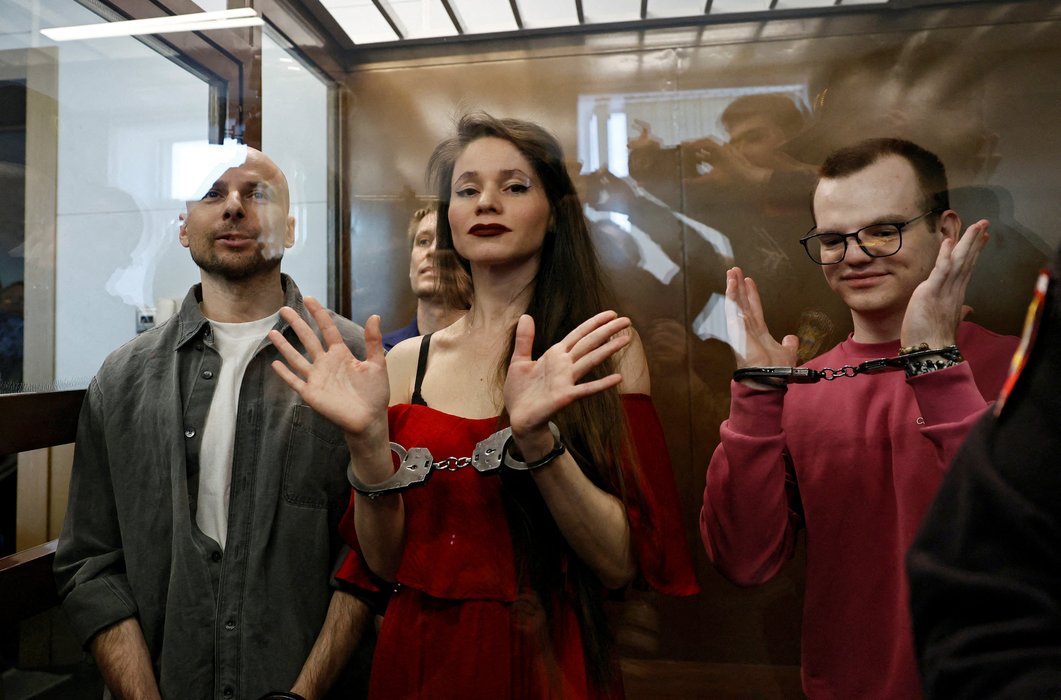
On 15th April, Moscow’s Nagatinsky Court sentenced journalists Antonina Favorskaya, Sergey Karelin, Konstantin Gabov and Artem Krieger to five and a half years in prison.The court found them guilty of participating in the activities of an “extremist organisation” for taking photos and videos for publication on the media resources of Alexei Navalny and the Anti-Corruption Foundation he founded, which is recognised as extremist and banned in Russia. In addition to imprisonment, the journalists are banned from leaving Russia for one year and from publishing online for three years.
SotaVision correspondent Antonina Favorskaya, arrested in March 2024, was accused of “collecting materials, producing and editing videos for the FBK”. She was the last journalist to film Navalny one day before his death in prison and had covered his trial for several years.
Her SotaVision colleague Artem Krieger, along with freelancers for the YouTube channel Navalny Live—videographer Sergey Karelin and journalist Konstantin Gabov—were also charged with “participating in the activities of an extremist organisation” on the same grounds.
Channel One journalist killed by landmine near Ukraine border
On 26th March, Channel One (Pervyi Kanal) correspondent Anna Prokofieva was killed near the village of Demidovka in Russia’s Belgorod region when a mine exploded. Cameraman Dmitry Volkov, who accompanied her, was wounded. The Belgorod region borders Ukraine and has seen frequent shelling since the start of Russia’s full-scale invasion.
Prokofieva, aged 35, had worked for Channel One since 2023 and had reported several times from the front line, producing stories highlighting the Russian government’s narrative on its “special military operation”. According to the Committee to Protect Journalists (CPJ), since February 2022 and the start of the full-scale invasion, at least 17 journalists and media workers have been killed while covering the war, and CPJ is investigating whether the deaths of two others were related to their journalism.