Introduction
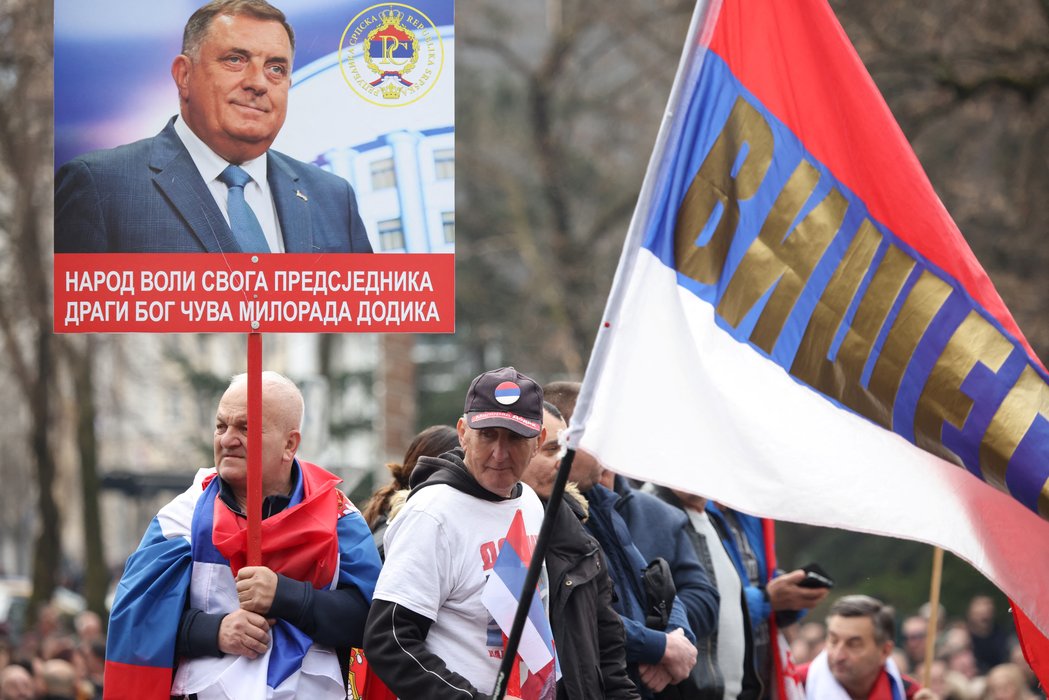
On 26th February 2025, President of Republika Srpska Milorad Dodik was convicted by the Court of Bosnia and Herzegovina for defying the rulings of the international High Representative, Christian Schmidt. Dodik was sentenced to one year in prison and banned from holding public office for six years.
As previously reported by the CIVICUS Monitor, Dodik has been engaged in a prolonged confrontation with Schmidt, who is responsible for overseeing the civilian aspects of the Dayton Agreement that ended Bosnia's civil war in the 1990s. As the international community’s High Representative in the country, Schmidt has broad powers, including the authority to dismiss elected officials and enact laws. The trial arose from Dodik’s repeated attempts to withdraw from Bosnia’s national institutions, including efforts to remove Republika Srpska from the armed forces, judiciary, and tax system, as well as to defy Schmidt’s authority, which he does not recognise. This led Schmidt to annul the secessionist legislation and criminalise defiance of his rulings.
At a rally in Banja Luka, Dodik dismissed the verdict as “nonsense” and urged his supporters to remain “cheerful”, framing the conviction as politically motivated. Despite the conviction, Dodik faces few immediate consequences at home, as his government continues to propose legislation to withdraw from national institutions, including the court that issued the verdict. Analysts note that Dodik’s influence may be increasingly constrained by international sanctions imposed by the US and UK for corruption and Russian ties, which could pose a greater threat to his power than the court ruling.
Freedom of association
In 2024, civil society across the Western Balkans and Türkiye operated in a fragmented and increasingly challenging environment. Although most countries retained legislation formally supporting civic engagement, a report by the Balkan Civil Society Development Network (BCSDN) notes that implementation was weak, political will limited, and funding insufficient. The report, published in May 2025, provides an evidence-based overview of civic space developments in 2024, drawing on verified data, fieldwork, and input from national civil society organisations. The authors further noted that early trends in 2025—particularly in Serbia and Bosnia and Herzegovina—indicate further deterioration, highlighting the urgent need for a coordinated response.
On 6th March, the parliament of Republika Srpska, the Bosnian Serb-majority entity in Bosnia and Herzegovina, passed the Law on the Special Registry and Transparency of the Work of Nonprofit Organisations—a law automatically designating any organisation receiving international funding as an “agent of foreign influence”. The legislation imposes strict reporting obligations and explicitly bars these organisations from proposing legislation or “influencing public opinion”, effectively penalising civil society groups for addressing social issues.
The law was rushed through parliament under a fast-track procedure, presented by authorities as a measure to ensure transparency. However, it was adopted immediately after the conviction of Bosnian Serb leader Milorad Dodik for refusing to implement decisions of High Representative Christian Schmidt, apparently in retaliation against domestic critics. Officials justified the accelerated process by claiming that rejection of the bill would lead to a “collapse of the constitutional order” allegedly caused by media outlets and organisations working in the interests of foreign governments. The law was first introduced in March 2023 and passed a first vote in the National Assembly of Republika Srpska in September of the same year, before being withdrawn from procedure in May 2024.
Its adoption drew immediate condemnation from the Media Freedom Rapid Response (MFRR) and the SafeJournalists Network, who warned that it targets independent media and civil society organisations, branding them as “foreign agents” and restricting their public interest activity. They argued that the law is intended to silence dissent, stigmatise critical voices, and shrink civic space, calling for its urgent repeal and urging the international community to take a firm stand in defence of media freedom and democratic values in Bosnia and Herzegovina.
The suspension of USAID funding in March 2025 further exacerbated the situation for civil society and independent media across Southeast Europe. The funding halt emboldened governments and pro-government media to intensify attacks on civil society organisations and journalists, labelling them as foreign agents, and created an increasingly hostile environment for free expression and independent reporting.
In contrast, June 2025 saw progress in the Federation of Bosnia and Herzegovina, the country’s other political entity, where the parliament adopted amendments to the Criminal Code criminalising femicide. The amendments define gender-based violence against women as violence directed at a woman because she is a woman or that disproportionately affects women, and establish that such “gender-based killing of a female person” is punishable by ten years in prison, or up to 45 years in specific cases. Additional amendments criminalised the distribution of AI-generated sexual abuse material involving children. These reforms were the result of years of advocacy by NGOs, activists, and parliamentary commissions, supported by public mobilisation and protests against femicide and violence against women, which have been documented in previous CIVICUS Monitor updates.
In addition, several industrial actions and strikes occurred during the reporting period. Workers at the Railways of Republika Srpska threatened to strike on 2nd April over unpaid February wages, but payment was made just before the planned action, reportedly using a government-backed loan. Workers also demanded a €150 pay increase, the introduction of a collective agreement, and greater accountability from management. Unions criticised the company for not fulfilling its legal obligations and warned that further action would follow if their demands were not met.
Meanwhile, Banja Luka faced a growing public health crisis as waste accumulated across the city due to a strike at the regional landfill in Ramići. Operations at the facility were reduced from 24 to just six hours a day, leaving an estimated 300 tons of uncollected garbage daily. The strike arose from ongoing disputes between the public landfill operator, De-Pot, and the private waste collection company, Čistoća, with workers calling for municipal intervention to resolve the conflict.
Freedom of peaceful assembly
On 12th February, workers from De-Pot, the company managing Banja Luka’s regional landfill, protested after a court ordered them to vacate the site by the end of the month. Ownership is set to transfer to the private company Čistoća, raising concerns about potential job losses and waste management for eight municipalities. Protesters argued that Čistoća lacks the necessary permits and infrastructure to operate the landfill effectively.
On 15th February, several hundred residents of Kalesija held a peaceful march following the tragic deaths of a local woman and her 13-year-old son. Over 100 citizens also gathered in Sarajevo to honour the victims. The event aimed to raise awareness of domestic violence and demand stronger protection for women and children.
On International Women’s Day, 8th March, thousands of women across Bosnia and Herzegovina took to the streets to demand gender equality, better working conditions, and an end to violence against women. Demonstrations in Sarajevo, Mostar and Banja Luka highlighted persistent discrimination, the underrepresentation of women, and the alarming rise in gender-based violence.
On 15th March, several hundred students and citizens gathered at the University of Banja Luka campus to express solidarity with Serbian students protesting the railway station canopy collapse in Novi Sad, which claimed 15 lives. The Banja Luka demonstrators observed 15 minutes of silence followed by 15 minutes of noise, symbolising their call for justice and accountability.
On 22nd March, around 400 residents of Prijedor protested against coal mining in Bukova Kosa, citing environmental and health risks. Locals reported coal dust, a persistent smell of sulphur, and deteriorating air quality in their community. Despite official assurances of no harm, residents remain concerned. Environmental groups have filed a lawsuit against the Republika Srpska government over the concession process.
On 2nd April, dozens of citizens gathered outside Parliament to protest the country’s worsening economic situation. Demonstrators demanded higher pensions and a reduction in employer-paid contributions, arguing that these costs burden both workers and businesses.
On 9th April, a group of students protested outside the Federation of Bosnia and Herzegovina government building, demanding accountability for the deaths of 27 people caused by landslides and floods on 4th October 2024 in Jablanica, Konjic and Fojnica. They criticised the authorities’ inadequate response, particularly in rebuilding homes and securing landslide-prone areas, and called for the prosecution of those responsible as well as a comprehensive review of all environmentally hazardous projects, including quarries.
On 31st May, activists and citizens in Prijedor commemorated White Armband Day, continuing their decade-long struggle for a monument honouring 102 murdered children, a project repeatedly blocked by local authorities. The “Because It Concerns Me” Initiative, which organises the annual commemoration, condemned the city’s refusal to engage with the victims’ families and urged citizens to show solidarity by wearing white ribbons. Organisers also called on the media to deny politicians a platform during the event, stressing that the day should convey only messages of humanity and opposition to discrimination. White Armband Day commemorates the 1992 persecution of Bosniaks, Croats and other non-Serbs in Prijedor, who were forced to wear white armbands and mark their homes, acts later recognised by the Hague Tribunal as part of a campaign of ethnic cleansing.
On 10th June, several hundred citizens and members of the Serb Democratic Party (SDS) protested outside the Prosecutor’s Office in Banja Luka following the arrest of SDS leader Milan Miličević. Party representatives denounced the case as politically motivated, accusing the ruling SNSD of orchestrating a fabricated indictment. SDS MP Želimir Nešković called for Miličević’s immediate release and warned that civil disobedience could follow if he remained in detention. Miličević, who is also the mayor of Teslić, was arrested the previous day along with two others on suspicion of influence peddling and accepting bribes.
Also on 10th June, citizens of Sarajevo gathered at the Eternal Flame to protest the ongoing genocide in Gaza and express solidarity with the Palestinian people. Demonstrators called for the arrest of Israeli Prime Minister Benjamin Netanyahu, carried banners denouncing the violence, and chanted slogans supporting Palestine. On 12th June, several hundred people joined a peaceful march in Sarajevo under the slogan “You can’t burn the truth”, expressing solidarity with the Palestinian people and the detained crew of the Gaza Freedom Flotilla's Madleen boat, which had been intercepted by Israel while attempting to deliver humanitarian aid. Organisers condemned the global silence over the humanitarian catastrophe and said the protest was the least citizens could do to show solidarity and demand accountability.
On 14th June, Sarajevo hosted the sixth Bosnian Pride Parade, highlighting the ongoing struggle for legal recognition of same-sex partnerships. Participants carried banners demanding equality and protection under the law. Organisers emphasised that love must be respected and legally recognised, while institutional discrimination persists, particularly in Republika Srpska. The march was supported by local artists and some politicians, and highlighted that Bosnia and Herzegovina currently has no legislation to protect LGBTQI+ rights.
On 27th June, residents of Stolac held a brief road blockade to protest against what they described as systemic discrimination against Bosniaks by local authorities. Stolac is located in the Herzegovina-Neretva Canton, and the municipality is governed by the Croatian Democratic Union of Bosnia and Herzegovina, a Croatian nationalist political party. The demonstration, organised by an informal citizens’ group, denounced the unlawful repurposing of state land for solar panel construction, inadequate waste management and years of neglect in infrastructure maintenance. The mayor declined to address the crowd but announced plans to meet with residents to discuss their concerns.
Freedom of expression
In March, the SafeJournalists network condemned a series of attacks and threats against journalists and media outlets in Republika Srpska. On 12th March, Centre for Investigative Journalism (CIN) journalist Milena Mitrović was verbally attacked at a press conference, during which RS President Milorad Dodik labelled her questions as politically motivated and described her as biased, attempting to discredit her as insufficiently competent to pose questions about legal proceedings concerning him. At the same event, Oslobođenje journalist Goran Dakić was barred from asking questions and was effectively banned from entering the presidential office after Dodik called security to remove him. According to BH Journalists’ Association, in the preceding two weeks, nine media outlets and eight journalists reported similar harassment by officials. SafeJournalists condemned this ongoing intimidation, calling on authorities to respect democratic standards and media freedom.
Previously, in late February, journalists from the Centre for Investigative Journalism (CIN) were physically attacked and subjected to harassment while reporting in Republika Srpska. On 27th February in Brčko, reporter Renata Radić-Dragić and cameraman Dženat Dreković were assaulted by three individuals who attempted to prevent them from filming an investigative story about RS politician and businessman Zoran Kokanović. The attack involved pushing, swearing, minor injuries, and damaged equipment. Police and prosecutors later announced criminal charges against one of the attackers.
On the same day in Banja Luka, Branislav Okuka, adviser to RS President Milorad Dodik, verbally harassed journalists from BNTV, Al Jazeera, and RTL in the RS National Assembly, obstructing their reporting and physically confronting them. Days earlier, Dodik himself publicly accused journalists and media outlets of receiving funding from USAID to “destroy Republika Srpska”, adding that “they should be put on trial by the people.” These incidents reflect a pattern of physical attacks, intimidation, and political pressure against independent media in RS, raising serious concerns about journalists’ safety and their ability to report freely.