Introduction
In September 2024, Austria’s far-right Freedom Party (FPÖ) declared “a new era” after winning the parliamentary elections with 28.9% of the vote — its strongest result to date. The conservative People’s Party (ÖVP) followed with 26.3%, and the Social Democrats with 23%. FPÖ leader Herbert Kickl hailed the outcome as a “piece of history”, vowing to build “Fortress Austria” with stricter immigration and asylum policies.
In the year that followed, Austria plunged into political turmoil. The September 2024 vote triggered the longest coalition talks in the country’s history, as efforts to form a government repeatedly collapsed. Five months later, the Christian-democratic ÖVP, Social Democrats (SPÖ) and The New Austria and Liberal Forum (NEOS) eventually struck an uneasy deal to exclude the far right, forming Austria’s first three-party coalition since 1947. Their joint programme, “Doing the right thing now. For Austria”, pledged to stabilise the economy and halt the FPÖ’s advance — yet both goals quickly faltered.
Facing a deeper-than-expected budget deficit, the new government introduced austerity measures that disproportionately affected low-income households, fuelling public anger amid record inflation. Meanwhile, the FPÖ continued to climb in the polls, exploiting the government’s every misstep through an extensive media network. With support now approaching 35%, analysts warn Herbert Kickl’s party remains poised to capitalise on voter frustration and reclaim the initiative.
Nevertheless, the results of the Demokratie Monitor 2024 survey, published in December, found rising public confidence in Austria’s political system. According to the survey, 43% of respondents — up from 39% in 2023 — believe the political system functions well, while 90% regard democracy as the best form of government. Trust in the government also increased to 44%, compared with 39% the previous year. However, this renewed confidence is unevenly distributed: approval of the political system has grown among the wealthiest two-thirds of society but continues to decline among the poorest third.
On 11th December 2024, Austria’s National Council voted to lift the parliamentary immunity of far-right Freedom Party (FPÖ) leader Herbert Kickl and three other FPÖ MPs in a separate case. A former member of the conservative People’s Party (ÖVP) accused Kickl of lying under oath about the use of public funds for pro-FPÖ advertisements. The three other MPs face allegations of violating the Nazi Prohibition Law after reportedly singing a Nazi-era song at a funeral. The decision allows prosecutors to proceed with investigations. The FPÖ condemned the move as politically motivated persecution.
Further legal troubles followed for the party. In July 2025, the Vienna Public Prosecutor’s Office requested the lifting of Kickl’s immunity in a separate case to pursue defamation charges over a speech in which he called Vice-Chancellor and SPÖ leader Andreas Babler a “left-wing tick”. In October, the National Council rejected that request, as well as a similar one concerning FPÖ MP Christofer Ranzmaier, accused of incitement to hatred over a controversial video. However, it authorised the prosecution of another FPÖ MP, Gerhard Deimek, in response to a German request for legal assistance. Deimek is suspected of violating the Nazi Prohibition Act after posting, in March 2022, an image showing men performing the Hitler salute or displaying swastika tattoos, which he claimed was intended as a critical comment.
Freedom of association
FPÖ launches inquiry into NGO funding
On 14th August 2025, the far-right Freedom Party (FPÖ) launched a sweeping parliamentary inquiry into the funding of non-governmental organisations (NGOs) in Austria, submitting more than 2,000 questions to ministries concerning over 700 organisations. The party demanded detailed information on state support, finances, and the membership of civil servants in civil society organisations, prompting criticism that the inquiry is emblematic of far-right strategies to incite resentment against civil society.
Experts and the Austrian Civil Society Network warned that the initiative stigmatises NGOs, many of which provide essential services in healthcare, education, and environmental protection, and reflects a broader authoritarian trend seen internationally. Economists emphasised that NGOs contribute billions to the national economy and rely on diverse funding sources, not only public funds. Critics also noted that much of the requested data is already publicly available, arguing that the inquiry is politically motivated and threatens the sector’s independence and the right to freedom of association.
Government establishes task force to scrutinise public funds for civil society
Following the FPÖ’s wave of parliamentary inquiries, on 26th August the Austrian government announced the creation of a nationwide funding task force to scrutinise all public financing of NGOs. Coordinated by the Ministry of Finance, the task force aims to evaluate whether state funding delivers tangible public benefits, with Chancellor Christian Stocker stressing the need for rigorous oversight of the sector.
The decision has drawn sharp criticism from civil society groups and opposition parties, who describe it as a politically driven attempt to intimidate NGOs and reinforce the FPÖ’s narrative of a so-called “parallel government”. NGO representatives insist that their finances are already transparent and well-documented, warning that the initiative risks undermining independent civil society and fostering unnecessary suspicion toward organisations carrying out vital social and cultural work.
Authorities threaten to deport German climate activist
In March 2025, it was reported that Austrian authorities were seeking to deport German climate activist Anja Windl, over her participation in “disruptive” environmental protests. Windl, a member of the German branch of the Last Generation climate movement, has frequently participated in its non-violent civil disobedience actions, gluing herself to roads and staging sit-ins to block traffic. However, she claims that authorities are targeting her because of her involvement in demonstrations opposing a potential coalition between the centre-right ÖVP and the far-right FPÖ.
Immigration officials claim her actions pose “a clear and present danger” to public order, citing allegations of property damage. Windl maintains that the proceedings are politically motivated and intends to appeal any deportation or residence ban before Austria’s Federal Administrative Court. The government insists that EU citizens may be expelled from the country if their behaviour threatens public order or security.
Armed police and helicopters deployed to execute raid on antifascist youth camp
On 27th July 2025, Austrian police conducted a large-scale intervention at an international youth education camp held at the Peršmanhof museum and memorial site in the Carinthian Alps, near the Slovenian border. The camp, attended by around 60 young people from Austria, Slovenia, and Italy, focused on antifascist education and commemorating 80 years since the end of the Second World War. The event was supported by the museum at the Peršmanhof memorial and organised by a Slovenian student association based in Vienna. Authorities cited administrative violations, including unauthorised camping and concerns about impact on the environment.
More than 30 officers—some heavily armed—were deployed, supported by helicopters, drones, and dog units. Several participants were temporarily detained, and one person sustained minor injuries. Critics denounced the operation as disproportionate and insensitive, given the memorial’s historical significance. The Peršman Association called for an independent investigation into the legality and proportionality of the police response.
On 23rd October 2025, a special task force appointed to investigate the raid concluded that the operation was partially unlawful and disproportionate, noting that police focused on collecting personal data from antifascist camp participants. The inquiry found no evidence of camping or environmental violations. It determined that the raid commander had acted excessively and that the district head failed to exercise appropriate oversight.
Freedom of peaceful assembly
Amnesty International warns of erosion of the right to protest
In 2024, Amnesty International published a detailed analysis of the state of the right to protest across Europe, concluding that it is “under-protected and over-restricted.” Its Austrian section raised particular concerns about police violence, the lack of thorough investigations, the increasing criminalisation of protests, the use of surveillance tools, and ethnic profiling.
Amnesty International Austria also criticised restrictive administrative directives that had led to the dispersal of peaceful assemblies, particularly assemblies organised to express solidarity with Palestinian people. On the issue of police violence, the organisation welcomed the establishment of an independent body in 2023 to investigate allegations of abuse by police officers. However, it questioned the body’s effectiveness, noting that complaints rarely resulted in disciplinary action and that the absence of individual identification marks on officers made accountability nearly impossible.
Court rules Vienna university raid unlawful
On 24th February 2025, the Vienna Administrative Court ruled that the police raid on the Palestine solidarity encampment at the University of Vienna on 8th May 2024 was unlawful and unconstitutional. The camp, occupied by students and activists for three days, was stormed at night by around 200 armed officers using drones, dogs, lorries, and a crane.
Police had justified the raid by alleging support for Hamas and potential incitement to terrorism, citing slogans such as “From the river to the sea, Palestine will be free” and banners reading “Intifada.” The court rejected these claims, affirming that freedom of assembly and expression is protected even when messages are provocative, and that the slogans did not constitute criminal incitement.
The operation involved the physical removal and prolonged detention of students, denial of legal assistance, and aggressive treatment of supporters outside the campus. Lawyers hailed the ruling as a precedent reinforcing constitutional rights against unlawful police repression.
Vienna NGO challenges police use of facial recognition at protests
In June 2025, Austria’s largest data protection NGO, epicenter.works, announced it had filed a complaint over the police use of facial recognition technology during a 2023 demonstration against a gas conference in Vienna. The group argues that there is no legal basis for such surveillance and warns it poses serious risks to privacy and civil liberties.
Around 140 protesters were arrested during the March 2023 protest, which activists said involved excessive police force. One participant discovered that his identification was carried out using automated facial recognition, prompting the complaint. Epicenter.works noted that similar systems have led to wrongful arrests abroad, including a case in Serbia.
The Interior Ministry insists all identifications are ultimately conducted by humans, but critics warn that Austria’s laws lag behind technological advances and that unchecked use of facial recognition threatens democratic freedoms.
Protests against the far-right
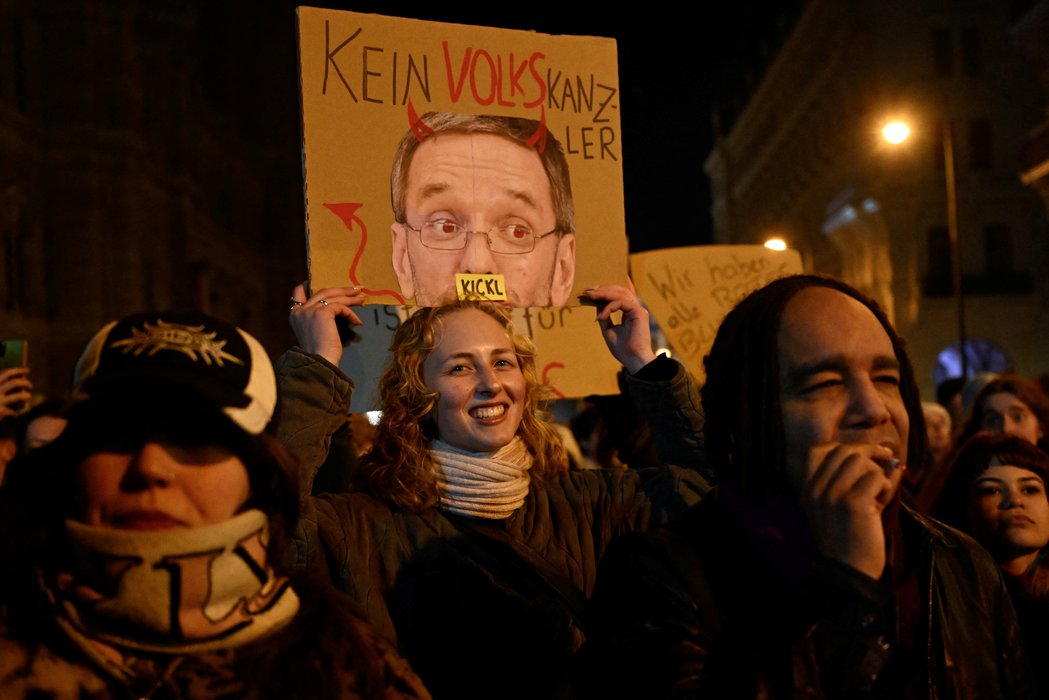
On 9th January 2025, thousands of protesters gathered in central Vienna to oppose the prospect of a government led by the far-right Freedom Party (FPÖ) as coalition talks were about to begin. Organised by human rights, refugee, and environmental groups, more than 10,000 demonstrators chanted “Kickl out” and held placards reading “Nazis out.”
The protest followed Chancellor Karl Nehammer’s resignation after failed coalition talks, leaving FPÖ leader Herbert Kickl to attempt forming a government. Despite heightened political tension, the demonstration remained peaceful, reflecting widespread concern over threats to democracy and human rights amid growing support for the far-right.
On 7th March 2025, hundreds of protesters gathered at the University of Vienna and marched across the Ring to Stephansplatz to oppose the Vienna Academic Ball, attended by prominent members of the international far-right and FPÖ officials. Police maintained a large presence throughout the evening. At the end of the rally, clashes broke out as police tried to prevent a small group of masked demonstrators from leaving the city centre, leading to confrontations. Identity checks were conducted due to the ban on face coverings. Police reported that several participants resisted orders and confirmed four arrests for resisting state authority.
➡️ 19:31
— Demo Reporter Wien (@WienReporter) March 7, 2025
Ein Teil der Demo wollte am Stephansplatz durchmarschieren. Erste Festnahmen - ein weiterer Teil läuft in Richtung Sperrzone. #w0703 #akademikerball pic.twitter.com/A5EKC1acxx
On 26th July 2025, around 200 supporters of the right-wing Identitarian Movement held a rally in central Vienna to “inform and educate” the public on asylum and migration policy. Multiple counter-demonstrations were organised, including one by the Communist Youth, which were dispersed by police. Vienna police reported 56 arrests and over 200 charges, mostly for administrative violations, with six criminal cases involving property damage and bodily harm. The arrests occurred during three counter-demonstrator sit-ins. Authorities reported that counter-demonstrators had behaved disruptively, and that masked individuals threw eggs and bags of faeces at participants and officers.
Graz cultural sector demonstration
On 20th March 2025, around 2,500 people marched in Graz under the slogan #SAVEKULTURLAND to protest cuts in the cultural sector. Organisers described the protest as peaceful, but police reported unrest, claiming that pyrotechnics were used and that a 29-year-old man resisted identification and insulted officers, leading to his arrest.
Pro-Palestinian protests across Austria
On 10th July 2025 the OPEC headquarters in central Vienna was vandalized early in the morning, defaced with red paint. Later that day, pro-Palestine and anti-OPEC demonstrations erupted, coinciding with meetings of OPEC member states. Protesters marched from Heldenplatz, criticising OPEC’s role in climate change and Middle East tensions. Police made five administrative arrests of participants who they report refused to identify themselves. The State Office for State Security and Combating Extremism has taken over the investigation into the vandalism.
On 26th July 2025, the opening ceremony of the Salzburg Festival at the Felsenreitschule was disrupted by at least six pro-Palestinian activists who shouted slogans and unfurled banners during Vice Chancellor Andreas Babler’s speech. The demonstrators reportedly entered using fake employee IDs and were removed by security, with six arrests made.
On 21st August 2025 hundreds of pro-Palestinian activists protested in Vienna, denouncing Israel’s actions in Gaza. The demonstration extended inside the headquarters of Austria’s public broadcaster, ORF, where protesters criticised what they called biased reporting on the conflict, accusing the broadcaster of complicity in Israel’s genocide. Austrian police intervened forcefully, arresting six participants.
On 24th September 2025, 15 pro-Palestinian activists were arrested at a Communist Party of Austria (KPÖ) rally against a Rheinmetall drone symposium in Vienna’s Simmering district. According to police, around 60 activists “formed an unregistered assembly” and attempted to access the symposium grounds while chanting slogans authorities deemed criminal, including “From the River to the Sea.” Police reported that the 15 individuals had refused to identify themselves, which led to their arrest. On 3rd October 2025, a pro-Palestinian demonstration in Innsbruck, organised by Palestine Solidarity Austria, drew around 1,000 participants. The march from the State Theatre through the city centre remained largely peaceful, though police later claimed that “riots” broke out, citing the use of pyrotechnics and the chanting of allegedly illegal slogans. Officers temporarily arrested three people and issued several administrative charges.
On 8th October 2025, hundreds of Palestinian solidarity activists staged a spontaneous blockade of the University of Vienna to protest the university’s alleged complicity in the genocide and its cooperation with the Hebrew University of Jerusalem. Protesters blocked entrances and disrupted classes before extending to the Ringstrasse, halting traffic around the campus. Around 100 police officers were deployed to disperse the sit-in, carrying out 27 provisional arrests and filing 73 administrative reports. Authorities claimed the demonstration caused “significant disruption” and violated the constitutional guarantee of free education and teaching. However, protesters condemned the rector’s decision to escalate the situation by calling in the police, asserting that the protest had been entirely peaceful.
On 12th October 2025 thousands of pro-Palestinian demonstrators rallied in Vienna, calling for an end to what they described as Israel’s genocide in Gaza and urging Austria to impose sanctions. The protest, organised by over 50 civil society groups, saw participants carrying Palestinian flags and banners reading “Stop the genocide in Gaza, sanctions now” and “Austria, you cannot hide; you support genocide.” Marching past the Chancellor’s Office, Foreign Ministry, and Presidential Palace, speakers—including Catholic priest Franz Sieder and trade unionist Axel Magnus—criticised Austria’s silence and pro-Israel stance, highlighting the humanitarian crisis in Gaza and accusing the government of complicity through arms and drone programmes.
Freedom of expression
New Freedom of Information Act greatly improves transparency
On 1st September 2025, Austria’s new Freedom of Information Act entered into force. Under the law, all public authorities are now required to make all “information of general interest” publicly and electronically accessible, including through the federal portal of the national information register. With the introduction of the law, the constitutional principle of Amtsverschwiegenheit—official confidentiality—was abolished, and citizens have gained a constitutional right to access information in its place.
Where information is not immediately available, authorities must respond to all requests for information within four to eight weeks. Although agencies were previously obliged to provide specific information upon request, the new law significantly broadens the range of information subject to disclosure, narrows the grounds for secrecy, shortens response deadlines, and extends transparency obligations to companies that are more than 50 per cent publicly owned.
However, watchdogs have warned that the practical effects of the law will depend on a change of culture within the public administration. Reporters Without Borders Austria welcomed the new law but highlighted serious shortcomings, identifying three main problems: exemptions for smaller municipalities, lengthy response deadlines and, above all, the absence of an independent body to review complaints.
BDS Austria takes case to the European Court of Human Rights
Boycott, Divestment and Sanctions (BDS) Austria is taking a case to the European Court of Human Rights (ECtHR) in 2025 after Austrian courts ruled against one of its activists, a decision upheld on appeal by the Austrian Supreme Court in May 2025. The dispute began in 2021 when the group shared an image on Twitter combining a “Visit Apartheid” poster with the Vienna Municipality’s logo. The city filed a defamation complaint, and in 2022 a Vienna court banned use of the logo and fined the activist €3,500, later adding €8,200 in legal costs after unsuccessful appeals.
In July 2025, the European Legal Support Center announced that it would challenge the decision at the ECtHR, arguing that it violates freedom of expression. The Coalition Against SLAPPs in Europe (CASE) has described the municipality’s actions as a strategic lawsuit against public participation (SLAPP) intended to silence and intimidate activists.
FPÖ Vienna leader attacks Der Standard over leaked recordings
On 14th January 2025, Vienna FPÖ leader Dominik Nepp attacked Der Standard after it published leaked footage showing two FPÖ MPs making indecent remarks about refugees, the EU, and coalition partner ÖVP. Nepp wrote on X that the “shitty paper” would be “done” within five years, using a hashtag calling for press funding to be reserved only for “real quality media.” Critics denounced the post as a threat to press freedom. The Press Council defended the reporting, citing strong public interest in the undercover footage.
ORF journalists warn of FPÖ threat to media independence
On 24th January 2025, the Editorial Council of Austria’s public broadcaster ORF warned that the far-right Freedom Party (FPÖ) was pursuing plans that threaten the broadcaster’s independence. The FPÖ has proposed cutting ORF’s funding, limiting its programming, and reshaping staffing along party lines. Journalists likened the plans to Hungary’s media transformation under Viktor Orbán. FPÖ’s Christian Hafenecker dismissed the warning as “panic”, while press freedom groups cautioned that such measures could erode Austria’s media pluralism.
FPÖ sues Falter editor over reposted video
On 11th March 2025, Der Standard reported that Austria’s far-right Freedom Party (FPÖ) has sued Falter editor-in-chief Florian Klenk for alleged copyright infringement after he reposted a video of FPÖ leader Herbert Kickl on Instagram and Facebook. Klenk had shared the clip from the party’s New Year’s gathering with a Falter slogan and subscription link. The FPÖ, represented by lawyer Christoph Völk, is seeking €1,000 in damages and publication costs, valuing the case at €47,500. Klenk called the lawsuit a test of how social media sharing is treated under copyright law.
Kurz-linked firm threatens Falter over planned investigation
On 7th April 2025, US law firm Clare Locke threatened legal action against Austrian magazine Falter over an upcoming investigation into Dream Security, a cybersecurity company founded by former chancellor Sebastian Kurz. The letter, also sent to Follow The Money, called the allegations “false, defamatory and highly damaging” and warned the outlets to halt publication or face legal consequences. Despite the threat, the investigation was published by both media on 8th April.