General
Since June 2025, President Donald Trump has deployed or voiced an intent to deploy the National Guard and expand military presence in Democratic-run cities across the USA, in an effort to expand federal power, target immigrant communities, and suppress dissent. As the administration increases its employment of authoritarian tactics at home, it has taken steps to shield itself from accountability for these actions abroad by withdrawing from participation in the Universal Periodic Review (UPR), a mechanism that facilitates a peer review of UN Member States’ human rights record and practices.
In parallel, the U.S administration has adopted an increasingly aggressive posture toward Venezuela, deploying warships, aircraft and 4,500 troops to the Caribbean in August 2025 under anti-narcotics operations targeting groups allegedly linked to Venezuelan President Nicolás Maduro. The operation’s goals and legal basis remain unclear, prompting speculation that it could be part of broader efforts to pressure or destabilise Maduro’s government. As of 16th September 2025, it has carried out two strikes on vessels alleged to be connected to organised crime, killing 14 people. UN Experts condemned the incident, describing the killings as extrajudicial executions under international law.
United States may be the first country to fully withdraw from UN Universal Periodic Reviews.
— CIVICUS (@CIVICUSalliance) August 29, 2025
This disgraceful copout devalues #humanrights and may enable repressions around the world.
We call #US to respect international human rights standards. #UPR #USA pic.twitter.com/ELVSnjuItz
Association
Clamping down on independent civil society
On 25th September 2025, President Trump issued a National Security Presidential Memorandum (NSPM-7) on “Countering Domestic Terrorism and Organised Political Violence”, directing federal agencies and law enforcement bodies to investigate and target civil society organisations, their funders, and activists, under the pretext of preventing political violence. The memorandum claims a surge in “organised campaigns of radicalisation, intimidation, and violence” allegedly led by “self-described anti-fascism movements”, yet provides no evidence to substantiate these allegations.
In tandem with the memo, the Department of Justice announced it would be conducting an investigation into the Open Society Foundations, a philanthropic organisation whose mission is to “champion bold democratic solutions to our urgent, common challenges that advance rights, equity, and justice”. According to The New York Times, the directive even lists potential criminal charges, from arson to “material support of terrorism”, and suggests that department leaders are acting on direct presidential orders to pursue investigations against specific individuals and groups, breaking long-standing norms insulating the Justice Department from political interference.
Our statement in response to reporting that the Trump Administration is directing investigations without evidence into our operations. pic.twitter.com/Zopfa8OG4e
— Open Society Foundations (@OpenSociety) September 25, 2025
NSPM-7 came three days after the President put out an “Executive Order” designating Antifa as a “domestic terrorist organisation”. This order is not based in nor does it create a legal authority to designate organisations as domestic terrorists, however, it lays the foundation for the government to go after political opponents under existing law. As stated by the American Civil Liberties Union (ACLU), the administration’s efforts to frame political violence and the erosion of democracy as an outcome of progressive, or left-leaning organising and advocacy is unsubstantiated and creates a chilling effect on civil society organisations, activists, and advocates across the sector.
These measures came in the wake of the 10th September killing of right-wing commentator Charlie Kirk, which the administration used to intensify rhetoric framing left-leaning organisations and funders as responsible for political violence.
On 15th September, Vice-President JD Vance, hosting Kirk’s radio programme, promised to target progressive foundations such as The Ford Foundation and Open Society Foundations, claiming they foster an “atmosphere of violence”. Senior White House adviser Stephen Miller similarly stated that federal law enforcement would be mobilised to “disrupt” those networks.
Expansion of sanctions scheme against Palestine advocates
On 4th September 2025, the Trump administration imposed sanctions on three leading Palestinian organisations, Al-Haq: Law in the Service of Man (Al-Haq), Al-Mezan Center for Human Rights (Al-Mezan), and the Palestinian Centre for Human Rights (PCHR), under Executive Order (EO) 14203, which established an International Criminal Court (ICC)-related sanctions regime. This designation was made because of the organisations’ direct engagement with the ICC “to investigate, arrest, detain, or prosecute Israeli nationals, without Israel’s consent”. This effort to stifle critical Palestinian civil society advocacy and human rights work and further limit engagement with the ICC, a vital accountability mechanism in the international system, was condemned by civil society organisations and UN Human Rights Chief Volker Türk.
It was the latest in a stream of economic and travel sanctions imposed on high-level human rights actors including ICC Prosecutor Karim Khan, four ICC judges, and Francesca Paola Albanese, the United Nations Special Rapporteur on the situation of human rights in the Palestinian territory occupied since 1967 (OPT). Such restrictions have created a challenging environment for civil society organisations in the USA, who have historically engaged these individuals and entities, limiting their abilities to carry out their missions.
On 29th August 2025, the U.S. Department of State revoked visas from the Palestinian Authority and Palestine Liberation Organisation, restricting their ability to engage in the UN General Assembly high-level meeting set to take place weeks later at the UN Headquarters in New York. The decision to limit the movement of public officials as well as independent experts to the U.S., and shortly thereafter to sanction key Palestinian organisations ahead of UN meetings inhibited both diplomatic and civil society participation.
BREAKING: In response to the imposition of sanctions by the US Dept. of State on Al Haq, Al Mezan, and, the Palestinian Center for Human Rights for their efforts before the International Criminal Court (ICC), we issued the following statement:
— Center for Constitutional Rights (@ccrjustice.org) September 5, 2025 at 5:00 AM
Federal level union busting
On 28th August 2025, days before Labour Day, President Trump issued an Executive Order to strip federal workers of their collective bargaining rights. This builds on a previous order that took away these rights from employees at other federal agencies. H.R.2550, or Protect America's Workforce Act, was introduced in the House of Representatives in the spring, calling for the revocation of the order and restoration of collective bargaining agreements.
Win for lawfare case defendant
In a judicial win for civil society, particularly organisations that support Palestine, a civil lawsuit against UNRWA USA - based on unfounded claims that the charitable organisation had supported terrorism in Palestine by providing monetary contributions to United Nations Relief and Works Agency for Palestine Refugees in the Near East (UNRWA) - was dismissed without prejudice.
This decision came down on 8th August 2025 and plaintiffs filed an amended complaint during the allotted window. UNRWA USA seeks to amplify Palestinian experiences and garner support from Americans to fund resources for Palestinian refugees through UNRWA, which was established by the UN General Assembly in 1949 to facilitate humanitarian aid and provide health, education, relief services, and more to Palestinians. UNRWA USA has been at the centre of information manipulation campaigns and is one of many organisations targeted by lawfare cases.
This lawsuit was a cynical misuse of the Anti-Terrorism Act to intimidate an organisation whose sole mission is providing humanitarian aid to a vulnerable population.
- Joseph Pace, legal counsel.
Peaceful Assembly
Protests against immigration crackdown met with federal militarisation and heavy-handed policing
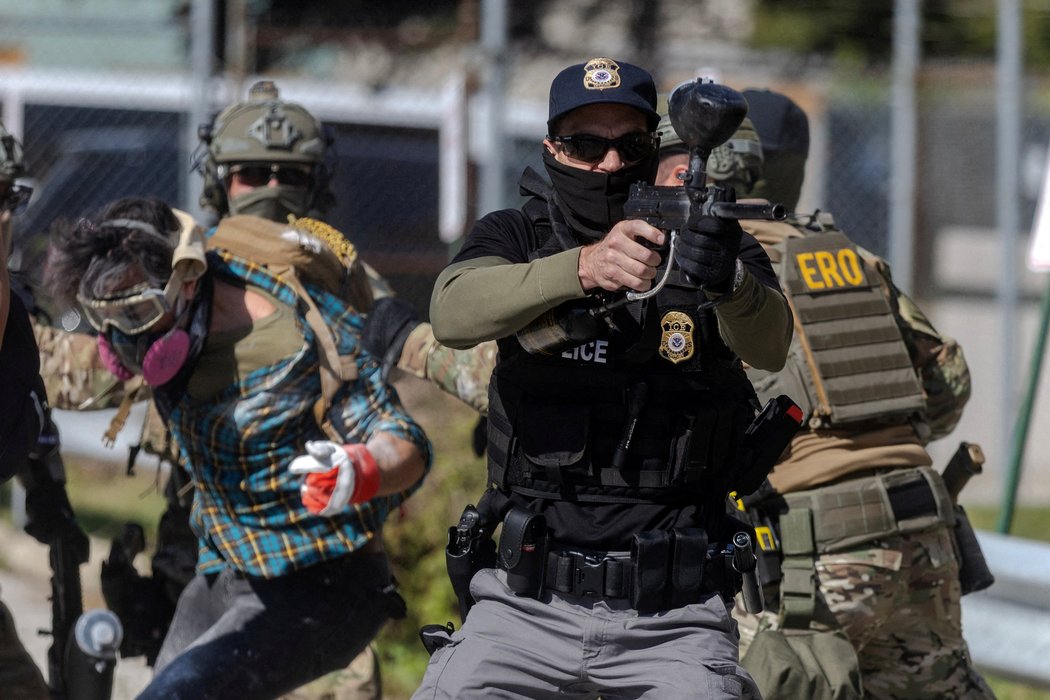
Protests in the greater cities such as Chicago and Portland have popped up to push back against increased law enforcement, including the National Guard and U.S. Immigration and Customs Enforcement (ICE) agents, and detention of immigrants across the country.
Notably, on 6th September 2025, thousands of protesters gathered in Chicago’s Gallery Plaza to denounce the Trump administration’s deployment of the National Guard to the city. The rally followed fears of deportations ahead of the Mexican Independence Day celebration, and fears of deportations, and a Truth Social post from President Trump saying, “I love the smell of deportations in the morning… Chicago about to find out why it’s called the Department of WAR”.
According to independent media, by 19th September, tensions had escalated at the ICE processing facility in Broadview, Illinois, where federal officers used pepper spray, tear gas and flash bang grenades against protesters blocking vehicle access. The situation intensified further on 26th and 27th September, when federal agents fired pepper balls at 75 people and arrested at least 11 protesters.
On 30th September, Mayor of Broadview, Katrina Thompson, called on the Department of Homeland Security (DHS) and ICE to halt their deployment of chemical agents and use of physical force against protesters. She expressed that these officials were “making war on [her] community”, and civil liberty organisations have also raised flags about the escalations in violence. DHS frames protesters as “rioters”, justifying their violent or heightened response to demonstrations, and categorises protest against federal officers as “political violence”.
On 28th September, the federal government authorised the deployment of 200 members of the National Guard to Portland, Oregon, for 60 days. This decision was in response to protests that took place outside a U.S. Immigration and Customs Enforcement (ICE) building and concerns by the administration that these facilities were “under attack” by “domestic terrorists”. The President’s deployment of the National Guard in Oregon is the latest in a string of deployments to other Democratic-run cities, including Los Angeles, CA and Washington, D.C. The administration has claimed that these regions have high crime rates that requires the federalisation of law enforcement and troop deployment. Communities in these cities continue to push back through protest and community organising efforts to protect immigrant neighbours and resist the militarisation of their cities.
According to data from ACLED, Illinois recorded the highest number of pro-immigration demonstrations in a single month since 2020. In at least five documented cases, protesters in Broadview attempted to block law enforcement vehicles to prevent detentions, resulting in physical confrontations and arrests. Nationwide, ACLED registered over 40 similar incidents since January 2025.
Microsoft employees arrested after protesting company’s ties to Israeli military operations
On 26th August 2025, seven current and former Microsoft employees were arrested after occupying the office of company president Brad Smith at the Redmond headquarters to protest the firm’s alleged complicity in Israeli military operations in Gaza. The action, organised by the No Azure for Apartheid collective, accused Microsoft of enabling “the first AI-powered genocide” through its cloud-computing contracts with Israel’s Unit 8200. Police forcibly removed the protesters, while others rallied outside the campus, calling for Microsoft to end its partnerships with Israeli defence institutions and address internal retaliation against pro-Palestinian employees.
The arrests followed a series of demonstrations at Microsoft facilities in the USA and Europe, including an encampment the previous week and a protest at a Netherlands data centre allegedly used by the Israeli military.
Expression
Media face political pressure amid lawsuits and threats to broadcasters
On 17th September 2025, ABC announced that Jimmy Kimmel Live!, a late-night talk show starring the comedian, would be suspended because of remarks Kimmel had made about Charlie Kirk in the wake of his assassination. The Chairman of the Federal Communications Commission (FCC), Brendan Carr, had criticised Kimmel’s comments publicly and expressed an intent to revoke the licences of broadcasters that continued to air the show.
Just two days prior, President Trump filed a lawsuit against The New York Times (NYT), four of its journalists, and Penguin Random House for $15B, alleging that their reporting was harmful to his brand and commercial interests. The NYT issued a statement pronouncing that the “lawsuit has no merit. It lacks any legitimate legal claims and instead is an attempt to stifle and discourage independent reporting”.
These incidents came on the heels of CBS’s cancellation of The Late Show With Stephen Colbert in July 2025. Columbia Broadcasting System had claimed that this was a financial decision, however, it corresponded with a lawsuit President Trump had filed against CBS’s parent company, Paramount, while they were in the midst of a major merger that was awaiting FCC approval. Paramount settled the suit, agreeing to pay $16M. This decision was criticised for serving as a means for appeasing the administration in the midst of the legal battle.
Jimmy Kimmel Live! returned to the screen on 23rd September 2025 after public outcry and civil liberties organisations sounded the alarm over threats to the First Amendment and censorship concerns.
Administration restricts entry of foreign media
On 25th September 2025, the Department of Homeland Security (DHS) proposed a rule seeking to restrict visas for foreign journalists to eight months, with journalists from the People’s Republic of China limited to 90 days due to perceived threats to national security. They are eligible for an extension as long as it is in direct alignment with the length of their “temporary activity or assignment.” The Committee to Protect Journalists and 117 other media organisations signed a joint letter opposing this rule, flagging that if enacted, this new policy would “reduce the quantity and quality of coverage coming from the U.S.”
Attacks on journalists covering anti-ICE protests
As anti-ICE and anti-militarisation protests continue, journalists covering these community actions face attacks, arrests, and detention by law enforcement officials. According to the Press Freedom Tracker, there have been 20 incidents where law enforcement officials assaulted journalists who were present at and reporting on the protests, in Illinois alone.
Some of those incidents are summarised below:
- On 26th September, federal agents threatened and later shot pepper balls at a photojournalist with the Chicago Sun-Times at the same Broadview protests.
- On 27th September, federal officers shot Dave Decker, freelance photojournalist, with pepper balls. His camera lens was also damaged while he covered the demonstrations.
- On 27th September, U.S. Customs and Border Patrol tackled, arrested, and detained journalist and co-founder of Unraveled Press, Steve Held, while he was filming protests and arrests of protesters outside the Broadview ICE facility.
- On 27th September, federal agents fired tear gas and projectiles at a Chicago Sun-Times reporter while they were reporting on the Broadview protests.
First Amendment win for non-US citizens
On 30th September 2025, Judge William G. Young ruled that non-U.S. citizens who reside lawfully in the USA have the same freedom of speech protections as U.S. citizens. The Knight First Amendment Institute at Columbia University filed the lawsuit on behalf of the American Association of University Professors (AAUP) and the Middle East Studies Association in March 2025, in response to the crackdown on pro-Palestinian advocacy on college campuses.
In his opinion, Judge Young determined that the Secretary of Homeland Security and Secretary of State acted “intentionally to chill the rights to freedom of speech and peacefully to assemble of the non-citizen plaintiff members of the plaintiff associations”. Law enforcement agencies under the Trump Administration arrested, detained, and deported non-citizen students for their protest and advocacy for Palestine, however, this decision clarified that these policies were a violation of the First Amendment.